When the iron eagle flies in the sky
—Padmasambhava in the eighth century1
And horses with wheels will run on roads,
Tibetans will be spread, like ants
In the whole world.
At that time the dharma will come to the land of the Red Man.
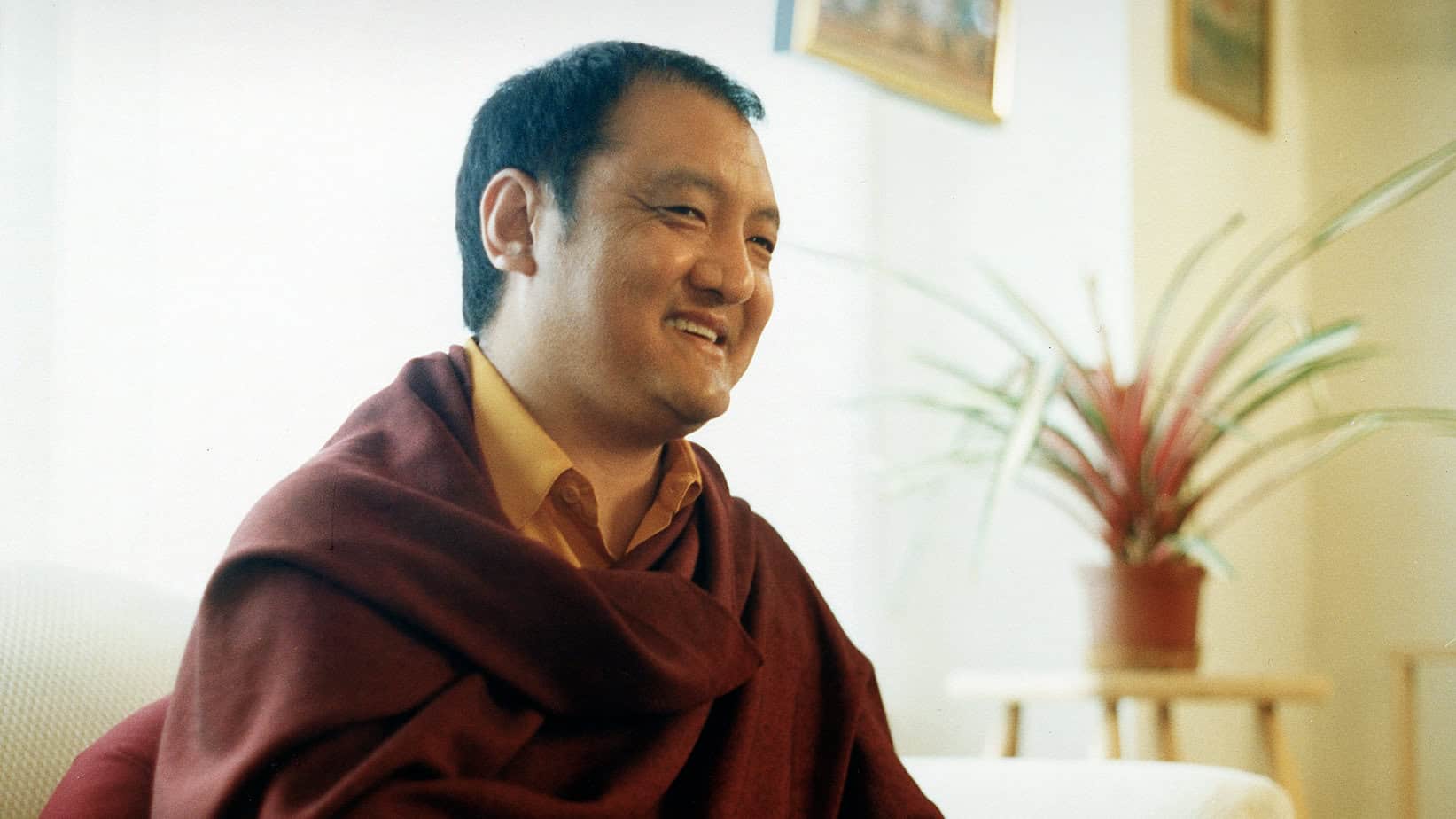
One of the main intentions of Karmapa’s visit to North America was to meet the original habitants of the continent. Before his journey to the West, Karmapa had repeatedly mentioned that he definitely wanted to meet the Hopi Indians, whom he considered to be the most peaceful of all American Indians.2
Finally, the moment arrived when his wish became reality. Karmapa’s golden Cadillac approached one of the plateaus, (which the Spanish conquistadores had called mesas), where over a thousand years ago the Bear Clan built the first clay houses in the village of Walpi.

It was an incredibly hot day. The earth was baked dry and the last rains had fallen long ago. Karmapa took the last bend of the serpentine road to this traditional settlement.
The visit, which later became famous as an encounter of two old and related cultures that had been separated for thousands of years, began with a small mishap. There was a misunderstanding about the date, and the tribe had expected Yishin Norbu a day later. Thus Karmapa came into a place that was half asleep.
Swiftly, the chief of the clan, Ned Nayatewa, a man in his eighties who lived at the foot of the mesa, and his wife Nerne were called. They very quickly made their way on foot, climbing up the hundred meters to the road. Karmapa, who was at ease with any situation and put no value on protocol, was not at all disturbed to be received in this way.
The chief welcomed Karmapa with these words: “I’m glad to see you in our village and I know you have made a very long way here!” Karmapa replied, “We have known one another for hundreds of years already. Your rituals, ceremonies and way of life are very similar to ours.” He presented gifts to the Hopis and added: “I will always remember you in my meditation.”3
They began to show Karmapa the village. The conversation between the chief and the Karmapa began relatively insignificantly, as Andrea Loseries-Leick remembers:
Karmapa told about his homeland, they talked about goats and sheep and the fertility of the earth. Ned said that it hadn’t rained for a long time. The Hopis had many rituals for rain; but though they had tried everything, the last rain had fallen some months ago. Of course, for the tribe, this was really serious. Karmapa said: “Don’t worry, I’ll take care of it!” Karmapa then spoke of the prophecy of Padmasambhava, and Chief Ned replied,“We have a similar prophecy! Indeed we are brothers!”
They embraced. Everything seemed ordinary and was at the same time historically significant. They understood each other very well and enjoyed being together.4
“We are brothers” referred to old connections between the Native Americans and the Tibetan-Mongolian tribes. Modern science tells us that they first migrated across the Bering Strait to America. The Hopis say that the Tibetans are their long-lost brothers and sisters, who left them at the beginning of time, going to the other side of the world in order to balance it spiritually.5 According to the prophecy, they would come back one day. Now the moment of reunion had come: the Hopis’ kinsmen had returned to the steppes of Arizona.
Ten years earlier the Hopi elder Dan Kachungva—at the time over one hundred years old—had met Hetty MacLise, the mother of the American incarnation of Sangye Nyenpa, and had shown her the prophecy rock. He explained to her that the prophecy announced the coming of the great purifier whose “path was identical with the path of the Great Spirit, and the Purifier would come wearing a red hat and a red cloak, bringing a red God. And he would make rain.”6 All of this now seemed to be materializing. Karmapa’s school of Buddhism was called the “red hats,” he wore a red robe, and in the evening he gave an empowerment of a red-colored aspect of Avalokiteshvara. On this occasion he wore a red Pandita hat.
It was a great event—the meeting of brothers and sisters who had been separated for a long time—but at the same time it was striking in its simplicity and the absence of any drama.
At the end of the tour through the village they came to the kosovi, the village square with its subterranean kiva, the sanctuary of the clan. Its shape symbolically represented the clan’s conception of the world. Ned invited the visitors in, but Karmapa declined, because his knee problems did not allow him to climb down the wobbly ladder.

While the Hopis explained to Karmapa’s attendants in the kiva the Hopi mandalas whose form interestingly resembled those of the Tibetan and showed them the sacred relics of the clan, “His Holiness sat on the flat roof of the sanctuary and began to recite the prayer of dewachen, the prayer of the buddha realm blessed by the Buddha Amitabha.”7 After that, His Holiness again recited the prayer of Avalokiteshvara for the great compassion of all buddhas and quietly the ceremony was over.
Shortly after, the party bid a warm goodbye to Ned, his wife and the other villagers who were present.
Karmapa’s driver remembers what happened next, on the ensuing drive to the Hopi Cultural Center:
We began our gradual descent down the mesa under an absolutely clear blue sky. When we were two-thirds of the way down, the Karmapa began chanting in Tibetan. A very special stillness settled in. During what seemed like a forty-five-minute journey,8 I was witness to nothing less than true magic. As the Karmapa continued chanting, I was amazed to see how, as if by magic and a kind of time-lapse, the radiantly blue sky transformed into a blackish-gray, threatening sky, full of a quick building up of energy that seemed to appear from out of nothing.9
For Jigme Rinpoche all of this was nothing extraordinary. Karmapa had explained to him that the drought had been caused by a sickness of the nagas,10 and he had told one of his monks to make an offering to them at a well—his famous black pills.11 The disease was cured almost immediately and the long-awaited rain fell without delay, as the prophecies had predicted.
After the torrential cloudburst, Karmapa announced during the dinner in the Hopi Cultural Center that afterwards he would give an empowerment. And he invited the Hopi and Navaho Indians who lived on the mesas and in the neighboring towns.
The Hopis seemed to share the same mastery of improvisation as the Tibetans: Tables in the conference room were pushed together and a shrine was built on them.12 One hundred and fifty Hopi and Navaho people came, including some of their chiefs. When Karmapa, accompanied by the sound of the Gyalings, entered the completely packed room, he was already wearing the red Pandita hat. The Hopis understood: It was exactly as their prophecy had foretold. Karmapa gave the Black Crown Ceremony and the empowerment on Korwa Dongdrub, a red form of Avalokiteshvara. Afterwards the Navahos and the Hopis lined up for the blessing. All who were present agreed: “It was a great reunion.”13 Steve Roth remembers:
What we witnessed during the empowerment was a communion between His Holiness and a wide-eyed, transfixed group of Indians; it was undeniable and unforgettable. We witnessed this kind of communion between His Holiness and the Indians, it was beyond words, we were just grateful to be present.
His Holiness was having a very personal connection with these Indians, and we, the Western dharma students who had somehow made our way to this historic occasion, were fortunate witnesses to this heartfelt meeting.14
Achi Tsepal remembers: “The Navaho and Hopi leaders were in tears, as they felt that that the empowerment was a restoration of an old connection.”15
Physically, the Tibetans and the Native Americans resembled each other. To their astonishment, they discovered that “Dawa” in the Hopi language means sun, whereas in Tibetan, it means moon. Also, during the empowerment, the Hopis saw similarities to their own ceremonies. Lama Tsültrim Allione recalls:
The people who traveled with Karmapa said it was so amazing to see the Hopis’ relationship to him because they were so similar to the Tibetan people. They had this kind of pure devotion, so connected to the earth, so humble.16
Steve Roth remembers,
We, as well as the Indians, sat there spellbound. The next day, two local papers ran front page news stories reporting that a string of seventy-five consecutive days without rain was interrupted by the visit of some notable but unfamiliar “East Indian chief,” who among other things was well known for making rain.17
Karmapa had expressed the wish to see a medicine woman, so the next morning the party visited Grandmother Caroline on the Middle Mesa. Again they discussed the prophecies of the Hopis and of Padmasambhava. She told Karmapa that when she was young, she still found in the nearby mountains all the wonderful medicinal plants that she needed. “Now the herbs have turned to poison.” She said that this is a sign that the Hopi prophecies are true, that it is the time of the transition from the fourth world to the fifth.18
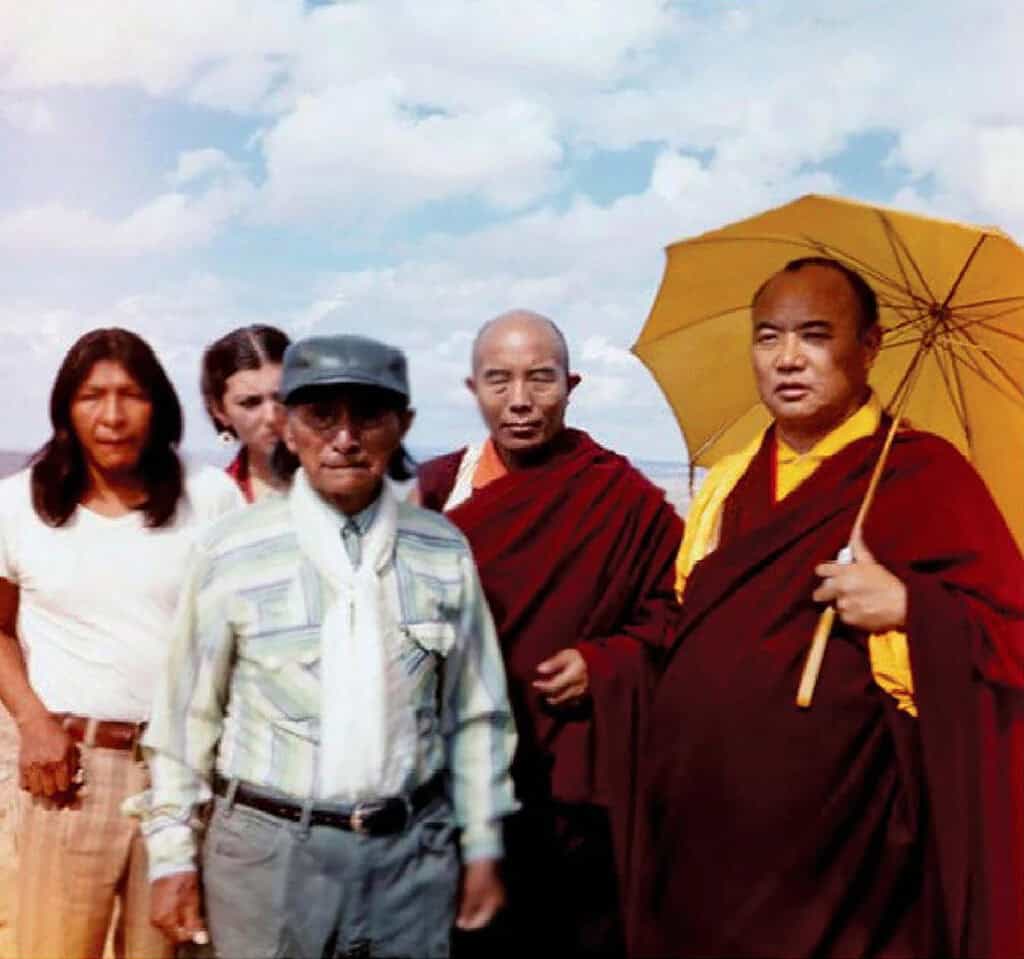
Next they visited the chief White Bear, who shared with Karmapa much of the ancient wisdom of his tribe. He also spoke about the three worlds that had vanished because of the degenerate, materialistic, and ecologically disconnected way of life, and the current fourth world, through which “people like you and me guide the people.” And finally, “the coming, fifth world, where we will have our say.” Karmapa replied simply: “Good!”19
When Karmapa left the Indian reservations, he left behind a people strengthened in their identity. Historically, the Hopis had repeatedly been the victims of Navaho conquest. But the evening with the Karmapa seemed to have brought both nations together again; this time they had come as friends to the Dharma King, who had invited both nations.
The journey continued over the Grand Canyon to Phoenix, Arizona, where they boarded a plane to San Francisco. Prior to the departure, a somewhat surrealistic scene took place. Word had spread that Karmapa loved birds, and so during the whole trip people offered him budgerigars, canaries and other birds. Quite a number of them accompanied the Karmapa in cages.
Microcosm at the Airport of Phoenix
After check-in at the airport in Phoenix, there was still some time left before the departure. Karmapa decided to allow the birds a little physical exercise. He opened the cages and let them fly around in the waiting room. He then explained that it was an opportune moment to bless all people present. His companions were aghast, because the aircraft was due to leave in less than fifteen minutes. “Oh, no,” he said. “They won’t be ready for another hour. There’s still plenty of time!” As soon as he finished his sentence, there was an announcement that, because of technical problems, the flight would be delayed for about sixty minutes. Emma Pounds recalls:
The Karmapa began blessing his fascinated fellow passengers. Soon the proprietors of the airport shops left their businesses like so many iron filings pulled up to this magnet for their blessings. One waitress, when asked why in her haste she had simply abandoned a tray in front of her bewildered customer, replied, “I don’t know, but I know one thing, I wanted that man over there to touch me!”
Immediately after Karmapa had finished the blessing, another announcement said that the plane was ready for boarding. This time it was the flight attendants who were in panic, as the birds were still flying around. The Karmapa smiled, clapped his hands, and the birds immediately flew back into the cage. Then he made a sweeping gesture over the cage with his arm and they fell asleep, and they all boarded the plane.20”
- Interestingly, the Hopi expression sivaki means “iron horse” and, as the corresponding Tibetan word signifies, train. ↩︎
- The word Hopi is the abbreviation of Hopituh Shi-nu-mu and means “The Peaceful People.” Steve Roth, who was Karmapa’s driver during this portion of the tour, recalls: “The whole purpose of His Holiness’s first visit was not to meet white people but to visit the Hopi Indians. Somehow he had known about them before he ever left Rumtek and regarded them as the most non-aggressive Indians in our land. That was his goal.” (Steve Roth, Radio Free Shambhala, November 2006.) Already during his visit to Rumtek in 1970, Michael Hollingshead had asked Yishin Norbu to visit the Hopis. (Hollingshead, Michael, The Man Who Turned on the World, 1974.) It is not known whether it was this request or something else that led the Karmapa to want to visit the Hopis. ↩︎
- Arn Passman, “Tibetans Fulfill Prophecy in Hopiland.” Berkeley Barb (October 1974). ↩︎
- Interview with Dr. Andrea Loseries-Leick, 2013. ↩︎
- The Hopi elder Thomas Banyacya, in a discussion with Khenpo Karthar Rinpoche in 1979. Etymological studies have shown that the Mongolian language family is related to the language of the Hopi. ↩︎
- Hetty MacLise, “Namthar of the Wee Lama Boy,” www.phantomlyoracula.com/2007_03_01_archive.html. In the Hopi newspaper Techqua Ikachi (Jan./Feb. 1977) the Hopi elders recognized the spiritual authority of the Karmapa and of Tibetan Buddhism, confirming him as “second helper” of the mentioned prophecy. ↩︎
- Sister Ketschok Palmo, The Life of H.H. the 16th Karmapa (unpublished audio). ↩︎
- When later Steve Roth drove this same stretch again, he ascertained that it took only ten to fifteen minutes. Because of the intensity of the situation he experienced it as much longer. ↩︎
- Don Morreale, “Steve Roth Witnesses a Miracle,” Examiner (2011). Reprinted with permission from Don Morreale. ↩︎
- Nagas have a body of a snake and the head of a human. ↩︎
- Lecture by Jigme Rinpoche, March 2013. ↩︎
- Arn Passmann, “Tibetans Fulfill Prophecy in Hopiland.” ↩︎
- Loseries-Leick, interview. ↩︎
- Done Morreale, “Steve Roth Witnesses a Miracle.” ↩︎
- Interview with Achi Tsepal, October 2014. ↩︎
- Interview with Lama Tsültrim Allione, Frankfurt 2012. ↩︎
- Don Morreale, “Steve Roth Witnesses a Miracle.” ↩︎
- Interview with Kenneth Green 2015. In 1979, Green visited the medicine woman, who told him about the Karmapa’s visit to her house. She confirmed that the prophecies of the Hopis and the Tibetans are the same. When Green later told this to Trungpa Rinpoche, he agreed that we were in a difficult phase of transition, but in the end‚ “basic goodness” would win out. ↩︎
- Oswald White Bear Fredericks gave Frank Waters much information, which Waters published in his Book of the Hopi. In The History of the Hopi From Their Origins In Lemuria, White Bear describes how the Hopis’ ancestors lived in Lemuria (White Bear calls it Kuttara, Tamil texts speak of Kumarinatu), which disappeared almost at the same time as Atlantis. ↩︎
- Emma Pounds in, Adele Seronde, Our Sacred Garden: The Living Earth Reuniting Us With Nature (Sanctuary Publications, 2011) 58. Bruce Cowen recounts similar things about Karmapa’s visit to Canada in 1977. ↩︎