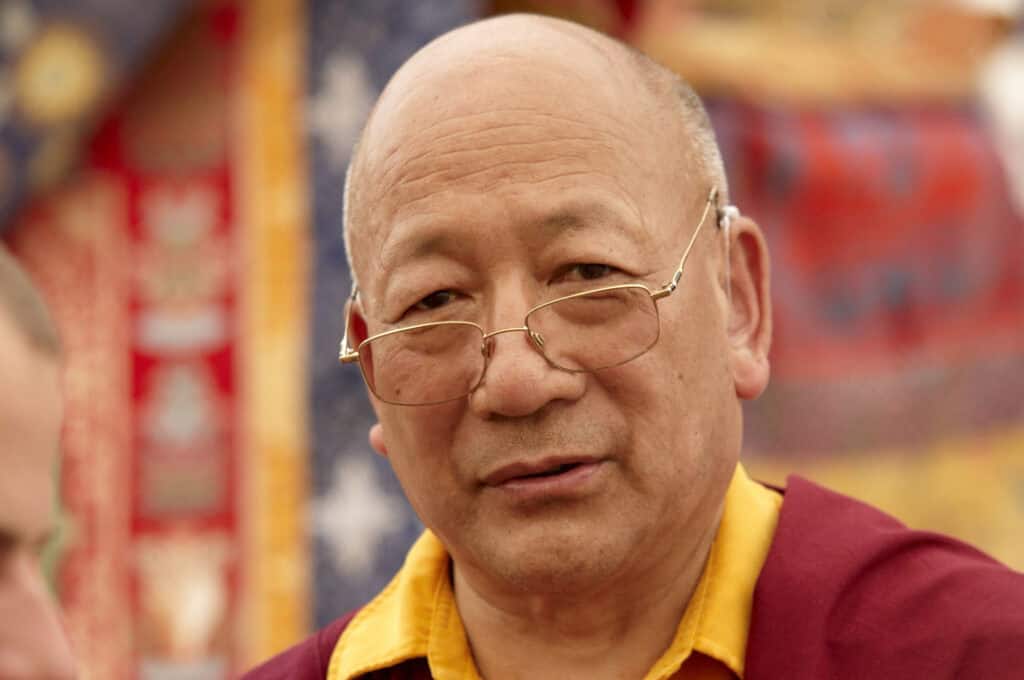
Since the early 1960s, Gyamkhar Tsultrim Namgyal has fulfilled the role of Solponla and has been responsible for the daily needs of the Karmapa. He was an attendant, secretary, and right-hand of the 16th Karmapa and then later for the 17th Karmapa. He has been very close to both Karmapas over long periods of time and accompanied them on their travels. Tsultrim Namgyal received his education in Rumtek Monastery and is considered very learned, especially regarding the Karma Kagyu lineage. In the 1950s, his family made a dramatic escape from Tibet that took more than one and a half years, during which time they had to defend themselves against Red Chinese troops in eighty-four battles. When Karmapa approached the editorial team, he said, “The article should be about his life story, which is basically about the buddha-dharma.” Lama Ole was also very pleased with the idea and fully supported it.
In May 2018, the Buddhismus Heute team spent a week at the Karmapa International Buddhist Institute (KIBI) in New Delhi and interviewed Solponla for up to seven hours each day. The interviews were conducted in Tibetan with the help of translators Dawa Tsering and Gönpo Tashi and translated directly into English. Karmapa‘s secretary Rabjam Rikki Catty, Hans Embert and the entire KIBI team also provided great support in helping fulfill Karmapa’s wish.
This article is an excerpt from a much larger text being published in Buddhismus Heute over several issues. With it, we delve into the world of old Tibet, the life of Gyamkhar Tsultrim Namgyal, his recollections of the Karmapas, and the world that Lama Ole and Hannah Nydahl immersed themselves in during the late 1960s, where they lived with, learned from, and meditated together with the highest lamas of our lineage.
Derge In Kham
I was born in the eastern Tibetan Kingdom of Derge into the Gyamkhar family. For most of my life, I served as the Solponla for the Karmapa. Solponla is a title for someone who is primarily responsible for organizing the daily personal needs of the Karmapa: for his food, his clothing, correspondence, and so on—a kind of personal attendant. The Solponla is also the chief of staff for the Karmapa. I served in this function for many years, first for the 16th Karmapa and then later for the 17th Karmapa.
The 16th Karmapa said to my father, when I was still a child, that my father should teach me to read and write. That was not a given in Tibet of the 1930s and ‘40s. However, it is said that all the people in the area where I am from could read and write well. This was ascribed to the blessing of the great Tibetan dharma translator Vairotsana. During the time of King Trisong Detsen, in the eighth century, he was banished from Lhasa to that region and left his writing implements there.
My parents’ families were connected to the Sakya and Nyingma traditions and weren’t originally Kagyu practitioners. My mother came from the Tummo Tsang family from Terlung, near Derge. The Khyentse Tulku lineage comes from this side of the family, such as the famous Sakya master Jamyang Khyentse Wangpo. The great Nyingma master Kathok Situ Chökyi Gyamtso was an uncle of my mother. The mothers of the 16th Karmapa and 14th Shamar Rinpoche, who passed away in 2014, were also from my family. Shamar Rinpoche was my cousin.
In Tibet, it was common to ask a lama to name a child after it was born. In my case, it was Khyentse Chökyi Lodrö who gave me the name Jigme Thöndup Wangyal, the first name I was given after I was born.1 Khyentse Chökyi Lodrö was raised with very strict discipline in the Kathok monastery. The fourth Kathok Situ, a very great scholar, taught him there. After fifteen years in the monastery, Khyentse Chökyi Lodrö returned to Dzongsar to the monastery of his predecessor. Dzongsar is not far from Derge, my home, and there I received my name from him.
My sister, Kelsang Wangpo, was the oldest child in our family, and today she lives in Rumtek Monastery. I was the second oldest, followed by Khenpo Tschödrag Tenphel. The fourth child was Pema Namgyal; however, he got the nickname Logya, and today also lives in Rumtek. He stayed in Tibet during our escape, was a prisoner of the Chinese for a long time, and had many bad experiences until he was finally able to flee Tibet. The youngest of my siblings was Tashi Namgyal, and he married into the royal family of Bhutan. He was a translator for the 16th Karmapa and has since passed away.
Meeting Karmapa
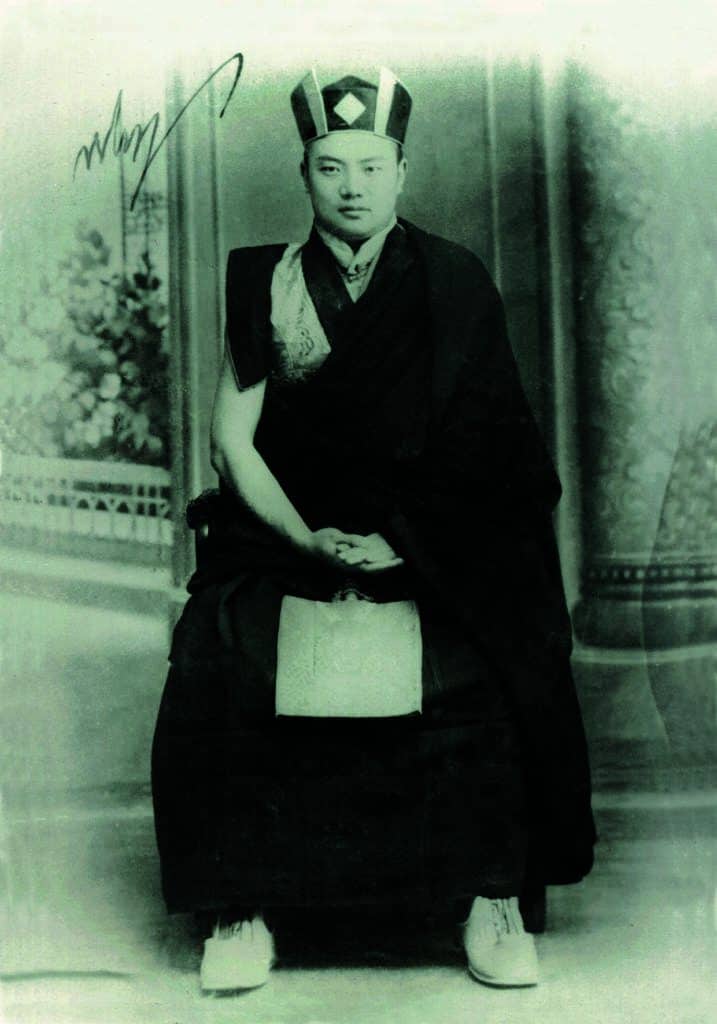
It was 1954 when I met the 16th Karmapa for the first time in Derge. Karmapa was thirty-one years old at that time and was visiting the monastery of the King of Derge, the Sakya monastery Derge Gönchen on his way to Beijing. At that time, I was around eight years old. Shamar Rinpoche was already born—as was Situ Rinpoche, I believe—but Jamgön Kongtrul Rinpoche and Gyaltsab Rinpoche were not yet born. This year, the year of the wood horse in the Tibetan calendar, was very critical for Tibet. The Communist Chinese troops were already in Kham, and Mao Zedong had invited the high lamas and powerful people from central Tibet to Beijing.2 Their travel route went through Derge, where I lived, and the authorities in Lhasa had requested that the King of Derge help the travelers on their journey. My father, Gönpo Namgyal, held the highest rank among the thirty-two ministers in Derge at the time, and it was thus his responsibility to welcome the high lamas from central Tibet. My father invited all of his family members from the surrounding area to Derge to meet the lamas and get blessings from them.
A tent camp had been set up for Karmapa on the banks of the river Drichu,3 and one time I was allowed to ride therein the back seat of a car. Without having been informed about me beforehand, Karmapa asked that I be brought to him. As I entered his tent, Karmapa was eating some tsampa.4 He gave some to me and said that later I should become a monk. That was the first time that Karmapa spoke with me. As I recall, at this meeting, Tsongpön Könchog also came to Karmapa. He was from Denkhok and worked with Dongsang Shabdrung, a brother of Karmapa. He brought the news that Karmapa’s brother had recently died.
During this first meeting, Karmapa gave me an eating bowl, which I always kept with me. However, I lost this several years later in a battle with Chinese troops during our escape from Tibet. Beginning in 1958, my family and I were on the run from Chinese soldiers for one year and eight months until we finally reached Nepal and then India. Somewhere near Dragyab and Gonjo, in east Tibet, I was awakened one morning by a shot, and a moment later, a grenade hit the tent in which I had left the bowl.
During our first meeting, Karmapa had given me a monk’s shirt together with a long belt, a kind of katak.5 It was a yellow Khampa belt with long fringes, which is used to tie a shamtab6 or chuba.7 These pieces of clothing were old, and Karmapa had worn them himself. When lamas give things like this, they are never new clothes but were always worn by them before and thus carry their protection blessing. Later, in dangerous situations during our flights, it saved my life and the lives of those around me on numerous occasions.
Who Is Karmapa?
Who is the Karmapa, this person with whom my entire life is so entwined, and about whom I am telling you here? He is one of the greatest and most famous Buddhist masters from Tibet, who, since the twelfth century, has consciously taken rebirth seventeen times so far and is the spiritual head of the Karma Kagyu school. It is said that he attained full enlightenment during the time of the previous Buddha,8 and is continually reborn to help other beings. As a matter of fact, many centuries ago, the Buddha himself prophesized the later appearance of the Karmapas in Tibet, as did Guru Rinpoche9 and other high-bodhisattvas. There is a book in which all of these prophecies are collected, and once in China, I discovered a text of the Buddha called Mangtso Gyamtsö Lungta, in which the Karmapa is also mentioned.
The most famous prophecy from the Buddha himself comes from the text Do Ting Dzin Gyalpo, which in Sanskrit is called Samadhirajasutra, the King of Samadhi Sutra:
Two thousand years10 after my lifetime,
the dharma will spread in the land of the red faces,11
they will be students of Loving Eyes.12
The Bodhisattva with the voice of a lion,
Known as KARMAPA, will appear
Through his mastery of deep meditation
he will tame beings and they will be filled with joy,
when they see, hear, touch or think of him.
Another prophecy from Buddha Shakyamuni is found in the Towo Namgya Barwe Dolle, the Burning Wrathful Meteorite Tantra: “In the completely pure mandala, the universally renowned being will appear, called KARMAPA, who unifies the Buddhas of the ten directions and shows the highest realization in this life.”
Yet another prophecy from Buddha Shakyamuni comes from a Manjushri tantra, the Jampel Tsagyu, or Mulamanjushri in Sanskrit. Here, Buddha says that a being will appear who will spread the teachings of the Buddha and will bring them to fruition. His name will begin with KA and end with MA.13
In the Do Lang Kar Shegpa, the Lankavatara Sutra, Buddha said that in the north, a special being will appear. He will be very powerful, will possess great knowledge and wisdom, and will be called the “Knower of the Three Times”14 as well as the “Holder of the Activity of All Buddhas”—that is, Karmapa. Further, it says:
The holder of the Black Crown,
who dons the robes of a monk,
will affect the benefit of all beings,
until the end of the teachings of the one thousand Buddhas.
Karmapa was also clearly predicted by Guru Rinpoche, who brought Buddhism to the Himalayas in the eighth century and who primarily taught tantric teachings: “The one who upholds the activity of Loving Eyes, Dusum Khyenpa, will appear at a placed called Tsurphu.”15
Further, Guru Rinpoche said:
An emanation of the speech of Loving Eyes will descend from the gods’ realm of Tushita16 in order to benefit beings. The first incarnation will be known as Sangtschö Dusum Khyenpa, “Knower of the Three Times,” who performs the secret activity. As a sign of his empowerment, he wears the Black Crown, the head ornament of his family. In every moment of his life, he will lead countless beings to awakening. All who see, hear, think of him or are touched by him will be reborn in front of the noble Loving Eyes (in Dewachen).
Guru Rinpoche also prophesized that there would be twenty-one Karmapas and even predicted their names.
My brother Khenpo Tschödrag Tenphel, who is very learned, once explained that the 1st Karmapa did not receive his name Dusum Khyenpa at birth, but rather at a much earlier time, after he had practiced a lot and when it became clear that he was aware of the past, present and future. Karmapa attained full enlightenment many eons ago and was active in many different ways and in many incarnations long before he appeared as the 1st Karmapa. The Tibetan King Songtsen Gampo, for instance, sent seven young men to India in the seventh century to develop a Tibetan script, one of whom was a previous incarnation of the Karmapa. In a later incarnation, Karmapa was Gyalwa Chöyang, one of the twenty-five main students of Guru Rinpoche. There are countless other stories about Karmapa’s activity before he appeared for the first time under the name of Karmapa in the twelfth century.17
Previous Lives of The Karmapas
The 15th Karmapa once told many stories from his former lives, from the millennia before he became the 1st Karmapa in Tibet. This is how it happened:
The 1st Jamgön Kongtrul Lodrö Thaye was the main teacher of the 15th Karmapa Khakyab Dorje. When the 15th Karmapa was sixteen years old, he received from him all of the great transmissions of the Kagyu lineage in Palpung monastery in east Tibet. Very nearby to this is the Dzongsar Monastery, and there the 15th Karmapa visited Jamyang Khyentse Wangpo, one of the great masters of the time, in order to receive the transmission of the Drubtab Kuntu, a huge collection of Sakya practices, which he had collected.
Interestingly, the future mother of the 16th Karmapa was also there at that time to receive a blessing from the 15th Karmapa. She was still just a small child, but the 15th Karmapa already saw that she would be the mother of his next reincarnation. He gave her a package of special teas, a silk scarf, a protector string and was very affectionate with her.
The 15th Karmapa requested teachings from the master Jamyang Khyentse Wangpo, and he, in return, asked Karmapa to tell something from the former lives of the Karmapas. The 15th Karmapa agreed and told him ten stories, which were later published under the title Sakarchupa. These stories were translated into English while the 16th Karmapa traveled with twenty-eight students in 1976 in India after he had given the Kagyu Ngagdzö empowerments18 in Tulku Urgyen’s monastery in Kathmandu.
As the travel group came to the area of Hyderabad, in a town called Dzalendara, the 16th Karmapa told a story from one of his former lives. This story was also added to the collection of stories from the former lives under the title Dzalendara. These stories from the 15th and 16th Karmapas were later published in a book with the title Dzalendara and Sakarchupa.19
At that time, Karmapa was making a month-long pilgrimage to southern India to places including the famous Buddhist caves of Ajanta and Ellora. Indira Gandhi, a great supporter of the 16th Karmapa (although she was Hindu herself), provided a train for the sole use of the travel group. When tracks were available, the group traveled by train, and where there were no tracks, buses were arranged. Among the twenty-eight travelers were also Lama Ole and Hannah and Lopön Tsechu Rinpoche, who was almost always with the 16th Karmapa wherever he went.
Death of the 15th Karmapa
If I am to tell about the 16th Karmapa, with whom I was later so close for many years, then I actually have to start with the death of the 15th Karmapa. This story is important for understanding the life of the 16th Karmapa.
Before the 15th Karmapa died at the age of fifty-one, he wrote a prediction letter about his next rebirth—just as many Karmapas had done—and gave this to his closest student Jampel Tsultrim.
The Karmapas are famous in Tibet for leaving predictions about their next rebirths; they were the only lamas in Tibet that could do that. My brother, Khenpo Tschödrag Tenphel Rinpoche, studied these things in detail and says that the letter of the 15th Karmapa is one of the clearest predictions that the Karmapas have made. However, it is not necessary for the Karmapa to do this, and not all Karmapas leave prediction letters.20
When the 15th Karmapa died, nobody could find a letter from him, and none of his students who were present had received an oral prediction. Sometime later, the 13th Dalai Lama—the King of Tibet—and his government asked Karmapa’s main monastery, Tsurphu, if the rebirth had been found, to which the answer was “no.” However, the close student of the 15th Karmapa, Jampel Tsultrim, had received the letter from the 15th Karmapa in confidence, but no one knew about it.21 At the time, he was far away in a meditation retreat and knew nothing of the events in Lhasa or Tsurphu.
For four years, Karmapa’s administration in Tsurphu was not able to present a Karmapa successor to the government in Lhasa. One of the most powerful men in Lhasa at this time was Lungshar Dorje Tsegyal. He came from an aristocratic family and had several sons. Against the will of the Kagyu lamas, the Tibetan government finally appointed one of his sons as the new Karmapa. Mahakala pujas were performed in all Karma Kagyu monasteries in Tibet for the return of the true Karmapa. Lungshar and the Lhasa government were so powerful that the Kagyus had to resign themselves to the situation and reluctantly accept it.
Karmapa was one of the greatest masters of Tibet, and many people listened to him. The reasons were purely political that Lungshar wanted his son appointed Karmapa and that the Lhasa government put so much pressure on Tsurphu to quickly find Karmapa’s rebirth.
Thus, one of Lungshar’s sons was enthroned as Karmapa. But then there was an accident. While the boy was playing with a paper dragon on the roof of the Tsurphu Monastery, he fell and later died from his injuries. Many years later, after the death of the 13th Dalai Lama, the boy’s father, Lungshar, also died a horrible death. He had become a victim of political intrigue in Lhasa and was tortured and blinded by having hot butter poured into his eyes.22
Finding the 16th Karmapa
When Jampel Tsultrim finally learned of the events, he immediately traveled to Tsurphu and handed over the letter. Shortly thereafter, he passed away. The letter was in dakini script, which is not readable for normal people. The previous Beru Khyentse Rinpoche was considered an expert in this, and he was asked to decipher the letter. A messenger was sent on the long way from Tsurphu to Palpung in east Tibet. As was common, the messenger had the letter in a sealed container fastened to his belt, which he could not take off day or night. Of course, this was very unpleasant so he was in a hurry to reach Palpung.
Shortly before he arrived something unusual occurred in the monastery: Saljay Rinpoche—who was studying under Beru Khyentse Rinpoche—was reading a text, when all of a sudden a piece of paper manifested out of thin air and landed directly in front of him. He could not read what was written on it and brought it to Beru Khyentse Rinpoche, who recognized it as the prediction letter of the 15th Karmapa. Shortly thereafter the messenger arrived with the “real” letter, and this contained the exact same text.
Beru Khyentse Rinpoche transcribed the dakini script into normal Tibetan letters, but the letter was still unintelligible because the contents were partly encoded in numbers. Beru Khyentse Rinpoche deciphered the content and made it understandable for everyone. A few days later, the messenger brought the deciphered letter back to Tsurphu.
The general secretary of Tsurphu handed the letter over to the 13th Dalai Lama—which was not, however, in order to receive spiritual recognition for the head of the Kagyu order. The Dalai Lama has never been involved in the recognition of the Karmapas. The Dalai Lama was the King of Tibet, and it was a political tradition for him to confirm the process of recognition. Intense discussion erupted within the government, and the general secretary of Tsurphu soon after suffered a heart attack and died. Afterward, one of the 15th Karmapa’s three sons, Thugse Jampa,23 became general secretary of Tsurphu. During the lifetime of the 16th Karmapa, there were seven general secretaries, the last two of which were Damchö Yongdu and Topga Rinpoche.
An excerpt of the 15th Karmapa’s letter reads as follows:
To the east of Tsurphu near a river, at a spot which long ago once belonged to the famous archer Pawo Denma Yulgyal Tokgod, a minister of Ling Gesar, on the Pal Hill, adorned with the letters A and THUP, there is an earthen house, which belongs to a royal and spiritual family. This is where the birth will take place on the fifteenth day of the sixth month of the mouse year.24
From the position of Tsurphu, the cardinal direction is named in which the child would be reborn. The Athup family lived to the east of Tsurphu, in the direction of the rising sun, close to the river Drichu. This is in the area of Denkhok, where the famous archer Denma Yulgal Tokgod, who lived during the period of King Gesar of Ling, was born. In the prediction letter, the 15th Karmapa describes the area of Denkhok and even names the Athup family. Nearby is the famous Dölma Lhakhang, a monastery dating back to the time of King Songtsen Gampo. He had both a Nepali wife and a Chinese wife. The latter, Princess Wencheng, built this temple.
In the complete version of the letter, even the name of the father is mentioned, Athup Tsewang Phüntsog, as well as the name of the mother, Gyamkhar Kalzang Chödrön. The birthdate is also mentioned, and the child—who would receive the name Rangjung Rigpe Dorje—came into the world according to the Tibetan moon calendar on the full moon day of the sixth month of the mouse year.
The Family of the 16th Karmapa
When Athup Tsewang Phuntsog, the father of the 16th Karmapa, was a young man, he went to Horkog—near Trehor, which was close to Kandze—to get married. His wife, Yangchen Lhamo, was the oldest daughter of a wealthy family called Hor Khangsar Pön. Together, they had a son, Khangsar Jamgön, who became a high Gelugpa lama. Later, however, they separated, and he went back to his homeland, to Denkhok, where he married again. His second wife was called Gyamkhar Kalzang Chödrön, and she was from my family, the Gyamkhar Tsang. They had eight children, four boys and four girls. One of the boys was the 16th Karmapa, another was the Nyingma Rinpoche Dzogchen Pönlop, the third was a Sakya Lama named Dongsang Shabdrung Rinpoche, and the fourth was the father of Shamarpa—Trinle Namgyal Rinpoche.
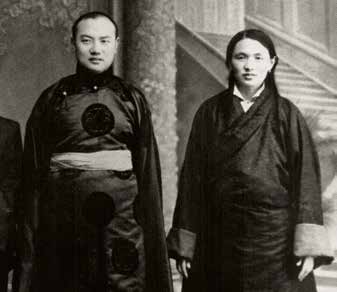
In my family, we knew very early on that Gyamkhar Kalzang Chödrön was a special woman. When she was still a baby, the great yogi Trom Drubtop Gyalwa Changchub came to visit. He usually spent his time meditating in secluded mountain valleys. The girl was brought to him for a blessing wrapped in goat fur. At that time, there wasn’t baby clothing like we have today in Tibet, so when it was cold, babies were wrapped in fur. When the yogi saw the child, he spontaneously took her in his arms and held her above his head to take a blessing from the child. He said, “This girl is no normal being; she is a dakini.” He didn’t say that she would one day become the mother of a Karmapa, but he blessed everybody there with the baby. This story has been passed down orally in my family, but it was never written down.
This yogi, Trom Drubtop Gyalwa Changchub, was quite famous then and sometimes behaved rather unconventionally. When sick people would come to him for a blessing, sometimes he would shoot at them with a gun. The bullets would go through their bodies without hurting them, and afterward, their illnesses would be healed.
I heard another story about the future mother of the 16th Karmapa from Tsongpön Könchog, a businessman. Later on, he worked for the 16th Karmapa for a long time in New Delhi and helped in Karmapa’s project to print Buddhist texts from the Kangyur and Tengyur. He told me that, previously in Tibet, he had served the father of the 16th Karmapa. At that time, there lived the highly realized master Sangye Sangpo in secluded mountain caves near Denkhok. One day, Karmapa’s future father and Tsongpön Könchog set out to visit this master. It was a difficult path, and in order to climb up to the yogi’s cave, at one point, they even had to leave their baggage. When they arrived, Karmapa’s father requested a long-life empowerment. During the initiation, Karmapa’s father showed intense devotion and a pure view towards this yogi. Afterwards, the master said that this was a very good sign and that because of this, his wife would give birth to a great bodhisattva in the future. This story can also not be found in any book and has only been passed down orally in my family.
Birth of the 16th Karmapa
When Gyamkhar Kalzang Chödrön was pregnant with the future 16th Karmapa, she and her husband visited his root lama, the 5th Dzogchen Rinpoche, Thubten Chökyi Dorje. Her husband asked him for a long-life blessing for his wife and child. Dzogchen Rinpoche prophesized that the child would be a high-bodhisattva and asked that he be informed when the birth was imminent.

Even before the birth, there were various signs that a special being would appear. It is said, for instance, that while the 16th Karmapa was still in the womb, he would recite the mantra OM MANI PEME HUNG. It could be heard by not only his mother but also others nearby.
The day before the birth, the 16th Karmapa suddenly disappeared from his mother’s belly. Of course, she was completely frantic and did not understand what was going on. But the next day he was suddenly back in her belly. It was not only the 16th Karmapa who demonstrated such miracles immediately before and after birth; other Karmapas are said to have done this as well. For example, the 3rd Karmapa Rangjung Dorje, immediately after his birth, sat up in the lotus position and began reciting mantras.
When the birth was imminent, the parents sent a messenger to Dzogchen Rinpoche, as he had requested. He said that the birth should not take place in the house but outside at the foot of the sacred Pema Ri Thang Mountain, which had been blessed by Guru Rinpoche and was directly behind the house of the family. There, a large tent was set up, and—as the family was quite large and wealthy—there were many attendants present.
During Karmapa’s birth on August 14, 1924, the tent glowed from the inside. Everybody could see this and understood that a great bodhisattva had been born. The mother did not experience any pain whatsoever, and all of the water containers in the house were miraculously filled with milk instead of water. During the birth, the mother heard unusual voices and sounds, and a form of the protector Mahakala appeared to her—his head was half the size of his whole body, and his eyes were half the size of his head. He was huge, like a mountain. The mother told this to her relatives and said that she didn’t feel anything unusual when she looked at him. In that moment it seemed to her to be perfectly normal.
A further sign is mentioned in the autobiography of the 11th Situ Rinpoche: during a retreat when he was thirty-seven years old, he had a vision in which the 15th Karmapa carried a black crown and was looking out of a window on the house of the Athup family, while the family all stood outside.
Palpung and Tsurphu
During his first years, the Karmapa lived with his family in Denkhok, and it became increasingly clear that this was a special person. There are many stories passed down orally about miracles that he showed as a child. When he was four years old, he threw eggs from the terrace of his house onto the cliffs, but the eggs did not break. Another time, he took a clay yogurt jar and deformed it with his hands as if it were made of soft wax. This jar was kept as a relic on the altar of his parents’ house until 1959.
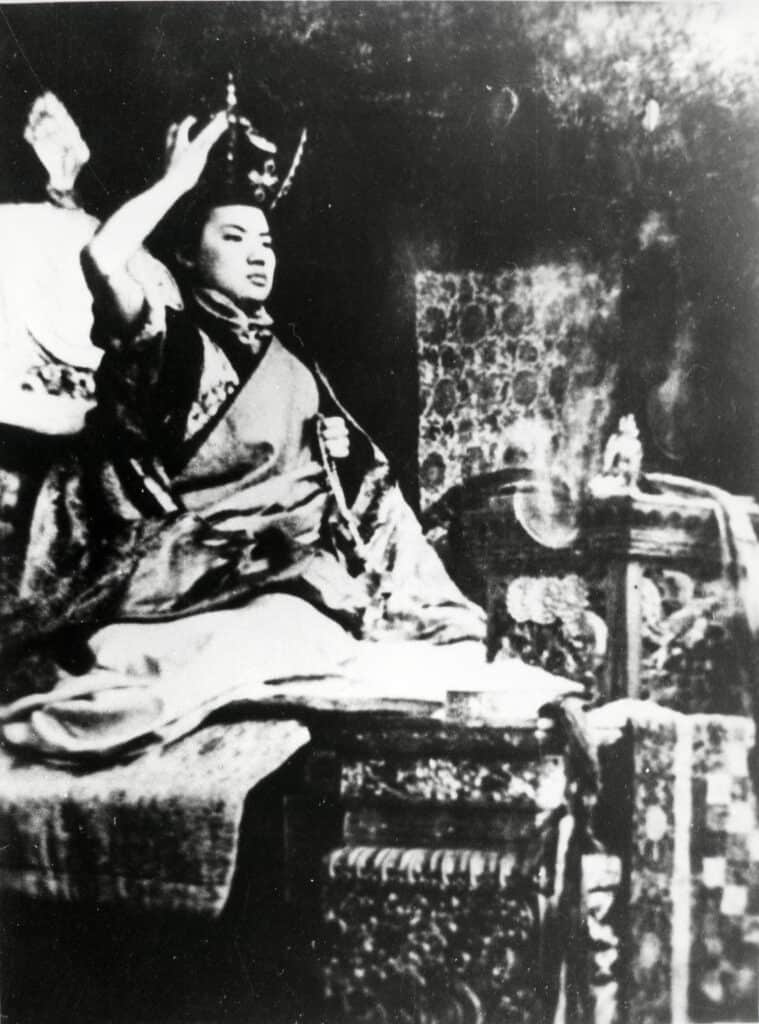
After the prediction letter of the 15th Karmapa was deciphered, a search party from Tsurphu was sent to find the location of the Karmapa’s rebirth, and the party finally arrived in Denkhok. It was comprised of Karma Lekshe Gyaltsen (the Simpön, a kind of valet for Karmapa), a lama named Gyaltsen Sangkyong and the cook Gyalrong Machen. These three were the most important people to take care of the young Karmapa after he would leave his parents’ home.
The 11th Situ Pema Wangchuk also came to the Athup palace in Denkhok to perform a purification ritual there. He gave the child the name Rangjung Rigpe Dorje. The Beru Khyentse Rinpoche incarnation of the time also traveled from Palpung to pay his respects to Karmapa.
Then, Karmapa was brought to Palpung Monastery, the seat of both Situpa and Beru Khyentse, who were the highest lamas there and who gave Karmapa transmissions and teachings.
From Palpung, Karmapa then traveled toward Tsurphu, his main monastery near Lhasa, which took about ten to eleven months. Karmapa traveled with his large monastic camp, the so-called Garchen, around a thousand people who accompanied him on his journey. On the way, he was invited into many Kagyu monasteries and those of other lineages, including Karma Gön, Nemdho, Namdröl Tse, and Dilyak.
Tsurphu Monastery arranged that great reception rituals were to be held at five different locations. The first location was at the monastery that Gendun Rinpoche came from—Kyodrag, in Nangchen. Several people had set out on the long trek from Tsurphu to go there and greet the Karmapa. The second location was Gyina Gön, in Nangchen, where Karmapa was welcomed in a very large tent and where he gave the ceremony of the Black Crown for the first time in this life on the thirteenth day of the sixth month. Karmapa was just eight years old. There were thousands of people present, and many said that they saw the Black Crown floating about one foot above Karmapa.
It was here that Karmapa recognized the rebirth of a tulku25 for the first time. While visiting Korche Monastery in Nangchen—from which Lama Norlha came, who would later head Kalu Rinpoche’s centers in the United States—a delegation from Surmang Monastery arrived. The abbot of their monastery, Garwang Rinpoche, had died, and they asked Karmapa for information about where he had been reborn. Although he could not yet read or write, Karmapa drew a sketch that described the birth location and surroundings. Thanks to this, they were able to find the 11th Surmang Garwang Rinpoche. His next rebirth in the court of the King of Sikkim was also recognized by the 16th Karmapa in the old Rumtek Monastery.
This very Surmang Monastery was founded by Mase Togden Lodrö Rinchen, a student of the 5th Karmapa Deshin Shegpa. In this monastery, there is an important book written by Mase Togden, Surmang Nyengyu, and a book by the 3rd Karmapa Rangjung Dorje, the Karma Nyinggyu, which is one of the most important texts of our lineage. The great master Vimalamitra appeared to the 3rd Karmapa in meditation and gave him transmissions, which were the source for the Karma Nyinggyu.
When Pewar Rinpoche, from Derge, was to give transmissions to the 17th Karmapa in 2010 in France, Shamar Rinpoche called him and requested that he urgently bring this text with him. The transmission for this text was dying out, and Shamarpa had been searching for someone who still had it when he came across Pewar Rinpoche. He was our only source for this transmission. Pewar Rinpoche told him that he had already given the 17th Karmapa the transmission in Kalimpong and that the text was in Shamarpa‘s house in Kalimpong. Shamar Rinpoche was very happy about that.
Karmapa came with his travel group to the region of the Nyenchen Tanglha Mountains, where a great worldly protector of Tibet of the same name lives. As a gift, Karmapa gave—by turning him loose there—a large, completely-white yak. The yak ran in the direction of the mountains until finally it climbed up the mountains and disappeared. About seven years later, the Karmapa came through this area again, and suddenly, the white yak came down from the mountain,“greeted” Karmapa, and then disappeared up into the mountains again.
Karmapa finally reached the monastery Damgyi Uma Dartang on the sacred Namtso Lake, the last of the five locations that had prepared a large welcome ceremony. Afterward, Karmapa arrived at Tsurphu for a great celebration after ten to eleven months of travel.
After the ceremonies and rituals in Tsurphu, Karmapa visited the 13th Dalai Lama in Lhasa and there received the “hair-cutting ceremony” from him. A nobleman by the name of Sawang Chenpo Trimön Norbu Wangyal was present for this. Later, he asked Karmapa’s father why, during the ceremony, Karmapa had not taken off his hat. However, Karmapa had not actually worn a hat. Sometimes people have the ability to see the power-field of Karmapa’s Black Crown. The actual Black Crown is not the material object that Karmapa shows in the ceremony but is a normally invisible powerfield above him. At the moment of his enlightenment many eons ago, it was given to him by the dakinis.
Karmapa received the hair-cutting ceremony from the 13th Dalai Lama, but this had no meaning whatsoever for his recognition. It simply served to create a good connection. No Karmapa has ever been recognized by a Dalai Lama. The Gelugpa school appeared with Tsongkhapa at the time of the 4th Karmapa; it couldn’t recognize the earlier Karmapas, nor could it recognize Marpa, Milarepa or Gampopa, for instance. The Kagyu school is much older than the lineage of the Dalai Lamas. The 13th Dalai Lama and the 16th Karmapa, however, had a very good relationship with one another. The 13th Dalai Lama, for example, composed a long-life prayer for the 16th Karmapa. The End.
- In Tibet, it was common to have additional names over the course of one’s life—for instance, after taking refuge or receiving the monk’s ordination. ↩︎
- In 1954, Mao Zedong invited the Dalai Lama and many other Tibetan lamas, including the 16th Karmapa, to Beijing. They were supposed to take part in the first National Assembly of the People’s Republic of China as the Tibetan delegation. ↩︎
- The Yangtze, the longest river in China, flows through Derge. ↩︎
- A Tibetan staple food made from roasted barley flour. ↩︎
- Tibetan silk scarf. ↩︎
- Lower piece of the monk’s robe, which is wrapped around the hip. ↩︎
- A traditional piece of Tibetan clothing. ↩︎
- According to the Bhadrakalpika Sutra, 1,002 Buddhas are to appear on this earth. Buddha Shakyamuni was the fourth. Here, the third Buddha is referred to, who lived many thousands of years before Buddha Shakyamuni. ↩︎
- Fully enlightened master from India who established Buddhism in the Himalayas in the eighth century. ↩︎
- In old India, both summer and winter were each calculated as one year, thus one thousand years in our modern calculation. ↩︎
- The Indians considered the people in the Himalayas “red faces.” ↩︎
- Avalokiteshvara, one of the eight great bodhisattvas. ↩︎
- KA and MA refer to the Sanskrit word karma, which means “activity.” The Tibetan PA was added as a suffix and means “he who” (performs the activity). ↩︎
- The literal translation of Dusum Khyenpa, the name of the 1st Karmapa. ↩︎
- Tsurphu was Karmapa’s main monastery in Tibet. ↩︎
- Karmapa is prophesized as the sixth Buddha. All of the 1,002 Buddhas are said to give teachings in Tushita before they take birth in our world. ↩︎
- The Mahasiddha Saraha was also supposed to have been a previous incarnation of the Karmapa, as were the Pandita Dharmakirti and other masters. ↩︎
- The collection of transmissions that Marpa brought from India to Tibet, which include all of the important Kagyu buddha aspects. ↩︎
- Also found in Former Lives of the Karmapas (KDDL, 2007). The 16th Karmapa told many such stories to his teacher Gongkar Rinpoche, which were unfortunately lost because Gongkar Rinpoche never left Tibet and died there. ↩︎
- Of the sixteen Karmapas, seven left written instructions, four left oral instructions and five Karmapas left no instructions at all. ↩︎
- It was not even clear to him that a paper roll, which the 15th Karmapa had given him, contained the prediction letter. ↩︎
- Unfortunately, there are many such reports. Things were not always so “holy” in the holy city of Lhasa. ↩︎
- Not to be confused with Thugse Jamyang Rinpoche, another son of the 15th Karmapa, who was, in fact, the 12th Shamarpa. ↩︎
- That is the year 1924, according to the Gregorian calendar. ↩︎
- That is a reincarnate lama. The recognition of tulkus from all lineages is one of the most important tasks of the Karmapas. ↩︎