Public life
At this time, while in his mid-thirties, Lama Shang had the reputation of a great yogi and quite a number of followers to match. However, he had absolutely no interest in public life and just wanted to meditate alone in the mountains. Once, he even considered fleeing from all the people who wanted something from him and leaving Tibet, although his teachers, including Yerpawa, reprimanded him for this. In 1160, when Lama Shang was 38 years old, he went looking for his teacher, Gomtsul, to tell him that he intended to wander aimlessly as a yogi through the mountains.
At that time, Gomtsul was staying in Lhasa, where he had a very difficult mission. Four different clans were at war with one another in Lhasa, such that the city and its surroundings were in stark decline. Both of the holiest temples in Tibet—the Jokhang and Ramoche—had been burned down. Bandits were terrorizing the country and there was general lawlessness. It had become all but impossible for pilgrims to travel to Lhasa, as they were often robbed and murdered on the way.
Gomtsul had been prompted by two dharma-protectors to see to it that peace returned to Lhasa. As the nephew of Gampopa, he was held in high regard and was considered an arbitrator. He had been invited by some of the warring parties and had a tough task ahead. For this reason, Gomtsul was not particularly receptive to Lama Shang’s “escapist” plans. Instead of giving the blessing that Lama Shang sought for his plans, he promptly named him Lord of the Teachings (Tib. Tenpä Dagpo) in an official ceremony and gave him the task of rebuilding both temples and bringing peace to Lhasa and the surrounding region. He was also made responsible for the Jokhang temple with the Jowo statue. Together these were considered the spiritual heart of Tibet. The condition of the temple and the statue was understood to be inseparable from the fate of Tibet. This gives one an idea of the importance attributed to Lama Shang’s new function—the welfare of the entire country of Tibet had been placed in his hands!

Lama Shang took very seriously the unexpected and radical change in his life through his teacher’s actions and set about his new tasks with all his energy.
He took responsibility for the security of the city and the entire region and put them under his seal, as it was referred to. He built two monasteries, Tshal Yang Gön in 1175 and Tshal Gungthang, his main seat, in 1187. As it proved impossible to pacify the warring parties and bandits around Lhasa by peaceful means, Lama Shang built up an army consisting primarily of monks from his monasteries. They subdued everybody who defied the seal.
Another reason he had to resort to violent measures was that it was necessary to impose law and order. For instance, he created armed escorts to accompany groups of pilgrims to protect them from attackers.
He also had to procure building materials for monasteries, retreat centers and statues, when these would not be given voluntarily. Juniper wood was particularly coveted for these purposes. Finally, he had to fight the enemies of Buddhism.
How is one to understand an enlightened master acting in such a way?
He did all these things with an enlightened attitude and did not have any disturbing feelings while he did them. It never happened out of anger or aggression but was done exclusively for the benefit of beings—regardless of how it appeared outwardly.
Of the four Buddha activities, it is the fourth, the powerfully protective, that is most difficult to understand for those with little trust and which can sometimes create doubts. Everybody likes it when a lama works in a pacifying manner because this is the way one generally imagines the activity of a Buddhist teacher. The enriching activity is generally also not experienced as controversial. The fascinating activity, which a teacher can only properly carry out when the ego is no longer connected with it, is more frequently misunderstood. However, the powerfully protective activity—which, unfortunately, is often incorrectly described as wrathful—requires a great deal of trust on the part of the students. It can only be done when the teacher no longer has any anger whatsoever and only acts out of compassion. Just as a surgeon has to do unpleasant things to a patient in order to help him or her, so must the lama do things that are necessary to prevent the greatest amount of suffering and to benefit the greatest number of beings in the best possible way for the longest possible period of time. In the case of Lama Shang, this could also mean waging war.
When someone who is enlightened exercises a function like this, then he works with every situation so that the least possible suffering is created. As a bodhisattva, one learns—as Künzig Shamar Rinpoche once formulated it—to be a master of illusions. The bodhisattva is no longer caught by the illusions of the world but instead uses them in a skillful way in order to help beings.
In one story about the King of Shambhala, it was foretold that during a battle, he would cause illusory soldiers to appear, which would battle other illusory soldiers in such a terrible way that the real opponents would become horrified, drop their weapons, and surrender. To a degree, Lama Shang also deployed magical tricks as a war tactic. In one text, it is told that he led a magical army and that Mahakala himself gave him the transmission in order to subdue enemies. Lama Shang had an especially close connection to a form of Mahakala with a raven’s head and to a form of Radiant Goddess (Skt. Shri Devi, Tib. Palden Lhamo), which was considered a protector of Lhasa and the Jokhang.
On one occasion, at the Tsangpo River in a valley to the west of Samye monastery, Lama Shang and his students stood against a vastly superior army. His students fell into a panic, but Lama Shang said, “You underestimate me,” went into a deep meditation, grabbed a riding crop and ran toward the opposing troops while swinging the whip in the air. The entire valley was suddenly filled with rainbows and his students followed him without any resistance. At the sight of Lama Shang, the opposing soldiers were overwhelmed by trust in him and gave up without a fight.
It is told that Lama Shang and his closest students were themselves on the field of battle together. His blessing was so strong that on the front lines, in the midst of the fray, some of his students had strong spiritual experiences.
He and his students had a strong connection to the Buddha of Highest Joy, who had appeared to him in numerous visions. Dharma Shönnu, a student of Lama Shang who would later become his successor in worldly power, once had a vision at the battlefront in which the face of the Buddha of Highest Joy appeared to him.
Other students had Mahamudra experiences in similar situations. One of them, Tishri Repa, was just fifteen years old when helping on the battlefield. After the victory, Lama Shang said to him, “Everything that I do is Mahamudra,” whereupon Tishri fell into a state of deep blessing.
Tishri Repa, who would later become quite famous and would defend the kingdom of Tangut with Buddhist rituals against invading Mongols, had had doubts prior to this experience. At Lama Shang’s command, he had twice slung stones at the enemy in battle. However, the third time, he had refused to do so because he felt guilty. He thought, “I came here to learn dharma and not to kill people.”
Lama Shang later prophesized that this refusal to carry out the attack was a sign that he would only be successful twice in defending the kingdom. And this is exactly what happened when the kingdom fell in 1226 at the third attack of the Mongols.
Life with Lama Shang must have been an exciting experience for his students. One text mentions, without further explanation: “Lama Shang was permanently surrounded by numerous beasts of prey.”
Lama Shang and the 1st Karmapa
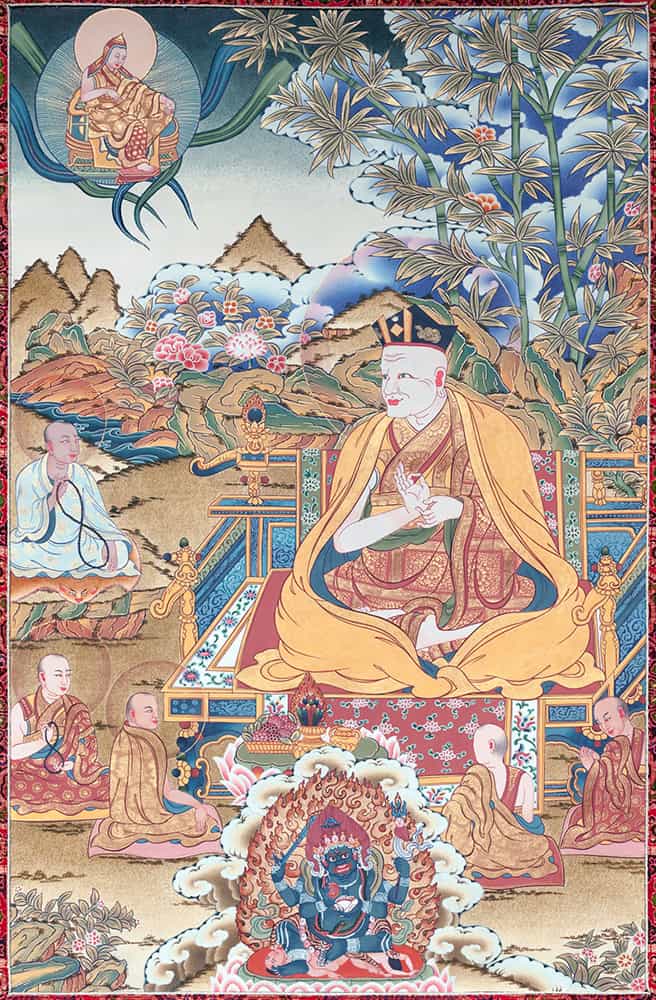
Lama Shang and the 1st Karmapa had a special and deep friendship. Lama Shang was the younger of the two, being born twelve years after the Karmapa, but both died the same year in 1193.
When Gampopa recognized one of his close students by the name of Khampa Use as the Karmapa, who had been prophesized by Buddha Shakyamuni in various sutras and tantras, the pupil was also confirmed by Lama Shang and Lama Shakya Shri. Once, Gampopa said to his students, “My student Khampa Use is just pretending in this life that he is my student. In fact, he has already achieved the highest goal!”
The 1st Karmapa Düsum Khyenpa was from East Tibet. He had spent some years with Gampopa in Central Tibet and then returned to his homeland, where he founded the first Karma Kagyü monasteries, among others, the famous Karma Guen. Later, when he was quite old, he traveled again to Central Tibet, where he built Tsurphu, later the main monastery of the Karma Kagyü lineage. During this visit, he again met Lama Shang and there he asked him to cease his warlike activities. It is told that upon hearing this request, Lama Shang took hold of one of Karmapa’s fingers, “danced wildly,” and thereafter stopped waging war.
One humorous story shows the close connection between the two: during a visit of the Karmapa to Lama Shang’s main monastery Tsal Gungthang, both slept in the same room. In the middle of the night, Lama Shang leapt onto Karmapa’s chest and slapped him three times. Karmapa’s guards, who were certainly experienced Khampa warriors, rushed into the room, but before they could grab hold of Lama Shang, Karmapa told them: “Lama Shang just prolonged my life by three years!”
In his monastery, Tsal Gungthang, Lama Shang built a large statue of Buddha Shakyamuni. It was considered the finest statue in Tibet at that time. Both his students and Lama Shang himself considered this statue to be inseparable from Lama Shang, and numerous miracles were attributed to it. It was said that during the day, people worked on the statue, and during the night, the buddhas did.
At the inauguration of the statue, there were great masters from various schools in attendance, including the 1st Karmapa. During this, there was an occurrence, described differently in different sources, which was in any case extraordinary:
The ceremony was led by both Lama Shang and Karmapa and at one point Karmapa grabbed Lama Shang and put him on the statue (or threw him against the statue, as reported by other sources), and called out, “Merge!” As a sign that the merging really happened, Lama Shang’s body became completely numb and stiff at that very moment.

Lama Shang’s last years and his death
When Lama Shang heeded the request of the 1st Karmapa to end his warlike activities, he was already quite old. Lama Shang spent the last years of his life teaching and administering the region under his control. In 1193 his health worsened, and he concentrated on teaching and on building a stupa in the Tsal Gungthang monastery for his own bodily remains.
When he finally passed away, there were the usual miraculous signs of the passing of an enlightened master: four earthquakes, wonderful sounds, an intense light and pleasant fragrances.
During the funeral rituals, it is even said that previous adversaries paid their respects and broke into tears. After several attempts to set fire to the corpse, it suddenly began to burn from within, and once again, numerous miracles were witnessed. Many relics were found in the ashes afterwards.
Writings by Lama Shang
The most well-known and perhaps most fascinating aspect of Lama Shang’s life was, of course, his warlike activity. However, his influence on Tibetan Buddhism goes far beyond this.
In fact, he left behind many writings, most of which have not yet been translated. His most famous and extensive work is entitled The Path of Ultimate Profundity (Tib. Lam Zab Thar Thug), the Mahamudra text from which Lama Ole uses excerpts.
Many are familiar with his quotations on the path of Mahamudra, which the 9th Karmapa Wangchug Dorje refers to in his book Mahamudra: The Ocean of True Meaning.1
An example about recognition:
This (experience of Mahamudra) is not understood through great learning.
It is not understood through great intelligence.
It is not understood by gross conceptual analysis.
It is not understood through mere knowledge of the pithy instructions.
It is not realized through obsessive and eager striving.
It is not realized through explanatory words or skillful means.
It is not understood through any kind of hasty impatience.
As it is said in the tantras, “It cannot be found at all.”
But if it cannot be understood by any of these means, what is to be done?
Well, realization depends exclusively on blessing because only through the blessing of a realized teacher will the self-knowing awareness be experienced personally from inside. As a tantra explains: “Because the self-knowing primordial awareness is beyond the possibility of verbal communication, it is within the scope of blessing. It is like that with the all-knowing primordial awareness.” (p.201)
How one calms the mind in meditation:
In brief, do not think about the previous thought, do not think about the next thought. Think, what thought is right now going on in my mind. By looking directly at this instant present thought, the wandering mind is cut through instantly, and as long as you are undistracted, no thoughts will arise. But as soon as you become distracted, thoughts will immediately arise again. By considering the arising of thoughts as desirable and looking at them directly, the thoughts will be self-liberating, and you will go straight into non-conceptuality. In this way take the arising of whatever thoughts appear as desirable and look at them directly. Do not make long practice sessions, but interrupt them while there is still clarity. Do short and frequent sessions. (p.123)
Another quotation shows his special emphasis on devotion and Guru Yoga:
To nurture stillness,
To nurture spiritual experiences,
To nurture samadhi and other spiritual states—
These are common.
But by the strength of your devotion,
For realization to arise from within
Due to the Lama’s blessings—
This is rare.2
Lama Shang and the 8th Karmapa Meditation
Lama Shang had a strong influence on the 8th Karmapa Mikyoe Dorje,3 who lived in the sixteenth century. He saw Lama Shang, who had lived several centuries before, as one of his root lamas. When the 8th Karmapa wrote his monumental commentary on the important text Madyamakavatara by Chandrakirti, he mentioned that he felt he had been blessed by both the 1st Karmapa and Lama Shang and that it was the blessing of the latter which led him to his philosophical viewpoint. Largely responsible for this was the same work now used by Lama Ole Nydahl, The Path of Ultimate Profundity. In the collected works of the 8th Karmapa, there are three further points which confirm the great influence Lama Shang had on Karmapa.

One group of texts by Lama Shang are the so-called “Sealed Instructions,” teachings that he secretly gave to a small circle of his most advanced students and which, at his behest, were not to be made openly accessible nor distributed.
Among these teachings was a meditation upon which the 8th Karmapa later built his “Meditation on the 8th Karmapa” (Tib. Tün Shi Lame Naljor), which literally means “Guru Yoga in four sessions.”
“The white panacea”
Alongside criticism of his military activities, Lama Shang was also criticized (above all by the famous scholar of the Sakya school Sakya Pandita), for his use of a phrase and the corresponding doctrine—which was used by both himself and Gampopa—Karpo Chig Thub. One finds various translations for this Tibetan expression in the literature, among them “the white panacea,” or translated freely, “enlightenment with a single means.” It would go beyond the scope of this article to thoroughly examine this topic. Over the centuries, some of the greatest scholars of Tibetan Buddhism have debated the matter and there are entire works of research devoted to it. Here is a brief look:
Gampopa had used the expression several times, but it was Lama Shang who brought it real popularity. He refers to this teaching:
Once one has been introduced by a teacher to the true nature of the mind, and has had an authentic experience of it, one does not need anything else to achieve full enlightenment; to remain within it and cultivate this Mahamudra experience is completely sufficient. To rest in this insight is like a remedy that can cure any illness, everything that keeps one from full enlightenment.
Lama Shang says: The moment you recognize your mind, all of the white4 qualities become completely perfected in one moment, and no other practice is necessary.
Such statements, which one can also read in Gampopa’s Jewel Ornament of Liberation, were most severely criticized by the famous scholar Sakya Pandita in the thirteenth century. The criticism was at times so polemical5 that Kagyü scholars such as Dhagpo Tashi Namgyal (sixteenth century) accused Sakya Pandita of personal aversion, censoriousness and narrow-mindedness.6
Sakya Pandita’s criticism of “the white panacea” consisted of three points:
- In his opinion, the teaching made all the practices and studies traditionally considered important for the path, superfluous. Sakya Pandita could not accept that just this one method could be sufficient—even if it were insight into emptiness.
- He did not agree with the idea that the wisdom of Mahamudra could be achieved merely through a method beyond concepts. This was exactly the teaching style of Lama Shang: the emphasis on direct, non-conceptual experience as opposed to studies and knowledge expressed in words. Thus, his famous quote that he had understood nothing from all his studies.
- Sakya Pandita accepted Mahamudra only within the context of tantric practice. For him it was only possible to experience Mahamudra through the fourth initiation in Annuttara yoga Tantra, the “word empowerment.” We receive this, for instance, in the Karmapa Guru Yoga, when all three lights from Karmapa’s power centers stream into ours. It is possible that Sakya Pandita was not familiar with the non-tantric path to Mahamudra, which Maitripa taught to Marpa.
For Sakya Pandita this teaching corresponded to a Chinese teaching which had already been rejected as heretical in the eighth century in Tibet during the famous “Debate of Samye.” Many Mahamudra and Maha Ati teachings sound similar, but there are important differences.
Critics charged that “the white panacea” would mean that one wouldn’t have to do anything at all and enlightenment would simply come by itself once the mind was free from all activity. However, this was rejected as a distortion of the Kagyü view by great Kagyü masters like Künkhyen Pema Karpo, Dhagpo Tashi Namgyal and Phawo Tsuglag Trengwa.
This criticism is part of a greater debate as to whether the path must always be gradual or if it is possible under the right conditions to become enlightened suddenly and even without tantric methods. Gampopa believed this was in fact possible, and proved it as well, when he introduced students to the nature of mind without tantric empowerments.
“The white panacea” is connected with the Mahamudra techniques used by Gampopa, which were new at that time in Tibet. In the nineteenth century, Jamgön Kongtrul Lodrö Thaye categorized one of these techniques as “Sutra Mahamudra:” It is based on the teachings on the buddha nature. Gampopa used teachings like Buddha Shakyamuni’s Samadhirajasutra and the Gyü Lama by Asanga and Maitreya to give people an understanding of and trust in their buddha nature and then had them meditate on this. In this way, Gampopa made Mahamudra accessible for people who were not yet in the position to do advanced tantric practices. Until Gampopa, Mahamudra was seen as something that could only be experienced and practiced on a high level of tantric meditation, above all after one had been introduced to the nature of mind by the teacher. This second path to Mahamudra was later termed “Tantra Mahamudra.” It required that one be at a high level, with much previous practice, and was thus something very exclusive.
Beyond this, for particularly qualified students, Gampopa also used a third way, later called “Essence Mahamudra,” the direct introduction to the nature of mind without a gradual path.7 Gampopa was actually very skillful in introducing people to the nature of the mind with little preparation and his success with his students proves this point.
In Mahamudra: The Ocean of True Meaning, the 9th Karmapa states, in connection with the Guru Yoga practice: “The masters Gampopa, Karmapa Düsum Khyenpa, Karma Pakshi, Shang Yudragpa, Götsangpa and others have said: “You do not need the word transmission, for the real transmission it is enough to directly follow me.”
Scholars of other schools criticized Gampopa and Lama Shang because they were not themselves familiar with this approach to Mahamudra. Gampopa, however, did not invent this himself, as one can find it in the Indian Siddha tradition, shaped especially by masters like Saraha and Maitripa. “Gampopa’s Mahamudra” is still the topic of academic discussions and research.
With thanks to Manfred Seegers and Jim Rheingans for their support.
- Karmapa Wangchuk Dorje, Mahamudra: The Ocean of True Meaning. Transl. H Havlat. Verlagshaus Monsenstein und Vannerdat OHG Münster, 2009. Page numbers are at the end of each quotation. ↩︎
- In Ron Garry, Wisdom Nectar: Dudjom Rinpoche’s Heart Advice. Snow Lion Publications, 2005, p. 47. ↩︎
- Source: Texts and verbal information from Jim Rheingans. ↩︎
- “White” means “positive.” ↩︎
- Sakya Pandita did not mince words. For instance: “Marpa did not have the blessing of Red Wisdom” or “… ‘the white panacea’ and other perverted teachings which contradict Buddhism.” ↩︎
- For example, regarding the assertion of Sakya Pandita that the Mahamudra of Gampopa and Lama Shang was an heretical Chinese teaching: “This claim is completely false, as it only shows the personal feelings of the critic instead of the truth. There are neither proofs nor logic in it …” ↩︎
- In The Jewel Ornament of Liberation, this quotation is ascribed to Gampopa: “If in meditation on the highest truth or on the nature of mind everything is included, why then are so many gradual methods taught? These teachings were conceived for those who are karmically less endowed and who do not yet understand the nature of the mind.” ↩︎