

The first article of this series on the Kagyu lineage, titled “The Kagyu Lineage, Part 1 (Yogis, Lay people, and Monks, and Lineages of Spiritual Instruction Versus Established Schools),” provided background explanations, especially concerning the roles of the Buddhist practitioners in Tibet and what actually constitutes a lineage or tradition within Tibetan Buddhism. Based on this understanding, this article presents a brief outline of the origins and early developments of the lineage. Accessing proper information about this early time is difficult because of a lack of reliable sources. Here, the two major sources applied are The Treasury of Knowledge by the 1st Kongtrul and A Scholar’s Feast by the 2nd Pawo Tsuglag Threngwa (1504–1566). The focus of this essay lies in the early lineage transmissions up to the 3rd karmapa because in general it is easier to obtain information on the later developments, e.g., In the relevant historical records.
The Tibetan name Kagyu mostly translates as “lineage of oral instructions.” Since this name could also be applied to other Buddhist traditions, it should be noted that this is the short form of a longer expression: “the lineage of the four streams of oral instructions” (Tib. ka bab shi gyu pa). Early occurrences of this expression appeared in the Collected Works of Marpa Chökyi Lodrö and in the title of a text in the Collected Works of Rangjung Dorje. Tibetan historical records basically distinguish between the Marpa Kagyu and Shangpa Kagyu traditions. Both belong to the so-called “eight original practice lineages,” which came from India to Tibet at the beginning of Tibetan Buddhism.
Although the transmissions of the Marpa Kagyu lineage originated with the North Indian yogi Tilopa or Tillipa (988–1069), the lineage, according to its Tibetan name, began in Tibet in the eleventh century with the translator Marpa Chökyi Lodrö (1012–1097). Marpa, after his three-year training in the Sanskrit language in Kathmandu, Nepal, is said to have traveled to India three times in order to study and practice authentic Buddhist teachings. He met the scholar and meditation teacher Naropa (956–1040), who had received four special transmissions from the accomplished master (Skt. mahasiddha) Tilopa. The principal focus of his lineage was tantric practice related to the inner energy system.

Tradition has it that, as a result of his high realization of the Buddhist teachings, the yogi Tilopa first met Buddha Vajradhara (Dorje Chang, Diamond Holder) in a vision and received his complete teachings. Kagyu practitioners regard Vajradhara as the tantric manifestation of the same enlightened essence as that of the historical Buddha Shakyamuni. He unites the qualities of the so-called Five Buddha Families and reveals, in particular, the tantric aspect of enlightenment. He also is the focus of identification in the Kagyu meditation on the teacher (Tib. lama, Skt. guru), the Guru Yoga practice. The practitioner’s personal teacher is called to mind in this practice in the form of Vajradhara.
Additionally, Tilopa collected all available tantric transmissions from the teachers of the aforementioned four historical lineages of spiritual instructions. In this way, he was able to compare these different kinds of transmissions, which, according to tradition, is a very favorable condition for keeping the instructions pure and effective. Most biographical sources agree on the reason for his search for further instructions given by teachers of the historical transmission lineages. On this subject, the 3rd Karmapa stated, “Tilopa taught that he had human teachers in order to overcome the lack of confidence of others in this regard (that he did not have a human teacher, but the Omniscient Dorje Chang).”
Both transmissions originating from Vajradhara and from Tilopa’s human teachers also contain the instructions of the Great Seal (Skt. Mahamudra). Tilopa composed several important commentaries on these essential practices, including a song of accomplishment that became known as the Ganges Mahamudra (Skt. Mahamudropadesha). Later, Marpa not only became the holder of these specific transmissions, which came from Tilopa and were transmitted to him by Naropa, but also he composed a spiritual biography of Tilopa. The lineage of transmission from Tilopa is called a short (literally “close”) lineage because, after the historical Buddha and before Marpa, there were only two Indian holders of this lineage.
Marpa also received a second important transmission imparted to him by the Indian master Maitripa (ca.1007–1085). This transmission mainly contained the instructions of the Great Seal. This second tradition is called a long (literally “distant”) lineage because there had appeared at least four other Indian masters before Maitripa as holders of this lineage: Ratnamati alias Manjushri, Saraha, Nagarjuna, and Shavaripa. The various approaches to the practice of the Great Seal associated with these lineages will be discussed in the third article of this series. The four most outstanding disciples of Marpa were known as the Four Great Pillars (Tib. ka chen shi): Ngog Choku Dorje (1036–1102), Tsurton Wange Dorje (11th century), Meton Sonam Gyaltsen (11th century), and Milarepa (1040–1123). The lattermost became the main lineage holder or spiritual heir of Marpa.
The two most famous disciples of Milarepa were Dhagpo Lharje or Gampopa Sonam Rinchen (1079–1153) and Rechung Dorje Drag (1084–1161). Gampopa built the first monastery and, therefore, was regarded as one of the most important founders of the lineage. In addition, his way of teaching served as a model for later teachers (discussed further in the third article). On the other hand, Rechungpa brought additional important transmissions from India to Tibet, which he passed on mainly to Milarepa, Gampopa, and the 1st Karmapa.
Here the teachings of the Great Seal of Tilopa and Naropa must be mentioned, which came to Rechungpa through Tiphupa. They became known as the Teachings of the Formless Dakinis (Tib. Khandro nyengyu). Rechungpa also became lineage holder of the long-life practice of Buddha Amitayus originating from Siddharajni (Machik Drubpe Gyalmo) (11th–12th century), the Buddhas Chakrasamvara (Khorlo Demchok, Highest Bliss), Vajravarahi (Dorje Phamo, Red Wisdom), and Avalokiteshvara Jinasagara (Gyalwa Gyamtso, Mighty Ocean), also transmitted by Tiphupa. All these are central meditation forms in the Kagyu lineage. In his research entitled The Biographies of Rechungpa, Peter Alan Roberts succeeded in correcting the image of Rechungpa, previously depicted one-sidedly in Milarepa’s later biographies. He thus provided evidence for Rechungpa’s great importance as a lineage holder in the Kagyu lineage.
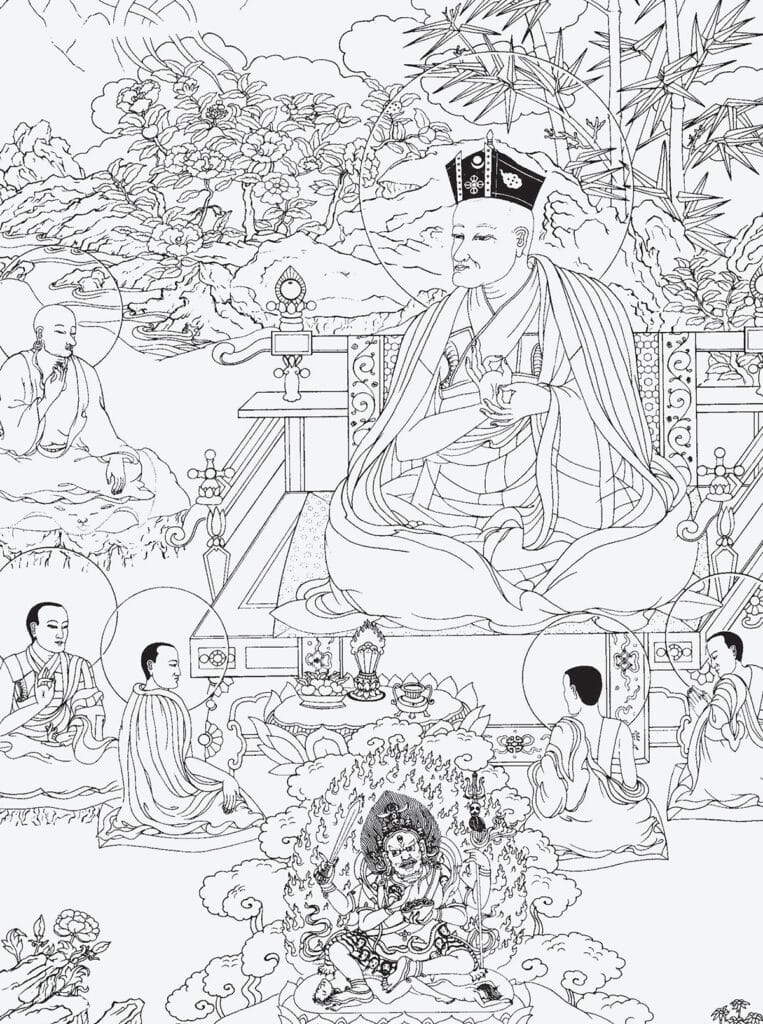
The principal students of Gampopa founded four major (Tib. che shi) and eight minor (Tib. chung gye) lineages under the name of Dhagpo Kagyu. “Major” in this context refers to their proximity to Gampopa and his nephew, Dhagpo Gomtsül Tsulthrim Nyingpo (1116–1169), because their founders had been direct students of these two teachers. The eight “minor” lineages were founded by students of Phagmo Drupa Dorje Gyalpo (1110–1170), who was one of the four principal students of Gampopa. From among these eight subschools, only the Drugpa and Drikung Kagyu still exist.
One of the four major schools is the Karma Kagyu or Karma Kamtshang. The Tibetan term tshang means “nest” or “family” and refers to the close connection between the supreme head Karmapa and his direct students. The 1st Karmapa, Dusum Khyenpa (1110–1193), founded the Karma Kagyu lineage. His name means “Knower of the Three Times.” Tradition has it that this name describes his accomplishment of the timeless state of full enlightenment. A special feature of Karmapa’s activity is to display a black hat (Tib. sha nag) on top of his head, the so-called Black Crown. Karmapa, in this way, transmits his experience of the Great Seal to his students. Dusum Khyenpa established the most important monasteries of the Karma Kagyu lineage: Kampo Nenang (1164), Karma Gön (1186), and, at the age of nearly eighty, his principal seat Tsurphu at the Tölung Valley (1189), about 50 miles to the northwest of the Tibetan capital Lhasa.
Having received the entire cycle of Kagyu teachings from Dusum Khyenpa, Drogon Rechen (1148–1218) became the next lineage holder. He imparted all teachings and transmissions to Pomdragpa Sönam Dorje (1170–1249), who subsequently became the principal teacher of the 2nd Karmapa, Karma Pakshi (1204–1283). Shortly before the end of his life, Karma Pakshi met the next lineage holder Orgyenpa Rinchen Pal (1230–1312), who later became the principal teacher of the 3rd Karmapa Rangjung Dorje. The 3rd Karmapa founded further important centers of the lineage and brought their central teachings into the form that is still used in the Kagyu lineage today.
This concludes the brief overview of the early history of the Kagyu lineage up to the time of the 3rd Karmapa. Presentations that are more detailed appear in the respective life stories of the masters, as well as in the classical historical sources of Tibet such as The Blue Annals, etc. A brief outline of the essential teachings of the Kagyu tradition as handed down and practiced until today will follow in the third and final article of this series.
Selected Sources
gTsug lag phreng ba, dPa’ bo II; Chandra, Lokesh (ed.) (1961), A Scholar’s Feast. mKhas pa’i dga’ ston. Delhi: International Academy of Indian Culture, Indo-Asian Literatures, 9.
Guenther, Herbert V. (1986), The Life and Teaching of Naropa: Translated from Original Tibetan with Philosophical Commentary. Boston, London: Shambhala Publications.
Kongtrul Lodrö Thaye, Jamgon, transl. Ngawang Zangpo (1994), The Treasury of Knowledge, Ithaca, New York: Snow Lion Publications.
Mar pa Chos kyi bLo gros, transl. Torricelli, Fabrizio (1995), The Life of the Mahasiddha Tilopa. Dharamsala: Library of Tibetan Works and Archives.
Mar pa Chos kyi blo gros (1987), rJe btsun chen po mar pa chos kyi blo gros kyi bka’ ’bum, contained in: ’Bri gung bka’ brgyud chos mdzod las | rje mar pa’i bka’ ’bum. Vols. ca and cha (5+6), pp. 1–484 and pp. 1–526.
Roberts, Peter A. (2007), The Biographies of Rechungpa: The evolution of a Tibetan hagiography, London and New York: Routledge.
Roerich, George N. (1996), transl., The Blue Annals. New Delhi: Motilal Barnasidass. Sec. ed. 1976, Reprint 1996. ’Gos lo tsA ba gZhon nu dpal. Deb gter sngon po.
Seegers, Manfred (2009), The Lord of Teachings: Life and Works of the Third Karma pa Rang byung rdo rje (1284‒1339). M.Phil. thesis. Canterbury, UK: University of Kent.
Taranatha, Jo Nang, transl. David Templeman (1983, 2009), The Seven Instruction Lineages. Dharamsala: Library of Tibetan Works and Archives.
Thaye, Jampa (1990), A Garland of Gold: The Early Kagyu Masters in India and Tibet. Bristol: Ganesha Press.
Tsang Nyön Heruka (1452–1507), transl. Lobsang P. Lhalungpa, (1977), The Life of Milarepa. New York: E. P. Dutton.


