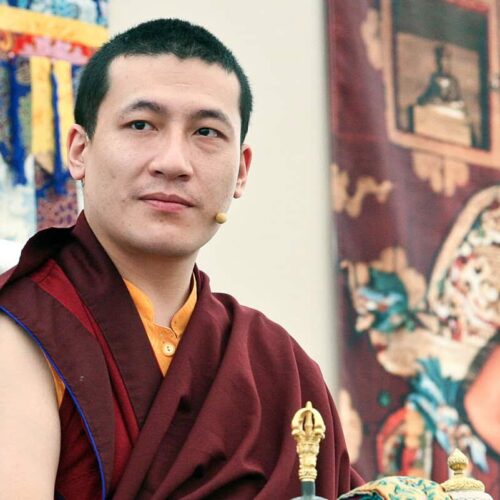
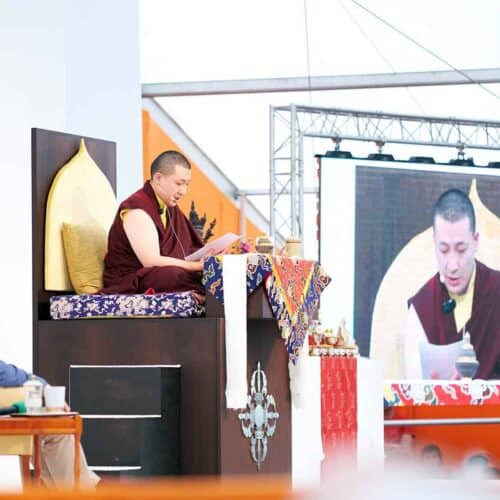
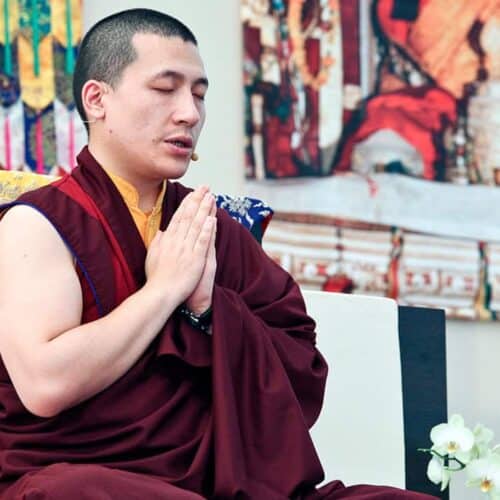
H.H. the 17th Gyalwa Karmapa Thaye Dorje

H.H. the 17th Gyalwa Karmapa, Trinley Thaye Dorje was born in Tibet in 1983. He was the first son of the 3rd Mipam Rinpoche, a great Nyingma Lama, and Dechen Wangmo, the daughter of a noble family descending from King Gesar of Ling. At the age of one and a half the boy started telling people that he was the Karmapa. In March 1994, he and his family managed to escape from Tibet to Nepal and then to India. He arrived in New Delhi, where during a welcoming ceremony H.H. Shamar Rinpoche formally recognized him as the 17th Gyalwa Karmapa. He was given the name of Trinley (meaning Buddha activity) Thaye (limitless) Dorje (unchanging).

17th karmapa in beckse

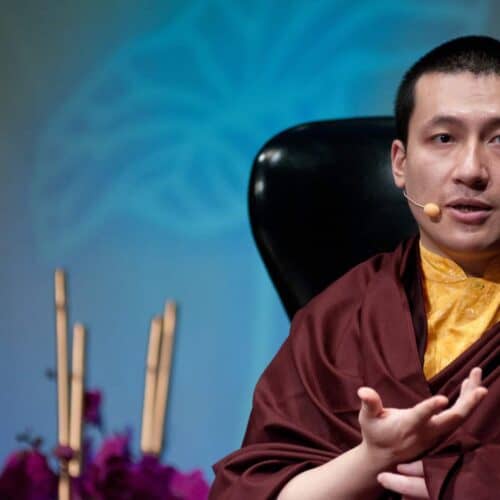
An Interview with Thaye Dorje, HH the 17th Karmapa (Enlightened Activity is Dynamic and Alive Like Music)

Following the Summer Course at the Europe Center (EC), two editors from the German and English editions of Buddhism Today had the exceptional opportunity to interview Thaye Dorje, His Holiness the 17th Gyalwa Karmapa. We asked him about the role of the Karmapa, the future of the lineage, and the impact of technologies such as artificial intelligence on humanity and dharma practice.
An Interview with Thaye Dorje, HH the 17th Karmapa (Enlightened Activity is Dynamic and Alive Like Music) Read More »

the 17th karmapa

Obstacles are Great Friends

In this article we continue with the commentary of Thaye Dorje, His Holiness the 17th Gyalwa Karmapa, on the Bodhicaryavatara, often translated as “The Way of the Bodhisattvas.” This is one of the most famous texts of the Mahayana, or Great Way. Shantideva composed the text around 700 CE. The author was one of the eighty-four Mahasiddhas and lived at that time as a Buddhist monk in the Nalanda University in India. In 2014, the 17th Gyalwa Karmapa began teaching this text, chapter by chapter, at his public courses at the Karmapa International Buddhist Institute in New Delhi, India. It was Karmapa’s suggestion that we publish these teachings in Buddhism Today, which we began to do in issue 42. While being comprehensive is not possible in the space of a magazine, we wish to share substantive excerpts with our readers. In the previous verses in Chapter Three, which continue here, Karmapa discussed how compassion tries to make the physical body into something useful for others. This theme continues in the following passages.

Obstacles are Great Friends Read More »

chenrezig statue

The Way of The Bodhisattvas, Teachings from Chapter 3 (The Tree of Bodhicitta)

In this article we continue with Thaye Dorje, His Holiness the 17th Gyalwa Karmapa’s commentary on the Bodhicaryavatara, or “The Way of the Bodhisattvas.” Up until this part of Chapter 3 in the previous excerpts, we have completed the preparatory phase in order to establish, adopt, and generate bodhicitta, or “enlightened mind.” The preparatory phase consists of accumulating immense merit and wisdom as a foundation, and that foundation is suitable to generate bodhicitta.

The Way of The Bodhisattvas, Teachings from Chapter 3 (The Tree of Bodhicitta) Read More »

A Special Message from Thaye Dorje, The 17th Karmapa, for the Fiftieth Anniversary of Diamond Way Buddhism in the West

The following is a transcript of a speech that was given by Thaye Dorje, His Holiness the 17th Gyalwa Karmapa, to the students of Lama Ole Nydahl during the 2022 summer course at the Europe Center in Immenstadt, Germany. Because the Karmapa could not be present in person, the message was delivered via video to the students at the course and live-streamed all around the world.

A Special Message from Thaye Dorje, The 17th Karmapa, for the Fiftieth Anniversary of Diamond Way Buddhism in the West Read More »

karmapa on adopting the bodhisattva mind

Karmapa on Adopting the Bodhisattva Mind – The Way of The Bodhisattvas (Teachings from Chapter 3 of the Bodhicaryavatara by Shantideva)

The Bodhicaryavatara, often translated as “The Way of the Bodhisattvas,” is one of the most famous texts of the Mahayana, or Great Way. Shantideva composed the text around 700 CE. The author was one of the 84 Mahasiddhas and lived at that time as a Buddhist monk in the Nalanda University in India. In 2014, Thaye Dorje, the 17th Gyalwa Karmapa, began teaching this text, chapter by chapter, at his public courses at the Karmapa International Buddhist Institute in New Delhi, India. It was Karmapa’s suggestion that we publish these teachings in Buddhism Today. This excerpt from chapter three follows the second chapter published in Buddhism Today Issues 45 and 46 and the first chapter in issue 42.

Karmapa on Adopting the Bodhisattva Mind – The Way of The Bodhisattvas (Teachings from Chapter 3 of the Bodhicaryavatara by Shantideva) Read More »

the way of the bodhisattvas (teachings from chapter 3 of the bodhicaryavatara by shantideva)

The Way of The Bodhisattvas (Teachings from Chapter 3 of the Bodhicaryavatara by Shantideva)

The Bodhicaryavatara, often translated as “The Way of the Bodhisattvas,” is one of the most famous texts of the Mahayana, or Great Way. Shantideva composed the text around 700 CE. The author was one of the 84 Mahasiddhas and lived at that time as a Buddhist monk in the Nalanda University in India. In 2014, Thaye Dorje, the 17th Gyalwa Karmapa, began teaching this text, chapter by chapter, at his public courses at the Karmapa International Buddhist Institute in New Delhi, India. It was Karmapa’s suggestion that we publish these teachings in Buddhism Today. This chapter follows the second chapter published in Buddhism Today Issue 45.

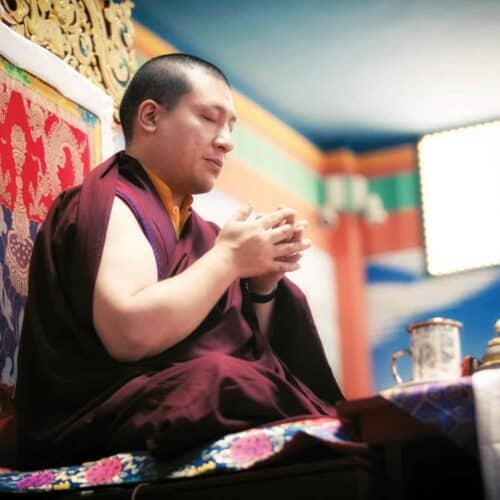
Gyalwa Karmapa teaching Shantideva’s Bodhicaryavatara, Chapter 3, March 2016, at Karmapa International Buddhist Institute, Delhi. Karmapa uses the following English translations: “The Way of the Bodhisattva” by Padmakara Translation Group and “A guide to the Bodhisattva’s way of life” by Stephen Batchelor.

The Way of The Bodhisattvas (Teachings from Chapter 3 of the Bodhicaryavatara by Shantideva) Read More »

The Karmapa on Courage as Compassion

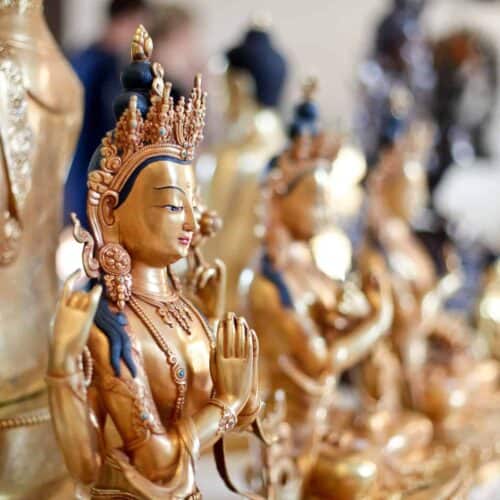
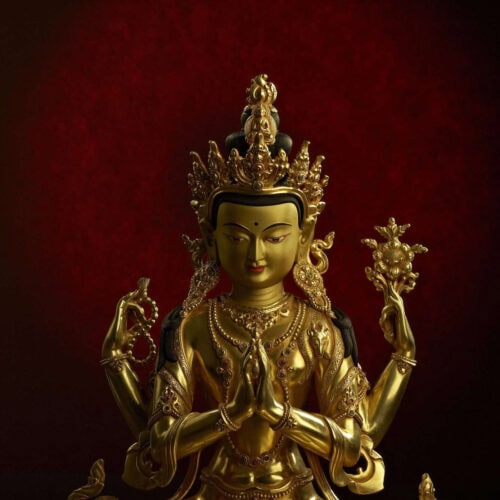
In August 2019, at the Europe Center in Immenstadt, Germany, the sangha welcomed His Holiness the 17th Gyalwa Karmapa Thaye Dorje, his wife Sangyumla, and their son Thugseyla. On the second day of Karmapa’s visit, more than 7,500 students were gathered in the tent at the Europe Center, to receive the empowerment of Loving Eyes (Tib. Chenrezig), the Buddha aspect representing enlightened compassion. Following the empowerment and the blessing, which lasted several hours, Karmapa addressed the crowd, explaining the meaning of the dissolution phase, where the visualized meditation form of Loving Eyes and his pure land are dissolved into emptiness.

The Karmapa on Courage as Compassion Read More »