
In the middle of the first millennium CE, India saw another great flourishing of Buddhist civilization. This time it was the tantric Buddhism of Vajrayana, or Diamond Way, that found itself at the crest of the spiritual wave. As time went on, tantra spread also to Central Asia, China and Japan.
With Vajrayana, the tradition of mahasiddhas developed. They were yogis and yoginis who lived on the fringe of society, in forests, caves and cemeteries. They meditated alone or in small groups and reached unusually high levels of realization of the nature of mind.
The Sanskrit word mahasiddha is composed of two parts. “Maha” means great, and “siddhi” means perfection. A mahasiddha is a person who has practiced the way of tantra, meditated a lot, and, as a result, attained yogic perfections, which are supreme accomplishments.
Yogic Accomplishments
Accomplishments (siddhis in Sanskrit) are the result of tantric meditation. They can be of two kinds: ordinary and supreme.
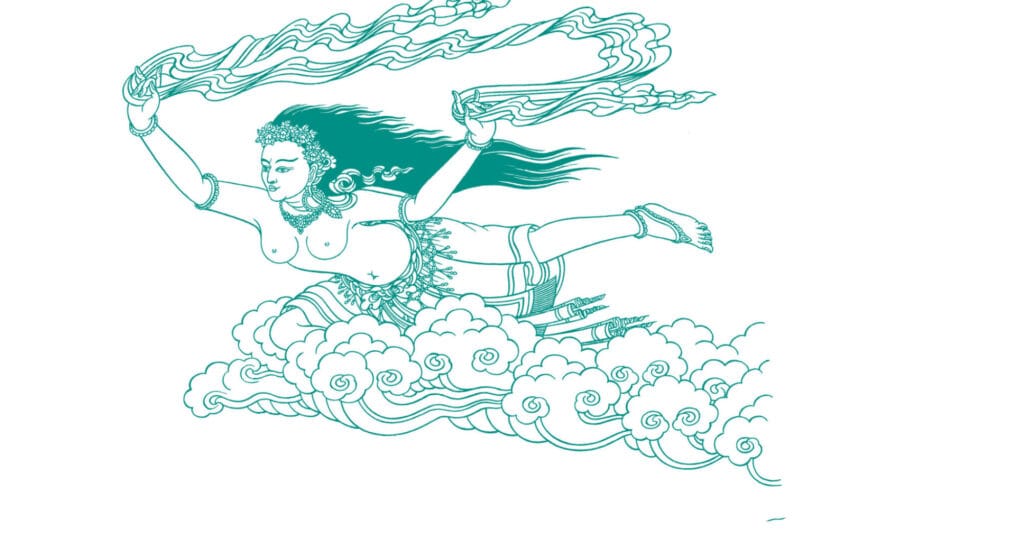
The former includes various kinds of supernatural abilities: clairvoyance, ability to fly, walk through walls, read others’ thoughts, etc. They are called ordinary accomplishments because they don’t lead to enlightenment. Ordinary siddhis inspire people and benefit them, but they also may become an obstacle if one strongly wants to obtain these accomplishments, becomes attached to them, boasts about them and is afraid to lose them.
The second kind of accomplishment—supreme—is not the ability to control laws of nature but is the so-called Mahamudra siddhi. It is the complete realization of the nature of mind. It is the most natural state, when everything is experienced as the union of bliss and space. A yogi who reaches this level is able to open the hearts of people and lead them to the highest realization. To attain the perfection of Mahamudra is the same as reaching enlightenment, which is to become a buddha.

In the eighth to ninth centuries, tantric Buddhism became the most popular and respected spiritual system in India. Mahasiddhas led lifestyles of simplicity and freedom. Rebelling against empty rituals, charlatans, fake philosophizing, the caste system and the supposed ritualistic purity of the Brahmins, the siddhas would break people’s traditional concepts. Free from all limited views and established rules, they enjoyed one another’s company, meditated and gave tantric teachings. Many of them were musicians and poets, and their realization inspired marvelous mystical and spiritual songs, written in colloquial language, using such metaphors as home and family, cattle breeding and handicrafts, as well as love and physical closeness. During the later period of the evolution of tantric Buddhism (ninth to tenth centuries), mahasiddhas showed tolerance and open-mindedness, becoming an integral part of society.
Biographies and manuscripts of eighty-four mahasiddhas have survived until our time. They came from a wide variety of social backgrounds in terms of birth and occupation and represented the full spectrum of human experience. Among them were clergymen-Brahmins, scholars, monks, kings and ministers, merchants and traders, hunters and servants. Outstanding mahasiddhas include a shoemaker, a herder, a thief, a swindler, a gambler, a princess, a housekeeper and a prostitute. Thanks to their good karma, every one of them had a chance to meet a spiritual teacher and received empowerment into the transmission lineage of tantric instructions as part of their tantric meditation practice. Among the most prominent mahasiddhas were the Great Brahman Saraha and the yogi Tilopa. Both left a considerable heritage of philosophical texts and spiritual poetry.
Several female mahasiddhas are also known. There exist accounts of entire tantric communities of female practitioners, which accepted only those yogis who had exceptional merits; those who gained acceptance into such communities received the highest teachings. One of the enlightened women, the yogini named Niguma, had the strongest influence on subsequent development of Buddhism. The Tibetan tradition of Shangpa Kagyu traces its roots back to her.
By the thirteenth century most of what is now India was fully conquered by Islamic invaders, and Buddhism quickly began to disappear from its homeland. In 1203 CE, the last Buddhist university, Vikramashila, was plundered and destroyed by the Muslims. Nearly all of its monks were killed, and the manuscripts were burned and destroyed. The great Nalanda University had been destroyed six years prior to Vikramashila. Many Buddhist teachers and monks fled India. Some crossed the Himalayas into Tibet, while others fled by sea to Southeast Asia and China.
Buddhism comes to Tibet
Buddhist influences began appearing in Tibet in the seventh to eighth centuries.
In the middle of the eighth century, Tibet was ruled by King Trisong Detsen from the famous dynasty of the Dharma Emperors (kings who unified Tibet and brought Buddha’s teachings there).

Before the arrival of Buddhism, Tibetans waged wars quite often, and under conditions of war, the unity of the country is imperative for its survival. However, it was very difficult to unite Tibet, as its vast territory consisted of valleys separated from one another by high mountains that were difficult to cross. Every valley had its own long-held customs, its own understanding of truth, and its own gods of wild nature. Nevertheless, the rulers of this dynasty achieved the impossible: during their rule, Tibet became a single empire. In order to reinforce political unity, the young king decided to introduce a single religion into the country. The nearest neighbors—India and China—had already been Buddhist for a long time, and he was contemplating which form of Buddhism to introduce: Indian or Chinese.
When Trisong Detsen was twenty-six, he had a romantic interlude. One of the influential Tibetan rulers had a daughter who was coming of age, and her name was Yeshe Tsogyal. When she reached marriageable age, young princes from all the neighboring valleys began to propose to her. But she did not want to marry. She had read and heard inspiring stories of young Indian princesses who ran away from their weddings and became well-known yoginis living in the wild, meditating in forests and composing spiritual songs. Yeshe Tsogyal dreamed about having such a free life. But her parents had their own plans for her, and at one point, her father called together all the contenders who wanted to marry her and declared a competition among them. One of the contestants won the competition, and the girl was forced into his caravan and taken to another valley.
During the night, the travelers stopped to rest in a forest. The retinue of the groom celebrated by getting drunk on beer, and in due course, all the guards passed out on the ground. Having noticed that Yeshe Tsogyal immediately ran away. She hid in the mountains, enjoying her freedom. But her escape triggered great turmoil.
Waking up in the morning and realizing that the lady was gone, the retinue suspected that the other candidates for marriage had stolen the bride, and they rushed off to look for the perpetrators. Running into another caravan, the guards immediately started a fight; then, a third group of warriors appeared from nowhere, and soon enough, the king of Tibet understood that because of this young lady, his herculean efforts to unite the country were about to be undone. Upon reflection, he made a Solomon-like decision to marry her himself.
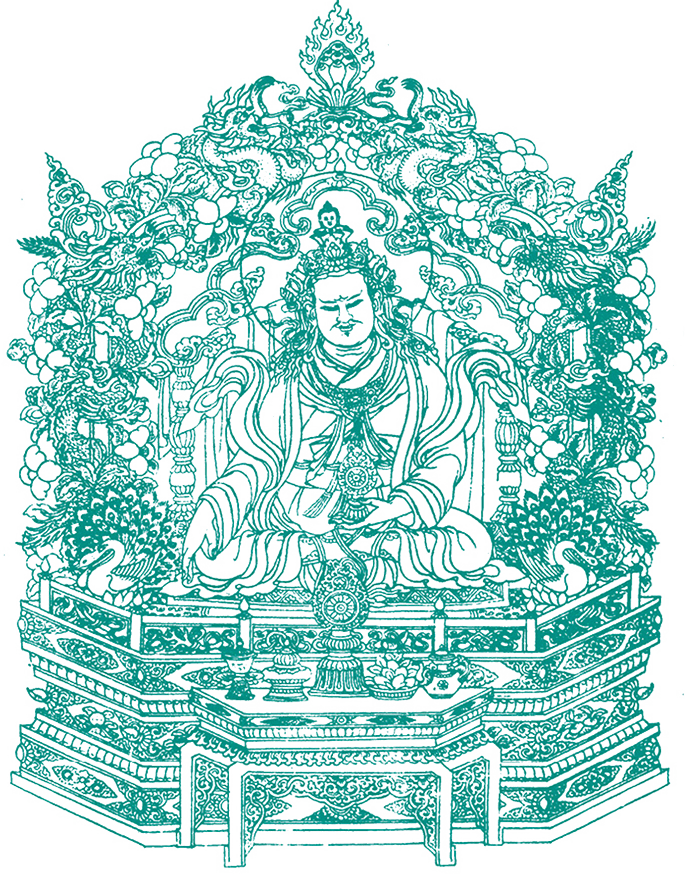
Yeshe became the queen, and soon Trisong Detsen came to appreciate her resolute and independent character. To please his spouse, who was interested in spiritual development, the king began to invite the best spiritual teachers from India. Around year 750 CE, at the king’s request, Padmasambhava—the renowned mystic and meditation master—came to Tibet. Just after he came down the snowy mountain pass, still on his way to Lhasa, the capital of Tibet, Padmasambhava performed several miracles in front of large gatherings of the inhabitants of the Land of Snow. He stopped an avalanche in the middle of its fall, halted a snowstorm with a snap of his fingers, and revived a spring that had dried out long ago, restoring the water supply to a village. In this way, he won total respect of the wild and wayward Tibetans. Rumors spread that the Buddhist master pacified all the local demons.
When Padmasambhava arrived at the royal palace, Trisong Detsen arranged a lavish reception ceremony, and during the very first empowerment, he gratefully offered to Padmasambhava, his new teacher, that which was the dearest to him: his beloved wife Yeshe Tsogyal. Her biggest dream came true: she became a yogini, a recluse, the wife and closest student of a renowned spiritual master. Meditating together with her guru, she also achieved timeless wisdom. Later, when Padmasambhava passed away, Yeshe Tsogyal remained the leader of the Buddhist community as his successor.
These three great characters—Tibetan king Trisong Detsen, yogini Yeshe Tsogyal and master Padmasambhava—are considered the founders of Buddhism in Tibet. The Nyingma transmission lineage originated from them. It was the first of the three major Tibetan schools or traditions, which are called red hat schools because during ceremonies, teachers from these lineages wear ritual spiked hats that are red in color. In these schools the practice of meditation is given the utmost importance, while the yellow hat school, Gelug, gives priority to reading and analysis of philosophical texts.
In the eleventh century, the second wave of Indian Buddhism’s spread to Tibet began. Educated Tibetans enthusiastically crossed the Himalayas, going south to practice with and learn from the Indian masters of tantra, and then brought back the teachings to the Land of Snows. During this period the Sakya school (literally “gray earth”) appeared, founded by the translator Drogmi. Mahasiddha Virupa is considered the Indian founding father of the Sakya school. Today, the leader of this tradition is Sakya Trinzin.
The Kagyü tradition—literally “oral transmission”—appeared during the same period. In India, it was founded by the mahasiddha Tilopa, and it was brought to Tibet by the hero and translator Marpa. He traveled from Tibet to India three times in order to gather tantric teachings. Marpa was a layman; his wife Dagmema also became known as a Buddhist teacher. Marpa’s closest student, Milarepa, became famous as a tantric yogi and a great poet, and Milarepa’s student, Gampopa, introduced monasticism and a system of progressive education. From the twelfth century onwards, the Kagyü tradition has been upheld by highly realized teachers, among whom are the Karmapas, wearers of the Black Crown.
The youngest school of Tibetan Buddhism, Gelug, is the school of the Dalai Lamas. It was founded at the beginning of the fifteenth century by the prominent scholar and monk Tsongkhapa. The Gelug school is also called the yellow hat school, distinguishing it from the three earlier red hat schools. Since the seventeenth century, the Gelug tradition has ruled over Tibet—both before and after the escape from Tibet in 1959.
Among the four main schools, Nyingma offers methods that mainly transform anger and pride. Kagyü works especially with desire and attachment. Gelug helps transform confusion, while Sakya, the school of prominent scholars and philosophers, attracts those in whom these three tendencies are present in equal proportions.
The schools are headed by teachers, also known as lamas, who are understood to consciously take rebirth in this world in order to protect and transmit the Buddha’s teachings. The first of these official tulkus was the Karmapa, the head of the Karma Kagyü school. In the twelfth century, before his death, the 1st Karmapa, Düsum Khyenpa, left instructions for his closest students that explained how to find his next incarnation. The boy found by Düsum Khyenpa’s followers became the 2nd Karmapa. Subsequently, all the other Tibetan schools adopted the tradition of conscious rebirth.
Over its thousand-year history, Tibetan Buddhism has established itself as an entire civilization. It is unique in that it encompasses not only teachings of the Diamond Way vehicle, but also practically all the other teachings of the Buddha.
For over 1,000 years, Buddhist schools have determined the structure of Tibetan society. Their monasteries fulfilled the role of educational, cultural, social, medical and even political centers.
In Tibet, as in India, in addition to the outer aspect of Buddhism, there has always been a deeper, “secret” life that took place far from the monasteries, from society and from politics. Yogis and yoginis lived in caves up in the mountains; they were recluses who fully devoted themselves to the practice of Buddhist tantras. Among them were mystics and poets, philosophers and historians, all of whom left a significant legacy to our world.

Tulku
This is what Tibetans call teachers who take rebirth consciously. A tulku is a person recognized to be the incarnation of one of the buddhas, bodhisattvas or famous lamas. Among them were both men and women. Usually, Tibetan teachers find and recognize tulkus when they are still small children. There also exists a procedure for verifying the young tulkus. They are usually presented with an array of items, from among which they need to recognize those which belonged to them in their last life.
Most tulkus become monks, but there are also some lay tulkus who live with their families. Usually, they dedicate their lives to giving teachings and caring for monasteries and spiritual centers. The best-known tulkus are the Dalai Lamas and the Karmapas.


