
It can seem odd that no matter how rich and engrossing an adventure may be as it happens, we nevertheless have to wait until later for memory, reason, other reports, and perhaps hidden purposes to come together in constructing a picture that we think shows us what really happened. And even then our understanding may continue to evolve. Here I offer a new awareness, beyond the reflections published earlier1. But first a bit on the beginning of my pedagogical adventure in India.
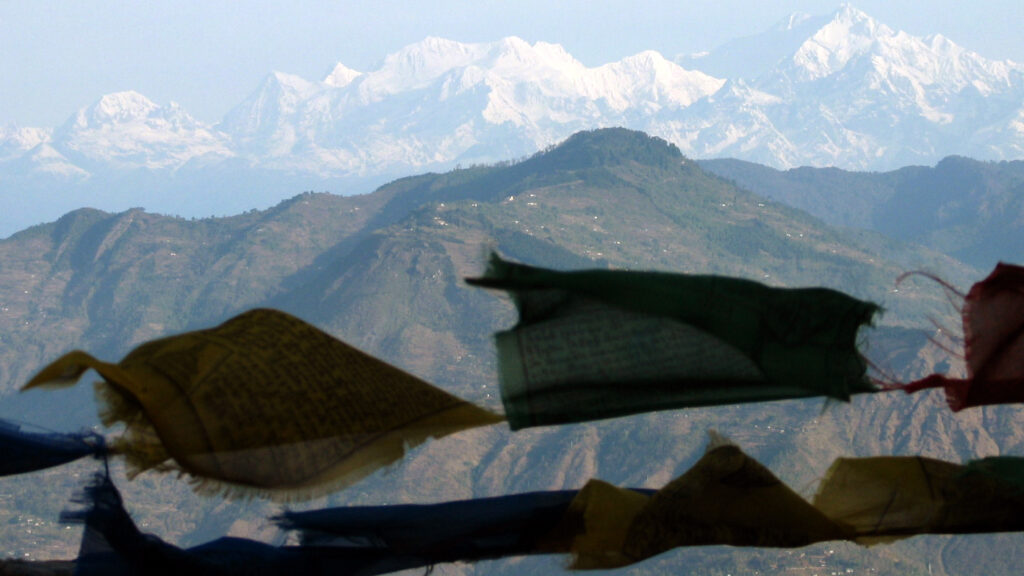
Kalimpong is a school and college town in West Bengal, India. It sits high on a ridge in the foothills of the Himalayas, and among the schools there is the Institute for Advanced Buddhist Studies. I went there at the request of Shamar Rinpoche to teach Western philosophy to the monks, but most especially to H.H. the 17th Karmapa Trinley Thaye Dorje the spiritual head of the Karma Kagyu school of Tibetan Buddhism. He was twenty-one years old at the time. Shamar Rinpoche is second to the Karmapa in the school hierarchy, and in addition to managing some six hundred Buddhist centers all over the world he has also been in charge of the Karmapa’s education. Since the Karmapa will have more and more dealings with people interested in Buddhism in the West, Shamar Rinpoche wanted him, and some other monks, to be familiar with Western philosophy. He asked me to be the teacher and to publish my story of the encounter. Since I had just retired from teaching philosophy at Washington and Lee University for forty-six years the venture was most attractive. So what happened during my mission?
There was no intention of trying to divert or convert the monks from their Buddhist studies. Rather I hoped to let them see Buddhism all the more clearly as they experienced a contrasting Western mode of thought. Much as the color red is more vivid when seen next to yellow, so I hoped the monks could see their own Buddhist thought enhanced as it stood in contrast with Western thought. Needless to say, it worked the other way as well. I came to see more clearly what I already knew; Western philosophy aims toward theoretical understanding and it thrives on questions. The more incisive, perplexing, and challenging the questions are, the better. Typically, professors judge students on their responses to perplexing questions and give the highest regard to a student who brings forth a new question so incisive the teacher is stunned and has to move beyond what he thought he had clear. I never questioned this role of inquiry until I saw it contrasted so sharply with Buddhist thought and pedagogy. The Buddha himself urged his devotees to test his teachings, but the purpose and goal of that testing is fundamentally different from our Western way, and as a result the monks were most reluctant to ask questions. I believe we can see why as we make the contrast more explicit.
Socratic questioning entices us to seek an intellectual clarity not yet attained, a more conceptually lucid and more inclusive understanding, all the while preparing us to see that whatever we discover will in turn be the occasion for yet more questions. Philosophy and science are on-going intellectual endeavors sustained and enlivened by incisive questioning.
This is not the case in Buddhism. Try as I might, I could not get the monks to ask questions in class, and even outside of class those who had the courage to ask a question would not pursue the issue further in reply to my response. Once the teacher had spoken, that was that, so I needed to see more clearly why the monks held back.
Happily, after class in my daily one-on-one conference with the Karmapa, he did have sharp and insightful questions, the kind well worth spending our allotted hour exploring. But first he always asked, “May I ask a question?” Once when he asked what Socrates meant by saying philosophers “practice dying” we had a notably rewarding discussion. Socrates and the Buddha both see philosophy taking us from an embodied individual entangled in worldly affairs toward ultimate non-temporal truth. Usually on these occasions, however, I was the one asking questions. For I had said my piece in class and was happy to reverse roles and question this outstandingly bright young Buddhist. In his replies he frequently pointed out that he was still just a student, but for all his modesty I could see a young man of remarkable insight and acuity. The ultimate truth of what both Socrates and the Buddha aspire to is radically different in each case, and each leads to a different pedagogy. First, we’ll explore the Western way.
As is common for in an introductory class I started with Plato’s Meno. Plato sets that dialogue in the trying times after Athens was defeated by Sparta, ending the long Peloponnesian War. He shows Meno, a rich provincial slave owner, as he swaggers up to Socrates and bluntly asks ‘Can virtue be taught?’ Socrates says he cannot answer because he does not know what virtue is, and asks Meno to tell him. Socrates easily squashes Meno’s facile replies and leads him into perplexity, the promising position of realizing you don’t know but would like to know. But rather than continue with an honest inquiry and a reflection on that, Meno changes the subject. Plato hoped that by showing Meno’s failure, readers of his dialogue would come to see exactly what Meno missed.
Could I be more successful with the monks than Socrates was with Meno? A simple mathematical puzzle is at the center of Socrates’ endeavor, and I tried a similar tactic with the monks only to learn that their training in mathematics did not go beyond the third grade—a bit of arithmetic but no geometry, no notion of a deductive proof. The Karmapa was the exception for he instantly saw the point of the mathematical examples. His early education went far beyond what the other monks undertook. I thought at the time that if I could do it over again I would try my best to take them step by step through the proof of the Pythagorean theorem in Euclid, perhaps skillfully enough to elicit an Ah ha! from a monk when the light suddenly came through and all was clear. As it was, I had to accept that so far I had not done very well with Socrates and Plato. Perhaps seeing the larger Platonic picture would help.
There was a stroke of luck on the very day I hoped to make clear what is so typical in Western philosophy by outlining Plato’s Divided Line simile in The Republic. At breakfast a friend asked Shamar Rinpoche about the meanings of two words for wisdom that were not clear to him, sherab and yeshi. I had not encountered these words in my reading, nor have I come upon them in subsequent reading. But they struck me as useful. Shamar Rinpoche said that sherab is being wise about this or that, and though such a person could be greatly knowledgeable and impressive, he was, in the end, superficial. One may go beyond sherab to yeshi, to ultimate wisdom, enlightenment, and from there the superficiality of sherab is exposed. Later in our conference the Karmapa used the example of a person looking through a microscope. He could come to know a great deal about a narrow field and attain sherab, but such clarity on things and concepts of this world falls short of yeshi, ultimate truth. It is tempting, but a mistake, to think of sherab as having a clarity within a narrow perspective, as with an expert with the microscope, while with yeshi one has the broadest perspective; but no, yeshi is not perspectival at all; there is no subject with a point of view and no object no matter how broad, in short openness devoid of a point of view.
The advance from sherab to yeshi I hoped could be seen as analogous to the advance from theories (first assumptions and deductions from them) at the third stage of knowledge on Plato’s Divided Line to what he calls dialectic at the fourth and top level. We can recall the proofs we followed or worked out in Euclidean geometry and the impressive theories so carefully worked out in science. Philosophy in its various ways and science in its more strict way can explain a great deal about this world and achieve sherab. But we are probably aware also that the scientists themselves become most excited and motivated when a well-established theory is nevertheless called into question and there is a need for an advance to a more apt and inclusive theory. There lies the challenge and there is the excitement in the long and varied history of Western thought. This upward move toward ultimate clarity Plato calls dialectic, and puts it at the fourth stage on his Divided Line, ongoing intellectual inquiry.
It is hard to resist an image of a grand pyramid of knowledge reaching toward a pinnacle, a first principle opening into a Theory of Everything, as it is spoken of in science today. But such a vision and enterprise is mostly seen as old-fashioned in contemporary philosophy. Deflating analysis, dissolving deconstruction, thinking beyond philosophizing, and other current modes are more modest with no intention to join in pyramid building. Incisive questioning, however, is still the life of Western philosophy.
When I put sherab and yeshi on the whiteboard the monks brightened up, for they were on familiar ground, and I was confident that they at least saw the analogy with Plato’s move from theories to open inquiry, dialectic. I hoped it also became clear that it is by thoughtful critical questioning that one can make this move. For their part the Buddhist could simply say it is by long and disciplined meditation that one can rise from sherab to yeshi, but what that means could not be conveyed easily. I thought it understandable that the monks remained silent, but I did wish they would respond with a few incisive questions. So far I could not claim pedagogical success. Let us then look at Buddhist pedagogy to fill out the contrast.
Western philosophers and others with philosophical interests often express impatience with Buddhist pedagogy, for typically it consists of lists—four of these, eleven of those, eight of another, etc. We in contrast want to see the logical coherence among the numbered topics showing how they come together in an explanation, or a theory, or a philosophical position. But no, in Buddhism the teacher sits paging through a text commenting on the various topics in numerical order, and the students sit quietly absorbing and committing to memory the words of the teacher. At the end the teacher may ask for questions, and if a student does ask a question the teacher gives the answer, and that is that. It may be helpful to see how running through numbered topics in a lesson is indeed appropriate by looking at a more curious Buddhist practice.
Numbering and listing topics rather than showing the logical coherence that we prefer might suggest that Buddhist philosophers are slack in logic. Not at all! Indeed, their logic manuals would impress even Aristotle, and their agility in debate and doctrinal dispute would impress a medieval schoolman or current logician, for they can detect an inconsistency or unfounded move instantly—usually accompanied by the hand gesture of the victor. But to what end? Here is the important part and to the Western mind the most curious part. I hope I have this right: the intent is not to bring to fruition a logically coherent position, an explanation, or a theory that can be defended, but rather to show by clever logical moves how all such theorizing finally removes itself. As it should—if ultimate truth is the goal. Entanglement in debate and theorizing, engrossing and stimulating and brilliant as it may be, holds us in sherab and is thereby a distraction from the goal, ultimate wisdom. The purpose of logic is to remove that distraction and itself. In sharpest contrast, we think of logic as the intellectual scaffolding of anything that makes sense, and it is that without which no claim or explanation can stand. But, a Buddhist would see any logical construction as a stumbling block on the way to ultimate wisdom, yeshi. Logic is not for building but for clearing the way. Perhaps we can see now why Buddhist philosophers do not present explanations or theories relying on logic to make them defensible and sound; but why instead do they typically present so many lists of types and topics?
A genuine Buddhist teacher is a bodhisattva, one who is dedicated to the attainment of enlightenment but who steps back into samsara, the cycle of rebirth, from his or her own release in nirvana in order to help others who are mired in worldly concerns and sufferings to move toward freedom. He knows the ten stages on the way to full buddhahood and can list them. Similarly a person well traveled can list all the towns a country friend will see on his way to the big city, but then for the country friend to ask the knowledgeable one to show the logical relations among the towns listed would be foolish. No, just go and you will see. Similarly to ask the teacher to show how the stages on the way to enlightenment are interrelated in a logically coherent theory or explanation would be foolish. Worse, it would offer a distraction from the truth. The teacher can offer a report on the stages he knows because he has been there, and he can offer a prediction that another who moves along the way will pass through the same stages. The teacher does not theorize, he lists the stages meditation will disclose. The appeal is to memory and to sustained meditative practice.
Sometimes my tough-minded colleagues in psychology and philosophy who have a thinly veiled disdain for all things Eastern prompt me to remind them of a story about Galileo. When he reported seeing nine moons around Jupiter through his new telescope, the learned professors at the university dismissed the claim out of hand. When Galileo invited them to come take a look for themselves, they did not come, for they knew in advance there was nothing to see. When I suggested that my tough-minded colleagues try meditation to see for themselves they were not interested because they knew in advance there was nothing to see. Perhaps they were right but did not know it, for there is nothing to see.
The reader can likely imagine what happened in my Philosophy 101 in India as we moved on to Descartes (the monks had as much fun with the cogito as students here), Hume (they easily saw the similarity), Kant (the Karmapa was most appreciative, for he had wondered how science is possible when what we face is illusion), a bit of Hegel and some more recent philosophers. What I hoped to convey was the ongoing nature of Western philosophy and science enlivened and sustained by carefully focused questioning. What is constant is ongoing critique and innovation. Alfred North Whitehead said all Western philosophy is a series of footnotes to Plato, but insofar as that may be true it means that questioning fundamental assumptions is the life of philosophy and science. In this sense Whitehead may be right, not least when what is questioned is Platonism. Early on in my time with the monks I mentioned that Buddhist thought must surely have an analogous history, but that elicited instant and firm denial. No, Buddhism was complete with the Buddha’s teaching, and what may seem like innovations are aspects of the teaching that had not yet been brought out. Buddhist philosophers through the years make more explicit some aspects of what is already there. To be sure, there are controversies among the various schools, but there is no Western style questioning of fundamental assumptions. In Buddhism there are none. There is ultimate truth beyond any subject and any objects, be they things or concepts, and beyond questions that would tie us to conceptual explanations. Buddhism by its refined pedagogy still thrives as it has through the centuries. And the contrast of East and West continues. I resist the obvious quotation.
As our time together was coming to an end I asked the Karmapa if he had any questions he would like to explore. He smiled politely and said no. It was a bit of a jolt, but a moment’s thought showed that he gave the correct answer, for philosophical questioning is not the Buddhist way and can be a distraction. So, was it the case that the student gave the correct answer but the teacher failed? Perhaps not, for my intent was not to divert the monks to the Western way of thought that is always ready with questions, but to show the contrast that could sharpen both Eastern and Western thought. I can attest that it did sharpen my own regard of Western philosophy, but did it sharpen the Buddhists’ regard of their own way of thought? Questions and curiosities still puzzle me long after my stay in Kalimpong. For example, amazingly, word reached me that the monks think I am a saint! Another word came back that I am one hundred years old. The second is amusingly way off the mark, but the first is as absurd as a round square. So what happened in Kalimpong? That is still a good question.
Photo credit: Ania Cieplinska
- The Buddha meets Socrates, A Philosophical Journal , Xlibris 2008 ↩︎


