

You have all gathered here in Karma Guen to hear some dharma teachings; I appreciate this very much. Most or all of you are doing Buddhist practices: you contemplate the four thoughts1 in the common preliminaries, and you are also doing the four special preliminary practices, ngöndro. You are very lucky because Lama Ole so skillfully introduces you to Buddhism in a systematic way; first introducing you to the four thoughts and to ngöndro, then going on with the guru yoga meditation on the 8th Karmapa. It is so important to have a solid foundation for your Buddhist practice. This foundation starts with having trust and devotion to the buddhas and to the dharma, developing compassion for all sentient beings. If you do that, then you are authentically Buddhist.

The buddha dharma is vast. There are many different practices that can be done in the dharma as you proceed toward enlightenment. One important aspect is the relationship between the teacher and the student. The student should have trust and devotion to his lama, and the lama should treat his students with kindness and love, and he should also be able to understand their life situations. In the case of Lama Ole, you have someone with whom you can really stay connected through all his centers. He really knows you and your life situations very well, so it is very important for you to keep this connection to him.
I am more or less the same as you, a practitioner of the dharma, and I have been asked to share some knowledge with you. There are general things which might be helpful, such as the importance of having trust and devotion to one’s lama and having compassion for all sentient beings. One special aspect of the Karma Kagyu lineage is that we work with what is called blessing. Many years ago, H.H. the 16th Karmapa, Rangjung Rigpe Dorje, blessed his main students here in the West, Lama Ole and Hannah, and put a lot of trust in them, and through that, he really established the root of Buddhist development in the West. All the development that we see now is growing from the blessing of the 16th Karmapa and the Karma Kagyu lineage. Therefore, it is my wish to help this development in any way that I can. I have a strong connection to Lama Ole and to Hannah especially; she and I did a lot of things together, and I had a very close bond with Shamar Rinpoche. Because of these good connections, we can work very well together—it is like a network of vajra brothers and sisters who work efficiently together. Lama Ole really has a lot of experience in working with people here in the West, so I am happy to support this.
Many years ago, Lopön Tsechu Rinpoche traveled to all of the centers founded by Lama Ole and Hannah, and blessed everybody with his dharma teachings. Later, Sherab Gyaltsen Rinpoche came and also gave many teachings. You have received so many teachings and so many empowerments, so now it is important to work with what you have learned and to apply it in your practice.
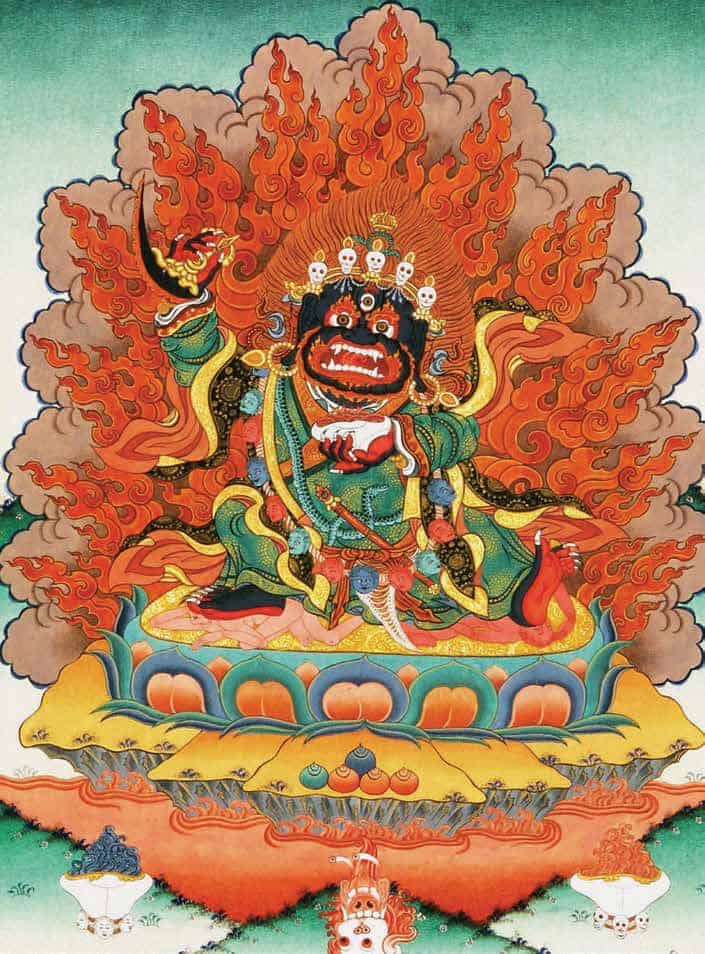
In the Karma Kagyu tradition, the main yidam is Vajrayogini (Sanskrit), the main guru yoga is on the 8th Karmapa Mikyo Dorje, and the main protector is Mahakala (Skt.), Black Coat. But actually, there are many yidams and protectors which are practiced in the Karma Kagyu tradition. Another one of the main yidams is Korlo Demchog (Tibetan), Highest Bliss. Then there are frequently practiced yidams such as Gyalwa Gyamtso (Tib.), a red Chenrezig in union, The Ocean of Victorious Ones, in a form with nine or with five aspects. Hevajra (Skt.), Kye Dorje (Tib.) is also frequently practiced, as is Kalachakra (Skt.), Dus Khor (Tib.), Wheel of Time, and there is also Korwa Dongdruk (Tib.), Loving Eyes which Shakes the Depths of Samsara—a red standing form of Chenrezig alone.
Regarding protectors, it is said that the main protector is Mahakala, but there are many others which are constantly practiced in rituals and pujas, such as Mahakala forms with six, four and two arms. There is a whole retinue around Mahakala which is mentioned in the invocation we do regularly, such as Namtose (Tib.), a buddha of wealth and the guardian king of the north, Dorje Legpa (Tib.) and Karnag Dorje (Tib.), the Vajra King of the Dark Citadel, who is a local protector of Tsurphu Monastery, the historic seat of the Karmapas in central Tibet—so it is really good to know them because we are invoking them every day in the “om madak” practice we use.
All of these aspects are mentioned in our short Mahakala invocation2. Not only do we name them all, but all aspects of practice, such as offerings, visualization, and wishes, are included. The “hung dza” invocation, which is sung at the end, was composed by the 16th Karmapa, so it is very important for us. The protector practices performed in big monastic institutions like in Rumtek are in the form of long pujas. Sometimes, in Rumtek, the pujas were performed for up to seven days. We continued these for seven days, and then we had lama dances. That is a very tough meditation practice.
THE STUDENT SHOULD HAVE TRUST AND DEVOTION TO HIS LAMA, AND THE LAMA SHOULD TREAT HIS STUDENTS WITH KINDNESS AND LOVE, AND HE SHOULD ALSO BE ABLE TO UNDERSTAND THEIR LIFE SITUATIONS.
There are so many forms of this practice—of short, middle and extended length. In normal life you would never have time to do all this, so the way Lama Ole has introduced this to you is very wise, namely as this short invocation, which contains all aspects and all parts of practice.
When I was appointed as a Vajra Master in Rumtek, it became one of my duties to do the special practices on the protectors. I did many retreats on Mahakala, once for six months. After that, I did short Mahakala retreats once a month over the course of three years. If you tried to meditate in the complicated way done in such practices, you would probably not be able to do it at first. So it is better to practice the short invocation every day. In the invocation text, it says the root lama is the embodiment of all jewels, of all yidams, and of all protectors—all of them are included. So, it is very short and very easy. Lama Ole has given you a very short but powerful and effective practice. I enjoy doing this invocation with you here every day.
The practice includes all aspects—lama, yidam and protector. These Three Roots are similar to the Three Jewels: Buddha, dharma and sangha. In the same way that Buddha is the source of the dharma and the sangha, the lama is the source of the yidams and protectors. The yidams and protectors simply represent the path toward enlightenment. If we proceed on this path properly, we can reach enlightenment, the state of Vajradhara (Skt.), Diamond Holder.
It is important to do our practice regularly and uninterruptedly. Whatever you do, whether the practice of Chenrezig (Tib.), Loving Eyes, reciting the mantra OM MANI PEME HUNG, or Tara (Skt.), Liberatrice, reciting OM TARA TUTARRE TURE SOHA, make it short but clear and clean, really concentrate on it. It may look insignificant, but if you do it regularly, it will bring you really good results.

Take the Dorje Sempa (Tib.), Diamond Mind practice, for instance. Sometimes people think it is insignificant, just a practice you do to reach a “real practice” such as a yidam. Some people think that, “Oh, I will only really get the blessing with the yidam, so now I just have to go through the preparatory stages.” We should not underestimate the Diamond Mind practice. It purifies all our obscurations and our negativity. Once you have completed the practice, then if you do other practices or make wishes—if you have fully purified your obscurations—then your wishes are immediately fulfilled. Whatever practice you do, you immediately get results if you have purified yourself beforehand.
The point is to have a pure vessel. A good example is if you want to cook food and you have rice and butter and all the ingredients, but you don’t have the pot yet—what will you do, cook it in your hands? It is very important to have a good clean pot to cook in. It is the same with dharma practice. That is called having a pure vessel; the clean pot stands for this. Being a pure vessel means having the devotion and pure trust in the Buddha and the teachings and compassion for all beings. Without these, you can practice whatever you want, but you will obtain no results. That is why it is important to purify yourself with Diamond Mind, with the one-hundred-syllable mantra, and with the nectar which you visualize flowing into your body through the top of your head. If you have obstacles, you may also practice Tara and you should do the Mahakala invocation every day.
It is also important to practice “calm abiding,” or shinay (Tib.) meditation, to pacify one’s own mind because the mind is the source, the root of everything. The problem is that we cannot master it, and we cannot control it. It does whatever it wants. At first, it is wild and uncontrolled, but then slowly, by pacifying it, you can really get it under control. This makes your vessel pure—by pacifying mind, you become the pure vessel for the dharma and can really make use of this precious human life.
THE YIDAMS AND PROTECTORS SIMPLY REPRESENT THE PATH
DIAMOND HOLDER
TOWARD ENLIGHTENMENT. IF WE PROCEED ON THIS PATH
PROPERLY WE CAN REACH ENLIGHTENMENT, THE STATE OF VAJRADHARA (SKT.)
The stability of mind that you obtain from shinay helps you to gain stability with the visualizations in the building-up phase of your meditation. Once you obtain the stability in the building-up phase—meaning that you can really identify yourself with the particular buddha form—then it allows the blessing of the body, speech and mind of the buddha form to enter you; once this happens, then you are getting close to understanding the meaning of the Mahamudra (Skt.), the Great Seal, or Maha Ati (Skt.), the Great Perfection. So, in order to approach such things as Mahamudra or Maha Ati, you really have to pass through all the previous stages.
Because practice means trying to understand the nature of your mind, if you practice properly then you can receive the blessing. If you can then receive teachings from an enlightened master such as Karmapa, then you can really digest his words and take them as secret instructions and can really understand what he means. So I really hope that you will all practice well.
A final thing I want to mention is the importance when you practice meditation of looking into yourself and not focusing on others; analyze what happens within yourself. It is important to offer whatever happens to you to your root lama and to receive instructions from him regarding what to do and to follow these instructions. That is actually everything I have to say.
- The four thoughts which turn the mind towards enlightenment: the precious human birth, the impermanence of all things, the law of cause and effect and that enlightenment is greater than anything we know today. For details, see Lama Ole Nydahl, The Way Things Are: A Living Approach to Buddhism for Today’s World. ↩︎
- This refers to the short Mahakala invocation used after the 16th Karmapa meditation practiced in all Diamond Way Buddhist centers worldwide. ↩︎


