

In the Karmapa meditation, the first thing is just to bring the mind into a calm state and learn to focus. We call this shinay or calm abiding. Then you start with the frame, which is important because we are all Buddhists. We always take refuge first, and we develop our enlightened mind, and then, when we start to meditate and imagine that the Karmapa manifests in front of us, we go through the different parts and we try as well as we can to imagine him. That is where we actually focus our mind, that’s where we train our mind to stay at one point, and not to be distracted. On top of that, you are given an option because what you are focusing on is either one image or different things in that image. This helps that training because there you can do this interruption that I was talking about—you can try to focus, with intense concentration, and then for a moment you just relax, and then you focus on something else. Or you try different ways of concentrating. You can do that in one meditation where you sort of shift from one focus to the next, which makes it easier to keep your concentration in the right way.
Also, when we use the mantra, it is another way of training one’s mindfulness. In the Karmapa meditation, you can focus on the sound, you can focus on the Karmapa, you can have different objects of your concentration. And then you stay with it for a short or for a long time, or you interrupt it and do that over a longer time. And here again you actually train that concentration.
When you focus on the different lights, it’s a combination of focusing the mind, and at the same time you also get the blessing. Blessing is just a word, but what it means is that we open up to the teacher. And when we open up to him, then his blessing, you can say, can be felt by us and it’s felt in the way that this is what makes some change in our state of mind. The teachers, the buddhas, have realized the nature of mind—by opening up to them, this shortcut happens that can help us to realize our mind. His mind, our mind, is the same. There is no difference, but we haven’t experienced this in our mind. So, this exchange is a way or a help to quickly experience what the mind is, through this connection. And that’s what we do here. We focus and then we have the support, we have the help of the blessing. And when we focus on the three lights at one time, when they come simultaneously, this is where there is a possibility to also experience what we call Mahamudra. Because here is this transmission, that when all three are together, it is the fourth empowerment actually, which is the word empowerment, which is the nature of the mind. So, if we are good at concentrating first, then, at this moment, we can have some short moments of clarity in our mind.
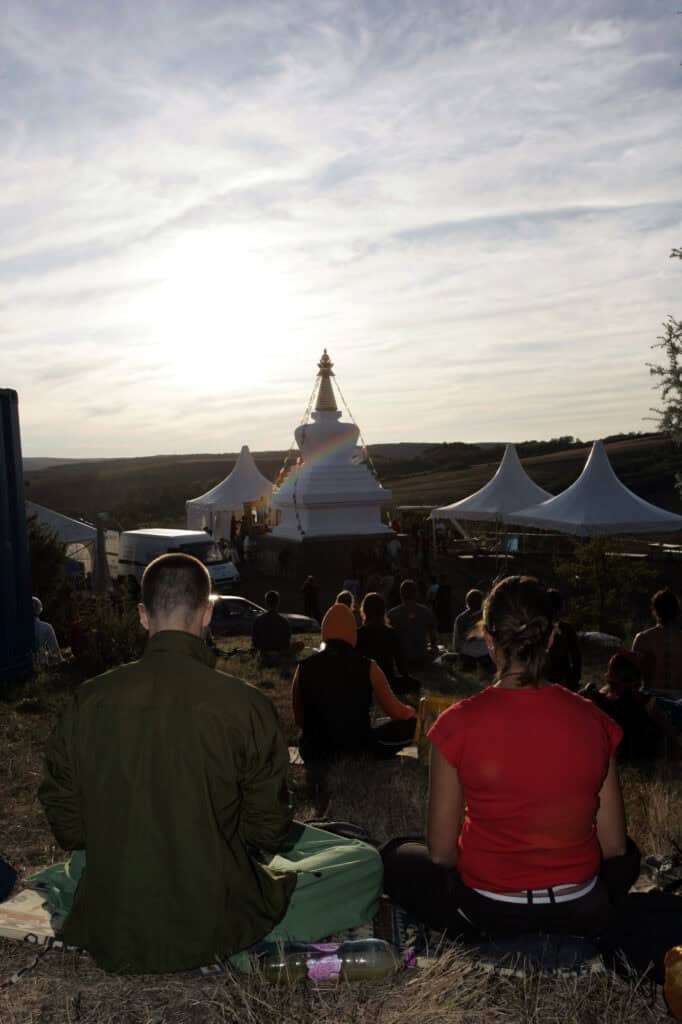
So when we come to the different lights, that is where we go into the vipashyana, the lhaktong or insight. It’s not something which can be explained theoretically that well, rather it’s better to be instructed in it when one is applying it to one’s meditation. But we always combine the two—shinay and lhaktong—even before we are kind of ready to really experience them ourselves.
In general, this insight meditation is what makes Buddhism special because it has to do with our understanding of the ultimate truth, of the nature of things, of emptiness as we call it. Everything related to that is actually in that category of insight. And that means every meditation which has that understanding in it is actually insight meditation.
In other Buddhist schools, like in the Hinayana and also in the Great Vehicle, in the sutra way, one gets to that meditation more through analysis. One analyzes whether one’s ego, one’s person, has real existence or not, and through analyzing, one gets to the conclusion that there is no truly existent, independent self or I. And then when one gets that understanding, one meditates on it. One stays in that understanding. Also, in the sutra way, one can analyze the nature of things, how nothing exists on its own, that everything is interdependent, etc., and one logically gets to the conclusion that there is nothing which has self-existence. This understanding one then meditates on, and that is then the insight.
Mahamudra is also insight meditation. And here there’s also the analytical way, the analytical approach. And then there’s what is called the direct approach. Analytical is again that you try to analyze, actually you look for your mind in that case. In all kinds of ways you check it out, and you find out that you cannot find it. And this is then something that you yourself understand by going through the different kinds of analyses. And then you stay in that meditation where you understand it, and that is actually then the insight meditation.
And then you have the direct approach, that is, for instance, when we have the dissolving phase. You focus on something—this is the skillful means of some of the tantras—where you build up a buddha image, you identify with this buddha image, and then you dissolve it. And when you have dissolved it, then at that point, you also have a shortcut to that insight meditation because through the identification of that, you can get to the nature of your mind. And there you don’t do anything. There’s no reference in your mind; you’re not meditating on anything, you’re just fully aware in that state, there’s no distraction whatsoever. But you’re also not trying to not be distracted, you just are not distracted.
That’s how you can understand why we need the first part, why we need the calm abiding, why we need the shinay. Because, if we haven’t learned first how to not be distracted, then it’s impossible to do these insight meditations, our mind is simply not able yet, it’s too dispersed, it can’t stay with either the analytical way or the direct way.
But everything we do, all the meditations we do, they aim at that insight. That is what Mahamudra is; it is to understand the nature of the mind. And all those things we practice, they are the path of the Mahamudra, they bring us to that.
In every meditation we do, we are so lucky, we are so fortunate that the methods we use, they allow us to train our mind in a way which leads exactly to that. The method leads us, it teaches us, it trains our mind to be focused—and it even trains our mind to get some taste of insight before we even have it. And then slowly, slowly, slowly—the better we can focus, the more we will then get of the real lhaktong. It will come as the capacity of the focusing increases, then also the capacity of the other will come. So in that way it’s a very round thing and it’s a complete thing, it’s a total tool for enlightenment. That’s what we all go for.
And it’s not to be egotistical and not be caught that we just want it for ourselves. We start with the refuge and we start with really not just lip-service, but really wanting to get enlightened for the sake of others. That we train this Bodhisattva attitude and also then in post-meditation, we train it in our actions.
So we have it and we just need to do it. That’s where meditation means to get familiar with it, to get used to it. And that’s why it needs a lot of repetition. A lot, a lot, a lot. Actually from the first meditation we do and onwards, we don’t need to doubt that if we do it, we are on the right way. And just to continue and do our best all the time going up or down, just continue, sometimes a little bit, sometimes a lot, but we can be sure that is the right way. Every single practice we do is actually complete in itself. Even if we were to do prostrations for the rest of our life, that would also be enough. It would also bring us through. Whatever practice is there, it has it all, if we just do it and do it enough and go into it, then it will get different depths. Whatever practice we do, if we stay with one of course, it will get to different levels as we go on. Just that you understand that it’s actually there in all of it.
Then it is skillful, it is clever, to use them step-by-step because these methods, they do work on our mind in a useful way, which makes it easier for us. That’s why we do the prostrations first, then we purify, then we build up positive karma, and then you can say the basis of the Mahamudra is actually the Guru Yoga.
So what happens during the meditation, the different meditation experiences and how do we relate to them? There’s one thing which is always good to repeat, that we easily forget. And that is that we understand that the meditation should serve the purpose of changing our habits.
That’s really what we want to do, to change our mind habits, to change our habits of clinging to ourselves, to our ego, clinging to reality, clinging to our disturbing emotions and acting from them. That’s how the meditation should work, that’s why we do the whole thing. That’s why we meditate. And that means that in the meditation itself, we don’t want to continue our habits. That’s the reason that we have to relate in a proper way to our meditation experiences. Because if we don’t do that, then we just continue our mental habits in the meditation.
We like the nice meditations, we want to keep them. We don’t like when they are not nice. We are fascinated by visions, by buddhas, etc. All these things that we normally have in life, that is our habit to react in that way. And in the meditation, we must make sure that we don’t just go into that, but cut it. Don’t follow these habits, and then the changes happen. And these changes, they work in the way that every time even a tiny mental habit has been cut, has been changed, it gives so much space and freedom in the mind. Because all these habits—that is what tightens us down. That’s how we make our own small universe, it’s our habit to only see things from our own perspective. And we claim it, this is our reality. And it is the right reality and if somebody has another reality, he’s wrong or he’s bad. And we’re often not really even willing to discuss it with him. That’s how all the problems come because we are so caught up in our own worlds. And to get out of that, we just have to break all these habits. And the more we do it the more we can see. And the more we are not stuck by our own ideas and our own judgments of others, or likes and dislikes and all of that, it gives a totally different tolerance also of other beings. Then we can do more for everybody because we don’t always react so subjectively to what happens. And that’s actually the idea with everything. I mean, that’s why we practice. That’s why we do what we do. We want to get broader minds; we want to be able to do more for others. Of course, we also want to solve our own problems—but not only—and all that happens by changing these mind habits.
In the beginning when we start to practice, I think most of us had that experience that we were very enthusiastic about everything, and we were very open to everything. And we also really did our best. And then it can happen that it becomes more habitual. And there are so many distractions in the world, in our life, that it can be difficult to always keep the motivation and to remember what we are doing and why we’re doing it. And it becomes something that we just do every day and we try to do it. And then sometimes we cannot do it because we’re too busy. But then, to keep it fresh, to really keep appreciating the huge chance we have that we can do it, then it’s good to remind ourselves of these things. And that really goes for everybody, I mean all practitioners, we are all in the same boat, we are on the path and there’s a big distraction being in this world. And we all have a lot of habits and it is a very slow thing. First one thinks everything has changed, and then suddenly something happens, and suddenly one finds oneself doing exactly the same as one has done before. Okay, it can be disappointing, but then at least normally one notices it first, but one can’t change it. And that’s already something, and then next time it happens, it will take longer time before one reacts in the same way. And next time again it will take even longer time so the progress is there, it is just not all the time that one can see it. Sometimes if you look back, you will notice, you will say, “Actually, before I would have done that and now I can deal with it better.” So that’s how one can see sometimes in the moment. It’s not always so easy.
If something’s very strong, it can be love affairs or death or war or whatever, something really strong in life can happen. And then to keep the practice, there we have the tools all the time; then to remember to appreciate it and to use it as well as we can and also not to get into this kind of guilt thing, don’t start to get a bad conscience. That’s not the idea, because it’s only you, you own it for yourself, there’s nobody else out there who is going to die with you, or who is in your mind when you die. So it’s yourself you’re talking to, nobody else. So you can be guilty with yourself, but anyway that’s also one way of motivating oneself. Just to do one’s best and be happy with that. And remember to do one’s best, and then enjoy it and be happy about it.
What to focus on when we say the mantra?
Well, when you say the mantra, you focus on the mantra. You can focus on the sound of the mantra, you can also focus on the Karmapa, you can also focus on the lights, it is just a different meditation when you focus on the lights together at the same time. This is in itself part of the meditation, where you get the blessing to meditate on your mind. So when you do the mantra recitation, your focus actually is the mantra. In this meditation, it is another way of shinay where the mantra is the focus and where you keep your mind on that and bring the mind back to that when it gets distracted. So that’s another way of training your concentration.
First, you have the light for the body, then the light for the speech, and then the light for the mind, and then you have all three together. In fact, they correspond to the four stages of empowerment, which is also in the Guru Yoga of the preliminaries. First, you have the vase empowerment, you have the secret empowerment, you have the knowledge-wisdom empowerment, and then you have the word empowerment. And they actually correspond to these blessings of the body, speech and mind and all three together. It is a very complete meditation.
You said one should not follow habits in meditation. So should I follow nothing or something else?
You cut your habits. The less fixed habits you have, the better you are able to act and think right in the moment because we are always blocking our own ability through the habits we have. We are always looking through glasses. If you remove all the glasses you look through, then you see much more, and you can also evaluate everything much better. You are freer, your mind is freer, and therefore its own potential can express itself much better.
I am talking about mental habits, I’m talking about the habit of always grasping at everything and always solidifying everything. You know, when you have an emotion, when you have an idea, when you have a thought, we always grasp at that, and we stick to it, and we exclude everything else. And it narrows us down, so we actually limit ourselves. And the mind cannot express its own wisdom even in that. That’s the problem of disturbing emotions and not knowing mind itself. Then you act out from this limited view. Emotions make us do things, think things, and then we have the results and then we react to the results without even noticing, and we have no distance. That’s what I mean by habits.
Sometimes one thinks that we are losing something, we have to give up something important. That there are then no emotions, and everything is kind of very cold. That’s not the case at all. The less you are caught by your emotions, the richer your mind is. Much more compassion is there naturally, you can do a lot more things, you are not limited. We are blocking our own richness. So give it a chance to come out—that is what you do when you break these habits.
Actually, that one can be reluctant about it and think that one is losing something, that one wants to hold onto it, that is understandable, because that is what we are used to. We always feel at home with what we are used to. So in the beginning, it feels very artificial and sometimes uncomfortable when we are changing that. Because we are not used to it yet. And once you start to break down these patterns and you get used to it, then it is a much more comfortable, much richer situation.
Using devotion on the path and meditating on the teacher, then sometimes it happens that you have a strong experience of openness and experiencing a special state of mind. Can it be a hindrance to relate to that state of mind and better to go back and just train your shinay?
You should relate to the cause of it and not to the actual experience. And the cause is your openness. You know, this openness is not always stable in the beginning. Through practicing, it can become more confirmed, and then it will be more stable, but whenever you have a kind of experience that is held through your openness, then instead of trying to get that kind of feeling of blessing back, you work more on keeping the openness. Because then it happens, it happens through the openness. The only thing that keeps it from happening is actually that we are not open enough. So you will not get it back by remembering the actual effect of it but more by working on the cause of it.
In our meditation, we have a devotional approach and a not-devotional approach. Our method and our lineage has a lot of the devotional approach in it. If one can follow that path, it is a gift because it is a short cut. And again, it is not suitable for everybody, that’s also why not everybody feels at ease with it. It does not mean if one is not naturally the devotion type that one cannot use these methods. But some of the methods, like the Guru Yoga and also the meditation on the Buddha of Limitless Light, they have to do with devotion. Then, there are other practices which are not so based on devotion. So there people are a little different. For some, it is very natural to follow the devotional way, and for some, it is not, and they like some other stimulation, and that is also fine. They will get it through another way. They will first maybe require some checking out, and then they will feel confirmed in what they found out, and then through that conviction, they will have the trust, which will also then be very stable.
Sometimes when we meditate, we have the kind of thoughts or experiences which are deeper than normal. Should we just be encouraged by this being more open or is this understanding also working on a subconscious level, what is happening?
In your actual practice, you just go on. You work more on the cause; you just continue whatever meditation you did and do not pay too much attention to it. If it is a real understanding, then first of all you will know it and you will not lose it. Whatever is true understanding, it is not lost. That is something that will be in your state of mind and will influence the way your mind develops. You will have some flashes that you cannot keep, but that’s okay. Once you have a flash and then you will have the next one, and slowly, slowly it will become more stable. And whether it was a true understanding, this you will then know and not need to ask.


