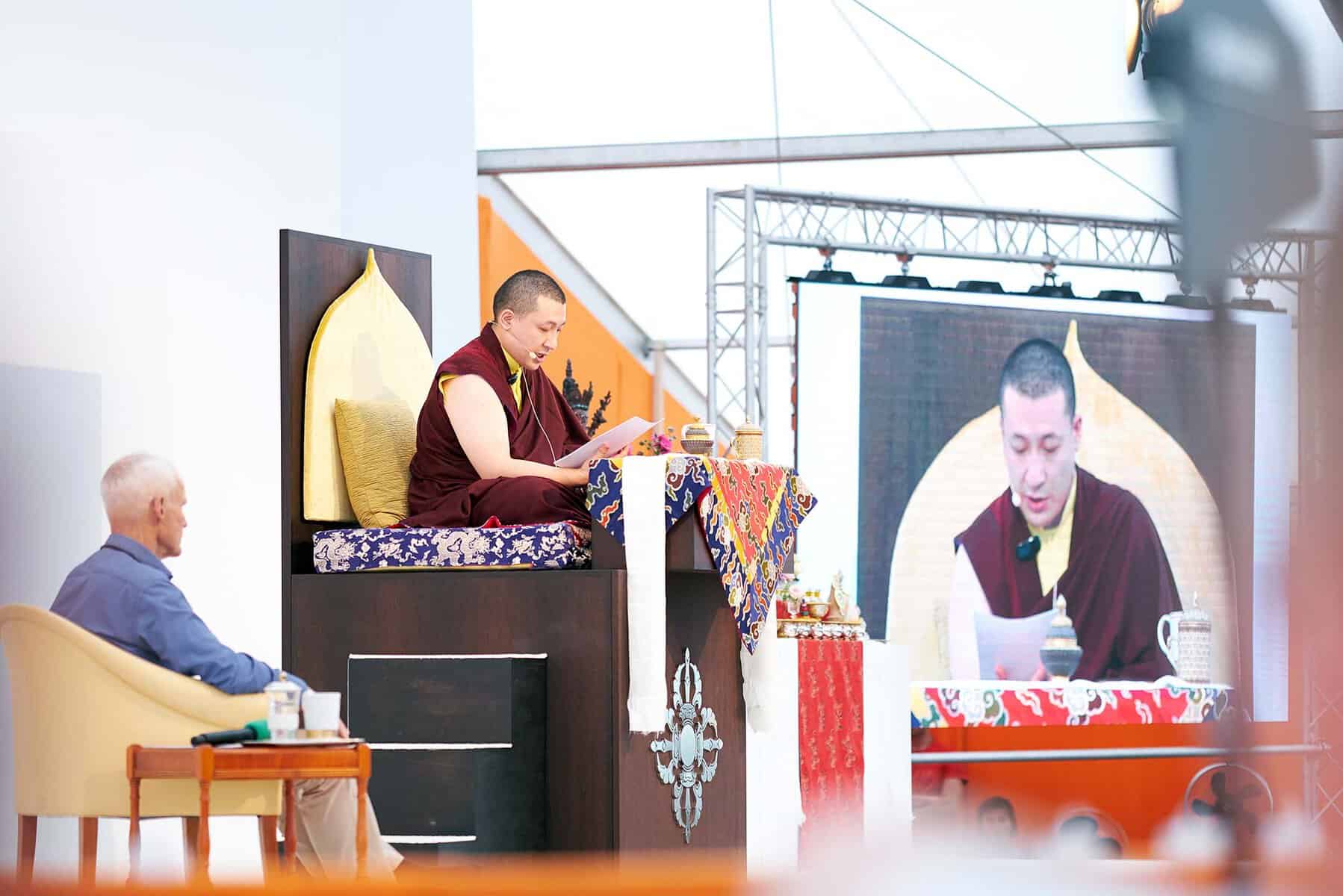
The Bodhisattvacharyavatara, or Bodhicaryavatara for short, is often translated as The Way of the Bodhisattvas and is one of the most well-known Mahayana texts. It was composed around 700 CE by Shantideva (also called Bhusuku1), one of the Eighty-Four Mahasiddhas, who was a Buddhist monk at Nalanda University in India at the time. In 2014, Thaye Dorje, the 17th Gyalwa Karmapa, began to teach this during his public courses over several years at the Karmapa International Buddhist Institute (KIBI) in New Delhi, India. At the request to publish a teaching in Buddhism Today, Karmapa suggested his teachings from these courses be used, chapter by chapter.
To begin, I would like to say something about the English text I am using. There are many English translations of the Bodhicaryavatara and one does not necessarily have to use just one of these to explain the teaching. Although many teachers have advised me to avoid using too many texts, it is useful to compare a couple different translations, in order to learn from their differences. It will not confuse you, but will instead enable a broader understanding.
VERSE 1
Respectfully, I prostrate myself to the
Sugatas who are endowed with the Dharmakaya
as well as to their Noble Sons
and to all who are worthy of veneration.
Here I shall explain how to engage in the vows
of the Buddha’s Sons, the meaning of
which I have condensed in accordance with the scriptures.

The great author Shantideva begins by bowing to the Three Jewels—none other than the Buddha, dharma and sangha. Taking refuge is the first, most important and last practice, which we must all do as practitioners. He demonstrates here that this is not only a kind of ceremony at the beginning in order to go on to greater things thereafter. Even for a realized bodhisattva like Shantideva, it is one of the main practices. It builds a basis without which the following ten chapters would not be possible. By bowing to the Three Jewels, Shantideva emphasizes this and makes it very clear.
The first of the Three Jewels he describes as the Sugatas, or in Tibetan Dewar Shegpa. This simply means “those who have gone to the state of joy.” It is a very widespread and colloquial way of speaking about the buddhas. One can also say the Sugatas are “those who have crossed the ocean of Samsara” and “reached the land of enlightenment.” It is a poetic way of describing the qualities of the buddhas.
“Completely enlightened buddhas,” in Sanskrit Samyaksam-buddhas, are beings who have developed their own purpose, which is attaining a complete understanding of kleshas2, karma, and habitual patterns. At the same time they have developed the ability to benefit sentient beings because they now have no other intention and no other obligations than this. So they are flawlessly and completely available in terms of benefiting sentient beings.
So basically, it is the Buddha one is paying homage to here, and then naturally, it says: “those who are endowed with the Dharmakaya as well as their Noble Sons.”
So Dharmakaya refers to the refuge of Dharma, the path itself. Shantideva then speaks of the “Noble Sons” in this case because we are now training in the way of the bodhisattvas, and the Sangha—the community of practitioners—is here none other than the Sangha of the bodhisattvas. These are not just any bodhisattvas; they are the realized bodhisattvas—those who are next in line or one step away from the state of perfect Buddhahood.

By offering his veneration, his body, speech and mind to the Three Jewels, he commits himself to composing this text for all of us. Later on he says that it is for himself and not for others, but that is a very polite and actually extremely humble way in which a bodhisattva portrays his gestures, his actions and speech and thoughts. By taking refuge in the Three Jewels, he here commits himself to composing and summarizing the conduct of the bodhisattvas, in terms of how to train one’s mind. By training one’s mind, one moves from an ordinary state of mind to an enlightened mind, and from an enlightened mind to a completely and perfectly enlightened mind. Shantideva promises that he will compose all of this according to the Dharma and to what the previous Buddhas and bodhisattvas have taught.
The first chapter is meant to awaken inspiration in the hearts of those who wish to follow the way of the bodhisattvas. Now we jump to the fourth verse, which begins very simply by explaining that there are certain requirements for developing bodhicitta, the enlightened mind, the attitude of the bodhisattvas. The first two verses provide a general understanding of these requirements. Once we have identified that, then there is a basis for generating bodhicitta.
To uphold and to carry out bodhicitta there are first of all physical conditions and then there are mental conditions, which are required. The physical conditions consist of all the various aspects that make up the precious human body. That seems to be very important. Animals, for example, have experiences which are very similar to those of humans. They experience pain, pleasure and joy. But nevertheless, when it comes to really understanding the truth, sharing the truth and also generating immense compassion towards others, they are limited, no matter how kind they are. While they have compassion and kindness towards their own children, their own loved ones, they are not able to go beyond that. On top of that, as we know, they are constantly driven by other obstacles.
Similarly, it is said that in the higher realms—a reality or a form of existence where beings only experience the fruits of positive actions—even though they have great capacity in this way, it is very difficult for them to devote time to these valuable and meaningful truths. So that is why in the end it all comes down to us human beings; the responsibility rests on our shoulders.
Our precious human body is especially valuable because it can change at any moment. Even as we speak, it is changing, and even more drastic changes can occur, such as accidents, for instance. So our body is subject to all forms of impermanence, yet is extremely valuable while it is intact. It is extremely valuable because it can support our deepest wish, which is to gain perfect liberation.
Although there is an abundance of beings who have obtained the precious human rebirth, only a few are able to utilize the condition to the fullest. I don’t know if we are that lucky or not, but we are very close—if we think about the conditions we have, like being able to be this close to the buddha, dharma and to many great teachers. At the same time, there is chaos and many problems around the world. But nevertheless, we all share the same values, and we all have the same dream in terms of practicing the way of the bodhisattvas and helping each other however we can.
While sometimes we can be overcome by emotion, we are able to pull back and to focus on what is really important. I would say that even if we don’t have the very best conditions, at least we are quite close. The only thing is that we constantly need some encouragement, some sort of inspiration, so that we will not give in to any of these afflictive emotions that arise from day to day.
When we go through such precious teachings—be it at seminars, lectures or by studying ourselves—we can leave the philosophical subtleties to the scholars. Instead, there is this very raw, very simple teaching that is right there in front of us. So this we should always read or listen to and then contemplate the meaning as well as we can because that is not too difficult to understand.
VERSE 4
Leisure and endowment are very hard to find;
and, since they accomplish what is meaningful
for man, if I do not take advantage of them now,
how will such a perfect opportunity come about again?
This is the main part of the first chapter, the verse that talks about the precious human existence. It is saying that this precious human existence is very difficult to obtain—that’s the first challenge. On top of that, there is the second challenge of utilizing this existence because if we don’t, we may just waste it completely, with no benefit at all.
If we don’t utilize it to the fullest now, then this precious opportunity is not something that will come again so easily. One should not think that one can have a relaxed approach about this existence, and just have the confidence that the opportunity will come again in the next life. As practitioners, we sometimes have this notion. This is one thing we should all be very wary of and try to understand as clearly as possible. We have been born as human beings, have met with the dharma, and are practicing the dharma now. Sometimes, because of this, we believe that this opportunity will come again. We use this logic particularly when we begin to feel more relaxed. We think not just that it might come again but that it’s almost guaranteed: it will come again. We think, “In my next life, I will do this and do that.”
Here, it says that there is no guarantee whatsoever, just as there is no guarantee about what will happen tomorrow. We don’t even know whether we will live tomorrow or not. In general, we don’t even know whether it will rain tomorrow or if the sun will shine.
The detailed description of the physical conditions and their qualities is timeless. In the text it talks about the eighteen different conditions that make a human body precious. Most of you are familiar with the book The Jewel Ornament of Liberation by Gampopa, in which this topic is examined in detail.
Shantideva now gives many examples of how precious it is to have the opportunity to practice bodhicitta. From here on it’s more or less talking about the physical and mental conditions. Even if you have a human body, you also need the right mental condition to receive the dharma. This is also very difficult to attain and very rare. That’s why it says:
VERSE 5
Just as a flash of lightning on a dark,
cloudy night for an instant brightly illuminates all,
likewise in this world rarely and briefly,
through the might of Buddha,
a wholesome thought appears.
The example is quite easy to understand. On very stormy nights, it is usually pitch-black. There is simply no way of knowing where you are, no way of finding the road, you don’t know anything about your surroundings, because it is simply too dark. When you experience a flash of lightning in the midst of such darkness, it makes your surroundings visible for just a fraction of a second.
Shantideva uses this analogy to illustrate how rare and difficult it is to have a meritorious thought even for a fraction of a second, not to mention bodhicitta, enlightened mind. Day after day, we experience countless things that seem important to us. Disturbing emotions constantly arise out of these experiences, and we try to counteract or deal with them using other emotions without really knowing what is going on. It goes on and on.
This is a very good example. Samsara is like a wheel that never stops turning. There is hardly ever a moment where one could really have a tiny instant of meritorious thought. That’s how rare it is. If it does occur, let’s say, once in a million, then it is due to the aspirations, the kindness and the blessings of the buddhas.
Although it is true, and we may have heard it before, sometimes it might not sound that interesting. Once the buddhas have become enlightened, then they simply have no other activity than benefiting sentient beings. That is their constant activity. Just as the sun never ceases to shed light—to illuminate—there is no pause. It is constant. We just need the proper moment and the proper conditions to become aware of and make use of that.
It is true, Buddha’s compassion and aspirations are always there. I like to use the analogy of oxygen. It is always right there, and all we need to do is breathe. Likewise, Buddha’s compassion is always right there; all you need to do is open your mind to it.
VERSE 6
Hence virtue is perpetually feeble, the
great strength of negativity being
extremely intense. And except for a fully
awakening mind by what other virtue will it be overcome?
When these two conditions are met, then there is an opportunity, an opening, just like the flash of lightning in the night. One should use this moment without a second thought. One must jump into it and make the best use of it. It is very rare to have a virtuous thought just out of the blue. When such a moment comes, don’t waste it but make the best use of it! Such virtuous thoughts are extremely perishable, and if they are exposed to very powerful disturbing emotions, then they are no match for them.
To begin, one has to become familiar with these meritorious thoughts, make the best use of them, and then, from there, use them to actually generate bodhicitta. Because it’s only bodhicitta that has the ability to overcome such powerful disturbing emotions.
VERSE 7
All the Buddhas who have contemplated
for many eons have seen it to be beneficial;
for by it the limitless masses of beings
will quickly attain the supreme state of bliss.
This is not an assumption or a theory, but it is something that our Buddha Shakyamuni directly saw and experienced before his enlightenment. During his long journey towards buddhahood, over many eons, again and again, he saw exactly what defeats disturbing emotions, their causes, and the karma that results from them. After having examined that lifetime after lifetime, over many eons, he was able to say with great confidence that bodhicitta is the way. This is why it says this phenomenon of bodhicitta can actually liberate the countless sentient beings, no matter who they are or where they come from. If beings wish for liberation if they wish for ultimate happiness, then this is it: bodhicitta.
VERSE 8
Those who wish to overcome the many
sorrows of conditioned existence, those
who wish (all beings) to experience a multitude of joys,
and those who wish to experience much happiness,
should never forsake bodhicitta.
In this conditioned world, within samsara, there are countless kinds of suffering, complications, difficulties, and challenges. If we wish to overcome them and at the same time relieve all sentient beings’ unhappiness, then one doesn’t have to look anywhere else—only bodhicitta can fulfill our wish.
If we wish for all of that and thus have that characteristic of a bodhisattva, although still as a beginner, then we only need to do one thing: never to let go of the bodhicitta.
VERSE 9
The moment bodhicitta arises in those
fettered and weak in the jail of cyclic
existence, they will be named a “son of the Sugatas”
and will be revered by both men and gods of the world.
When one-day, bodhicitta arises in you, then from that moment onwards, your name also changes. You are no longer known as a samsaric being, one with karmic debt and with disturbing emotions. Common names no longer apply to such an individual. Instead, that person—whoever it is—will be revered and respected by all and will be called a bodhisattva. From that point onwards, we will be respected by all, starting with all the powerful beings in this world and by the godlike beings in the higher realms and so on, but most of all, the buddhas and bodhisattvas will then cheer us on, and offer words of inspiration.
VERSE 10
It is like the supreme gold-making elixir,
for it transforms the unclean body we
have taken into the priceless jewel of a Buddha form.
Therefore, firmly seize this bodhicitta.
Here, Shantideva gives examples of how precious bodhicitta is and here compares it to what is called the “philosopher’s stone,” basically the chemical compound that can turn metal into gold, not just in terms of appearance but in actuality. This alchemical stone is very precious because it can literally turn all metals into gold simply by touching them.
In a certain way, our precious existence is considered impure simply because it is conditioned. Because of this, it can decay, and most importantly, it can give rise to various disturbing emotions.
The moment we generate bodhicitta, just like the philosopher’s stone, it can transform this impure physical condition into something that is meritorious, virtuous and invaluable. Our human condition then becomes something invaluably precious: it becomes a truly precious human body.
Therefore, one should firmly hold on to bodhicitta.
VERSE 11
Since the limitless mind of the Sole Guide
of the World has upon thorough
investigation seen its preciousness,
all beings wishing to be free from worldly
abodes should firmly take hold of this precious bodhicitta.
This analogy tells of merchants who used to sail out on their ships in the old days in search of precious jewels. These kinds of journeys used to take place a lot in the old days, and prob-ably in those days many of the islands and other places were uncharted and precious jewels could have been found there.
The most experienced of captains knows exactly where to go and where to find the most beneficial wish-fulfilling jewel. Such a captain will only take you to that goal and nowhere else.
In the same manner, Buddha Shakyamuni shows us the way; he has the experience and knowledge about which path will help us most and what kind of mind will benefit us most. Buddha has seen and experienced that it’s the mind of bodhicitta that is the most beneficial.
Buddha knows exactly what kind of mind we should generate, especially if we wish to liberate beings. He can point exactly to one mind, which will fulfill all of their wishes. This mind is none other than bodhicitta.
VERSE 12
All other virtues are like the banana tree;
for after bearing fruit they simply perish.
But the perennial tree of bodhicitta
unceasingly bears fruit and thereby
flourishes without end.
Bodhicitta is superior to all the many meritorious actions that one can perform. All the other virtues are like the banana tree, which can bear fruit only once. The “tree of the bodhicitta,” on the other hand, is like the wish-fulfilling tree; it continuously bears its virtuous fruit, regardless of how much one picks. If one wishes to generate virtue, then why not generate bodhicitta because it bears endless positive fruit.
VERSE 13
Like entrusting myself to a brave man
when greatly afraid, by entrusting myself
to this (bodhicitta) I shall be swiftly liberated
even if I have committed extremely negative acts.
Why then do the conscientious
not devote themselves to this?
If there were a criminal in the neighborhood, we would need the protection of a good guard. Without such protection, there could be many obstacles, and even life-threatening situations could arise. We would hold to these precious, brave guards, just like we hold on to our own dear lives. In the same way, when a sentient being is threatened by karma and disturbing feelings, then it would be good to have bodhicitta as our protector. Without it, the journey would be very difficult. But with bodhicitta as our protector and guide, then we can reach our destination without fear, and in a short time. If there were a criminal in the neighborhood, we would need the protection of a good guard. Without such protection, there could be many obstacles, and even life-threatening situations could arise. We would hold to these precious, brave guards, just like we hold on to our own dear lives. In the same way, when a sentient being is threatened by karma and disturbing feelings, then it would be good to have bodhicitta as our protector. Without it, the journey would be very difficult. But with bodhicitta as our protector and guide, then we can reach our destination without fear, and in a short time.
VERSE 14
Just like the fire at the end of an age,
it instantly consumes everything negative.
Its unfathomable advantages were taught to
the disciple Sudhana by the wise Lord Maitreya.
What bodhicitta can achieve is then compared to a supernova, one of the most powerful phenomena in the universe. When a massive star dies, it can explode. This ability to quickly unleash massive power serves as an example. In less than a moment, it could burn away and eradicate eons of negative actions, words, and thoughts that one has accumulated. Bodhicitta has that much power and ability.
If one wishes to gain further inspiration from such examples and analogies, Shantideva’s advice is to read the dialogues between the great Maitreya and another bodhisattva by the name of Norsang. These describe the various benefits of generating bodhicitta, how powerful and beneficial it is.
So far, it has been about inspiring us for bodhicitta. Now it continues by explaining exactly what bodhicitta is, how it is understood by other great masters, and finally, how Shantideva himself understands it.
First of all, the great Shantideva was trying to inspire us so that we would be motivated to follow his example. Follow is a wonderful word, but I also sometimes use the word mimic or imitate because we are like children. If we get inspired by someone, then naturally, we would like to mimic the way they walk, the way they talk—everything.
Shantideva was able to accomplish this inspiration in just a few words through his great skillful means, born, of course, out of compassion. Amazing! Without having to create an organization, he was actually able to inspire people peacefully in a few plain words.
Following the various analogies that he has used for this purpose, we then come to a very important part: what is bodhicitta? If we try to examine it with great elaboration, with great effort, it is immense, it is immeasurable. Shantideva tries to simplify it, to shorten and to summarize it. He says that bodhicitta has two aspects: aspirational bodhicitta and the application of bodhicitta.
VERSE 15
Bodhicitta, the awakened mind,
is known in brief to have two aspects:
first, aspiring bodhicitta in intention,
then active bodhicitta, practical engagement.
Many things could be said here. But to keep it short, aspirational bodhicitta is very simple to understand. I remember that all of my teachers who taught this text in Tibetan used a very simple analogy. They would simply say, “It’s like if you wish to go to Lhasa from here.” That wish, that aspiration to get to Lhasa—that is like aspirational bodhicitta.
Then comes the practical engagement, the journey itself: active bodhicitta. Your mind is not only set on the goal but is already preparing to go. You take the first step and continue the journey until you get there. That is the actual activity involved in reaching your destination.
Of course, our aim is to develop bodhicitta. And it’s not just a random thought—“Oh, that would be nice”—something like, “It would be nice if this hall was painted pink.” It’s something far more than that. You have to understand the benefit, actually.
For this, it is important to have as a foundation a good understanding of karma. It sounds very simple, and we all talk a lot about karma, but more often than not, we just use the word without actually understanding it. Karma is often seen as an external factor, which is not so interesting. It is very important to understand causality. Without this understanding, we cannot really understand what bodhicitta means.
VERSE 16
As corresponding to the wish to go
and then to setting out, the wise
understand respectively the distinction
between these two.
It is actually quite simple. Aspirational bodhicitta is a state of mind that wishes to go somewhere. Active bodhicitta is the actual journey, from the very first moment until arrival. For instance, you begin by being kind and generous and by developing deep meditation and great wisdom, which arises from experience.
VERSE 17
From bodhicitta in intention, great results
arise for those still turning the wheel of life.
Yet merit does not rise from it in
ceaseless streams, as is the case
with active bodhicitta.
If one is able to practice both kinds of bodhicitta, the aspiration is genuine and one acts accordingly; it’s not like there will suddenly be a good breeze and that one will now only experience comfortable and favorable things and that one will now only feel good. It is about something with great depth and weight, and that depends on an understanding of causality. If one understands that certain actions cause corresponding results, and not just for oneself but also for others, then one has more respect for causality.
Once one has understood this on a deep level and developed this kind of thinking, then it is possible to give rise to aspirational bodhicitta, although it is not easy. Once this is generated, then from there onwards, no matter how long one remains within cyclic existence, no matter how colorful, how interesting the life that we have, as long as we have this bodhicitta, then the result—which is the merit—will never cease. It will continuously bring merit all the time.
Only the Buddha can teach this kind of thinking. Not even the kindest and most loving of persons, such as one’s parents or grandparents, can teach this.
This thought of bodhicitta is something completely different from the way we usually think. We are so used to the way we live, to the way we think and function, and we have our logic and reasons to prove that this is how it is and how it works, and we’re happy with it. Nevertheless, bodhicitta—and particularly the bodhicitta of the bodhisattvas—is something so unique that it really topples everything we know. That’s why we can continuously generate merit.
Why is this the case? Because it’s the opposite of the way we usually think, not in the context of good and bad, but in terms of an environment where we have to survive, where we have to fight for our space and our rights. This notion is very hard to come by, so that’s why bodhicitta is very special. It does not just aim for your own benefit but for all others, however many there are. It is for all. Even as beginners like ourselves we can really take comfort in that.
VERSE 18
As soon as somebody gains hold perfectly
of that mind, with the thought never to
turn back from totally liberating infinite
realms of limitless beings . . .
The main part here is: “with the thought never to turn back from totally liberating infinite realms of limitless beings.” From the moment we promise ourselves to liberate all beings, we have to have that with midogpa’i sem as we say in Tibetan, meaning a mind of never turning back. That is easy to say and easy to hear, but it goes back to a correct understanding of karma and having recognized the faults of samsara. To be really certain about making such a decision, you have to have found good reasons to do so. Then with this conviction, you can uphold this attitude.
VERSE 19
from that time hence, even while asleep
or unconcerned, a force of merit equal to
the sky will perpetually ensue.
From that moment onwards, when we have generated bodhicitta out of that very certain mind, immeasurable merit and immeasurable wisdom will arise. So even when we are asleep, the merit will continue to grow, as vast and limitless as the sky. It’s like having deposited something in your bank account: if you have done it exactly according to the system and law, then even when you’re sleeping, talking or walking, it will still accumulate.
VERSE 20
For the sake of those inclined toward the
lesser (vehicle), this was logically asserted
by the Tathagata himself in the
Sutra requested by Subahu.
When one has generated bodhicitta and it is not damaged in some way, then the accumulation of merit is ceaseless. The Buddha confirmed this.
VERSE 21-22
If even the thought to relieve living
creatures of merely a headache is a beneficial
intention endowed with infinite goodness,
then what need is there to mention the wish
to dispel their inconceivable misery,
wishing every single one of them
to realize boundless good qualities?

It’s really true. We experience this with those around us who are special to us, such as our parents or our children. Sometimes, we have these kinds of good wishes for them. However, if we want to develop bodhicitta, it is not just with regard to helping one or two beings but all sentient beings, regardless of who they are or where they come from. It is just without any differentiation. Bodhicitta breaks down all of our habitual patterns, rules, regulations and boundaries—everything. The analogy is that even though there is limitless merit from benefitting just one sentient being, in this case, it’s not just a great number of them but all of them. So, therefore, the merit is endless.
VERSE 23
Do even fathers and mothers have such a
benevolent intention as this?
Do the gods and sages?
Does even Brahma have it?
Here the text talks about gods and sages and Brahma—what does this mean? Gods, in this case, are not understood as supernatural beings. If we accumulate enough merit, then we may take rebirth as in a god realm. In the great ancient times, there were many wise men. They were great beings with immense knowledge, and often their main practice would be that of non-violence.
As for Brahma, in certain non-Buddhist philosophical schools and religions, they believe in certain gods being the possessor or the creator of all. In this case, Shantideva is saying that even a creator god is not able to comprehend the generation of such a mind.
VERSE 24
If those beings have never before even
dreamt of such an attitude for their
own sake, how would it ever arise for
the sake of others?
Basically, it is true that not even in our own dreams do we have that kind of attitude, courage, and heart, even for one’s own benefit, let alone for that of others.
VERSE 25
This intention to benefit all beings,
which does not arise in others even
for their own sake, is an extraordinary
jewel of the mind, and its birth is an
unprecedented miracle.
It is very rare to have that kind of moment, and should that moment appear, then nothing can beat it. Even finding an elixir to overcome death—if something like that existed—it cannot beat this.
In Buddhism, we assume that we have been in this cyclic existence for countless eons. Actually, countless means that there is no beginning at all. Having the opportunity to give rise to bodhicitta is something unprecedented, something that has never happened to us before.
VERSE 26
How can I fathom the depths of the
goodness of this jewel of the mind,
the panacea that relieves the world of pain
and is the source of all its joy?
The bodhicitta attitude is something joyful because we know that it can liberate and benefit all beings in the most profound way. The merit that will be generated out of this great attitude is immeasurable, so how could we begin to fathom it? It’s impossible to measure.
VERSE 27
If merely a benevolent intention excels
venerating the Buddhas, then what need
to mention striving to make all beings
without exception happy?
Having a kind heart is already great and is something that Buddha would praise. This is the case even when we have thoughts that are similar to bodhicitta. But striving for the sake of happiness of all beings without exception is immeasurable. It is a means or a path where we will definitely bring great benefit.
VERSE 28
Although wishing to be rid of misery,
they run toward misery itself.
Although wishing to have happiness,
like an enemy they ignorantly destroy it.
This verse describes the situation of all sentient beings. No matter how kind they are, how generous or how courageous, when they give in to their disturbing emotions and habitual patterns, and when karma ripens and takes control of them, then even if they wish for happiness, they will always go back to square one.
We destroy everything that is meritorious as if it were our enemy. It happens all the time in our lives. That is what all the great teachers have said, and it makes sense. We always manage to sabotage ourselves. It must be interesting for buddhas and bodhisattvas to see how we repeat that cycle over and over again.
VERSE 29-30
For those who are deprived of happiness
and burdened with many sorrows
it satisfies them with all joys, dispels all suffering.
And clears away confusion.
Where is there a comparable virtue?
Where is there even such a friend?
Where is there merit similar to this?
For all sentient beings who are basically victims of karma, disturbing feelings, habitual patterns and so on, what is the only force, the only friend that can really fulfill our deepest aspirations? It is nothing other than bodhicitta.
VERSE 31
If whoever repays a kind deed is worthy of
some praise, then what need to mention
the Bodhisattva who does good
without it being asked of him?
We normally praise and show gratitude to someone when they offer support and encouragement. Shouldn’t we do so even more when someone generates bodhicitta and carries out the activity of bodhicitta?
VERSE 32
The world honors as virtuous a man who
gives a little plain food disrespectfully to a
few beings, which satisfies them for only half a day.
Shantideva is saying that many people often praise very worldly acts of generosity. If that is laudable, then what to say of the true generosity of the bodhisattvas?
VERSE 33-34
What need be said then of one who
eternally bestows the peerless bliss of the
Buddhas upon limitless numbers of
beings, thereby fulfilling all their wishes?
The Buddha said that whoever bears a
negative thought against a benefactor
such as a Bodhisattva will remain in the
paranoia realms for as many eons as there
were negative thoughts.
This is a matter of fact, but in such advice and teachings as this, there are direct and indirect messages. The indirect teaching is “constantly develop respect towards every individual.” First of all, because all deserve respect, just as we deserve respect. But also because anyone could be an actual bodhisattva.
VERSE 35
But if a virtuous attitude should arise
(in that regard), its fruits will multiply far
more than that. When Bodhisattvas greatly
suffer they generate no negativity, instead
their virtues naturally increase.
Here, it is simply saying that one should first develop respect, and beyond that, if one can do more than just expressing respect, then there is much more benefit.
VERSE 36
I bow down to the body of him in whom
the sacred precious mind is born. I seek
refuge in that source of joy who even brings
those beings to happiness who harm him.
Here, those beings are praised who have generated this unbelievable bodhicitta. Even if we try to harm, in return, they give joy, they give benefit. And to such beings I prostrate, and I take refuge in them, says Shantideva.
- Although Shantideva had great realization, to the other students at Nalanda, he seemed to be the laziest person, so they called him bhusuku (Sanskrit). Bhu comes from bhukta, which means “eating,” su comes from susta, which means “sleeping,” and ku comes from kuchiwa, which means just “walking.” So, bhusuku is one who just eats, sleeps and goes out to the toilet. ↩︎
- ↩︎