The explanations given here refer to the same version of the meditation as what was published as a special edition, in 1999, to commemorate the first visit of the 17th Gyalwa Karmapa Trinley Thaye Dorje to the West. Following the wishes of the 16th Karmapa, Lama Ole Nydahl has formulated today’s version of the meditation in a contemporary and accessible way for the West.
The complete Tibetan title of this meditation is bla ma’I rnal byor sku bzhi i myu gu skyed byed bdud rtsi i char rgyun. The English rendition of the full title is The Meditation on the Teacher, the Streaming Rain of Nectar, Which Develops the Seedlings of the Four Buddha States.
All footnotes in this text have been provided by the editors of Buddhism Today. The editors are especially grateful to Manfred Seegers for his careful and wise oversight of what appears here.
Translated from Tibetan by Ngodup T. Bukhar.
Revised from Tibetan by Manfred Seegers.
As it is said in the teachings, the root of a thousand buddhas is one’s Guru, one’s teacher. So generally, the guru plays a predominant role in one’s realization. The buddha nature pervades all sentient beings. According to the sutras and the practice of the Enlightened Attitude one works towards the liberation of beings taking many eons for one to attain the state of enlightenment. According to the tantras the practice is the direct recognition of one’s inherent potential or that of one’s embodiment of the three vajras, the indestructible nature of body, speech and mind.
First, when one begins to become a teacher oneself, one’s aspiration is to have the knowledge that suffering pervades all the limitless sentient beings. On the basis of this understanding, one wants to liberate all sentient beings from their suffering. With one’s embodiment of the Buddha nature one sees the possibilities for doing that. Thus, until all sentient beings are liberated, one would like to remain in the cycle of existence working for the benefit of beings. Such a genuine Enlightened Attitude also means that one desires to have a complete exchange in terms of giving all one’s happiness to the beings and taking their suffering upon oneself. A complete exchange. That includes a determination, a confidence and courage that one will be capable of liberating all beings. This is based on the power of the inherent potential and the power of the aspiration of the Enlightened Attitude.

The experience of the awakening, the realization of the truth state, the Dharmakaya1, takes place on the basis of the inherent potential and one’s aspiration [to the Enlightened Attitude]. Having attained the state of the Dharmakaya, the enlightened activities are spontaneous in terms of liberating sentient beings. At this point, there is no desire any more to have the power to liberate beings, but the power to liberate beings is spontaneous. It is a natural quality of the state of the Dharmakaya, a spontaneous pervasive activity of the enlightened beings.
The state of the Dharmakaya is actually inconceivable, beyond concepts, beyond the explanation in words and thoughts. If one asks whether or not this state actually exists, it is not possible to say that it exists. But one also cannot say that something like that is not taking place, because the enlightened state of the Dharmakaya pervades all beings, yet it is beyond thoughts, beyond all extremes. It is beyond all reference points.
Such a Dharmakaya state of enlightenment is beyond ordinary terms or explanations. It goes beyond the four extremes and the eight mental fabrications. The natural quality of the Dharmakaya is great compassion for all sentient beings; the awakened energy is all-pervading and working for the benefit of all beings, yet it is beyond ordinary perception and conceptualizations. If one says that it is not contained in the eight-fold group of consciousness, this is not true because it pervades all sentient beings. But even if it is present in the eight-fold group of consciousness, it goes beyond the perception of ordinary beings; it is completely beyond conceptual states of mind.
Then, from the power of the Dharmakaya naturally manifests the Sambhogakaya. Among the four states of a buddha, the manifestation of the Sambhogakaya also does not arise through some kind of concept or through a certain thought, which would be like a wish to manifest, but it is a natural, spontaneous manifestation of the power of the Dharmakaya that appears in the form of the Sambhogakaya.
And through the spontaneous power or blessing of the Sambhogakaya again the Nirmanakaya is manifested in order to benefit and help beings to get rid of all confusion and neuroses. The power of the Dharmakaya as a cause can be compared to the power of the sun, and the Sambhogakaya corresponds to the rays of the sun. And the warmth of the sun’s rays that we feel on our body is like the power of the Nirmanakaya. Even if beings are under the influence of confusion, they can be permeated by the blessings of the Nirmanakaya.
If one asks whether or not these three states are the same, the answer is that they are definitely the same because, in the same way as in the above example, their nature is like the sun, that is, the Dharmakaya. Even if there are different states, like the sun, the sun’s rays and the power of the sun’s rays, they are not different in essence, not different from the sun. Whether one looks at it from the point of view of the essence or from the point of view of the effect of that essence, in terms of being the sun they are the same. All this in essence is the Dharmakaya; and the inseparability of the three kayas on the basis of the Dharmakaya is called the Svabhavikakaya or Vajrakaya. And the Guru is the embodiment or the accumulation of the four kayas.
This particular Guru Yoga is also called the The Seedlings of the Four Kayas. The name shows the purpose of this practice. Since the ultimate nature of the lama is that of the Dharmakaya, one could also say that this nature is the inseparability of emptiness and phenomena. This is expressed through the OM SOBHAVA mantra at the beginning. In the actual practice, it is said that from the play of the sphere of phenomena, which is free from mental fabrications and unborn in front of one in the sky, there arise vast clouds of offerings. Here, when speaking about the empty space which is limitless, one might need to receive more instructions. For the practice of the Guru Yoga, one actually needs to work on a lot of preliminaries. It is not very easy to do the practice. But the basic point is to understand the guru in the way just explained.
The empty sphere of phenomena is compared to space. One should fill this space with the offering cloud of Samantabhadra2, which again has a lot of elaborate explanations. In short, there are three kinds of offerings: the outer, the inner and the ultimate offerings. In terms of the outer and inner offerings, we can imagine all kinds of pleasant things, whether they have been taught or not. We can offer Mount Meru3, the four greater continents and the eight lesser continents, and all precious objects of offerings such as the seven precious offerings, the eight auspicious offerings, then the offering goddesses, etc. In this way all material as well as imagined offerings, one’s body, speech and mind, all one’s belongings, one’s family, everything altogether should be given. The ultimate offering of suchness refers to Buddhahood and the collections of teachings. It actually requires at least a slight understanding of the Dharmakaya. So, every object that is worthy should be made as offering, letting go, surrendering, and every object that one can imagine should be included in the offerings.
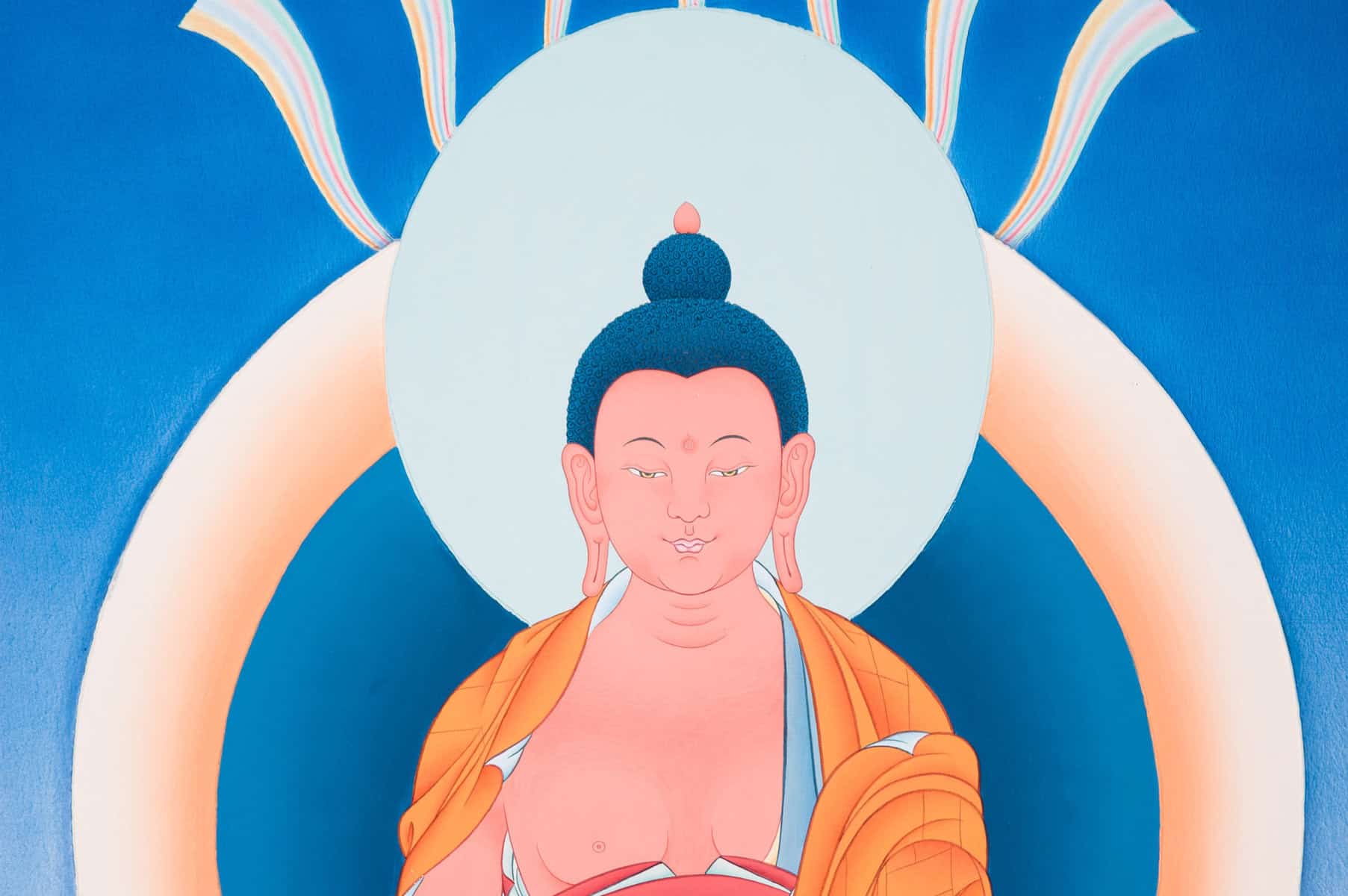
The visualization of one’s own root Guru is as follows. There is a beautiful throne that is lifted by eight lions. On top of that appears a reddish-white lotus [flower] with a thousand petals. On top of that, traditionally, there is a sun and a moon disk, but in this particular case, there is just a moon seat symbolizing the unborn nature of bliss-emptiness. On top of this seat, instantaneously, there appears one’s own root lama, majestic and radiant, being the embodiment of the Three Roots, the lama, the yidams, the protectors, and the power of all the Buddhas. At that particular time, even if one can let arise only one moment of unconditioned confidence and devotion, just the moment of a finger snap, that could be the cause for immeasurable accumulations of meritorious qualities.4

Having visualized the Guru in this way, experiencing the radiant and majestic blessings of the Guru, with one-pointedness of one’s mind, as sincerely and genuinely as one can, one recites the Guru’s mantra of KARMAPA CHENNO. With a sense of tremendous supplication, one is doing the mantra, and one develops a deep openness. And while one is doing that, at a certain time one could also receive the body, speech and mind blessings of the Guru, meaning that from the Guru’s Three Vajras the white, red, and blue light emanate out simultaneously, and enter one’s own three doors of body, speech and mind. In this way, one is receiving the four empowerments; one constantly receives the blessing of the body of the Guru, going through the purification of all obscurations of body, speech, and mind while receiving the three lights. Having received the four empowerments with the understanding that the Guru is the embodiment of the three kayas—the Dharmakaya, Sambhogakaya, and Nirmanakaya plus the Svabhavikakaya—, one could repeat: KARMAPA CHENNO.
Finally, the Guru is dissolving and melting into one; and one is remaining in that inseparability of the Guru and one’s mind. One remains in that meditative state.
Then, as has been said earlier, the Guru is the embodiment of the four kayas; and the attainment of that state of enlightenment arises through the power of the Enlightened Attitude that one wants to liberate all sentient beings, that until all sentient beings are liberated one remains in samsara, and that one will guide all sentient beings to liberation. After having experienced again the inseparability with one’s Guru, one should have the same powerful attitude that henceforth one will also be able to liberate all sentient beings, and that until all sentient beings are liberated one will remain in samsara. One wishes that one may be able to take over the responsibility of liberating the sentient beings, even if it is only one. In that way one is concluding the practice. So once again one develops this aspiration, now with the sense of dedication.
- The four aspects of the Buddha mind are known as the four kayas. They are:
The Dharmakaya — the all-pervading truth state
The Sambhogakaya — the joy state
The Nirmanakaya — the compassionate emanation state
The Svabhavikakaya — the inseparability of the three kayas as the essential state.
When one sees the way things are and recognizes that their mind is like space (Dharmakaya), then one becomes fearless. With nothing to be afraid of, one is joyful in every way (Sambhogakaya). And from this basis of good feelings brought about by seeing the nature of one’s mind, one is naturally compassionate (Nirmanakaya) because, from this vantage point, it is the only reasonable activity. These three kayas are seen ultimately as being the inseparable characteristics of the Buddha mind, or in this case, the guru mind (Svabhavikakaya). Even more simply put, it can be said that “highest truth is highest joy” and “highest joy is highest functioning.” ↩︎ - There are two different aspects called Samantabhadra. One is the Buddha Samantabhadra and the other is the Bodhisattva Samantabhadra. Here the Bodhisattva is meant. He was praised by the historical Buddha for being able to present perfect offerings to the Buddhas. He created huge offering clouds until the whole universe was completely filled up. There was not the slightest space left. Thus he became the perfect example of how one should make offerings towards enlightenment. ↩︎
- Mount Meru is the symbolic center of the Buddhist universe. Here, Karmapa is indicating that we offer everything that appears from space (mind) back to its essential truth nature. ↩︎
- The lama in this meditation represents the Buddha, who is simply a mirror that shows us our own enlightened nature. When we are fully concentrated and invested in our meditation, contact is made with our own enlightened nature. ↩︎