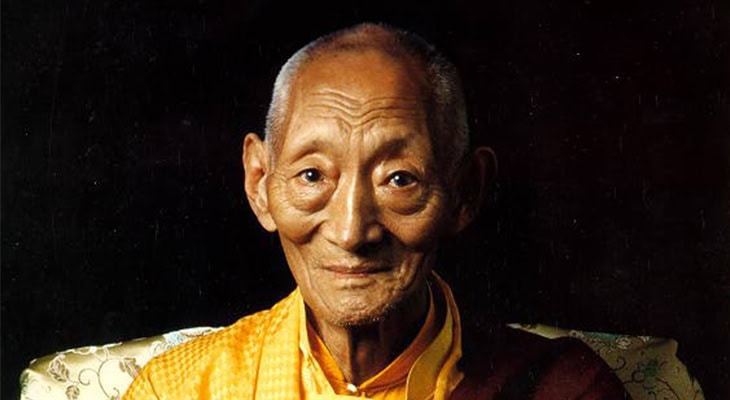
Q: Is there some aspect of Tibetan Buddhism that you feel is more suitable or more important for Westerners?
Shamar Rinpoche: Nowadays, Tibetan, Mahayana, and Theravada Buddhists are spread everywhere and are organized very well. The Gelugpas have translated many books, and Western people have started studying Buddhism just as the Tibetan lamas did in Tibet. Westerners in America, as well as in Europe, study everything and are getting very well educated in Buddhism.
So we see that Buddhist teachings are for everybody. East or West no longer matters. There are no teachings that we can say are more or less important for Westerners. Of course, Western society is different, and the language is different. In the past we selected a few particular teachings from the Buddhist treasures that worked for Westerners at that time. For example, understanding what are virtuous and non-virtuous actions, in order not to create negative karma and keep from falling into the lower realms. In the case of teaching meditation in order to reach enlightenment, in the past, only certain aspects of meditation were taught. We simplified it like that in the past, but it is not necessary to do that anymore. Now everyone can study everything.
So you are saying that all the teachings are important and can be understood by Western practitioners. But do you perhaps have some thoughts about aspects that Westerners might focus on in their practice, e.g., more devotion, more compassion, more courage, more wisdom as useful qualities?
Westerners should work on the ego. Western societies have a lot of ego to work with! Whatever they learn from dharma, the ego will be there, even if you yourself cannot realize it. And the dharma does not work when the ego is overwhelming or overpowering. This may be the result of training in school, or maybe parents are training children. But it keeps you from knowing the difference between confidence and the ego.
So this is something that Westerners need to learn?
Yes. First, the dharma must be learned very well. But then, some work needs to be done with ego and pride. Without generalizing, I can say that I have seen quite a few Western Buddhist practitioners who claim to be scholars, meditators, or renunciates (yogis) but who are overwhelmed by pride. When this happens, one will not improve but only worsen. If one’s ego and pride are too strong and one does not realize that, then whatever is learned from the dharma will not work. It will not address one’s needs. When there is pride, there is no realization but only decline. Therefore, I emphasize to Western people, when they learn dharma, to be extra careful not to become overwhelmed by pride. It seems that in the West, the difference between pride and confidence is not clear.
Can you point out what the difference is?
Pride is thinking, “I am very great.” Confidence says, “Oh, now I have learned something, I understood it.” Being sure about it. Yes, that is all.
Is this different in Tibet or Nepal?
Buddhists in Tibet and Nepal know the difference because it is so clearly explained in the teachings. The dharma explains very clearly what pride is and what ego is. In Tibet, we say, “If you have pride, then you are like a rolling stone.” A rolling stone can collect no moisture. The same exact thing is taught in the dharma: If one is overwhelmed by pride, then one cannot develop dharma qualities.
Is the motivation important here?
Yes. You have to check yourself. It is not about “I am great,” but about learning the practice. Confidence is having learned the practice.
Some Buddhist teachings suggest focusing on suffering. There are people who find that this causes them to become unhappy or even depressed.
I think this is a matter of being too thin-skinned, and Western culture may be contributing to that. Small wounds bother a lot. There are many, many good things about Western culture, but putting too much emphasis on people’s being sensitive is not one of them. This will lead to becoming unhappy and depressed instead of developing more compassion. Buddhists understand that mind is quite spacious, and therefore, this is not a problem. By applying the dharma, this can be controlled. It depends entirely on having a good understanding of the dharma teachings. For example, Nagarjuna’s “Letter to a Friend” is a helpful text to study.
There are many teachers today who have different styles, who give different teachings and practices (like ngöndro). And some people go to different teachers and get different things. Can you comment on this?
The style depends on the personal skill of the teacher, but in Buddha dharma, there is no such thing as different teachings. The teachings that the Kagyupa, Gelugpa, Nyingma and Sakya are learning are of the same dharma. There are many subjects available that one may choose from, but the teachings are not different. The treasure of the dharma contains so many teachings. If one says, no, do not do ngöndro, do some other practice— that is also within the teaching of the dharma. So it depends on who selects what. The teachers are selecting here from teachings of the dharma, from the teachings of the Buddha.
As for ngöndro, there are different kinds. In Nyingma practice, they have a ngöndro, the Nyingma Ngondro. In the Kagyu tradition they have practices like Hevajra, Chakrasamvara, and Vajrayogini; each one of them has ngöndro. The Kagyu Lojong as well has a ngöndro. In the Kagyu Mahamudra practice, when one does a Kagyupa yidam practice, then one has to do the ngöndro. According to the main practice, there is a ngöndro that precedes it. So, all practitioners from everywhere should finish their ngöndro.
All this may seem confusing to a beginner.
That is why I mentioned how, nowadays, Western people are studying Buddhism as the Tibetan monks do. If you study everything in that fashion, then you will not be confused. Confusion is there because there is a lack of knowledge and understanding.
And the practices?
Then you will decide which practice is suitable for you. You yourself will choose. In some cases a qualified teacher is chosen first, and the decision is made to follow his instruction. You decide. You will either first choose the practice and then pick a teacher, or sometimes you decide who the teacher is and then follow his instruction.
Most of the Tibetan practitioners, especially monks who study Buddhism, will not follow a teacher unless he is either educated in the dharma or is a great meditator. They may go to an academically well-trained teacher for learning, but then they will examine whether he is qualified for meditation or not. If not, they will look for a meditator. It is also possible that they find a teacher who has both the academic knowledge and the meditation experience. However, they must find as their teacher a meditation practitioner, regardless of whether or not he is academically trained. In no case will they accept a teacher who has neither academic experience nor meditation experience.
So meditation has to be there.
Meditation is number one. They give priority to meditation. The Tibetan people will know which is which because they are well-informed. They are part of the same culture, the same language. Therefore, they can get accurate information about a teacher’s background. For foreigners it is difficult; that is understandable.
Today, most lay people who practice dharma also have very busy lives: work, families, and so on. What is your advice on the best way for them to use the meditations and the teachings?
Well, it depends on the person’s mind. One way is to learn the simple dharma, e.g., what the virtuous and non-virtuous actions are. To decide not to engage in non-virtuous activities and to accumulate merit, e.g., through generosity. Like that, you do as much as you can. Then methods like shinay and lhaktong can be used if one has the goal in mind to reach enlightenment. Otherwise the practice of Amitabha Buddha, for example, can be used in order to be reborn in the pure land of Amitabha. This simple dharma is also okay for individuals.
What if people want to go deeper in the practice?
You need more time and retreat. Even one or two retreats may not be enough; you need to do a lot and for a long time.
Does this depend on the individual, or is it the same for everyone?
Generally, it is the same for everyone… unless you are like Gampopa.
You never know. [laughs]
You never know! [laughs]
Before we finish, can you say a few things about the future of Karma Kagyu Buddhism?
Teaching. Teaching is very good. Organizing dharma activity, organizing Buddhist centers, organizing retreat centers. All of this is good for the future. With good people working hard, the future looks bright.
Great. Thank you so much.
You are welcome.
This interview was conducted on September 28, 2008, at Shamar Rinpoche’s Bodhi Path Buddhist Center in Natural Bridge, Virginia. Conducting the interview for Buddhism Today was Tasso Kallianiotis.