Cancer is a name for many different diseases that share the characteristic of an uncontrolled growth and spread of abnormal cells. Many forms are survivable if treated early, but the name still commonly invokes fear. The best of many blessings that came from a breast cancer diagnosis in May 2007 was the opportunity to discover how truly valuable the view, teachings, and methods of the Diamond Way (vajrayana) are. In an instant, the “rubber hit the road,” and wisdom I had been given became living reality. It made what might have been a terrifying, useless experience—”sound and fury signifying nothing”—into a true adventure of great value and meaning.
The View—Highest Truth is Highest Joy
At the time of my diagnosis, I had been studying and practicing under the guidance of my teachers, Lama Ole Nydahl and his wife Hannah, for about ten years. In the powerful tantric meditation practices of Diamond Way, we focus on buddha aspects, forms of energy and light, such as a lama like the 16th or 8th Karmapa. My mind was trained to focus on the highest possible view, that of enlightened wisdom and compassion, rather than on distracting thoughts and feelings. This translated into my “practice” of undergoing cancer treatment automatically, and I perceived the “both/and” in every situation I encountered. My treatment included surgeries, chemotherapy, radiation and medication, or “slash, poison, burn, and suppress.” It was and continues to be difficult. But always present at the same time is the awareness, or mind, perceiving it; and there is joy in every situation. On the one hand, it was inconvenient to have to see a plethora of physicians and other care providers. On the other hand, it was obvious how lucky I am to have such kind and skilled care available. Many of the procedures were painful or unpleasant, but they gave me the opportunity to understand what it is like for beings to suffer physically. I could recognize both awareness itself and what was appearing in it, and my mind automatically focused on the more joyful view. I experienced the truth, namely that illusion—the things appearing in mind—and buddha nature or mind itself, are the same.
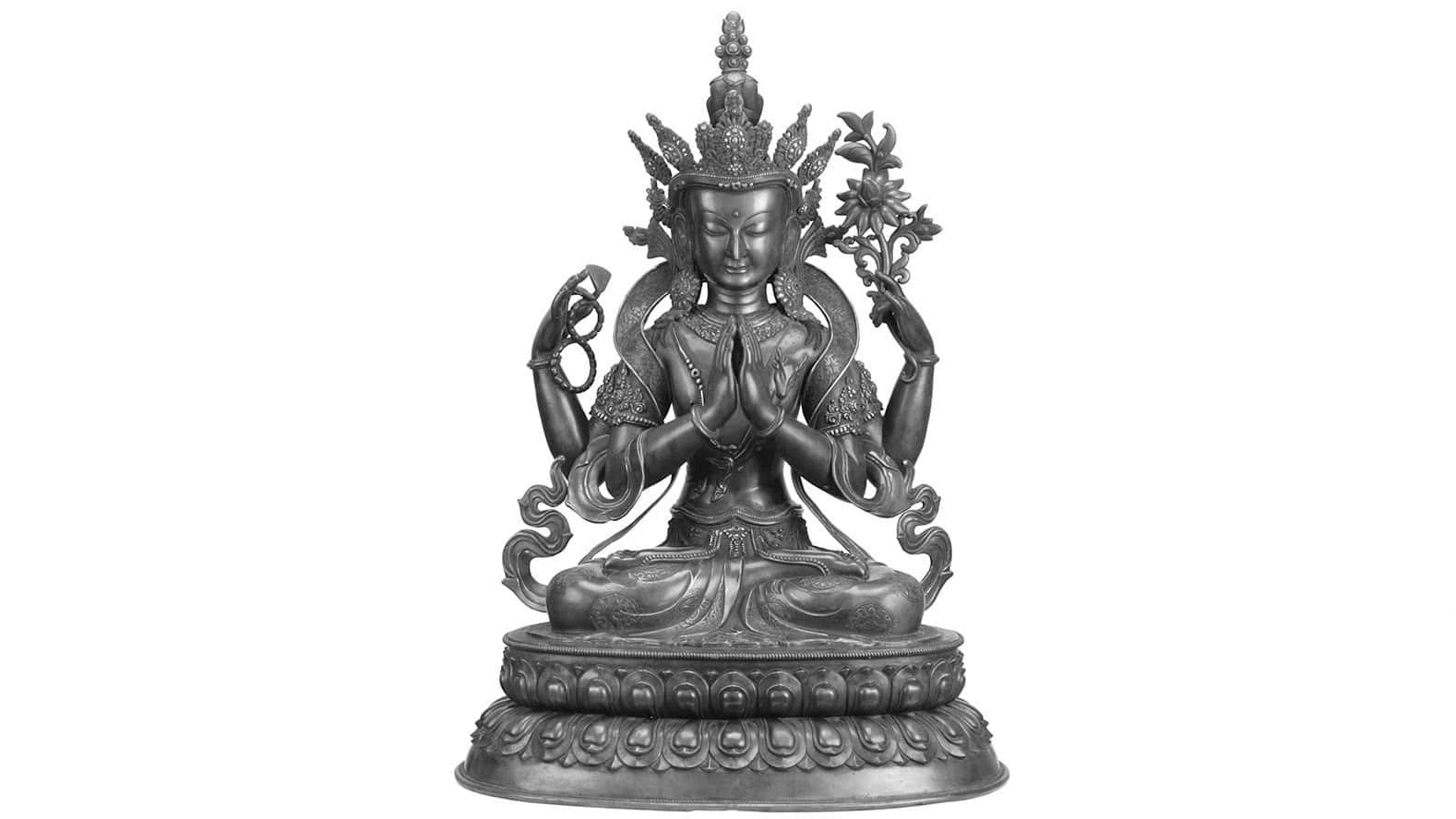
I was also pleasantly surprised that meditations automatically came to me in what might otherwise have been the most difficult times. In the process of being diagnosed, a young pathologist spent an hour repeatedly spearing a large bore needle, with the pressure of a staple gun, into my breast, while expressing her concern that she wasn’t hitting the tumor. My mind immediately connected with the experience of any being who finds itself being harmed physically. And the form of Loving Eyes (Tib. Chenrezig or Skt. Avalokiteshvara) and his mantra, Om Mani Peme Hung started playing in my head, despite the fact that it is a practice I seldom do.
On the day of my first two surgeries, I listened to a series of guided meditations on my iPod all morning during the preoperative procedures. This enabled me to go through some very painful, creepy experiences with my lama’s voice as my main focus. I could feel the pain but it didn’t bother me. My attention was on my lama’s voice and the meditation while the physical sensations were in the background. Often, during later treatments, the blue Medicine Buddha (Tib. Sangye Menla) appeared, or I experienced myself as him, his mantra repeating itself as I saw myself beaming his blue light to all who have ever needed or will need healing.
Fearlessness and Joy
Authentic lamas embody all enlightened qualities, and each transmits certain of these predominantly. My lama “specializes” in fearlessness, joy, and active compassion. Identification with the lama is our most potent Diamond Way method; and enlightened qualities vividly mirrored by our lama enable us to develop them. We are blessed to have certain practices, in particular the Phowa, that give us both the direct experience that we are not our bodies, and the ability to identify instead with mind itself. This training enabled me to write in a journal soon after diagnosis:
“…the brain is not the source of consciousness or awareness, but is rather the transmitter. Through our lamas and our meditation, we gradually recognize that we are not the body, but instead have a body that we can use as a tool to help others. This view changes everything. I know that it is what is making this easy for me so far…. I know my mind wasn’t born and won’t die. It doesn’t have cancer and is instead aware of this experience called “having cancer,” the procedures, etc. I know that not even cancer will last forever. One way or another cancer will end, treated successfully or not. Of course, it’s easy to say that now, before the real ordeal begins, but it is how I feel so far.”
And as it turns out, it was how I felt throughout.
It’s Impersonal!
I was lucky when I was diagnosed to have had many years of experience in meditation. Every time I meditated, as we are instructed, I had reminded myself of the Four Basic Thoughts, the second of which is impermanence. I knew that everyone dies, most get sick, and the “lucky” ones merely get old, which isn’t easy either. I never wondered, “Why me?” I thought, “Lots of people get cancer. This one took five to seven years to develop. Why get upset about it now that it has been diagnosed and they are going to remove it?”
This freedom from taking my situation personally enabled me to know immediately upon hearing my diagnosis that I wanted to wring every bit of usefulness from the condition and treatments. I had a great opportunity to learn and made a promise to use everything to benefit as many others as possible. That gave the experience meaning; and no matter what happened, part of me was assessing how I might use it to be a good example, or in teaching, or to relate to others.
My condition immediately let me know what it is like for someone whose life is threatened. During the ultrasound that preceded the needle biopsy, the pathologist reported a number to the tech. Suddenly, I knew I had cancer. Before I could register it consciously, my sympathetic nervous system responded with a “flight or fight” response—rapid heart rate, sweating, and an impulse to run. I realized that bodies have a life of their own and that my survival instinct had been triggered. Had I identified with my body’s reality, I would have been terrified. As it was, I was watching my body, amazed at its immediate, intense response, and was able to do deep breathing to help it calm. Lama Ole teaches that as long as we are in a body, it will prefer pleasant stimuli to pain. If we think we are our bodies, we suffer. If we know we have our body, we can recognize that it is like all other beings, wanting pleasure and to avoid suffering. We can observe it with compassion while using our minds as we wish.
Everything is a Blessing or a Purification
Lama Ole teaches us to view everything that happens as either a blessing to be shared with others or as purification, the result of negative impressions from past actions, words, or thoughts that have “ripened” or arisen in our present awareness. When the experience was unpleasant, I would remember that it was old karma ripening and leaving my mind-stream, or as Lama Ole describes it, “the tails of the tigers as they leave.”
There were a few nights during chemo when I had allowed myself to get too tired, and the fatigue made me feel discouraged. When I could change my view to recognize my deteriorated state as a purification, I could let it go, and say, “Go to sleep, Gretchen, you are bound to feel differently in the morning.”
The blessings in my adventure with cancer were immediately apparent and much more obvious than any pain or discomfort. The greatest blessing was seeing how worthwhile it is to practice meditation and study the Buddha’s teachings. My friends and family poured out love and support almost every day for a year. It felt awkward at first, but eventually, it was fun to be the center of so much attention after a life of attending to others. Kindness is a very powerful force. It was the only thing that routinely brought tears to my eyes, making my heart open and tender. Right after my diagnosis, a friend offered to drive me to all of my radiation appointments every day for seven weeks. My first thought was, “Oh, no, that’s too much!” But then I thought, “Wait a minute. You may need it and she needs to help.” I told her that I would keep her offer in mind and promised to let her know if I needed a ride. She was thrilled. I recognized that by graciously accepting people’s offers it gives them the joy of being helpful. I learned firsthand that the giver, the action or object given, and the receiver are all one thing. There can be no act of kindness or generosity without a recipient.
Trust Space
Lama Ole counsels his students to “trust space,” not by trying to force decisions but rather by waiting until the right time, for “conditions to ripen,” so we have enough information that the decision almost makes itself. This means exercising patience to trust that what we need will appear when we need it. Statistics on the kind of cancer I had show less likelihood of recurrence and death when chemotherapy is initiated within three months of surgery. I dreaded chemo! I wanted to be sure I really needed it. After much research, I was unhappy to learn chemo was warranted. But one of the recommended drugs had permanent toxic side effects—heart damage and leukemia risk. Rumors suggested that the drug might not be effective with the kind of cell I had, but the definitive study results wouldn’t be available in time for me. I needed to make a decision and the clock was running.
I had an appointment with my doctor coming up. I wanted to be able to tell him my decision so that he could schedule treatment within the three-month window. A few days before the appointment, my husband Jim called his sister who called her former boss, an oncologist and the head of a cancer unit at a big university hospital. He told her that they were no longer using that chemo drug with my kind of tumor, and he thought eventually nobody would. Just in time, the decision made itself. Months later, the week I would have finished all the doses, newspapers reported that the drug was ineffective for the type of tumor I had. It was a powerful lesson in “trusting space.”
Working With Disturbing Emotions
Towards the end of chemo, I made the following journal entry:
“I’ve been watching the “disturbing emotions” of greed and anger arising and falling away again and again in response to things…. This morning when I sat to meditate, I made a strong wish that I understand the root of these emotions and be able to transform them to their corresponding wisdoms, thus using them to benefit all beings.
Suddenly I realized I am lucky to be having these emotions. They are the material we use for transformation in Diamond Way Buddhism, one of our main methods. I have karma good enough to have a life with little frustration or emotional need. Because of that, I haven’t been able to really work with transforming powerful emotions. It’s a lucky thing, too, because until recently, I would have felt pretty helpless…. As soon as I recognized that these emotions are the stuff of transformation, I was thrilled! I have felt excited and happy all day. This despite being a physical wreck.”
The emotions diminished to nothing with that realization. Watching disturbing emotions come and go has become a source of entertainment. When one comes up, I can usually watch it like an interesting DVD. This is what Diamond Way meditation practice makes possible.
Living In The Moment
The Buddha taught that happiness is our natural state and is obscured when we either want what we don’t have, or try to get rid of what we don’t want, or are confused. Suffering is the product of the disturbing emotions that ensue from our attempts to force life to conform to our ideas. As I wrote in my journal:
“I know this cancer is treatable, but I realize now that anything can happen and I am both less optimistic and more settled. Hope and fear are the same: wanting things to be other than they are. Neither hope nor fear is useful right now. I have to just be with each thing as it is and not want it to be otherwise. It is the only way to be truthful, really, or sane.”
As our meditations promise, I had learned to “use my mind the way I wish” and was able to stay present, not wandering into anxiety or worry. I seldom lost sleep except occasionally from certain medications. Chemo was dreadful— six long months of gradual, creepy deterioration. I had to spend a lot of my time trying to treat or prevent multiple side effects using treatments recommended by my naturopathic physician. I could often feel my thoughts drifting into some future time when I would feel better and have energy to do things I love. But that is the essence of suffering—wanting things to be other than how they are in the moment.
So instead, I kept my attention focused on the present. There was always the “both/and” of the unpleasant experience and the awareness in which it appeared. In addition, my lama teaches that one of the most important qualities we can cultivate is gratitude. Anytime there was pain or discomfort, I could concentrate on my gratitude for how lucky I am to have the means to survive and the immense kindness of the people around me.
“If you focus on yourself, you have problems, and if you focus on others, you have lots of exciting things to do,” is something that I learned from my lama from the first days I knew him. Taking the Bodhisattva Promise transformed my life and professional work into enlightened activity and a source of joy. Because my work is sedentary—I am a counselor and my office is at home-—I was able to continue working through chemo and radiation. No matter how I felt, as soon as I turned my attention to my client, pain or discomfort disappeared from my awareness. It was immediate relief, better than any medicine.
One night, near the end of six months of chemo, Jim and I were getting ready for bed, laughing about something silly. He said, “You know, we’ve never stopped having fun!” It was true, and those words are an acknowledgment of the profound value of Diamond Way teachings and practice, the priceless gifts of my teachers. One never knows what will happen or how one will respond. If I have a recurrence or some other unfortunate condition, I don’t know how it will be. But this experience has left me confident that no matter what, I can truly take refuge in awareness itself, the Buddhist teachings that point to it, and all the people who have provided and continue to provide them.