
We are driving back on U.S. Highway 285 through the San Luis Valley in the shadows of the stunning 14,000-foot peaks of the San Juan and Sangre de Cristo mountains and, for the first time in this months-long process, we are upset. We started the three-and-a-half-hour drive from Denver to Saguache, Colorado at 6:00 a.m. with guarded optimism that the Saguache County Commissioners would give the final approval needed in the permitting process to purchase Dakini Ranch. This was the fourth time our team had made this trip in the last six weeks. We arrived promptly at the scheduled time. After ten minutes, the commissioners informed us that they had not received our application until that morning and would defer their vote in order to investigate the claims of our neighbors in opposition.
For the first time, this spectacularly scenic drive back to Denver seemed long, our earlier optimism only a memory tangled with apprehension. By the time we arrived back in Denver, Lama Ole had already received an update and sent these words of encouragement: “As so much good will happen at Dakini Ranch, karmic hindrances would be expected to manifest. Please go on with full power and all our wishes are behind you.“
Ten Years of Searching
While this temporary setback was disappointing, it was actually only a small hindrance, experienced by the latest of many groups of Lama Ole’s students over the last ten years to fulfill his wish to have this special place for a Diamond Way retreat center. From the start, this project came from and was motivated by Lama Ole’s own intuition and heart connections to Colorado. Just as with the other teams before us, we were not completely sure how the events would unfold, but we went on with full confidence that eventually the best outcome—fueled by our hard work and the lama’s wishes—would emerge.
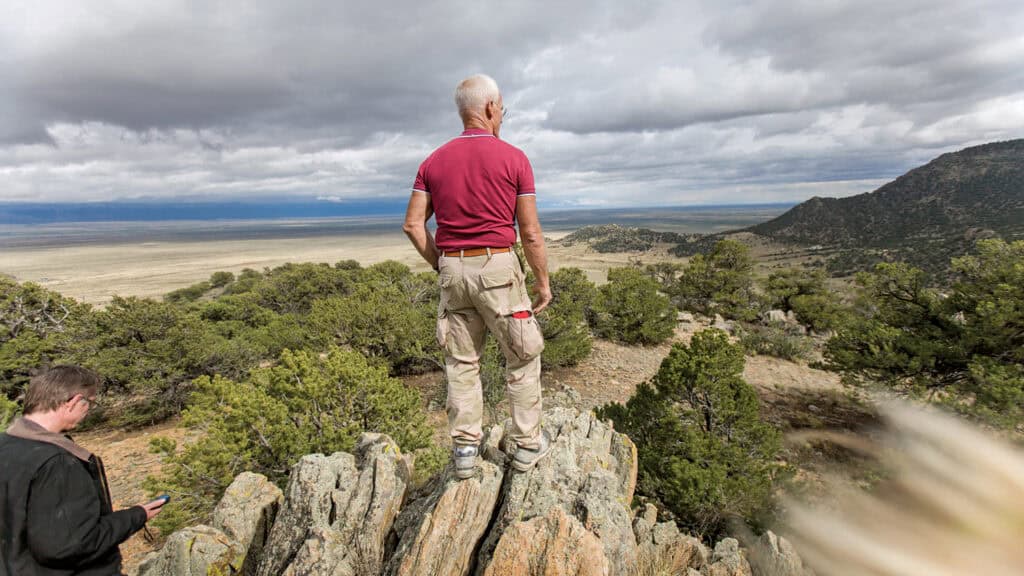
The 324 acres of land, known formally as Saguache Peaks Ranch, lies in the heart of the San Luis Valley of Colorado. It is a 122-mile long and 78-mile wide valley with an average elevation of 7,600 feet, bordered by the Sangre de Cristo Mountains to the East and the San Juan Mountains to the West. The ranch sits at 9,000 feet and supports stunning views of the valley and the surrounding 14,000+ foot peaks, which many have compared to the landscape of Central Tibet. With a population density of fewer than two people per square mile, this valley is officially classified as “frontier” by the US census.
Originally, Saguache Peaks Ranch had been subdivided into multiple small lots, but Sam Johnson, a businessman from nearby Salida, Colorado, slowly pieced together five separate properties into the one 324-acre property—the one that we were pursuing.
Starting the Search
Lama Ole first mentioned looking for a National Retreat Center for the USA in Colorado in 2003, after searches in California and the Pacific Northwest ended. While Colorado has a long and rich history with the Karma Kagyu lineage, including multiple visits by the 16th Karmapa, there were no centers under the guidance of Lama Ole at the time.
So, in 2005 a group of friends from around the country moved to Colorado Springs to locate this future retreat center. The San Luis Valley was an obvious focus because of its stunning views, secluded beauty, and history of importance for the Karma Kagyu lineage. In 1979–80 the 16th Karmapa visited Crestone and picked out the spot for a stupa at the southeastern end of the valley. People with Karmapa during this time remember him saying that this location would provide a safe haven for Karma Kagyu teachings. The stupa was built after the Karmapa’s death in 1981 and inaugurated in 1996.
Our team worked with Mal Sillers, a local real estate agent. After 5,000 miles of car travel and 1,500 emails, our team found Saguache Peaks Ranch and felt strongly that this was the right place.
An Enchanted Place
When Ole first visited this particular land in 2007, he knew that this was a place of power. Originally, he had given the instruction that the mountain view should look to the west of the land, but after surveying the land, he realized that looking to the mountains in the East and toward the future Europe Center was best. From his first moment on the land, Lama Ole describes having extremely unique, intense, and
“magical” experiences. When first driving onto the land, he described seeing a giant Garuda, whom he saw hanging over the mountains across the valley. It followed him onto the land. On his first drive up to the land, Lama Ole saw an old red pickup truck coming the other way, driven by a wild-looking woman with ever-changing facial expressions and erratic gestures. He called her a “wild Dakini.” The name Dakini Ranch, spontaneously given to this place by Lama Ole at a meeting in Albuquerque, suggests the direct, intuitive feminine wisdom in our tradition. Indeed, Dakini Ranch seems to be “an enchanted place where miracles will happen often,” as Lama Ole has said.
Death and Dying
Although Lama Ole has not yet given specific instructions for the future activity of Dakini Ranch, it seems that practices concerning death and dying are important for this land. One of the first things Lama Ole said when stepping on the land was, “I could die here.” Spoken by a Buddhist lama from a long lineage of masters that have chosen the time and place of their death, this is more than just a frivolous comment. Furthermore, Lama Ole has given Phowa—the practice of Conscious Dying—to over one hundred thousand students over the last forty years. On several occasions, he has visited a special place on the land where he and others observed large black birds crawling into a small crevice in the rocks to die there.
2008
After Lama Ole visited the land, he spoke about his excitement at each stop in his constant travels around the world. This project seemed particularly close to Lama Ole’s heart. Even on the day when the contract was signed for the Europe Center—the land in Immenstadt, Germany, that would become the world headquarters for Diamond Way Buddhism—students remember Lama Ole’s excitement about Dakini Ranch. He had received a panoramic picture of the land, and he was wrapping the panorama around students’ heads to give them “a 360-degree view of this place.” One student, who was with Lama Ole and his wife Hannah during the final months of Hannah’s battle with cancer, remembers this panorama of Dakini Ranch as one of the few pictures hanging in the room.
Another Change of Direction
Throughout 2008 the local team in Colorado had prepared to purchase Saguache Peaks Ranch, including water and well permits and permission to use the land for large retreat gatherings. By the fall, everything was in place. The funds were raised and the permissions granted. In spite of the excitement and the groundwork, three days before the closing date, Lama Ole called the local team and told them that the Diamond Way organization was not going to buy it. With the 2008 financial crisis just beginning to gain steam, Lama Ole had performed a series of divinations, the results of which strongly suggested that this was not the right time to purchase the land. This was a sudden change of direction, even for Lama Ole. His heart was so connected to this land that he said, facetiously, that it was the first time that he had considered not taking the Buddha’s advice and buying the land anyway. In the end, he did follow the Buddha’s advice and canceled the deal. It was decided to donate the earnest money and more to Sam Johnson for his time, patience, and understanding. By that time, Lama Ole and Sam had become close friends. Sam understood the reasons for our stopping the deal and said, “You are the perfect people for this land, and it will be waiting for you.” A few days later, Sam took the land off the market. We later learned that Sam took the money we gave him and invested it in further improvements to the land. It also had a special place in Sam’s heart. Lama Ole could not completely let the connection go, and a small 35-acre parcel of land, almost adjacent to Saguache Peaks Ranch, was purchased.
Because of the decision to pull out, there was an evolution of the North American Retreat Center Project from the focus on one national retreat center to several regional retreat centers. These would be located on the West Coast, in the Midwest, and along the northeastern corridor of the United States. Within two years, the Western Retreat Center in California and the Heartland Retreat Center in Wisconsin were founded, and a scouting team in the Northeast began their search.
In Colorado, the Denver center grew. A national team continued to make small improvements to the 35-acre parcel and to develop a vision for its future.
Colorado Never Left the Lama’s Heart
From 2008-2013 Lama Ole continued to talk worldwide about the Colorado land. In January of 2013, at an International Foundation meeting, Lama Ole again expressed a specific interest in having a retreat center in Colorado. A month later, we received news from Mal Sillers, our real estate agent in 2008, that Saguache Peaks Ranch was on the market again, now for half the 2008 price. Perhaps Lama Ole had seen this potential at the start of the year. Now the conditions seemed perfect for moving forward.
An international fundraising campaign was launched, and with Lama Ole’s unstoppable enthusiasm, the necessary funds were quickly raised. We also launched a worldwide push to collect 10.8 million Karmapa Chenno mantras to support the project. We resurrected all the documents that the team had prepared in 2008 and resubmitted our application for a Conditional Use Permit (CUP) to allow us to use land for a retreat center. Since all of these permits had been approved in 2008, we hoped everything would move forward quickly.
Connections in the Community
We also discovered a number of amazing connections already in the community. On July 4, 2013, forty-five friends visited the land and stayed in the local town of Saguache, population 493. In a kind of synchronicity, we made some very important connections. We met the owner of a local art gallery and, after a few minutes of friendly small talk, discovered that she had once served lunch to the 16th Karmapa and Jamgon Kontrol Rinpoche. We also connected with another local shop owner who just opened a new organic grocery store and used to own a retreat center in Colorado. In the evening, we attended a local concert and, afterward, shared some drinks with the local musicians and the owner of the theatre. Toward the end of the evening we learned that Jeff Shook, the drummer for the band with whom we were sharing stories, was a member of the Planning Commission making a decision on our CUP and was one of our main supporters back in 2008.
Hindrances Appear
All of these connections would become incredibly important in the next few months, as one major condition had changed since 2008. Our immediate neighbors now opposed the project. After we submitted our CUP application for public review, we received some strong opposition. Our neighbors presented their arguments at our first meeting with the Planning Commission. The Planning Commission deferred a decision for a month and chose to do a site visit. Although it was not an easy decision for the Planning Commission, they ultimately voted to recommend approval of our CUP to the County Commissioners.
At this point, we had already begun a cautious celebration. We were told that the County Commissioners generally take the recommendations of the Planning Commission. This would not be the case this time. The county commissioners wished to do further internal investigation. Hence, we find ourselves back at the beginning of the story—loading into our vehicle for the long drive back to Denver.
The Final Decision
A month later, after another round-trip drive and another site visit, our team was again leaving in the early morning for Saguache for a final vote on our CUP. While we still completely trusted that we would be successful, our external moods were not as optimistic as before. The leanings of the County Commissioners were difficult to read during the site visit, and the emotionally charged arguments from some neighbors might have been taking hold in the minds of the commissioners. We had also learned that the sentiment of our neighbors had an historical basis. There had been some issues with different spiritual groups located in Crestone (at the southern end of the San Luis Valley) over the years, causing some polarization in the community. While many authentic spiritual groups exist in Crestone, there are others with questionable reputations. We had prepared a new set of arguments that, in addition to addressing the technical aspects of our CUP application, explained how Diamond Way Buddhism has an authentic 2600-year-old transmission through the seventeen Karmapas and back to the Buddha Shakyamuni and has powerful methods for recognizing the nature of our mind to benefit others.
We arrived at the small meeting hall and saw that our neighbors were there and had grown their entourage of support from the month before. We were also pleasantly surprised that our new friends, including Jeff Shook, were also there. The commissioners heard our neighbors’ arguments again, and Jeff took the floor. With his years of experience in local planning and economic development work, he presented support for our project as a private citizen. When it was the seller’s chance to speak, Sam said, “Well, I had all kinds of arguments prepared but Jeff has said everything I would have said, only more eloquently.” While Jeff was speaking, we learned that Lama Ole was on a bus tour with friends in Europe and had stopped the bus to meditate and make wishes for our success. Our local team added a few more statements and then it was time for the commissioners to take a vote. They praised our professionalism and style, and then voted: two in favor and one abstention. Success!
Inaugurates Dakini Ranch
We received official approval of our CUP on November 19, 2013, and finalized the sale on November 20. Six days later and five years after first visiting Saguache Peaks Ranch, Lama Ole inaugurated the land as Dakini Ranch, the newest Diamond Way Retreat Center. We were joined by Sam Johnson, Jeff Shook, and ninety friends from around the world. Again, it was a magical day. It had been snowing for three days before our visit. Thanks to beautiful sunshine, a virtually cloudless sky, and our heroic friends who cleared the road, we were able to approach the land.
Four miles from Dakini Ranch, we suddenly hit a wall of fog and could not see ten feet in front of the vans. Jeff Shook, who has lived in the area for thirty-one years, said that he had never seen anything like it. We were all concerned that our visiting friends would not be able to see the inspiring views. But, as we approached the entrance to Dakini Ranch, we rose above the dense bank of fog, into complete awe. Lama Ole saw this as a great sign. He said, “It is like being born into a pure land.”
At Dakini Ranch we toasted our success with some champagne, and Lama Ole and Sam reconnected and expressed heartfelt words of gratitude to each other. As Sam officially passed the land to Lama Ole, he teared up and said, “I’ve done things up here over the years and I never really understood why. Now I understand.” Jeff said that this day was one of the most inspiring he has experienced in all the years he has lived the San Luis Valley.
After hiking the snow-covered land, we left for Denver, just as the sunset reflected on the Sangre de Cristo Mountains in the full range of colors of the rainbow in sequence. In the van, Lama Ole said, “These mountains show the rainbow, one color at a time.” Jeff Shook explained that one reason the mountains were named the Sangre de Cristo (Blood of Christ) by the Spanish is that often the sunset ends with just a thin brilliant red line of light outlining the mountain range that Lama Ole has said looks like the Red Dakini laying on her side.
The Future
The specific activity of Dakini Ranch will take some time to unfold. The CUP currently limits its use to one large gathering of three hundred people and maximum water usage of one hundred and eight thousand gallons, and this will be reviewed annually. Many in the community have welcomed us, but others still need time to warm up. A vision for future development needs to be finalized.
We will move forward, trusting that the most useful activity will emerge, and following the intuition of Lama Ole and the wisdom of our lineage. We know that we now have an immensely beautiful place to support our development and our meditation in a power place for Buddhism and the Karma Kagyu lineage in the USA.
Photo credit: Marcin Muchalski | Diamond Shot Photography Studio, NYC


