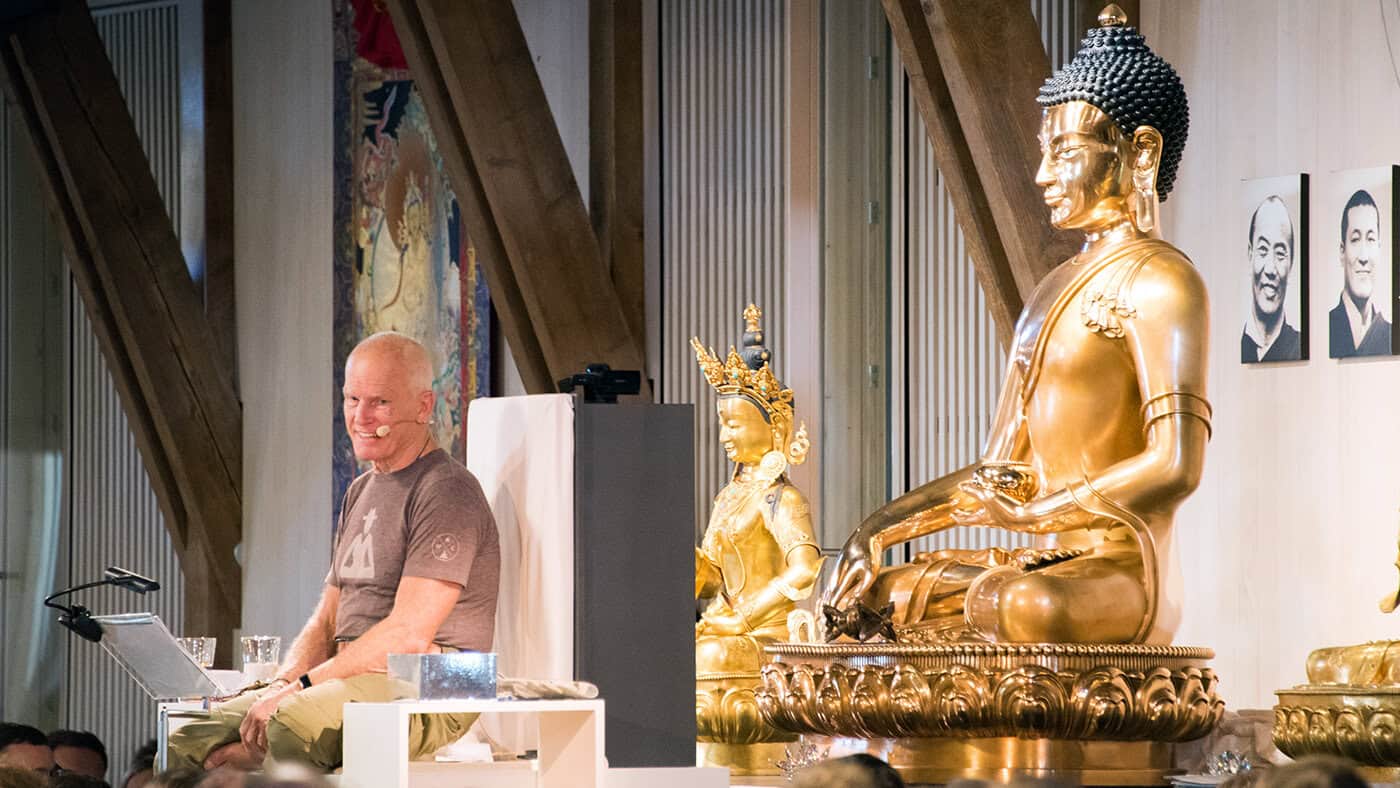
In 1974, the 16th Gyalwa Karmapa Rangjung Rigpe Dorje made you his representative in Europe, with the now famous quotation “In the person of Jigme Rinpoche, I give you my heart.” Was it a surprise to you, to be put in this position in Europe?
Actually, it was not really a surprise, because all of us who were around Karmapa just did whatever Karmapa’s activity needed. Before Karmapa had decided that I should stay in Europe in 1974, he had already said that Buddha’s teachings are very important for every part of the world where there is no Dharma yet. I felt it was very important to follow everything that Karmapa was saying, and have continued to stay in Europe since then. The conditions here were difficult in the beginning, but when Karmapa told us to do something we were just willing to do it and to serve the Dharma for the benefit of sentient beings.

I would like to be more precise with something in connection to the sentence you just quoted. I think the reason for His Holiness Karmapa to say “In the person of Jigme Rinpoche, I give you my heart” is rooted in the Kagyu tradition. For example, once Marpa had accomplished his path, Naropa was calling him “my son” or “my heart,” and the same went with Milarepa from Marpa. One should not understand it in an emotional way; it is a way in which a master relates to his disciple.
Did the 16th Gyalwa Karmapa give you detailed instructions on how to work in Europe?
Karmapa told us that it is important to bring the dharma to Europe. I would like to say that the sole purpose of this is to give access to the values of the Buddha’s teaching to those who were interested in applying it and benefiting from it. Karmapa talked about how to give teachings, how to preserve the Dharma and how to settle here. For this to happen, teachings should be given to the public, and also to people who wanted to do Buddhist practices. Karmapa also wished for the establishment of facilities for the texts of the teachings of Buddha and the texts for the practices. He gave detailed instructions about this.
This is now forty-eight years ago, and during this time many of these things developed. Many could be done, but some not yet. We really tried, though, to follow the advice that Karmapa gave.
Can you tell us what you heard from the 16th Gyalwa Karmapa about his ideas and wishes for Karma Kagyu in the West?
Karmapa wrote down some topics that were important to him. One of them is to give general Buddhist teachings to the public. He said it is very important to plant the basic Karma Kagyu teachings in the West, and he even made a list of the teachings that we had to study for this. These were mainly teachings by the 8th Karmapa Mikyo Dorje, the 7th Karmapa Chodrak Gyamtso, and other different lamas, like the Shamar Rinpoches and Jamgon Kongtrul Rinpoches. Besides this list of study topics he told us to practice the meditations of our lineage that Marpa had established, we call it Gyude.1 Karmapa explained very clearly how these practices should be established in the West, and talked also about how these meditations should be guided with the right instructions, according to Karma Kagyu tradition.
Some years ago you became the General Secretary of the 17th Gyalwa Karmapa Trinley Thaye Dorje. Did he give you some specific ideas and wishes for Dharma in the West that you can share with us?
My function as General Secretary is mainly in regard to the Rumtek monastery in Sikkim, the Buddhist university (Tib. shedra) in Kalimpong (West Bengal/Darjeeling in India), and the shedra in Sharminub (which is in Kathmandu in Nepal), which have to be taken care of. But what the 17th Karmapa said about such activities was very similar to the wishes of the 16th Karmapa. Besides that, he did not say anything precise or specific about the dharma in Western countries.
Since the parinirvana2 of Gendun Rinpoche and the late Shamar Rinpoche, you took on much more responsibility in the Western Karma Kagyu organizations that they had established; Bodhi Path and Dhagpo Mandala. Can you tell us a bit about that?
Gendun Rinpoche’s main responsibility was what I mentioned before: to pass on and establish the transmissions of the practices from Marpa and Rechungpa, like Khorlo Demchog, Gyalwa Gyamtso, Dorje Phagmo, and Black Coat (Skt. Mahakala). He gave detailed explanations about them, and some people did the practices. Then gradually people who do the practice will get accomplishments. Taking care of this is not an extra heavy duty for me, but keeping continuity here is very important.
Shamar Rinpoche aimed his teachings very much for the general public’s benefit. He taught a simple way of how to apply the practices. We try to establish this gradually, according to the needs of the people. Also, this is not heavy-duty, but a matter of time, of introduction to the people, and then of what people want. It’s about a far-sighted vision of the work.
Can you tell us how you first met Lama Ole and Hannah? Was that in 1969 in Kathmandu where they met the 16th Karmapa for the first time?
Actually, I did not meet them at that time in Kathmandu, but the next year, when they came for the first time to Karmapa’s monastery in Rumtek, Sikkim. From that time on until today I was always in connection with them.
We heard from Tibetans that the 16th Gyalwa Karmapa prophesied that Lama Ole and Hannah would have a big role in spreading the Karma Kagyu to the West.3 Did you witness some of his words about that?
The 16th Karmapa said that the work of Ole and Hannah would be very beneficial for the introduction of dharma in Western countries. Karmapa said that both of them—due to the blessing, their effort, their connection—were very successful in their work in the West; successful in the way that they laid a lot of preparations for the Karma Kagyu teachings to be planted to a big extent in the future. When the result of this planting will come, it will provide a lot of support for the next generations of Buddhists.
Through their work, the activity of the 17th Karmapa Thaye Dorje in Western countries was much easier. The Dharma had been introduced to the Western population very well and also Karmapa’s name was already well-established.

We want to quote something longer before our next question, from one of your articles in the German edition of Buddhism Today:
Karmapa often said that we should be like Lama Ole because his mind is one-pointed. He used to say, “If your mind is one-pointed, you will get results.”
Karmapa himself said, “Ole and Hannah have a lot of trust and that’s why I can trust them too. They are very single-minded and will have very good results.” I remember those remarks well.
This single-mindedness, which we already saw in Lama Ole at that time, has obviously led to good results around the world. Such success is something many wish for, but few achieve. Lama Ole and Hannah, in bringing so many people around the world to the Dharma, have done something very important. Through their connection with Karmapa, they have been able to give others a glimpse of Karmapa’s inspiration and qualities and devotion to him. They were able to bring many people into connection with Karmapa.
Once you make up your mind to do something, you never turn back. I learned that from when the 16th Karmapa said, “Lama Ole is one-pointed.”4
Can you talk a bit about this special quality of being so one-pointed? Is it also connected with devotion and with the pure view?
For this one-pointedness, you have to have a strong devotion to following Karmapa. If you can do this, and, for example, you want to bring beings to the Dharma, you will be very successful. If you apply this devotion in your practice, it brings you to liberation.
All the Karma Kagyu masters of the past talked about how important devotion is because through devotion you get the blessing. By the combination of your devotion and the blessing, your goal can be achieved. This was the main emphasis of all these masters, and through this many people got liberated. It is a very simple practice, but the result is a very high level of realization.
Today there are three big Karma Kagyu organizations under the 17th Gyalwa Karmapa Thaye Dorje in the West – Diamond Way, Bodhi Path, and the Dhagpo Mandala. You have an important function in all three of them. In one article in the German Buddhism Today magazine, you said:
Lama Ole and I developed slightly different styles over the years, but the vision behind it is the same. The essence of our work is not so different, and I think that is very important: we follow the direction shown by Karmapa and because of that we can benefit people.5
Can you give your view about how the three work together and fulfill different functions in Karma Kagyu in the West?
In Diamond Way, Lama Ole gives the teachings that make it possible for many people to practice Buddhism. The method for this is to not use many different teaching topics, but instead, a very simple way. In this way many people can apply these practices.6
Shamar Rinpoche developed Bodhi Path, and that is similar: basically a very simple way of practice. In the case where sometimes one is missing important teachers for guidance, some study programs are helpful to improve one’s practice. It is similar to Diamond Way, but you have a combination of several practices and study-programs, which gives some self-sufficiency.
Gendun Rinpoche developed the Dhagpo Mandala according to the instructions of the 16th Karmapa. Here there is a lot of variety in the practices, and that is more difficult to do than in Bodhi Path and Diamond Way. The teachings and practices themselves are not so difficult, but it is a question of the capacity of most people. It just takes much longer to engage in the application of these practices.
The Dhagpo Mandala is very important in order to preserve all the practices that Marpa and Rechungpa brought from India to Tibet. If European people aim to preserve this quality of the practices and properly apply and engage in them, then this quality can remain and settle in the Western countries. But this is not so easy; it also needs the aforementioned one-pointedness and devotion. When people appear with such qualities in their minds and some of the instruction-teachings have already been established in Europe, they can then apply them and get results.
You witnessed how Kalu Rinpoche and Chogyam Trungpa Rinpoche discussed with the 16th Gyalwa Karmapa their particular styles of teaching Westerners. Did you hear anything that the 16th Gyalwa Karmapa said about the people that will come to Karma Kagyu through Lama Ole and Hannah, and how to guide them?
Kalu Rinpoche and Chogyam Trungpa Rinpoche were a little bit similar in their teaching structure but had different styles of teaching. Kalu Rinpoche gave more traditional instructions for tantric practice, and Trungpa Rinpoche gave such tantric teachings much later, after a lot of very basic preparations.7
What Lama Ole and Hannah developed in Diamond Way is basically similar, but specially adapted to the people who came as students to Diamond Way.
Many people in Diamond Way practice by doing the Foundational practices (Tib. Ngöndro) one or more times; parallel to that, and later they mainly do Guru Yoga on the Karmapas especially; while receiving Mahamudra-Transmissions. In one of your articles in the German Buddhism Today magazine you said:
In the Diamond Way Buddhism, as you are taught by Lama Ole Nydahl, the first and most important aspect is the connection with Karmapa. To be subconsciously always in contact with Karmapa is something really big. By applying the Guru Yogas every day, you are always protected, blessed, and in connection with Karmapa.8
Can you explain a bit how that works?
This is linked to what I talked about before. The Mahamudra teachings will lead you to a recognition of your buddha nature, which gives you the capacity for liberation, in a similar way to all the old masters and yogis who practiced like this. In order to realize your buddha nature, you can, on the one hand, apply the practices—but you also need a lot of blessing, and for this, the Guru Yogas on Karmapa are so important. Through the blessing of Karmapa, you can really realize your buddha nature when you receive instructions on it. Otherwise, these instructions are just words, and it would be difficult to realize buddha nature just by hearing them. You won’t realize your buddha nature properly without correct instructions and without blessing. For this, you definitely need blessing, especially Karmapa’s blessing. This is most important because Karmapa is a high-level bodhisattva, and his wishes carry blessing.
To be really able to receive the blessing, we have to apply different methods, for instance, the Foundational Practices. They reduce the obscurations of emotions, tendencies, samsaric worldly concepts and so on, because at the moment our mind is obscured by different conditions, mainly former negative deeds. On top of this, in the Ngöndro there is also a part for improvement and the development of our capacity through merit.
So, the reason for us to do Ngöndro is first of all the purification of obscurations due to former negative deeds and, secondly, accumulation of merit to develop our nature. The last part of the Ngondro then is Guru Yoga, to receive blessings and through this to get the realization of our buddha nature, which will prevent us from falling back into a samsaric life.
In Diamond Way we use, among the different Guru Yogas that exist in Karma Kagyu, mainly the ones on the 16th and the 8th Karmapa. Can you explain a bit about Guru Yoga compared with methods such as the Path of Naropa and the Path of Maitripa?
Actually, in the 16th Karmapa Guru Yoga, it is all complete, it is all contained here.9 It was Karmapa’s advice to Lama Ole and Hannah to use this method, I heard. There are so
many instructions in Karma Kagyu, but, in order to bring a lot of people from the Western population in touch with Dharma, Diamond Way’s very simple and effective practices are most important. This must be the reason the 16th Gyalwa Karmapa gave that advice to Lama Ole and Hannah.

The 16th Gyalwa Karmapa told Lama Ole and Hannah, “Don’t do a Three Year Retreat, but develop the centers! You will have the same results by doing this.” They taught their students in a similar way, and so Three Year Retreats were not emphasized very much in Diamond Way. Can you say something about this?
The Three Year Retreat is a specific way of practice, for which you need specific guidance. Karmapa told Lama Ole and Hannah that they don’t need to do that, and this is because of Karmapa’s blessing, I think. They received the Karmapa Guru Yoga directly from him as their practice and for their students.
I think the benefit of a Three Year Retreat depends a lot on how you apply it. It is a very important method, but if you cannot apply it properly then it can also lead you in the wrong direction. Only with very proper guidance will there be worth and value.
Karmapa’s instructions to Lama Ole and Hannah were to help many people in the West to come to the Dharma. For this, very simple and effective practices are better than difficult and complicated ones.
One of the unique aspects of Diamond Way is the Phowa Courses that Lama Ole gave extensively over many years, from 1987 to 2014. Was Phowa in Tibet ever given so widely?
Actually, in Tibet, many lamas gave Phowa often, but nowadays not so many do it. Lama Ole decided to give the Phowa, and that brought a lot of benefits to many people.
Lama Ole and Hannah were free from the restrictions and entanglements of Tibetan society and could openly oppose Situ Rinpoche, Gyaltsab Rinpoche and others during the Kagyu controversy, beginning in 1992. Can you say a few words about in what way they were very important for supporting the 17th Karmapa Thaye Dorje in this situation?
At that time, at the beginning of the controversy, Lama Ole and Hannah followed Shamar Rinpoche’s instructions. The main goal was to not let the 17th Karmapa “disappear.” And now we see the important result of that effort: Karmapa is here! If at that time there would not have been a lot of effort, the 17th Karmapa would not be really present today.
Many people in Diamond Way feel a lot of openness to Lama Ole, as they came to know him closely and received so much from him. On the other hand, we meditate on the Karmapas, but most people cannot come to know Karmapa personally, which makes it more difficult to really open up to him. What do you think about this, as you always emphasize the connection to Karmapa a lot?
People have to somehow connect to Karmapa. Otherwise, they cannot have that devotion I talked about. My feeling is that Karmapa should really be here in the West often, and people should have the possibility to get close to Karmapa. Without teachings, practice and connections it is difficult to get the devotion. Karmapa should often be present for his followers.
Is there anything else you would like to share with the students of Lama Ole and Hannah on this special occasion in 2022?
The Diamond Way organization has existed for fifty years now, and during all that time Lama Ole gave teachings to people who were open to it. What he and Hannah established has to be continued. The followers of Lama Ole and Hannah should not lose their confidence, regardless of obstacles and conditions. You have to go on, because the teachings that you received should result in your liberation, so that you will not fall again into the samsaric conditions of suffering. Therefore, it is of the highest importance to continue to apply the teachings and practices.
- Gyude Chunyi, in full Gyude Khyilkhor Chunyi, comprises all the great practices such as Gyalwa Gyamtso, Khorlo Demchog, and Dorje Phagmo, etc. ↩︎
- Buddhist honorific expression for the death of enlightened masters. ↩︎
- Several Tibetans have said that the 16th Karmapa said to them that, while the Tibetans would like to believe that one day they would return to Tibet and everything would be like before, this will not happen. Instead, the work of Lama Ole and Hannah would spread the Karma Kagyu lineage throughout the world and thereby help to preserve its teachings. ↩︎
- Quote from the German Buddhismus Heute, No. 51. ↩︎
- Quote from the German Buddhismus Heute, No. 56. ↩︎
- Practices such as the Ngöndro and the Guru Yoga on the Karmapa used in Diamond Way are very profound yet simple, in that they are easy to use for people in modern life. They don’t require practitioners to do a lot of theoretical study or long meditation retreats, or require a lot of knowledge about rituals. ↩︎
- Jigme Rinpoche suggested that we briefly explain more about the two approaches. Rinpoche talked about this some months ago during an online lecture. He was present when Kalu Rinpoche and Chogyam Trungpa Rinpoche explained to the 16th Karmapa how they were going to train Westerners: Kalu Rinpoche said to Karmapa that he would give Refuge first, then let people do the meditations on the Buddha Loving Eyes (Tib. Chenresig) or Liberatrice (Tib. Drolma). In this way, they became prepared to do the Foundational Practices (Tib. Ngöndro). He said that in order to keep people from developing wrong ideas, it was important to really take refuge in the beginning, before getting a lot of teachings and meditations. Chogyam Trungpa Rinpoche told Karmapa, that Westerners’ minds are very intellectual, influenced by science, and in that way difficult to teach. He developed an approach where people were just sitting (not really in Calm Abiding meditation (Tib. shinay), but just sitting with awareness, similar to the Zen method called Shikantaza) for six years, before they were to get more teachings and refuge. Then they could start the Foundational Practices. Like Kalu Rinpoche, he wanted to avoid people getting wrong ideas that might cause them obstacles later. ↩︎
- Quote from the German magazine Buddhismus Heute, No. 58. ↩︎
- See Manfred Seegers, Buddhism Today, No.10, pp. 34. ↩︎
Featured photo credit: Lukas Richter