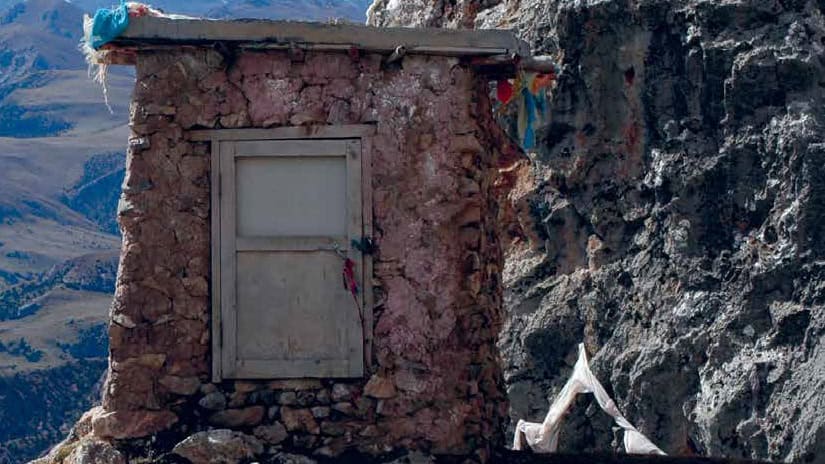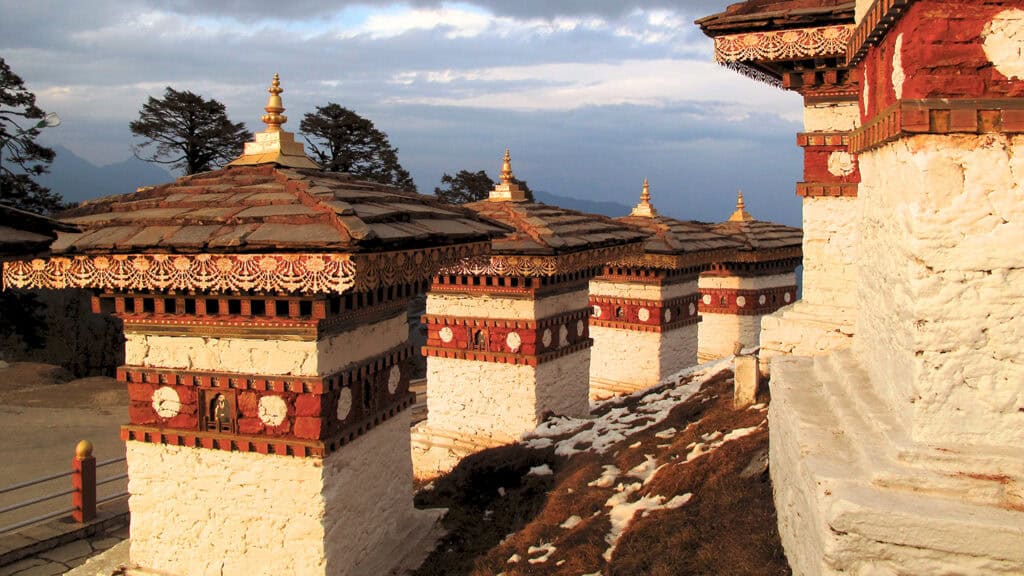
People of all religions feel the power of special places throughout this world. There are some places that are simply different. They can give inspiration, shake us out of our daily emotional trips and remind us about what is really important. They give a feeling of support on one’s spiritual path. For these reasons, in all religions pilgrimage to holy places became a spiritual practice unto itself.
At the start of our Bhutan Pilgrimage in spring 2008 we asked the 17th Karmapa Trinley Thaye Dorje what would be the best mental attitude with which to approach a Buddhist pilgrimage. He emphasized “devotion.” He told us it was important to remember what our great masters had achieved by working with their minds in these holy places and to remember that we all have this potential within us. Visiting holy places can induce this devotion and therefore advance our practice. Professor Sempa Dorje, currently the main teacher of the 17th Karmapa, emphasized later that information is also important in order to understand the meaning of the holy places, what has happened there and who meditated there.

Buddha Shakyamuni recommended pilgrimages in the Parinirvana-Sutra. He mentioned four places that were connected with significant events in his life: Lumbini, the place of the Buddha’s birth; Bodhgaya, where he attained enlightenment; Sarnath, where the first students were taught; and Kusinagara, where he passed away. In the same sutra, Buddha said that these places were so special that anyone who died on a pilgrimage to one of them would go to a pure realm.
Later on in the history of Tibetan Buddhism, pilgrimage became a very popular and widespread practice. Every Tibetan dreamed about paying a visit to the holy city of Lhasa or to Mount Kailash at least once in his or her lifetime. Still today you see people of all ages from Kham making prostrations all the way to Lhasa. The efforts and hardships of these long journeys give a huge amount of merit to the mind of the practitioner and purify a lot of bad karma.
At a holy place the blessing is used as a boost for development. Everything done with body, speech and mind will be magnified there a million times. Practitioners enjoy the power and blessing of the holy places and at the same time use them actively for working with their own minds. Just being in the place has special meaning and everything you do there makes deeper impressions in the mind. Guru Rinpoche once said that just one day of meditation at such a place brings us closer to enlightenment than one year of meditation at an ordinary place.
So what are these places that can have such a strong influence on us? The idea of a distinction between “ordinary” and “holy” places comes from our relative level of experience. Being stuck in likes and dislikes, ideas of good and bad, beautiful and ugly we clearly experience differences in our world. Somebody with an experience of absolute reality, an enlightened person, would not make this distinction. For him or her, the whole world is a pure realm and inherently “holy.” For us, when we look at a beautiful stupa in the mountains, the all-inherent purity and perfection is easier to sense there than in a big-city ghetto.
The Tibetan word for such “power places” is ne. Making a pilgrimage is called ne-khor, with khor meaning “circle.” The word ne-khor hints at the traditional practice of circumambulating holy places, as is commonly done at Buddhist stupas. The word for circumambulation in Tibetan is khora. According to some lamas, there are two different kinds of power places: “self-arisen power places” (Tib. rangjung ne) and “blessing-power places” (Tib. dschinlab ne).
Self-Arisen Power Places
These are sites that have a special power all on their own. The power can be felt by many people, both Buddhists and non-Buddhists. The energy in these places is not dependent on what may have happened there in the past, it is just naturally present. For example, Mount Kailash in West Tibet is venerated as a holy mountain by both Hindus and Buddhists.
Mythological explanations for such places are given in the tantras. In the Tantra of “The Buddha of Highest Bliss” (Tib. Khorlo Demchog, Skt. Chakrasamvara), it says that a long time ago, the universe was ruled by a very negative being. At certain places in the world lived his retinue, consisting of gods, ghandarvas, ghosts, demons, nagas, asuras, etc. To end this negative rule, Buddha Diamond Holder (Tib. Dorje Chang, Skt. Vajradhara) assumed the form of Buddha of Highest Bliss and subjugated all these beings. All their residences were blessed and became power places of wisdom beings inside the mandala (also known as the powerfield) of the Buddha of Highest Bliss.

The vajrayana provides a very profound view of these power places and by understanding it when we are there, pilgrimages can bring us in closer contact with our innate wisdom. The tantras explain that there is a relationship between the so-called “outer,” “inner” and “secret.” Objects and places in the outer world—e.g. mountains, rivers, lakes, planets etc.—all correspond to inner energy channels, energies, and energy-points (Tib. tsa, lung and thigle) in our subtle body, and on the so-called secret level both correspond to the powerfields of certain enlightened beings. In India, for example, there are 24 outer power places that correspond to 24 inner energy channels, energies and energy-points within our body, and on the secret level to 24 wisdom beings (Skt. dakas and dakinis). You can say that these wisdom beings live at these holy places and in your body. Since mind is the basis for all that can be experienced, the inherent connection between outer phenomena, inner subtle energies and enlightened power fields begins to makes more sense.1
A person without a lot of realization would simply see these places as ordinary mountains. But an enlightened being would see these mountains as the residences of enlightened energies. The 16th Karmapa once explained to Lama Ole and Hannah Nydahl from his direct experience that the chain of mountains one could see from Rumtek Monastery were the residences of different buddhas. He actually saw them like that!
Whole areas can even exist in relation to certain buddhas. In these places the buddha-aspect is sort of “embedded” in the landscape and all the features of the landscape correspond with certain parts of the buddha’s body. The most famous example of this is the beyul Pemako (beyul means “hidden land”) in the border-area of southern Kham and the Indian state of Arunachal Pradesh. Here, the female Buddha “Red Wisdom” (Tib. Dorje Phagmo) manifests, and all the mountains, rivers, lakes, etc., are related to different aspects of her form.
Blessing Power Places
These places became holy places because something significant happened there. Often great masters practiced here or showed special miracles. In India, these places are connected with events in Buddha’s life—the place of his birth, his enlightenment, and his death. In the Himalayas, these places were blessed by later masters such as Milarepa, Guru Rinpoche, and the Karmapas. Over the ensuing centuries, many other great masters came to these sites to practice, and so they became blessed even more.
Beyuls, or “hidden lands,” are a kind of blessing power place. Guru Rinpoche blessed 108 specific areas and said that in future dark times they would serve as places of refuge for practitioners. On our pilgrimages in Bhutan, a couple of our friends felt their power the night before we entered the beyul Bumthang in Central Bhutan through special dreams and strong experiences. Though beyuls are not pure realms, one can more easily sense the all-inherent purity within them. Everything that happens to us there has a special meaning and everything we do has more power. Pemako, in the area where the river Tsangpo enters India from Tibet, later becoming the Brahmaputra, is considered the most excellent of these “secret valleys.” Other famous beyuls are Yolmo, Rolwaling and Khenpalung in Nepal.
The most important thing to do at such a place is to make strong wishes. This is a practice called monlam in Tibetan, or “path of wishes” in English. It is one of the ten liberating actions that bodhisattvas perfect on the 8th bodhisattva-level. Every time we make a wish, a seed is planted in the mind. When the right conditions come together the wish will be fulfilled. How fast and to which extent this will happen depends on several things, including the conditions under which the wish was made. Wishes made in the presence of great teachers or at holy places have more power and will come to fruition more quickly and powerfully.
As long as we are still under ego-illusion, making wishes can also be dangerous. If we are more concerned about our own welfare instead of the well-being of all sentient beings, we should be careful with our wishes and not make them too personal. Very personal wishes for worldly things can come true in unexpected ways that don’t always give us the happiness we were looking for. Our teachers emphasize that the best wish to make is that all beings quickly attain enlightenment and that we become able to lead them to that state. Wishes in this way bring about the best and most long-lasting results because one’s individual happiness is included and no one is left out.
Visiting the holy places in Asia, we also make the wish to carry their special blessing home to the West and back into our dharma work. After one tour of Bhutan, the 17th Karmapa told us directly: “Bring Bhutan’s blessing to the West now.” Not everybody can or wants to make these journeys. But as more Western Buddhists do, they will develop a sense of our old roots and bring more profoundness, quality and strength to our work by sharing their experiences there with others.
It is a question of “ring and hook” as to how much blessing we’ll get from visiting holy places. On the one hand the site has special power, whether we have confidence or not. On the other hand maybe not so much of this power can really reach somebody who thinks it’s all make-believe. Ultimately, openness and confidence are crucial. Because of their devotion, there are people who have received strong blessings from ordinary people, ordinary things, and ordinary places. Others can be totally close to an enlightened master or holy place and get no blessing at all because they lack confidence. Not only Buddhists see it this way—a Christian pilgrim once said: “What’s the use of visiting the sanctuaries of the Lord, if the heart doesn’t follow?”

Devotion to a teacher will increase as we come to under- stand the qualities of enlightenment and begin to discover them in the example of our teacher. Similarly, one can also open up to holy places by hearing who has meditated there and about the special experiences people have had there. By concentrating on this and enjoying the feeling of gratefulness to the lineage and our teachers who make all of this accessible to us, our practice and wishes will become stronger.
As more people here in the West begin to achieve realization and do great deeds at certain places, we will create our own holy places. The most holy places we have right now are the altar in the Copenhagen center and maybe the Kalachakra-Stupa in Malaga. Lama Ole said that the altar was blessed by the 16th Karmapa to such an extent and there are so many special relics there, that we cannot find anything comparable in the West. This is THE place to make wishes. And after having inaugurated the Kalachakra-Stupa in Karma Guen in Spain, Lopon Tsechu Rinpoche is supposed to have said that now there is no reason to go to Asia anymore because this Stupa is as holy as all the pilgrimage-places there.
For sure it is also a pilgrimage to travel with one’s lama. He or she is the mirror through which our inherent enlightenment is revealed to us. Traveling with the lama we do not travel to a holy place but with a holy place. Sometimes people ask whether they should use their vacation for traveling with the lama or for a pilgrimage. With the right view there’s not much difference. We can inwardly be very close to the lama at the holy places in the Himalayas, even if he’s on the other side of the globe. Conversely, all the blessing of these places can also be felt in the physical presence of the teacher.
Ultimately it’s our view that determines if a journey is just sightseeing or really a pilgrimage because to make a pilgrimage is more than just a tally of the holy places in the itinerary. A certain readiness for adventure is necessary for a pilgrimage, being ready to go beyond the cozy realm of the well-known. A practitioner on a pilgrimage has to expect and be willing to accept that some purifications will happen. We will experience purifications in the physical hardships and challenges faced on the journey. Often it is the physical exhaustion before reaching a special site that gives rise to tears of devotion in the eyes of the practitioners. The Tibetans even have a traditional saying: “To die on a pilgrimage is the best result. Getting sick is second best, and at the very least you should get robbed or lose something.” This teaching was given especially to those to whom these things have happened.
Extreme conditions make it easier to let go of ego-games and to see things around us as they really are. A pilgrim once said about Dorje Phagmo’s Beyul Pemako: “If you want to realize it, you have to totally surrender to her. If you try to conquer or possess her, she will always elude you. Pemako is not a place you can seduce. The place seduces you.”
A traditional teaching says that sometimes the holy places have special protectors who keep those away who aren’t really willing to engage. These protectors can bring up all kind of hindrances—outer problems, diseases, doubts, emotional disturbances, problems in the traveling group. Only he who unflinchingly and with good motivation just goes on will reach the place. Or maybe everybody will reach there, but then only he who passed through all of that will really experience the blessing. The more the conditions of the journey unsettle us, the better it is actually. On pilgrimage, complaining all the time about simple food, dusty hotel rooms, or bumpy roads will make it difficult to discover more than the outer aspects of the holy places.

A pilgrimage is not just visiting the holy places; that is just the outer pilgrimage. The inner pilgrimage means that we learn something and develop wisdom and compassion. We know from Phowa courses about the inner turbulence that can be experienced there. But we also know that we are not the same afterwards. The world is not the same anymore; our life has changed.
The secret pilgrimage means that our ordinary view was transformed into the pure view. That would be the best result of the journey—a new way to see, through the eyes of a buddha. This is what we practice after every meditation, when our texts remind us: “The world is perfect and pure. Every atom vibrates with joy and is kept together by love. Everything is fresh and new, full of unlimited potential. All beings are female and male buddhas whether they know it or not. Sounds are mantras and thoughts wisdom for the sole reason that they can happen.”
Photo credits: Sophie Foerster-Streffleur, Tom Lamm, Hania Lubek, Detlev Goebel, Wolfgang Schitter
Suggested Reading
Ngawang Zangpo, Sacred Ground: Jamgon Kongtrul on Pilgrimage and Sacred Geography (Snow Lion Publications, ISBN: 1559391642).
Ian Baker, The Heart of the World: A Journey to the Last Secret Place (Souvenir Press, ISBN: 0285637428).
Keith Dowman, The Power Places of Central Tibet: The Pilgrim’s Guide (Penguin Press, ISBN: 0140191186).
Tarthang Tulku, Holy Places of the Buddha, Crystal Mirror Series (Dharma Publishing, ISBN: 0898002443).
Toni Huber, Cult of Pure Crystal Mountain – Popular Pilgrimage and Visionary Landscape in Southern Tibet (Oxford University Press, 1999, ISBN: 0195120078).
- Detailed explanations on this topic were given by the 3rd Karmapa Rangjung Dorje in his summary of the tantric explanations to the true nature of mind and body, the sabmo nang gi don, the “profound inner meaning.” ↩︎