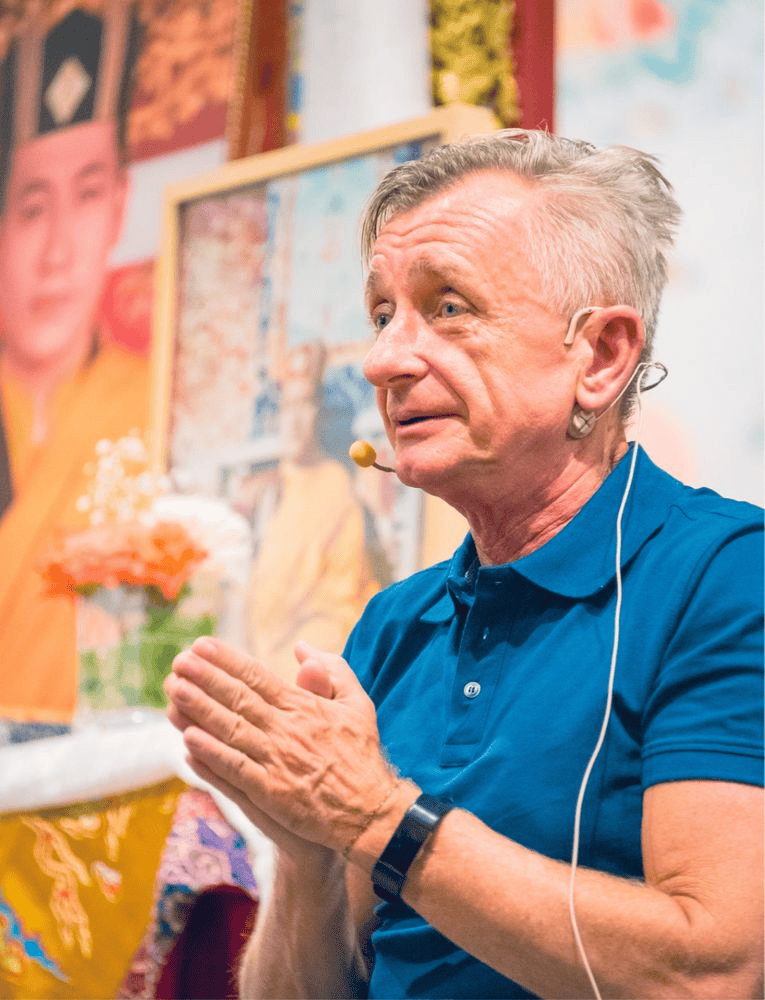
Tomek, could you please introduce yourself and how you became Buddhist?
My name is Tomek Lehnert, and I am Polish. I met Lama Ole in January 1983 in Gdansk, during the time when we had martial law in Communist Poland, which had been declared in order to break the free labor union Solidarność (Polish, literally: “Solidarity”). Already at our first meeting, I translated a lecture for Ole right next to the Lenin Shipyard in Gdansk, which was the birthplace of Solidarność. It is important to mention that Ole’s early activity in Poland was completely interwoven with the fight for freedom in our country.
I had already heard about Lama Ole half a year before I met him. When I saw his picture and heard his name, it hit me like a lightning bolt. I knew right away that he was my teacher. Ole Nydahl is not a Tibetan or Buddhist name at all, but I simply knew that he was my teacher.
Why did you move from Poland to Copenhagen in 1985?
That is a long story. In the winter of 1985, I accompanied Ole and a group of friends on a pilgrimage to Rumtek in Sikkim, the main seat of the 16th Karmapa outside of Tibet. In those days, you still needed an additional visa to go to Sikkim. Our friends from Poland were not able to get this visa, so Ole decided to smuggle us over the Sikkimese border from India. The plan was to create so much commotion at the border that the guards would not notice the additional sixteen Poles in our bus.
Our natural ally was the general chaos that one usually finds at such places. The spectacle that we put on reached its climax when the border guards came in our bus to compare the number of people with the number of passports. In the decisive moment, Ole shouted, “Everybody go to the toilets now!” That was enough. As much as they tried, our helpless soldiers had no chance, and ten minutes later we drove over the border with a big grin on our faces and our sixteen “illegals” successfully onboard. These days you can get entry clearance when you land at the airport in Bagdogra, but back then it was really difficult.
We had just arrived when one of the Danish girls from our group was bitten by one of the notorious dogs of Rumtek. Just making eye contact with one of these creatures could make you bedridden for days, and a bite meant serious problems. Somebody had to go with the girl to the hospital in Gangtok. It was in the last days before the Tibetan New Year celebrations, and the lama dances were about to start. Trying to find volunteers to go forty miles from Rumtek to an Indian hospital in Gangtok was not easy. Finally, I decided to go. The royal family of Bhutan lent us a jeep and driver, and we drove our way through the windy narrow roads down to Gangtok. I missed the lama dances, but I got a new girlfriend.
Half a year later when I was back to Poland, I decided to visit this girl in Copenhagen during my semester break from university. I left Poland on the ferry from Swinoujscie. When I called home, I was surprised to hear that the secret police had come to arrest me for my underground work for the banned Solidarność movement. They had come ten minutes too late. I wasn’t exactly a big fish in the free trade union movement, but I was still not able to go back to Poland for the next five years. I have lived in Denmark ever since. It is now my home.
Can you tell a little more about what you experienced in Solidarność?
Today, I look back on that from the perspective of more than twenty years. Everybody who stood up at that time was actually risking their lives. We stood up for our freedom and dignity. Many people who later worked in our centers and became close students of Lama Ole were my friends at that time. What made Ole so attractive for us when we first met him was that he insisted how important it was to fight for certain principles without hating those one fought against. That gave our struggle a completely new dimension. It was a very important time in our lives. I am really happy about this because I learned to appreciate certain values, which people take for granted today.
The Communist regimes were very repressive and unpleasant, and what happened in Poland was the first shot for the fight for freedom in the rest of Eastern Europe. I am deeply grateful to have been a part of this historic movement.

You are Lama Ole’s tour manager and coordinator for the Karma Kagyu centers. What does your work entail?
I travel with Lama Ole and am part of the team. The work entails many different things: all the practical things that ensure the tours function—such as arranging flights, trains, and cars and making sure that all visas are in place and that everybody gets the right information at the right time. These are practical and clear tasks, but you have to be very precise with them. We don’t want to arrive at an airport at five in the morning just to find out the flight doesn’t leave until five in the afternoon.
Our work entails preparing Ole’s travel plan around the world. It is very important to divide Ole’s time so that the most possible number of people can benefit from it. A year has 365 days, and we have over 500 centers1; Ole has thousands of students around the world, and of course the demands surpass far more than we can provide. Our greatest challenge is the lack of time. It is real acrobatics to take care of everybody and still find time for projects like writing books, which is an important part of our yearly plan. Just to give you an idea of the complexity in creating Lama Ole’s travel plan, we have to consider not only the vacation times of people in different countries in which Lama Ole teaches, but also when mosquitos have their peak seasons in different regions.
We also keep contact with all of the centers and help them with advice to keep them going. We coordinate the many building projects, which above all are going on in Eastern Europe and Russia. We also help with Ole’s manuscripts and articles. I support on some projects in the English language. This is an important part of Ole’s activity.
We have a very clear idea how we want to present lay Buddhism in the media. I take care of media in the English language and to a degree in Spanish and Polish as well, and together with a group of friends I coordinate our activity on the internet. Without creating a “dharma police,” we have to establish certain general guidelines as to what we wish to emphasize on our web sites and what we want to avoid. Lama Ole also asked me to teach. I think I travel around three to four weeks of the year during Ole’s book retreats.

Lama Ole has thousands of students and hundreds of centers, so a healthy “clientele” keeps us going from mornings until late in the evenings. At the same time, we try to involve as many friends as possible in our work. Today the internet gives us unlimited possibilities. However, we have managed to avoid creating a dangerous species—bureaucrats. That is our great strength. Our activity is based on idealistic help from hundreds of talented friends, who represent our centers everywhere. History is full of examples of idealistic movements that lost their attractiveness when they became over-institutionalized, and Ole is totally aware of the dangers in this.
What can Buddha’s teachings give modern Western people?
That is a fundamental question. Whether we are talking about modern Western people or about people from other time periods, the question is what can Buddha’s teachings offer us?
These teachings represent unique knowledge about the nature of the mind. This knowledge together with the methods to realize it, has been passed down from the time of the Buddha until today. Because this knowledge is absolutely practical, anybody can work with it. The realization of the nature of mind is ultimately what Buddha’s teachings can offer not only modern people, but people from any time period, culture, or environment. In Diamond Way, we begin by identifying ourselves with perfect qualities. I think that a well-functioning modern person in the West has the ability to identify with his or her Buddha nature and the benefit from this is enormous.
However, it is important to understand that we live in a society that is different from societies in Asia—just as most parts of Asia are different from Tibet. Buddha’s wisdom must be given within a certain framework. It is very important that we receive this in a context that Westerners can understand, so that we can apply the teachings. That is Lama Ole’s unique contribution: he is able to give Western people this great knowledge about the nature of the mind in a way that they can relate to, in a way they can practice and then achieve the desired results.
What fundamental information or view should every practitioner hold in their mind?
My understanding is that above all we should be aware that there is a goal which is worth reaching, buddhahood. This is a state of ultimate perfection beyond past, present, and future; a state of highest joy. That is our true nature. Secondly, Buddha gave a wealth of methods to achieve this perfect goal. The third point is that there is a community of highly realized beings as well as many thousands of friends on the way, who all use these methods toward attaining this highest goal. Every Buddhist should hold this in their minds, the foundation of Buddhism: Buddha, Dharma, and Sangha.
As Diamond Way practitioners we use certain direct methods, which the Buddha gave to his closest students under special circumstances, in order to recognize our minds as clear light. These methods have been passed down in an unbroken chain from teacher to students until today. In order to apply these direct teachings, we need a realized teacher. I think these are the basic things we should hold in our minds, and if they become the center of our daily lives then we can never go wrong.
What motivates you personally to work for so many people?
I came to Buddhism completely through the path of devotion to my teacher. It is Lama Ole’s example which inspires and motivates me. He is the greatest example that I know, and I try to follow this example every day as well as I can.
Why is the Europe Center so important for the future?

This question could be expanded to a more general question—namely, why is European culture so important for the future? Here in Europe as well as in North America, Australia, and New Zealand, we have created a society unique in history. Never before have so many people been able to experience so much freedom. We have achieved a certain general prosperity, which offers unbelievable possibilities. Samsara (Skt., lit. “the conditioned world”) remains samsara, and we cannot make an ideal world out of it. But the favorable conditions that we have in the West are decisive for establishing and running Buddhist centers.
It is not enough to have exceptional qualities only on the outer level. We want to bring these qualities together with the ultimate teachings on the nature of mind and ensure that people who have the ability to understand such teachings can make full use of them. This is a unique mixture of the highest teachings being given under the best possible conditions. In this context, the Europe Center is of the greatest importance.
You are originally from Poland. Do you feel more Polish or European?
I was born in Poland, and my family is mostly of Polish descent, but there are other influences as well. As a child I grew up in South America and went to school for almost six years in Argentina. I actually grew up bilingual with Spanish and Polish. As a child I lived outside of Poland. We traveled with my father in Africa, and I lived for several years in England where I went to school. When I left Poland forever in 1985, I had already spent more than half of my life outside of my country.
Of course, I feel strongly connected to Poland, but I have lived for so many years in so many countries, and especially now that I have traveled so much and made so many friendships around the world, I really feel at home everywhere. If I could highlight one place where I feel most at home, then this is Denmark. That is my new home, and I feel very connected to it, regardless of where I am in the world.
Many people believe that a good Buddhist has to go into a monastery or at least visit Tibet once.
Certainly not! That is nonsense. It assumes that Buddhism can only flourish in a monastic environment or only in traditional Eastern societies, and we in the West can only watch from outside, watch the exotic show and never become a part of it, let alone experience it. According to this we would have to wear robes and adopt an Eastern lifestyle in order to participate. Such a viewpoint makes Buddhism very small and assumes that the dharma is only true and useful in certain surroundings. It robs Buddhism of its breadth and universal validity, and locks it up in a little box.
I would like to quote the classic example, in which Buddhism is compared to a radiant diamond. If you put it on a black background, then it becomes black. If you put it against a red background, then it sparkles red. The diamond remains the same regardless of which background it reflects. In a similar way, Buddhism takes on a different flavor depending on the society in which it is taught, in order to best reach the people in that society.

The goal of Buddhism is nothing other than to be useful for people and teach them the way things are. In feudal Tibet monasteries were a part of the social order, while Buddhist dharma was and still is today a universal truth. It cannot be limited to the East, just as it cannot be limited to the West.
How do you think we can be most beneficial to all beings?
Being beneficial to all beings carries a huge blessing. When we only concentrate on ourselves, then we get the energy to accomplish the things we need for ourselves. If we focus on all of our friends, then many more possibilities open up. If we focus on our country, then this gives us even more power, because we can then bring benefit to the five or eighty-five million people, or however many live in our country.
Still, sometimes people have a problem with the statement “benefiting all beings” because endless numbers sound too abstract. “Benefiting everyone” can often be understood as “benefiting no one.” It is difficult to grasp. Whenever using this, I would always try to encourage the correct understanding. There is a great power behind this. When we concentrate on wishing to benefit as many beings as the sky is vast, this gives us an enormous power and motivation. But we need to know what we are doing.

When I was battling with my prostrations in Bodh Gaya, it gave me the highest motivation to imagine all beings around me. Bodh Gaya is about a third of the way between the Bay of Bengal and the Arabian Sea. I imagined this astounding number of beings from one coast to the other, that they were all ready to start with their prostrations but couldn’t because I hadn’t started. By imagining all the countless beings stretching out across the Indian subcontinent from one ocean to the other, I managed to do my prostrations despite the heat in Bodh Gaya.
How can one best help all beings? My advice is to start in our own groups and centers. Just start. We could climb atop the highest building in our town and declare our readiness to benefit beings near and far, but the result would probably be more comical than useful. The greatest visions always begin on our own doorstep. And at the same time, we just continue practicing. Our meditations contain the highest of all wishes to benefit all beings and to share the most noble of all offerings, everything good.
Is it possible to imagine that we are building up lots of positive energy when we meditate?
Definitely! I have no doubt that we build up a lot of good energy and develop ourselves while we meditate. I am deeply convinced that every single mantra we say and every single prostration we do bring us closer to the realization of our true nature. Our work in the centers is just as important. If we all lock ourselves away and only meditate, then nobody will hear from us. At the same time, even those who work the hardest in our centers should find twenty minutes a day for meditation. I don’t believe we can’t manage that. We are not highfliers on the New York Stock Exchange who juggle billions of dollars back and forth every minute. We can always find twenty minutes. Here I can cite the example of a very good friend, Pedro. He completed the prostrations and Diamond Mind practices, even though he worked long shifts in a restaurant every day. He had to work thirteen hours a day, and before he went to work, he would do five hundred prostrations every morning. I am certain that every busybody in the center can find twenty minutes a day. And I direct these words to myself just as well as to others.

You give lectures, translate into Spanish and Polish, and write articles for magazines. You are a very busy man. How do you manage to find time for meditation in your daily life?
That is a central question. We are all very busy people, but we still need to find those twenty minutes every day for meditation. I must admit that I could do more. Of course, there is always that odd day when we have to catch a flight at five in the morning and then have a full program working until three at night. But, in general, I firmly believe that we can always find those twenty minutes for practice. I am absolutely certain that those so convincing arguments and complex excuses we find not to have to meditate in that free half hour, are nothing other than ego-games. The more I manage to convince myself that something else is so much more important, the more I am tricking myself.
Do you have any other message you would like to share with our readers?
My advice is to be aware that the most precious treasures have become part of our lives—a clear goal, effective methods, the most noble friends, and truly realized teachers. My message is: be grateful, use the methods, and enjoy.
Interview conducted by Ilona Svetluska.
Tomek Lehnert—A Brief Biography

Tomek Lehnert was born in 1956 in Gdansk, Poland and grew up in Argentina with his family. He later moved back to Poland. He studied civil engineering at the Polytechnics of Gdansk and English Literature at the University of Poznan, Poland. In the early eighties, he became active in the students’ Solidarity movement against the Communist government. In January 1983, during martial law in Poland, Tomek met Lama Ole Nydahl, took refuge, and became Lama Ole’s student.
In the following years, Tomek received teachings and Buddhist empowerments from the main Karma Kagyu lamas in India and Nepal. After moving to the Diamond Way Buddhist Center in Copenhagen in 1985, he began traveling with Lama Ole in 1987. For more than twenty years, he translated Buddhist lectures into Polish and Spanish. He wrote articles for the Buddhist magazines Buddhismus Heute (Buddhism Today) in Germany and Diamentowa Droga (Diamond Way) in Poland.
From 1988 until his death, he was a principle organizer of Lama Ole’s dharma activity and helped start Diamond Way Buddhist centers in the Americas, Australia, New Zealand, Russia, and in Western and Eastern Europe. In 1999, at the request of Lama Ole, Tomek began teaching in Diamond Way Buddhist centers around the world.
In July 2019, Tomek passed away due to a lung infection resulting from his heroic battle against cancer. He died surrounded by his family in Benalmádena, Spain.
Tomek’s sister Maggie Lehnert remembers:
A brilliant, outstanding mind with a prodigious memory and a sparkling sense of humor. He traveled unceasingly around the world, bringing benefit to others through his unstoppable dharma activity. A true friend to thousands of people and a real example of devotion of student to teacher. Best brother, best uncle.

- That was in 2006, today there are over 700. ↩︎