
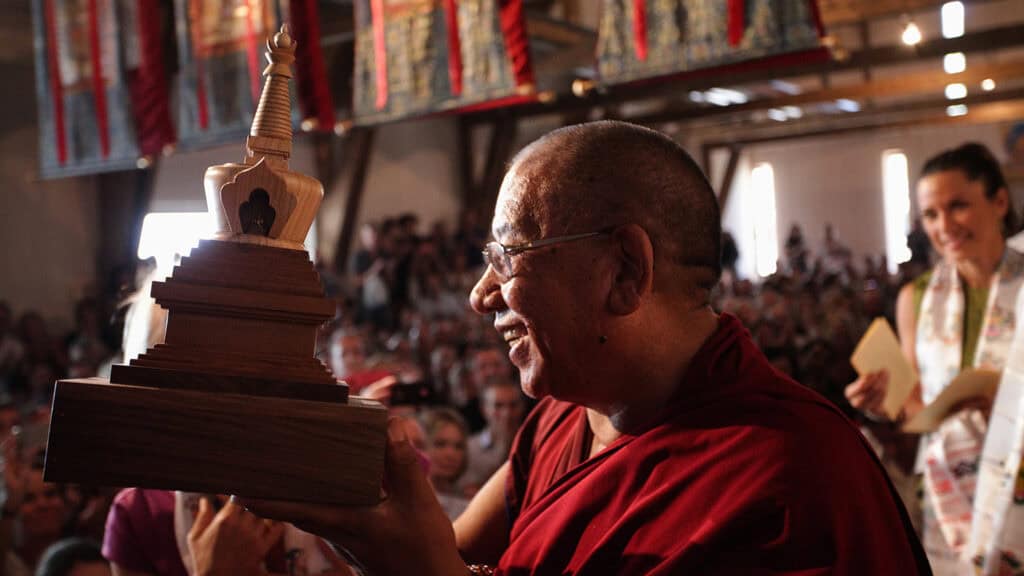
Question: A lot of people attended your lectures and received empowerments from you, but a lot of friends have not had a chance to meet you personally. Can you please tell us something about yourself? Where do you come from?
Sherab Gyaltsen Rinpoche: I was born in Nepal, in the district at the border of Nepal and Tibet called Manang; in Tibetan, this area is called Nyishang.
Can you briefly tell us something about your life? Where did you get your education?
I started to study the Dharma when I was eight years old. There is a story behind this. When I was four years old, I lived with my parents. We had some cattle in the mountains and had to bring the cattle to the water to drink. One day, we walked down to the water, and it was raining. I found a book lying on the ground. I could not read at that time, but I was so happy that I found this book that I took it with me. When I came home, I told everyone I found the book, and I was very happy. It was quite unusual, because even though it was raining, the book did not get wet.
Then, my mother took the book and showed it to a monk who came from Samye Ling in Tibet and asked what he thought, what it meant that her child had found the book. The monk said that my finding the book was definitely meaningful, but he could not interpret it since he did not know enough. He said we should show it to a high lama. Around the same time, the previous incarnation of Shangpa Rinpoche had come to the country. Although he was sick, my father took me on his back, together with the book packed in a khatag, to see Shangpa Rinpoche.
He went to the Rinpoche with two concerns. He said, “I am sick, so please make a divination to see if it is something serious. I have also brought my child who found this book, so if you can, please tell me something about that.” Rinpoche looked at the book and did not say what book it was. He just said that I should start practicing the Dharma when I turned eight years old. If I did not start, I would not have a long life. To my father, he said, “Even if you get the Long Life Empowerment from one hundred lamas, you will die.”
When we returned home, my father told my mother, “Our son should start learning the Dharma when he is eight years old, otherwise he will not live long. Remember that.” My father did not want to tell my mother that he would not live long, because she would be very sad, so he told some other people. My father died that year, when I was four years old. When I became eight, as Shangpa Rinpoche had requested, I started learning the Dharma. This explains why I started at that age.
I was then learning to read, write, and so on for some years. When I was 12, I did the Ngondro, the Four Preliminary Practices—Prostrations, Dorje Sempa, Mandala, and Guru Yoga. When I was 13, 14, and 15 years old, I was going to different houses—it is customary that people invite you to their houses to read important texts and do different pujas that you are asked to do. They give you food, and you stay and do whatever is necessary. I was doing that for three years, and at that time I lived with my mother.
When I was 15, I went to Rumtek to meet H.H. the 16th Karmapa Rangjung Rigpe Dorje. I went to the old monastery first where Karmapa was staying at the time, and that is where I took refuge from him and also became a monk. Then I stayed in the new Rumtek Monastery. When it was finished, we all moved up there. At that time, we did not have a Shedra (the school in the monastery), so the main education was to learn all the Tantras. We learned books by heart, and the rituals like Demchog, Phagmo, etc. I studied that for three years. I also had to learn how to play the instruments, how to make tormas, and how to draw mandalas. All of these skills were part of the study.
You were ordained by H.H. the 16th Karmapa, and you spent a lot of time with him. Can you please tell us something about that time and about the Karmapa himself?
Gyalwa Karmapa is a very special teacher, and one cannot really grasp his qualities completely. His ability to know things is unobstructed. Of course, I had a very strong devotion and belief in him because I could see his qualities. To believe in his qualities and have a kind of confidence also requires some reason. At that time, one of the main activities of the Karmapa was to find incarnations. People coming from different monasteries would say, “Our teacher from this and this place has passed away. Can you please help us find the incarnation?” Then, out of his wisdom, he would be able to tell exactly where the incarnation was born, the name of the father and the mother, and the exact birth date of the child. There were not many who could find tulkus. At that time, he was one of the few who did. That was one of his special activities. Nearly all Kagyu and Nyingma tulkus were found by the Karmapa, and some Gelug and Sakya tulkus were found as well.
Here is one example of how the Karmapa was and how he knew everything about what people were thinking, and how they were. There was someone called Khyenpa Gyaltsen, a Sikkimese. Unfortunately, he has already passed away. He had lived in Sikkim, where there were many visiting tourist groups. He knew how important the Karmapa was, so one day he brought his group of people to see the Karmapa in Rumtek. The Karmapa was in the big room in Rumtek, his sitting room. He was sitting on the floor and had various birdcages around him. Sometimes, he would spend his time like that—taking care of his birds and communicating with them. There were about three birds in each cage or something like that, and he would take the dirty water out, clean it, put it in again, bring food…and he would be fully occupied with the birds.
This tourist group came in, and Khyenpa Gyaltsen introduced them and told them that this was the Karmapa. The Karmapa asked everybody to sit down and had some tea made for them. They sat there, sometimes asking questions, but the Karmapa was so absorbed in working with the birds that sometimes he would answer and sometimes he would just be occupied with his birds. Khyenpa Gyaltsen then thought, “You know, somehow this is a pity. These people came from so far away, and the Karmapa is not really paying attention to them. If he paid more attention, it would be better for them.” He had that kind of thought. And the moment he had that thought, the Karmapa looked at him and laughed. Then he asked him in Tibetan, “So, why don’t you translate to the group what you just thought?” Khyenpa Gyaltsen got so shocked that afterward, whenever he saw the Karmapa, he desperately tried not to think anything. He knew that the Karmapa knew all of his thoughts exactly, knew everything that was going on in his mind. That’s an example of how the Karmapa was.
You are a retreat master (Tib. dordže lobpön). What does that mean?
It means that you give empowerment and instruction to the people who do the retreat. I made a retreat place for nuns, and I was an instructor there for three years. But the place is so difficult to reach because of the weather— in summer it rains, in winter it snows so the airplanes can’t fly—and it is really quite difficult to organize a retreat there. So we could only make a retreat there once. Later, in Parphing—it is a place in Nepal, a Guru Rinpoche place—we started a retreat place together with Shamar Rinpoche. We have completed two three-year retreats there. A third one is planned, and I will be the teacher and retreat master for it.
What is the purpose of a retreat?
If you are in retreat, it means that you are practicing and meditating; you use all your time for practice. You start out doing the Ngondro, first the four common practices and then the four unusual practices. After that you do different guru yogas, then you do the lojong —giving and taking—then shine. Then you do lhaktong, and after that you do the yidam —Dorje Phagmo. When you have finished Dorje Phagmo, you can do the Six Yogas. In connection with the Six Yogas, you also practice different physical yogas. After that, you can do the yidams, like Demchog, Gyalwa Gyamtso, Hevajra, and you will do Buddha Opagme. You will learn Chöd and in the end you also do White Tara, a long-life practice. You also learn two yidams, one of them is Mitugpa (Skt. Akshobya). In the twelfth month of the year, you do Mahakala: You do the practice and the mantra for three weeks, and the last week of the month you do the big pujas of Mahakala. During one retreat, sometimes you do it four times, sometimes you do it three times, depending on when you start the retreat. When I did retreat, I did Mahakala four times, because we started the retreat in winter.
What would you say about the differences in practicing Dharma in the West and in the East?
I can see quite a big difference in the approach to the Dharma. For example, if you look at Malaysia, Taiwan, and those countries, people go mostly for the rituals, pujas, empowerments, and blessings. I haven’t traveled much there, but when I was there I noticed that if I gave an empowerment on the first day, many people would come. Then if I had another program the next day, there were fewer people. And the next day again, there were even fewer people. If I stayed longer, only half of the people kept coming. In the West, I have the impression that it is the other way around, that actually more people come. The more I am here, the more people come.
How is it in India and Nepal?
Of course, there are many monasteries, lamas, and monks, and they practice the Dharma. But generally, people have a different approach. They really go for empowerments and expect to get blessings for different objects, but they really don’t ask for explanations. Generally, in the whole Eastern region, they don’t often ask for instructions, meaning, or explanation. That’s the difference between the East and the West. I see this as a mistake that they don’t want to learn more about the practice. Also, I see more development in the West. The first time I was here was about 20 years ago when I accompanied Shamar Rinpoche. At that time, if Shamar Rinpoche gave an empowerment and was asked to give some explanation, there would be questions and answers. But now, the quality of people’s questions has changed a lot. At that time, the questions were still more on a personal level, about one’s own problems and one’s self, not so related to what was actually taught. I also find that Western people are now much more clear in their questions. If I teach Mahamudra, the questions are about Mahamudra; if I teach Ngondro, the questions will be about Ngondro. They are more to the point. So I see this kind of development in the West.
You gave us a lot of empowerments as a blessing. What is the meaning of an empowerment?
You have to be clear about what a “real” empowerment is. When the disciple gets to know the teacher and the teacher gets to know the disciple, a connection is established; and the teacher can see if the disciple receives a certain empowerment to do a practice. Then this is his way to develop himself. This type of empowerment also engages one; it is a commitment. This is the actual meaning of empowerment, how it is supposed to be. Then there is the other kind of empowerment you are talking about. There is a big announcement that there will be such and such empowerment, and people will know about it a long time in advance. A lot of people will come for it, so you cannot establish the same kind of connection between teacher and disciple. That’s why it is more like what one would call a blessing. Of course, it gives some positive impressions in mind, and there will be people who connect with the Dharma through that. It has that quality, but it is not really like an empowerment in the traditional sense.
Thank you very much for your time and your answers.
Photo credit: Volen Evtimov


