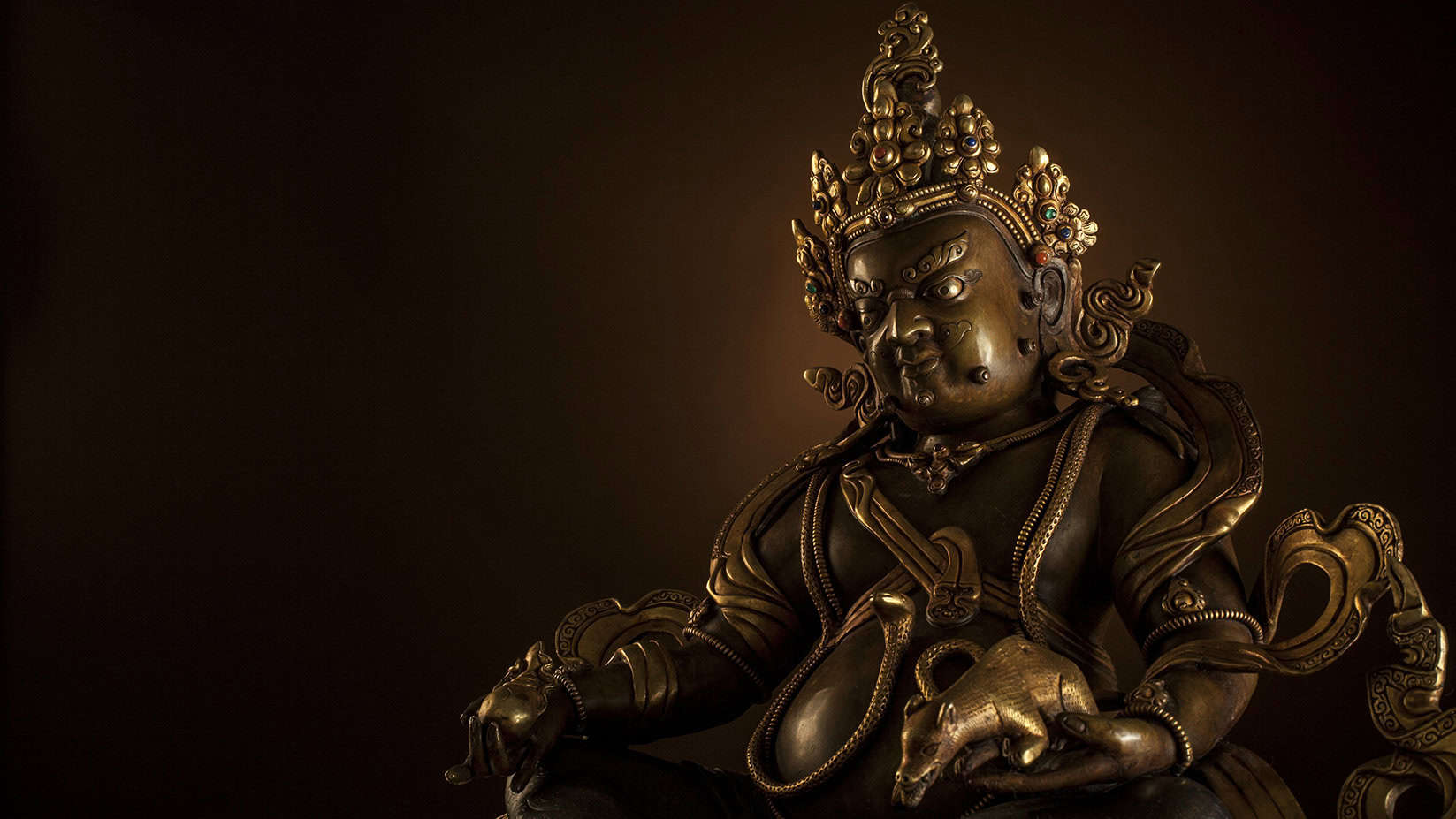
Free! Free! You are free from samsara and nirvana;
Free in the expanse of great bliss and the true nature of phenomena!
You are liberated within inexpressible awareness;
Free in the sphere of meditation that is devoid of fixation!1
–Maitripa
The Tibetan translator Marpa received the Great Seal teachings (Skt. Mahamudra, Tib. Chag Chen) on the nature of mind from Maitripa, an Indian teacher. Maitripa thus plays a central role in the Karma Kagyu transmission lineage, marking the transition between 1,500 years of practical Buddhism in India to one thousand years of Diamond Way methods thriving in Tibet.2
This knowledge about the nature of the mind has been available to us in the West since the 1970s when Lama Ole Nydahl and his wife Hannah began teaching at the request of the 16th Karmapa, and invited many Tibetan lamas to the West. Students of the Diamond Way use the methods of the Great Seal beginning with the Foundational Practices (Tib. ngöndro), guru yoga meditations, and a conscious practice for everyday life. The goal of these practices are fearlessness, joy, and active compassion—fundamental qualities that are embodied by the Mahamudra masters of the lineage. They carry on the tradition of the great realized yogis of India such as Saraha, Maitripa, and the Karmapas of Tibet.
Studying and Becoming Buddhist
Maitripa, “the kind one,” was born near the city of Kapilavastu to a Brahmin family. He probably lived from 1007 to 1085 in the region of Magadha in the area of Bengal (modern-day Bihar) during the era of the Buddhist Pala kings.
Before he turned eleven years old, he left his parents’ home and wandered through the countryside as a student. After a seven year basic education in Sanskrit grammar and Vedic subjects, he was considered a Brahmin scholar. When he was eighteen years old, his aunt, a consort of Naropa, asked him to begin using Buddhist methods to overcome conditioned existence (Skt. samsara), stating, “Go debate Naropa, and let he who loses accept the teachings of the other.” Maitripa lost this debate and thus became Buddhist and a pupil of Naropa, who gave him the transmission of Highest Bliss (Skt. Chakrasamvara, Tib. Khorlo Demchog). Maitripa began practicing Diamond Way methods and studied all levels of Buddhist teachings under Naropa in Nalanda for around twenty years. Maitripa then deepened his studies of the tantras for a further eight years under various other masters.

While he was active as a scholar and abbot in Vikramashila,3 his powers as a tantric master blossomed, and he had a vision of the face of Red Wisdom (Skt. Vajravarahi, Tib. Dorje Phagmo). Maitripa did a personal meditation practice on the fifth and twenty-fifth days of every month which included tantric offerings of meat and alcohol, and which were done in his room in the company of women. During one such meditation, a monk saw how he drank beer with a woman. When the head of the monastery and the community of monks confronted him, however, he had already transformed the beer into milk and the woman had become a ritual bell. Despite this, all kinds of rumors spread about him throughout the monastery.
On another occasion when the suspicious monks were secretly watching him, he was unable to hide his activities with mantras. Consequently, Atisha, who was himself a tantric master, but was responsible for discipline in the monastic university, had to throw Maitripa out of the monastery. According to the story, he promptly left his room by passing through the wall and hovered over the Ganges on the fur of a black antelope. At this point, the monks realized that Maitripa was actually a great realized master (Skt. mahasiddha), and they tried to convince him to come back—but in vain. Atisha had to purify this mistaken action by going to Tibet, which was quite uncivilized at the time, and bringing Buddhism there.
Maitripa had developed unlimited powers through the practice of Red Wisdom, but had still not fully realized the nature of the mind. According to some sources, around the age of fifty, he deepened his practice on Green Liberatrice (Skt. Tara). After he had recited ten million Tara mantras, this female buddha-form also appeared to him in a dream as a wonderful girl. She told him to go to a monastery called Khasarpana and to meditate on Loving Eyes (Skt. Avalokiteshvara, Tib. Chenrezig). Maitripa gave up his monk’s vows and after one year of doing this practice, he received a prophecy from this bodhisattva of compassion: “Go to the twin mountains of Sri Parvata, where Shavaripa lives with his consorts Padmavali and Jnanavali, and ask him for his transmission.”4 Maitripa set off on this journey together with the prince Sagara.5
Meeting Shavaripa
The search proved to be anything but simple for Maitripa and Sagara. They looked for their teacher in the mountain region of Sri Parvata for around six months. They sustained themselves by eating various plants, roots, and fruits, and would always offer mandalas. One night, Maitripa had a dream of Shavaripa in which he had a dark violet, almost black, body and sat in a relaxed position. His hair was bound in a knot and held together by a piece of bamboo. He held a bow, which was ornamented on each end with the upper and lower half of a pig, and a quiver with two openings, each of which held five arrows decorated in the color of pomegranate. His pants were made of peacock feathers, and in his left hand he held a precious empowerment vase to his heart. One of his consorts, dressed in the attire of a huntress, held the bodies of a dead peacock and a stag in her hands. Another consort played two bamboo flutes with both hands.6
One day during their strenuous search, Maitripa and Sagara climbed up to a flat cliff and meditated there without food for ten days. Exhausted and full of despair, Maitripa is said to have been close to taking his own life. In a moment he confessed in tears, “I have always been like this, weak and separated from you because of my obscurations. I am enchained whether I meet you or not. I will achieve liberation whether I meet you or not.”

With these words, Maitripa let go off all attachments, and an intense meditation experience arose in him. Shavaripa appeared before both of them, exactly as he had appeared in Maitripa’s dream. They both received empowerments and transmissions. Maitripa was very inspired by this and would compose important texts based on this experience. Sagara was able to make great progress in his development and achieved the rainbow body.7 But Shavaripa then disappeared, and Maitripa’s search continued.
When Shavaripa showed himself again with his consorts, he had the dakinis8 display the illusion of killing animals. One of them hunted wild animals with a bow and arrow, while the other ate lice from her dark and unkept hair. Maitripa was shocked by the killing of animals and thought, “how can someone have so little compassion?”
Then, one of the dakinis sang:
In the beginningless forest of conditioned existence
runs the wild boar of ignorance.
Shooting the arrow of radiant wisdom
I slay the wild boar.
Eat the meat of the non-dual experience!
Experience its taste as highest joy!
At this, Shavaripa, his consorts, and the entire apparition disappeared.
In yet another situation, Maitripa’s highest view was challenged in a similar way when one of the women slew a stag, and sang:
In the beginningless forest of conditioned existence
runs the stag of separation between experiencer and experience.
Shooting the arrow of Mahamudra
I slay this buck of anger.
Eat the meat of the non-dual experience!
Experience its taste as highest joy!
And in an instant everything disappeared again.
As Maitripa could not translate this highest view into his daily experience, and since his devotion to his teacher was still partially covered by the veils of doubt, Shavaripa appeared to him and in a song pointed to the unborn, timeless nature of mind:
Nothing is born.
Nothing really dies.
Nothing is limited.
There is nothing which is liberated.
Maitripa continued to practice under the guidance of Shavaripa, who disappeared after every encounter. Maitripa was given further tests as well. One such test arose when Maitripa saw one of the women massaging Shavaripa’s feet. She asked Maitripa if he would teach her massage, and he said yes. Then, surprisingly, she said that she doubted his abilities and that he shouldn’t teach anything in which he was not confident himself. She said he lacked trust, kicked him, and then disappeared.
One morning, Maitripa woke from a dream and realized that he had forgotten the essential teachings of Shavaripa and, because of too much thinking, no longer had real access to them on the experiential level. As a great scholar who strived for highest realization, he became dispirited. Shavaripa liberated him from this with the following words, which pointed to the nature of the Great Seal, beyond time and space:
“Maitripa!9
How can one remember teachings which have never appeared?
How can one forget teachings which are timeless?
The three realms have always been liberated.
We are only obscured by ignorance.
Highest joy is our timeless nature.”
Maitripa Attains Realization
Finally, Shavaripa told Maitripa to climb down from Mt. Sri Parvata, go into the next village, find a household with a family consisting of one man and two women, and become their student. The three of them lived from butchering animals, and therefore their house could be found at the edge of town. This occupation was considered impure, and butchers were outcast from society. In India at the time, it was unthinkable that a Brahmin—Maitripa came from a Brahmin family—would enter the house of such people and have direct contact with them. But Maitripa did what Shavaripa told him to do: he went to the village and found such a house at the edge of town with a man and two women. They were already quite old and made their living by butchering animals. Maitripa thought to himself, “They are probably the ones my teacher spoke of.” Free of doubts, he immediately performed prostrations in front this family’s house, and asked the man to take him as a student. But the man did not answer. Maitripa continued to do prostrations, and repeated his request again and again until the man finally gestured to him to come into the house. The moment he entered the hut, neither the man nor his two women were there. His whole perception was completely transformed, and he saw the complete mandala10 of the Buddha Highest Bliss with all its radiant buddha forms. In this way Shavaripa showed himself to Maitripa and gave him the entire transmission—the empowerment into the Buddha of Highest Bliss and the essential teachings of the Great Seal.
During this, Shavaripa sang:

When the original mind is purified,
The qualities of the teacher arise in one’s own heart.
Achieving this, shoot the arrow and sing the song of realization.
All tantras and mantras are one, but they cannot be “seen.”
When you receive the blessing of the lama,
Then you see the treasure, as if it were in the palm of your hand.
On the path of effortless Mahamudra
Every hope for realization becomes unnecessary.
Mahamudra means understanding the essence of your own thoughts.
The appearances here and now are nothing other than one’s own mind.
With this, Maitripa achieved realization.11 He understood that all of the actions of Shavaripa and his consorts conveyed the essential meaning. He expressed his understanding to his teacher in the following way:
All experiences are space.
Emptiness and compassion are the non-dual teacher.
When one grasps this original meaning,
Then all actions lead to liberation.
I have understood the meaning, which is free from
Being grasped as “something” real.
It is uncontrived and goes without any conscious effort.
Now I don’t have to ask anything else of anyone.
He took the name Non-dual Diamond (Skt. Advayavajra), and at the age of 53, he traveled back to the middle country, Magadha, following the wish of Shavaripa: “Instruct the scholars there about the way things are. Give special attention to those who are suitable vessels.” Through Shavaripa’s empowerments, core instructions, and practical advice, Maitripa had attained the wisdom to recognize the nature of all things as they are. Many students, both men and women, requested his transmission, and he became the teacher of many realized dakas12 and dakinis.
Transmitting the Great Seal
Being recognized as a great yogi, Maitripa led meditation in Bodhgaya, and the King of Magadha honored him with the name “Great Sovereign.” Maitripa married the daughter of the King of Malabar (a region in southwest India), who later became known as the Sky Dancer Gangadhara. She was a great Diamond Way Buddhist master, and it is said she was able to transform her body into that of a wolf, and many other kinds of miraculous forms.
On a mountain in the east of India with the name Blazing-like Fire (which apparently lay in the originally Buddhist area of Magadha), Maitripa built a meditation retreat. He practiced together with his students and gave them instructions on the foundation, path, and fruit of the Great Seal. This was where Marpa met him and received his Mahamudra transmission.13 Maitripa also gave him the tantric empowerment of Highest Bliss and Marpa’s main yidam,14 Oh Diamond (Skt. Hevajra). All doubts melted away, and highest experiences and realization arose in Marpa’s mind.
Marpa then thanked his teacher with a spontaneous song about his experience:
In the palace of highest joy on the crown of my head
On a stainless lotus, a sun, and a moon disc,
Sits my master teacher, the beloved protector.
Please bless my mind.
All Buddhas of the three times,
The countless yidams and protectors are inseparable from you, glorious Maitripa.
Please sit on the lotus of my heart.
In addition to tantric methods and Mahamudra teachings, Maitripa also transmitted various teachings on Conscious Dying (Tib. Phowa) to his students. According to the story, after his son Dharmadode died, Marpa sent his son’s consciousness to Maitripa’s meditation area, Cool Grove, so that he could find a new body for him.
When the time came for Maitripa to die, he gave a blessed object to each of his students, and gave them final practice instructions. They beseeched him to remain for many years, but he said that they already had all his transmissions. He died at the age of seventy-eight, melted into Red Wisdom, and attained the highest realization of Mahamudra. The End.
Author’s Note
The life stories of great masters tell of their spiritual development to liberation and enlightenment. The stories of the yogis or yoginis are intended to serve as inspiration for the practice of the reader or listener. For the Diamond Way Buddhist view of Maitripa’s life, I used biographical texts about Maitripa’s life, including Marpa’s life story and texts composed by Maitripa. I abstained from copious text citations to make the article easier to read. For an exhaustive review of original texts, I recommend the work of Mark Tatz on Maitripa (1987), which was my primary source. The accounts of Maitripa’s life by Khenpo Chodrak (1996) and Karl Brunnhölzl also provided important perspectives. I would especially like to thank Manfred Seegers for his valuable feedback and for comparing Maitripa’s texts with Tibetan source texts.
For the sake of brevity, here are the five most important sources cited for this portrayal of Maitripa’s life:
Brunnhölzl, Karl, trans. Straight from the heart. Buddhist Pith Instructions. Ithaca 2007, S. 125–190.
Chödrak, Khenpo. Notes from the lectures The Karma-Kagyu Transmission Lineage and the Life of Maitripa. The Karma-Kagyu Transmission Lineage and the Life of Maitripa. 1996.
He-ru-ka Gtsan-smyon. The Life of Marpa the Translator: Seeing Accomplishes All. Boston: Shambhala, 1999. (The Tibetan yogi Tsang Nyön Heruka composed his Marpa biography in 1505 based on the Marpa biographies of Milarepa and Rechungpa, among others.)
Mathes, Klaus-Dieter. A Fine Blend of Mahamudra and Madhyamaka: Maitripas Collection of Texts on Non-Conceptual Realization (Amanasikara). Vienna, Austria: Verlag der Österreichischen Akademie der Wissenschaften, 2015.
Tatz, Mark. The Life of the Siddha-Philosopher Maitrgupta. Journal of the American Oriental Society107, no. 4 (1987): 695–711. https://doi.org/10.2307/603308.
- These Mahamudra verses of Maitripa come from his text “A Golden Garland of Mahãmudrã”, Mahãmudrãkanakamãlã (Mathes 2016, p. 286 s.). This text was also translated by Marpa into Tibetan. ↩︎
- Due to Muslim invasions beginning in the eighth century and continuing over several centuries on the Indian subcontinent, the flowering Buddhist, (and to a certain degree Hindu), cultures in many Asian countries including India, Afghanistan, Pakistan, and Bangladesh were substantially weakened or completely destroyed. The first wave of Buddhist transmission from India to Tibet had already taken place in the eighth century, primarily through the efforts of Guru Rinpoche. ↩︎
- Vikramashila, along with Nalanda, was one of the two most important centers of learning in India during the Pala Empire. ↩︎
- Shavaripa means “man of the mountains,” and is also the name of his family clan. He made his living for a long time as dancer and singer until he had a vision of the bodhisattva Ratnamati (an emanation of the Wisdom Buddha Manjushri). Thereafter, he gave up his worldly life and retreated to a hilly region of southeast India. There, he pretended to be a hunter and trapper while practicing tantric meditation, especially on Buddha Highest Bliss. He applied the Mahamudra methods of Saraha and thus attained highest realization. His Mahamudra and tantric transmission came primarily from Nagarjuna. He is thus a part of the transmission lineage of the Great Brahmin Saraha, which was passed on from Maitripa to Marpa, and in this way became a part of the Karma Kagyu transmission. Shavaripa is also referred to as the “smaller” or “younger” Saraha. ↩︎
- Sagara (also, Sakara or Saroruha) was a great yogi, and episodes from his life can be found in the life stories of the eighty-four mahasiddhas. ↩︎
- The details of this dream all have symbolic meaning. ↩︎
- Highly realized masters are able to transform their body into energy during the process of dying; only physical parts that do not have nerves (e.g. hair, finger and toenails) remain. ↩︎
- The term dakini has a wide range of meanings, which are usually personification of the female principle of wisdom. ↩︎
- The original text gives two other names for Maitripa; Advajavajra and Avadhutipa. ↩︎
- Literally, “the center and surroundings”: a pure mandala is the power-field of a buddha that emerges out of the possibilities of space. ↩︎
- Some sources say that Maitripa only achieved the first bodhisattva level. Because of his doubts and lack of trust, Shavaripa is said to have prophesized that he would only attain full realization in the process of dying through the blessing of Red Wisdom. However, this stands in contrast to the experience of Marpa, who held the highest view of Maitripa. He saw both him and Naropa as fully enlightened buddhas. ↩︎
- The male counterpart to dakinis. ↩︎
- According to Tsang Nyön Heruka, Marpa travelled three times to India, met Maitripa during each of these journeys and received his transmissions. Maitripa was only around five years older than Marpa. A meeting between the two during Marpa’s final journey was thus more likely at a time when Maitripa was already a mahamudra master and maintained a meditation place. ↩︎
- Source of enlightened qualities. One of the Three Roots (lama, yidam, protector). Above and beyond the Three Jewels they are the refuge in the Diamond Way. ↩︎