Wishes guide our actions from beginningless time. They are the first impulse that turn our thinking in a specific direction, even before we can assign words or take action. While we can find many creative differences among the motivations behind human wishes, the wishes for all sentient beings can be reduced to two basic tendencies: We want to experience as much happiness and have as little pain as possible.
In our culture today, however, we do not give enough attention or significance to wishes. Too often we dismiss them as unattainable, romantic fantasies. A small example of this are the wishes we make each January 1st. Even as we make and announce these New Year’s resolutions, we already know that we will not keep them.
Buddha saw wishes in a totally different way. For him, our future is potentially already laid out in every wish, and we ourselves decide which of the various wishes will become reality. If our bodies, our whole perception, and the world around us are all products of our power of mind, then wishes are the key for experiencing lasting joy.
Buddha looked very carefully at the body and activities of mind (e.g., thoughts and feelings) and drew the conclusion that all these perceptions have the same foundation. The closer he looked, the less he could find proof for our concept of a truly existing reality. With his investigation of the physical, material world, as well as in coming to know his mind, Buddha always found the open expanse of space to be the origin of all things.
Unfortunately, however, most of us fall for the same illusion, again and again—and we have since beginningless time. We say “I” when our mind becomes conscious and “You” or “Other” when we see something outside ourselves. With this concept of separation, our experiencing mind creates a reality that at each moment limits our available possibilities—even though our mind can only perceive material things, because both the mind and things have the same nature.
But if we experience this separation between us and the world, then we always have to establish a relationship to everything that appears in front of us as if it exists separately. It is very strenuous and energy-consuming to try to change something in the seemingly existing world that is actually there in front of us, separate from us.
Buddha, on the other hand, not only understood the nature of space as containing and holding information, but he also experienced it directly. For him, mass appears as energy—and with that, all objects, things, and bodies can manifest as light-forms. In the same way, he perceived thoughts and feelings as energy. The 3rd Karmapa Rangjung Dorje said it this way, in his famous Mahamudra text (Verse 18):
Observing phenomena, none is found. One sees mind. Looking at mind, no mind is seen. It is empty in essence. Through looking at both, one’s clinging to duality naturally dissolves. May we realize mind’s nature, which is clear light.1
We, on the other hand, again and again fall for our superficial perception of the various objects. They look different and can be used in different ways. In our rather coarse way of experiencing the world, we automatically assume that these objects also have different origins. We do a similar thing with our thoughts and feelings: As soon as an energy impulse arises in our mind, we take it seriously and identify with it.
Buddha experiences space as the starting point for all things. With that, our “wishful thinking,” or mind’s wishes, has an amazing power, since it does not stay in our heads but can be perceived as moving through space, as a messenger, and can be taken in by others. The nature of space is like a gigantic database to which everyone with an openness and ability to meditate can have access.
Wishes can gather in specific places or be stored by objects. Every thought works in its own way and assists in creating our idea of the world.
An earlier incarnation of the Karmapa, the realized Saraha, described the power of mind like this:
The mind alone is the seed for everything and everyone. It manifests the world of appearances, as well as the buddha nature, and harbors every fruit. I bow to the wish-fulfilling jeweled mind.2
Since our mind carries in itself this wish-fulfilling power, it is simply a matter of the content of these wishes and the appropriate working with a manual. Since information cannot be lost in space, it is wise to consider carefully our wishes—lest we cause a contradictory wishes-spam.
The content of the “order” has to be consistent, for the principle of cause and effect also functions with our wishes. If we want to release lasting happiness in our mind, then we have to pay attention to the side effects of our wishes. For example, personal joy can arise only from those wishes where no one is harmed. Lasting joy can arise from wishes that have to do with knowing our inner potential—and not from wishes that refer only to temporary, limited happiness, like partnership, health, and career success.
Transpersonal wishes are liberating, since we share with all living beings the same space and our strongest wishes. We are very tightly bound with them. Therefore, it makes a lot of sense to wish constant and lasting happiness, not only for ourselves but directly for all beings. On the one hand, it thwarts our customary perceiving of a separation between us and them; and on the other hand, when conditioned by generosity, the ensuing joy automatically becomes more powerful and vast.
Through the powers and insights arising from meditation, may we help beings mature, train in the buddhas’ pure lands, and perfect the aspiration to attain the buddha qualities.
After accomplishing the steps of maturing others, training, and perfection, may we reach buddhahood.
May these pure wishes of all beings, through the compassion of the buddhas and bodhisattvas of the ten directions and us, And the power of all actions that are benefificial and meaningful, Be fulfilled exactly as they are made.3
Samantabhadra is considered the king of those who write about wishes. In a very creative way, he managed to break through all concepts of limiting wishes. In front of the stupa in Bodhgaya, the place where Buddha reached enlightenment, wish marathons are regularly held, where the gatherings of verses by Samantabhadra are recited for days on end.
May I be able to let the realms of all pure lands of the three times appear in one single atom, thus letting appear the pure realms of the buddhas in all regions of the universe…. Whatever the boundaries of the universe are, only there are the boundaries of all beings. Only there is the boundary of karma and emotional suffering, and only there is the boundary of my wishes reached.4
It is only a matter of time until the effect of a wish shows itself. The Tibetans again and again called the 16th Karmapa “wish-fulfilling jewel.” It is a sign of highly realized lamas that the time difference between the wish and its fulfillment shrinks. When no separation between inner and outer is experienced, space is information; and the thought impulses reach the “speed of light,” because they do not have to work through the hard-as-concrete concepts of finitely existing realities.
The stronger our habit is to identify with an “I,” and the stronger we experience the world as independent and separate from us, the longer it takes to process our wishes. Lama Ole Nydahl sometimes uses the example of jello: If you wiggle it on one side, it takes a few moments until the other side wiggles.
But since no wish that is powerfully generated gets lost, it is only a question of time until the conditions for its implementation come together. The only important thing is that we not become impatient or develop doubts, since we would then rob our wish of its power. If we like our ego a lot, we should build a time-lapse into our wish-making, because it is often the case that when personal wishes we have been making for years finally become reality, we suddenly realize that our needs at the time of wishing changed a long time ago—and now we are going in a different direction!
Repetitions strengthen the power of wishes. If we have an important wish—and not just a passing thought—we will again and again think about it. We keep it actively in mind. Through repetitions, habitual patterns get built up and then guide our activity.
Focused and expressed in the here and now, wishes develop a special power. For example, after all meditations in the Karma Kagyu lineage, we make wishes for our teachers’ long lives, since the bodily energies are united and mind is especially focused and powerful.
The first moment of awareness in the morning is particularly magical, since it has an impact on everything that we think, say, and do in the entire ensuing waking phase. While we sleep, the bodily energies are naturally gathered in the center of the body, and it is only when we wake and stand up that they spread out again over the whole body. So, it is useful to use this first moment of waking up to give direction to the new day. If we briefly say, “May we benefit as many beings as possible today,” the work day gets a transpersonal motto. This moment comes close to the gathered power after a meditation. Freshly stroked and filled with a lot of concentrated joy, wishes naturally get stronger.
Power spots or special moments operate to expedite wishes. When enlightened powerfields condense, the effects of everything that we think, say, and do become more intense. Our wishes have more “punch” to them during the special moments of meditation—such as when our lama mixes his mind with ours, or when we are near a stupa or in places where there has been a lot of meditation. So, wherever realized beings adapt or have adapted their mind to the space-nature of their mind, we can ride on the “wave” or edge of their experiences.
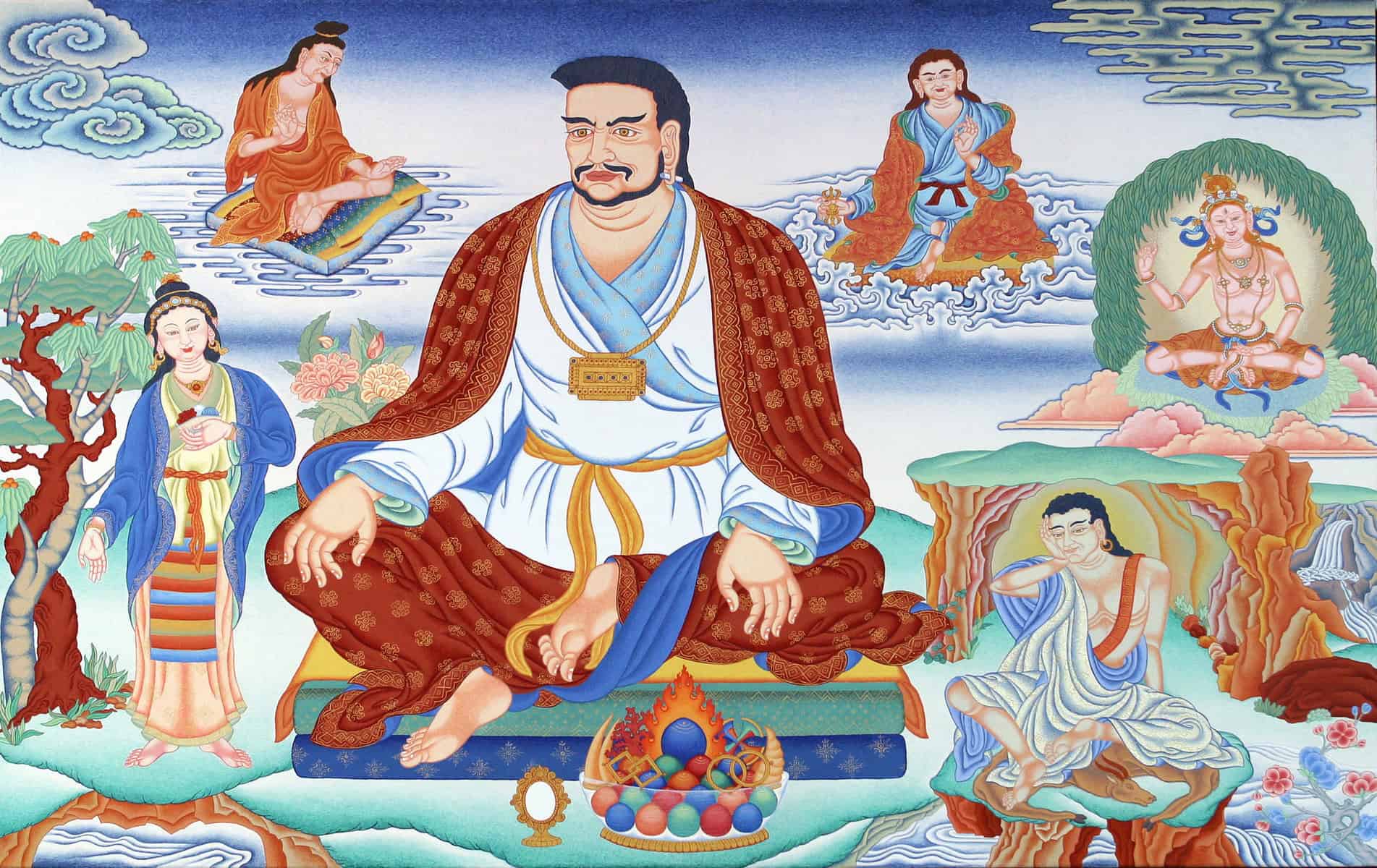
If we connect with Gampopa, we can also expedite the power of our wishes through our own ability for sympathetic joy. In conjunction with him, a genuine sympathetic joy— where we experience no envy, jealousy, or separation— leads to the same karmic results as if we ourselves had done the same positive deeds as he did. This is extremely energy-efficient, since we only have to seek out examples of wishes that our lamas have already realized and have heartfelt joy about their activities.
Better to leave the details to the buddhas, because it makes sense to frame the wishes more generally, since with our limited view we cannot always glean the exact dimension of the effect. What if we forget an important detail and—presto—we bring on some kind of curse!
Lopön Tsechu Rinpoche advised young men who had not yet developed their own stream of activity, for example, to use the mantra of the female buddha Liberatrice. Her protective sound has a very quick and smooth activity, and helps the right conditions emerge.
Imitating is allowed. We do not need to find new wishes. In Diamond Way Buddhism, it is customary to borrow the far-sighted wishes of realized teachers, especially if by using these wish-forms they have awakened the buddha nature in their own mind and the minds of their students. The 13th Karmapa Dütsog Dülwa used a nice example:
With the raining down of the stream of the blessingnectar of the lamas, who show us our mind as the truth-state, may the general and highest realizations, without exception, be afforded to me and all beings, whose number is as boundless as space…. Through the four powers and the hundred syllables, may we clean the veil of negativity. Through the giving of big Mandalay, may we fully realize the two accumulations and quickly receive the blessing of Guru Yoga.5
However, if we are a hopeless case when it comes to poetry and feel a little silly when reciting poems, we can make it much simpler. We connect to the wishes that have been preserved for centuries simply by connecting swiftly, after every meditation, the wish that Karmapa’s wishes be fulfilled. In this way, we bind ourselves very naturally with the activity stream of our lama and at the same time develop a good contact with him.
We also need the broad view of wishes, because there will surely be a next life. In case something goes awry in this life and we die without being liberated or enlightened, it makes sense to think of the more distant future. If we want to find out on the spot where we were interrupted in this life by our death, then one or the other wish should be aimed in this direction. Therefore, it makes a lot of sense to wish to be near the lama and to apply the power of wishes in our mind as a protector.
As long as this has not yet been accomplished during this and in all future lives, may we not even hear words like evil and pain, but instead experience oceans of goodness and bliss. Having obtained excellent freedoms and endowments, as well as confifidence, diligence, and insight—as a result of having been sustained by a spiritual teacher and receiving his essential instruction—may we correctly follow them without hindrance, realize them, and practice the noble teachings in all future lives.6
I call upon you, the great and mighty master of Dharma, who brings the great relief of fearlessness. Birth after birth, in all my lives, may I be born with a good disposition, a clear mind and no pride. And with great compassion and respect towards my glorious lama, so that I can keep the bonds to him. May wrong views about the liberating actions of my lama, not even form for an instant in my mind. With devotion, may I see that everything the lama does is good, and may his blessing enter my mind.
All my lives may I never be separated from my true lama but enjoy using the richness of the Dharma. Having perfected the qualities of the levels and paths, may I then quickly attain the enlightened state of Diamond Holder.7
- Verse 18 of the Mahamudra text of the 3rd Karmapa Rangjung Dorje as it appears in Lama Ole Nydahl’s The Great Seal: The Mahamudra View of Diamond Way Buddhism (San Francisco: Fire Wheel Publishing, 2004). ↩︎
- From the 9th Karmapa Wangchuk Dorje Mahamudra, Ozean des wahren Sinnes (Zürich/München: Theseus Verlag, 1990), p. 111. ↩︎
- Verses 24-25 of the Mahamudra of the 3rd Karmapa Rangjung Dorje, from The Great Seal. ↩︎
- Das Sangtschö Mönlam “der König der Wunschgebete für vortrefflfliche Aktivität” des edlen Samantabhadra (skt. Arya Samanta Bhadracharya Pranidhana Raja), from Online-Gemeinschaft im Tibetischen Zentrum e.V. at http://www.tibet.de/forum/index.php. ↩︎
- The 13th Karmapa Dütsog Dülwa, from the Rumtek edition of the Ngondro text compiled by the 9th Karmapa Wangchuk Dorje. ↩︎
- Verses 3-4 of the Mahamudra of the 3rd Karmapa Rangjung Dorje, from The Great Seal. ↩︎
- The 8th Karmapa Mikyö Dorje, from…Concluding Wishes from Karmapa Mikyö Dorje, translated from Tibetan by Hannah Nydahl (Hamburg, Germany: BDD Publishing 2006), p. 37. ↩︎