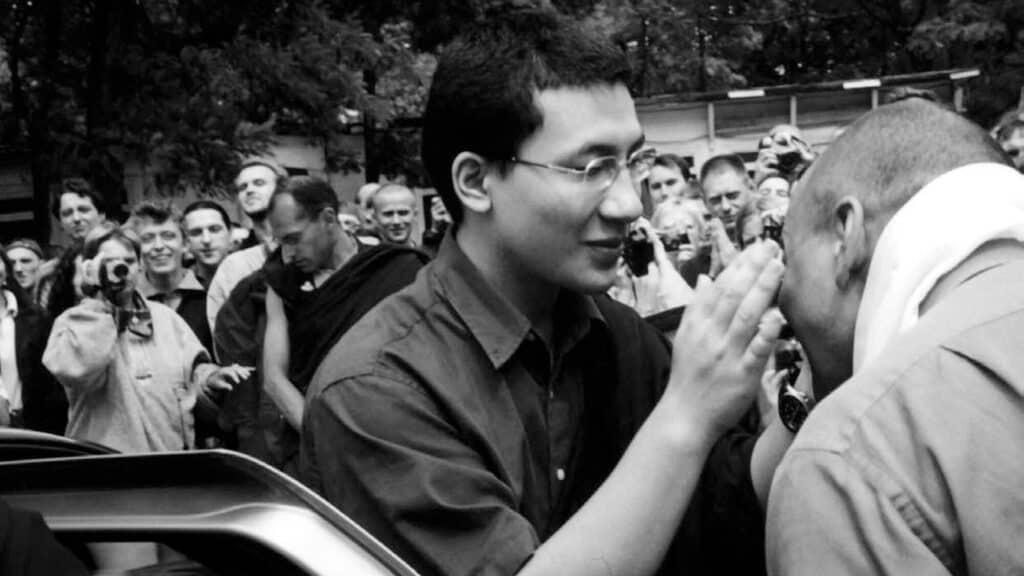
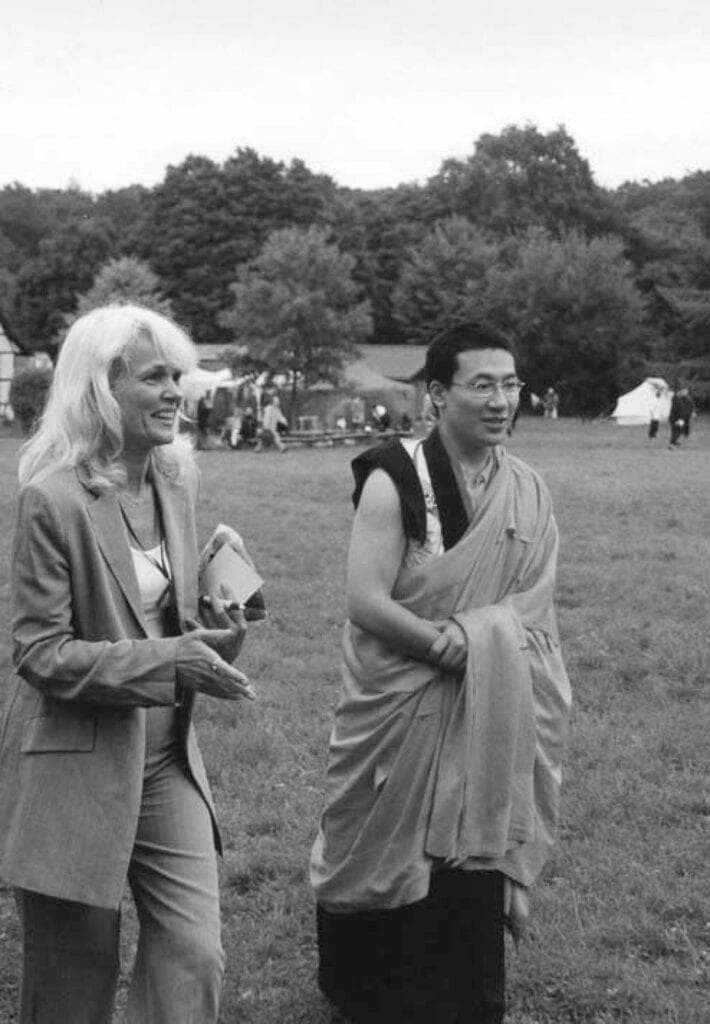
Editor’s Note: This interview with H.H. the 17th Karmapa Trinley Thaye Dorje took place during his European tour in the summer of 2005. The questions came from a number of Diamond Way Buddhist students and were put to the 17th Karmapa by Hannah Nydahl and Cristina Ferrando. For definitions of selected Buddhist terms, see the Glossary.
What is the connection of “benefiting others” with Buddhist ethics? The issue of “benefiting others” goes beyond Western concepts of ethics or morality. And Buddha’s teachings shed light on this “deeper ethics” or “more than ethical attitude.” Are Buddhist ethics beyond morality?
In Buddhism, the whole concept of being of benefit to others has to do with both the motivation and the ability to do so. Basically, the more we have developed our own potential, the more we can do for others. On the Bodhisattva way, the practice is based on not being selfish, and that is what we are all training for.
The historical Buddha himself is an example of such development. For countless kalpas, in many lifetimes, he researched all things and practiced until he reached enlightenment; his teachings are the methods he gave to others after his enlightenment in order to show them the path he followed, so that they can attain enlightenment, too.
The Buddha taught ethics as the best means to develop oneself. They are given as advice and not as orders that we have to obey in order not to be punished.
In Buddhism the idea is that we work to help others and not only for our own sake. How do we know what is good for others?
Generally, as Buddhists, we know what brings happiness and what brings suffering. Buddha explained about cause and effect. When we want to help others, we have to understand that the cause of all the problems in this world comes from karma and the negative emotions of ignorance, hate, and attachment. The better we know the individual needs, characters, and tendencies of beings, the more efficiently we can help them overcome their obstacles and guide them in the right way. Compassion combined with the ability to see what beings need bring the best results. Gradually everybody needs to find a way to realize the nature of their mind and through that process be freed from all obstacles.
Can the transmission of the Karma Kagyu lineage live in the West? Is it fully here or will it take more time? How can we help this to happen?
This transmission has gone from India to Tibet, so why not here to the West? It is specifically for this reason that all of us are trying to expand activity here. People have received many empowerments and teachings over the last thirty years, and there is already a good basis of dharma here. How far the transmissions will be kept alive or not depends on how you all apply the methods. Some will receive the blessing only and not use it for further practice, and some will use the methods to go deep in their own practice, which is the core of the transmission.
Transmission can mean many things, for example one can talk about a transmission of the refuge. In the teachings that the Buddha gave, which are called the Secret Mantra Path or the Diamond Way, the transmission is very important and is what keeps the teachings alive and accessible. You have to distinguish between the actual transmission line and the practitioners who use the transmitted methods. The transmission line is held in the lineage. These are Buddha’s essential transmissions that are passed on orally from teacher to student and which cannot be given in public. It has to be the right student, who can really carry out the responsibility of being the holder of a certain transmission. These transmissions have to be uninterrupted. So far in our Karma Kagyu lineage, the Shamarpas and Karmapas, the Karmapas of the red and the black crown, have been the main holders of the transmissions, and, from my point of view, that’s how it will be.
To simplify, there are transmissions of explanations, the philosophical or the study part, and transmissions of meditation. In the Karma Kagyu lineage, these transmissions are kept intact. The meditation transmission of Mahamudra and the Six Yogas of Naropa, including the tantric practices and series of empowerments, is the most important. As long as the transmission is not interrupted, it is authentic, and the practitioners get the authentic teachings. They practice the methods and can then teach others. They again practice accordingly.
How should Buddhists contribute to the societies they live in? What is their role in society? Could hospice be one of the contributions?
It depends on the kind of society we live in. Some have governments who take care of social programs, so in those countries there is no need for a specific Buddhist activity of that kind.
Generally, societies involve politics and are therefore not entirely based on benefiting others. Buddhism improves our quality of life, and spreads in a non-missionarizing way. It gives advice on how to live better, behave better, and thus improve one’s life. From my point of view, that is the basis of a perfect society. When we improve individually, it will automatically lead to a better society.
Hospices are one-way Buddhists can contribute to our society, and it is already happening in several Western countries. As Buddhists, we are taught to be aware of impermanence throughout our whole life. Being born, we die. That is the nature of phenomena, and dharma teaches us to die in the right way.
During your visit last year to Europe, you mentioned that we live in confused times and that the main thing that can be done is to develop bodhicitta. Can we diminish this confusion in some way? Can we do something about this general regression?
We need to develop bodhicitta, the enlightened mind. Whenever we are in samsara, we are always confused because of our emotions. It is not just a question of the time we live in decaying; it depends on us. If we get lazy, we can always blame the time or the situation, even though it really only means that we are getting lazy. In normal worldly surroundings we get carried away when it is not our intention to do the wrong things; we are not in control. Therefore, we must develop bodhicitta. Step by step we train the actions of generosity, ethics, patience, enthusiastic effort, and meditation, and with the sixth paramita of wisdom the actions are perfected. This is how we combine compassion and wisdom. It is a process of training where we develop our qualities and therefore become more useful for the world.
It does not mean that we are trying to achieve something totally new. Our true nature is compassion and wisdom. However, since beginningless time we have been constantly distracted by our disturbing emotions, so we need to realize the wisdom nature of our mind and thus break the cycle of confusion. The basis of realization, the buddha nature, has always been with us. We just did not come across the right circumstances to discover it yet.
To what extent can our wishes for others change their karma, in cases when we have no special connection to them? Everyone has their own karma, so is there anything we can do to change people’s karma?
It is not possible to simply change the karma of other individuals. If that were so, it would have to have happened already. All Buddhas and Bodhisattvas therefore help in the way of providing methods, which allow beings to change the cause of their own karma, if they use them. They help to provide the right circumstances, and it is up to the individual to check out and use the methods. Bodhisattvas always dedicate the wish for beings to have the right circumstances of time, place, climate, etc., for beings to improve their karma.
In the Bodhisattva Promise it is like that. The promise of aspiration to help all beings to enlightenment is not just a wish but also a determination to do something about it. And what one can do is show others how to achieve enlightenment, for example by showing them how to do the Dorje Sempa (Diamond Mind) practice. You cannot purify their karma for them. The practice itself is a way to change one’s mental state through the meditation. You have to do the practice, get used to the practice, be familiar with it, and slowly there will be the results.
It depends very much on our intention and mental level how much we can do for others. The more realized we are, the more efficient our wishes obviously are. That is why Bodhisattvas’ wishes are so efficient. Because wishes made out of love and compassion for beings always carry blessing. It is indispensable that positive wishes will be fulfilled when the conditions come together. Just as with commitments, wishes can be felt without of course being physically substantial. Whether this “something” works or not again depends on the receiver. The more openness the receiver has, the more it will be felt; it is cause and effect. The classical example of this is the ring and the hook: The wishes and the blessing are like the hook, and the openness is like a ring.
How can we find a healthy balance in the effort and time we dedicate to our activity in the outer world and to formal practice? Is there any sharp border between these two activities?
The whole point of Buddhist practice is improving our own behavior. We have to be more compassionate and less selfish. Of course, this is difficult, but that is why we practice. Our formal practice should give results in our actions. Therefore, in order to get the results, we do need some time for formal practice.
Normally, we would begin our dharma life and practice with Buddhist studies, then reflect on the teachings, and, reaching an understanding of them, finally meditate. This is when we have time for all of it. As we gradually develop those three trainings and become stable in our meditation, we are strong enough to teach others the same.
Now we live in a time where everything happens so fast, and we need to find a balance between action and meditation. Buddhism in the West is young, only 30 to 40 years old; and so an important activity here is to provide the right environment and possibility for people to practice. It is not easy to find favorable environments of time and place for practice, and this is a priority. Engaging in such activity we definitely accumulate a lot of merit, and it creates better circumstances both for this and future lives.
In order to reach enlightenment, however, merit and good karma are not enough. They will give us wonderful rebirths, but we’ll not reach enlightenment. When we are involved in Buddhist activities—and on top need to sustain our lives—we are in constant risk of our habits reappearing. We need to keep a check on our progress and to develop our wisdom as well. That is why it is very important that we find some time for formal practice, even if it is only short.
What is the meaning of having a main practice?
The importance of main practice is to go deep at one place. We like to start a lot of things, but many things remain unaccomplished. Because of circumstances, we are not able to finish it. Therefore, it is good to have one particular practice; it can be Ngöndro or any other practice. We must have one main practice, yidam or guru yoga, and keep that for life. In between one’s main practice it is possible to do other practices, as long as one keeps the main one.
The reason for this question is probably that people received many empowerments and might feel confused that they need to practice all the yidams they received empowerments for. This is, however, not the case. The practice depends on whether the empowerment is given as a blessing or with the promise to practice the yidam for a certain time. One must therefore be sure about the kind of empowerment one receives.

When we have our main practice of guru yoga or a yidam, other guru yogas and yidams are included in that main practice. Both guru yoga and yidams are simply wisdom forms, and they all have the same essence of compassion and wisdom. The most practical way to keep up with different guru yogas and yidams, if one needs to, is to add the mantra of the other forms, after reciting the main mantra.
How often should we meet with our teacher? Who is the main outer support for our development? How important is it to have contact with one’s teacher?
The teacher is important for our dharma practice, and there is no limit to how much time we need contact with him. It depends on whether we have questions or not. It is also the teacher’s responsibility to give advice.
Teachers in Buddhism are those who guide us in our practice so that we do not stray from the path of our development. There are different kinds of teachers and lamas, such as the lineage lama and the root lama.
We always need guidance, but I cannot say this much or that much. The teachers are there to assist the students in the practice.
You told Lama Ole Nydahl’s traveling teachers to emphasize teaching the Ngöndro. Why?
Because it is the foundation practice, and most of the traveling teachers meet the new students.
Do all Tibetan schools have something like the Ngöndro?
Yes. Except for the Guru Yoga, there is not much difference in the preliminary practices of the schools. The difference lies in the different transmission lineages of lamas.
Often new people have very high expectations of somebody who has done the Ngöndro, and sometimes feel disappointed. What should we expect from the Ngöndro?
Many people think that Ngöndro is only about completing the specific number of 111,111 of each practice. This is however not the case. The main focus of a dharma practice should be to develop one’s body, speech, and mind, and become a better human being. Ngöndro gives us a wonderful opportunity to practice dharma, and it is especially meant to get rid of disturbing emotions. This can of course not happen right away, but within the period of time it takes for us to do the Ngöndro practice we can expect some results. Practices like Prostrations, Dorje Sempa (Diamond Mind), and Mandala Offerings purify negative karma and accumulate a lot of merit. By removing our negative habits, we improve our way of thinking and doing things in life. That is why it is good when teachers encourage the students to do a lot of Ngöndro practice. How quickly the results come depends on the individual.
Is it true that one can get realized just by doing the Ngondro?
Ngöndro in Tibetan means “preliminaries” so it is by definition a foundation practice that prepares us for deeper methods. Our Ngöndro is called Mahamudra Ngöndro. By practicing the Ngöndro, we accumulate a lot of merit and remove many obstacles of negative karma. It improves our actions and thoughts. With that as a basis, we are ready for the deeper practices, which in our lineage are Mahamudra and the Six Yogas of Naropa. For somebody who already has some results in his practice, it is possible to get realized by doing the Ngöndro practice, which in that case would include the Mahamudra level.
Should one do the Ngöndro quickly or take more time?
It is good to take more time, definitely. We should take more time.
Is it true that you also practiced the short version of Ngöndro?
Yes, I did.
What is the reason for you doing it, as there is surely no need for purification and so on?
Actually, the reason I did the Ngöndro was that I was about to receive the Six Yogas of Naropa, and a condition for that is that you must finish one Ngöndro first. I did not have time to do a full Ngöndro, so I did the short one. I still continue with Prostrations and Guru Yoga.
Do you support people doing several Ngöndros?
Yes, very much so, and simultaneously with other practices after they have completed the first one.
How do you understand freedom?
In the Buddhist path when we say freedom, we mean free of our disturbing emotions, that’s freedom.
What does the word lama mean?
We use the word lama because it refers to one who has much more experience than beginners. It means one step ahead.