Editor’s Note: Photographs by Marcin Muchalski. The Rubin Museum of Art in New York City is the first museum in the Western world dedicated to the art of the Himalayas and surrounding regions. Buddhism Today met with Jeff Watt, Senior Curator at the museum and Director of the Himalayan Art Resources website, arguably the world’s largest resource for the sacred art of the Himalayas, and the religious and Tantric art of Buddhism. We talked for a while about the Museum’s mission, some works in its collection, and what it has been like to show this work to an entirely different audience than was originally intended. For definitions of selected Buddhist terms, see the Glossary.
How did you come to be involved with the Rubin museum, and how did the museum come about?
An acquaintance of mine tracked me down back in 1997 when the Himalayan Resources website was first being created—back then it was called tibetart.com. They were looking for someone who could explain what some of the paintings were. Early on I didn’t want to be involved; they were speculating. It just looked to me like some kind of new age endeavor, so I didn’t want to be involved at all. Then in the spring of 1998 they asked me, “Why don’t you want to be involved?” So, I told them, “You’re just writing about all these thangkas and who these lamas are and who the deities are, and you can’t tell the difference between a Gelugpa thangka, a Nyingma, or a Kagyu one. It’s insulting to everybody.” Then I slowly got involved.
There’s definitely an effort to bridge some culture gaps and show the relevance of this work to our modern Western society. For instance, the names of the Buddhas are translated into English, and you have these really interesting multimedia displays. What other things have you done to bring this work from the East into the West?

Well, as you say, it’s very important to translate the names. This museum is not here for scholars, professors, Buddhist lamas, teachers, students, or dharma center people. It’s here for the general public. We can’t use a lot of jargon, Tibetan words, or Sanskrit words. Many of the names for deities are descriptive, so why not just translate them into English for the general public? I mean, we’ve already done that with the Karmapa. He’s commonly known in English as the Black Hat Lama. So, there we go, it’s not foreign. There have to be hooks and bridges for people to approach this art, so translating the names is one way. Now for the scholars, the Tibetans, or others, we have both the Sanskrit and Tibetan names, with Sanskrit and Tibetan fonts, on almost all of the labels in the museum. So, if a Tibetan speaker comes, they can read the name of the subject.
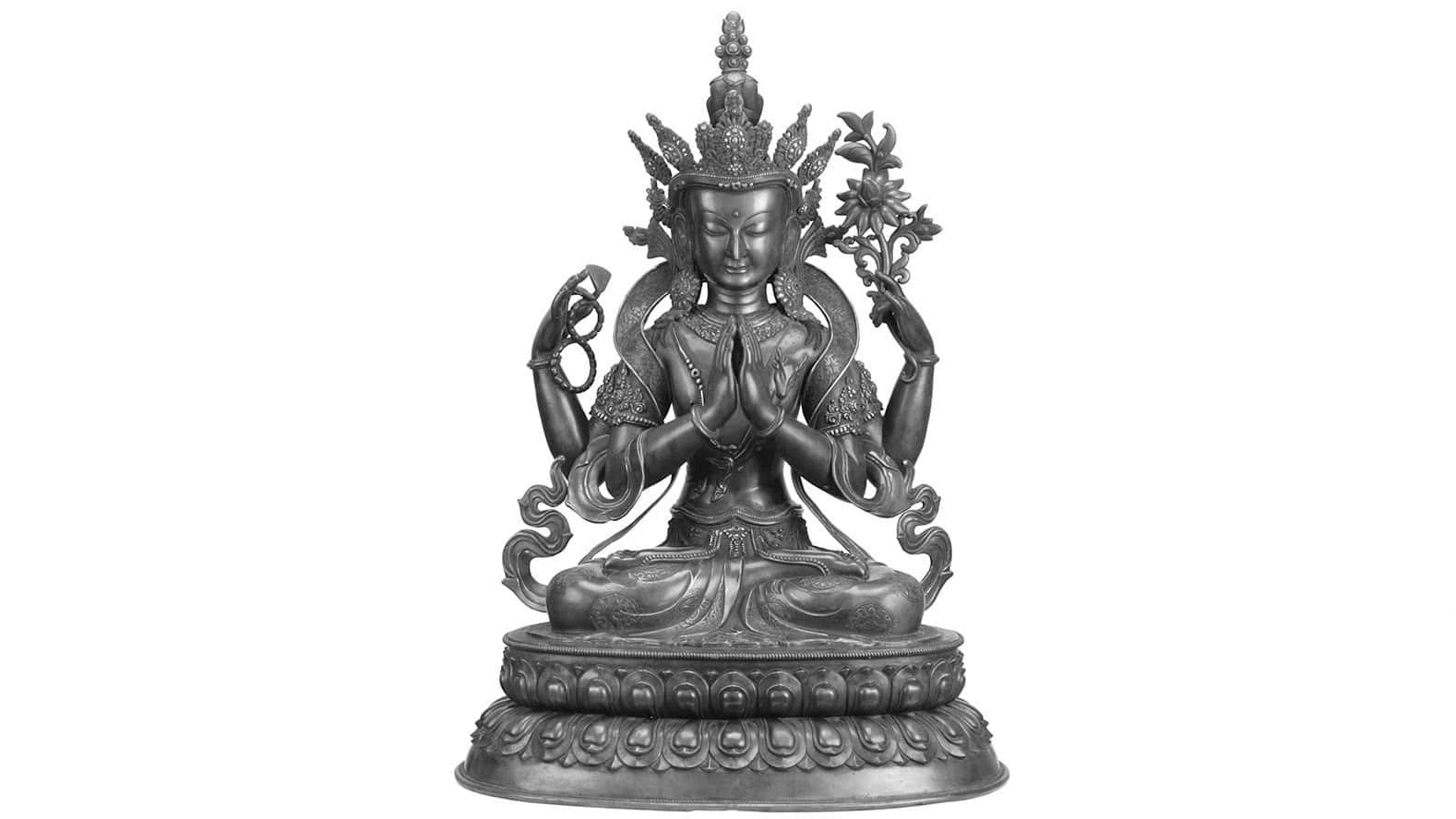
Another thing is to really bring out the stories, bring out the narratives, because mostly this is figural art. It’s not landscapes, and it’s not like these works don’t have the same type of variety as Western art. There was no renaissance in Tibet and the Himalayas. We’re dealing mostly with people and deities, so it’s important to try and bring out the narratives and make them come alive. Now with the deities, what I’ve tried to do is show how they’re pneumonic devices; they’re personifications of Tibetan tantric texts. Tantric texts are manuals, and these deities are an expedient type of visualization technique that is employed in tantra—and not just Buddhist, but Hindu and Bonpo also. You can even find similarities to Taoism in China and Jainism in India. Multi-headed deities, multi-armed deities do not exist, and do not have a real location the way we do. Buddhist deities are creations, and they’re creations to represent Buddhist teachings. If you have a figure like the “All-Seeing Lord” (Avalokiteshvara), then the four arms represent the four immeasurables (love, compassion, joy, and equanimity). The original Avalokiteshvara didn’t have four arms. He was a normal appearing student of the Buddha. The colors came along later, because they’re keys to understanding what the overall metaphor is for that practice. For Avalokiteshvara, it’s compassion and benefiting others. The white is for peacefulness and calming the suffering of sentient beings, so that plays well with the four hands for the four immeasurables. The one face shows that everything is actually just of one nature. All sentient beings are equal in suffering and in wanting to be free of suffering. All of these deities are complex because they’re representing all different kinds of Buddhist teachings put into a very succinct, very tight image.
Most of the art at the Rubin Museum is from the Rubin family collection, correct?
No, not exactly. It’s from the Shelly Donald Rubin Foundation Collection that was gifted to the museum last year. That’s the majority of the collection. The Rubins still have all of their own collection—over 1,000 pieces.
How did the family get involved in collecting this kind of work?
It’s really Donald Rubin. He prefers the wrathful imagery, the wrathful deities, and he thinks there’s something Freudian and Dantesque in it all.

Is he a New Yorker by birth?
Totally a New Yorker. His father started the Hotel and Restaurant Union in New York. Donald, of course, as kids often do when their parents are really into something, went in the opposite direction. His parents were quite socialist, and so he became a capitalist!
And then he got bit by the wrathful Buddhas?
He did. He likes the wrathful imagery because he thinks it’s cathartic and it’s a way of dealing with all of the anger and emotional upheaval or instability in the human mind. Which is somewhat close to a tantric viewpoint.
Is he a Buddhist?
Not at all.
I understand that right after Shakyamuni’s time there weren’t many depictions of the Buddha. What can you say about the development of the Buddha image?
The Buddha image did not come around for a while, and even then, it wasn’t the Buddha. According to recent studies in Sarvastivadan literature, it says that the Buddha told his students not to make images of him in his enlightened form. That’s why we have so many Gandharan images of the Buddha as a bodhisattva—a kind of warrior or prince.
As to the appearance of the Buddha, we have records from very early times. By early I mean the Ratnavali of Nagarjuna. There he talks about these 32 major and 80 minor marks of perfection and how they represent this universal sort of monarch, this Chakravartin king, the highest worldly form a living being could take. In the Pali sutras we also have descriptions of this. So, within two or three hundred years of the Buddha’s passing away, the early sangha was obviously thinking about these things, and then wrote them down.
The characteristics that we all understand and see regularly, like the ushnisha (the bump on the top of the head), the urna (a dot on the forehead), the penis retracted inside the body, the extended ears, arms down to the knees, fingers all the same length— all these characteristics come out of the form of the Chakravartin king, the universal perfect man.
Also, in very early sculpture we don’t see the rigid standardization of later periods. Take for instance the bump on top of the head. If you look at Himalayan and Tibetan art, you’ll see that they always put a gold ornament on top of the Buddha’s head. You have all of the blue-black curly locks on the crown of the head, then the bump, and the hair on the bump, and then you have this gold ornament on the very top. You don’t see that in early Gandharan or Kushan art. There the bump is much more relaxed, and the hair looks more like hair. Later it became more iconic and standardized.
There is a great exhibition on the sixth floor of the museum entirely devoted to depictions of female Buddhas. Can you talk about the show and the feminine principle in Buddhist art?
Well, this show truly is art-driven. This is based on coming up with an exhibition that is different but informative, and hopefully interesting to a broad audience. The whole notion of female Buddhas is known to most Westerners, but it’s unknown to a lot of Buddhists in Asia. This is because the idea of female Buddhas comes from tantra. It’s coming out of Northern Buddhism and then within Northern Buddhism it’s coming out of the tantric traditions. The first and foremost of the female Buddhas is Tara. We know this from her literature, principally several tantric texts that are concerned with her (Tara) practice. Many of them say that many eons ago, when she was about to reach enlightenment, she took a vow that she would only appear as a female for the benefit of those sentient beings who were more in tune with a female form than a male one. So, Tara is really the first female Buddha.
Many of the other female figures are emanations of other Buddhas. Some of them are Indian folk deities that have been absorbed into Buddhism and then became associated with a particular Buddha family (Amitabha or Vairocana) and by default, got elevated to being an emanation of that Buddha. How that’s dealt with in Buddhism is with two terms: “worldly deity” and “wisdom deity.” Wisdom here means completely enlightened. In Buddhism, we have deities like Sarasvati, who is also the Hindu goddess of learning, the wife of Brahma. As Buddhists, we say that the Hindu deity is the “worldly deity” Sarasvati, and in Buddhism she’s the “wisdom deity” Sarasvati, meaning she’s an emanation from the Akshobhya Buddha family. Therefore, she functions as a fully enlightened Buddha. So, there’s all of these “workarounds.” For us as Buddhists, however, the narratives are not as important. Deities are tools; they perform a function to help us reach enlightenment quickly and help all sentient beings. In Hinduism, these deities exist within a cultural narrative. They’re very much tied to the stories and later on to the written literature, but within tantric Buddhism the actual narrative of Sarasvati doesn’t matter so much. Because which Sarasvati are you talking about? Are you talking about a white, one-faced, two-armed Sarasvati that comes from a particular Buddhist pandita (Indian Buddhist practitioner) who’s using it as a meditation aid so he can memorize more text, meditate better, and write better commentaries? Or is it a red power Sarasvati with three faces and six arms that comes out of the Krishnayamari Tantras? Or is it a special Sarasvati that comes out of the terma (hidden text) lineage of the Nyingmas that performs a special function? You see, there is no narrative that ties all these Sarasvati together in Buddhism. You have to look to people like a particular Karmapa and the Sarasvati he’s practicing and to what tradition it comes from. The important narrative is the lama lineage: what did that particular deity tool perform in the history of the lineage, what is the initiation being given, what is the intention behind it, how are you going to use it, and how does that relate to the tradition that you are following? That’s the narrative that’s more important for Buddhists.

Do you have a lot of active involvement with the way these exhibitions are arranged?
Actually, I did all of the layout for the sixth floor. As senior curator, I am involved with all the floors and the arrangement of the art.
What reactions are you getting from people who have never seen this kind of art before?
So far, we’ve had an extremely good response, and I hope that will continue. It is foreign to a lot of people. The wall text has to continually be developed in a way that will be informative, educational, and entertaining for the visitor, yet at the same time accurate and not condescending to the culture or the religions involved. One thing that has to be understood is that all of this art is sacred art, it’s religious art. It’s the art of the Himalayas and Tibet. What we show in this museum, in terms of a timeline, is like medieval Europe before the Renaissance, where everything was religious art. That was all based on the Old Testament, the New Testament, Greek ethics, and the heroes of Europe. That’s what this art is: it represents the narrative stories. We can have people like Ling Gesar, we also have the Shambala kings, we have the life stories of Tonpa Shenrab the founder of the Bon religion, and the Buddha’s life stories—the Jakata tales. All of these are represented in the art, like their European counterparts.
Is there a particular work in this collection that inspires you the most?
There are three pieces, and they are all paintings. With one of them I had a Drukpa Kagyu lama come in, and we looked around at a lot of different art. He stopped at one painting, and I asked him why he liked it because it was an extremely provincial piece. Provincial is a very kind way of saying primitive style. So, I asked him why this one? And he said it was completely correct according to the literature. It was a Mahakala painting, with all of the retinue figures. It had the complete retinue figures for the one-faced, four-armed Mahakala in his tradition. Everything was absolutely correct. He said, “This is a good thangka!”
Correctness comes first with Buddhist art. Aesthetics are a Western thing. We don’t care if the iconography’s wrong. We don’t even know it, so what does it matter? We’re interested in the beauty of something. For the lamas it’s the accuracy. Now in another situation there was a Bonpo lama, Lopon Tenzin Namdak, the most educated Bon lama living today. He looked at a particular painting; it was not as rough as the other painting, but it was a little bit aged. It was old, it was dark, and again he asked for a copy of it because he said they didn’t have this. It was a particular goddess called Lamla, a deity that’s not represented in Buddhism at all. She’s their deity of travel and flies on a bumblebee. He said that this was a very rare subject, and the painting is absolutely correct to the text, so he wanted a copy to have it painted in India.
Then I had another lama come through who looked at something and said, “Oh I must have a copy of this!” It was a representation of a complex mandala offering visualization. He said, “This is so difficult to explain to the young monks in India, please can you make me a copy of this, so I can have it painted in India?” To me these kinds of experiences are most important, to be able to make the art available to the world, both for Westerners who are not familiar with this type of art, but also to the religious traditions where this art comes from and let them take back ownership of it.
What aspects of Himalayan art do you think go beyond cultural distinctions?
The quality of some of the pieces. There’s an aesthetic quality that goes beyond culture, and the curatorial mission of the museum is to take Tibetan and Himalayan art and raise it up to a world stage where we believe it belongs next to the best of European art, the best of Egyptian, the best of Central American, the best of Indian, the best of Japanese. You know this type of art has been marginalized by the Chinese, the Russians, and the English, since the 19th century. With the “Great Game,” the competition over who shall own Central Asia, what ended up happening was Asia was split up into China, Russia, and parts of Afghanistan, Northern India, and Nepal. Then, if you look at the art we’re talking about, this Himalayan style art, it becomes a minority ethnic community of China. It becomes a minority ethnic community of Northern India. So, they were all marginalized within these greater cultures. What we have to do is look at it as one large cultural group, Central Asia. We have to include lots of ethnic groups like the Mongols, the Turkic Mongols, the Cossacks, and the Tibetans being the largest of the group.
You have all these different groups. But you have this art as an art form that came out of the Himalayas. It was of course informed by Gandharan and Kashmiri art, but it’s also informed by Northern Indian Hindu and Buddhist art. It was really developed strongly in Kashmir, Nepal, and Tibet, and it’s a style that then went out to China. It’s very common to see Himalayan art in China, and then of course it went to Mongolia and to Southern Siberia. It’s a particular type of art from these regions, primarily sacred art: Buddhist, Hindu, and Bonpo. It has a specific type of composition, symbols, and motifs. You always have central figures, or else you have mandalas. With the central figures you have other figures at the top, at the sides, or below. They’re done in certain ways. Peaceful deities appear in a certain way, and the wrathful deities appear in a certain way. These are the types of things that define Himalayan art.

Another unique aspect of Himalayan art is that its paintings and sculptures are often done in sets. So, whatever you’re looking at, in terms of these individual paintings, it’s like looking at the tip of an iceberg; there’s a lot more going on. Anytime you look at a Karmapa painting you really have to assume it’s from a set. Karmapas are usually done as part of the Mahamudra lineage set or the Karmapa Incarnation lineage set.
In the Eternal Presence exhibition there is a silk painting of the third Karmapa, dated from his time period. Historically we know that the fifth Karmapa was presented with the official Black Crown by the Chinese emperor in his day. Yet on the silk painting there’s a black hat on the Karmapa. How can this be explained? Was the Black Crown known of before the fifth Karmapa?
The standard line that would be used is that the high lamas of the time could see the invisible black hat, so they just painted it. As a matter of fact, at one point there was some question: Was it really a black hat, or was it possibly something else? Also, the black hats have changed over time, so it’s hard to say. There is also a Tibetan scholar in China saying that there is actual textual evidence for a physical black hat prior to the gift of the emperor. So, there are a lot of opinions, and it’s also mixed up with a lot of faith-based oral tradition.
Is there a distinct difference in the presentation of the Black Crown in Kagyu art? Or does it stay pretty consistent throughout the history of the lineage.
There are differences in the art. I’m not sure why. It’s something that could do with a little study. Someone could easily do an M.A. or a Ph.D. on Tibetan hats, focusing on a particular one like the black crown. Or even the red hat of the Shamars and Situs—even those are supposed to have differences. The Shamar hat is supposed to have a crossed vajra on the front, and the Situ hat usually has three jewels on the front. Then in art sometime the Situ and Gyaltsab hats are more orange. In Karma Kagyu there is the Black Hat Karmapa (sha nag) and the Red Hat Karmapa (sha mar). I think an important question is when did Shamar get his hat, and did it predate the physical black hat gift of the Yung Lo emperor, and why?
That would be an interesting question for Shamar Rinpoche!