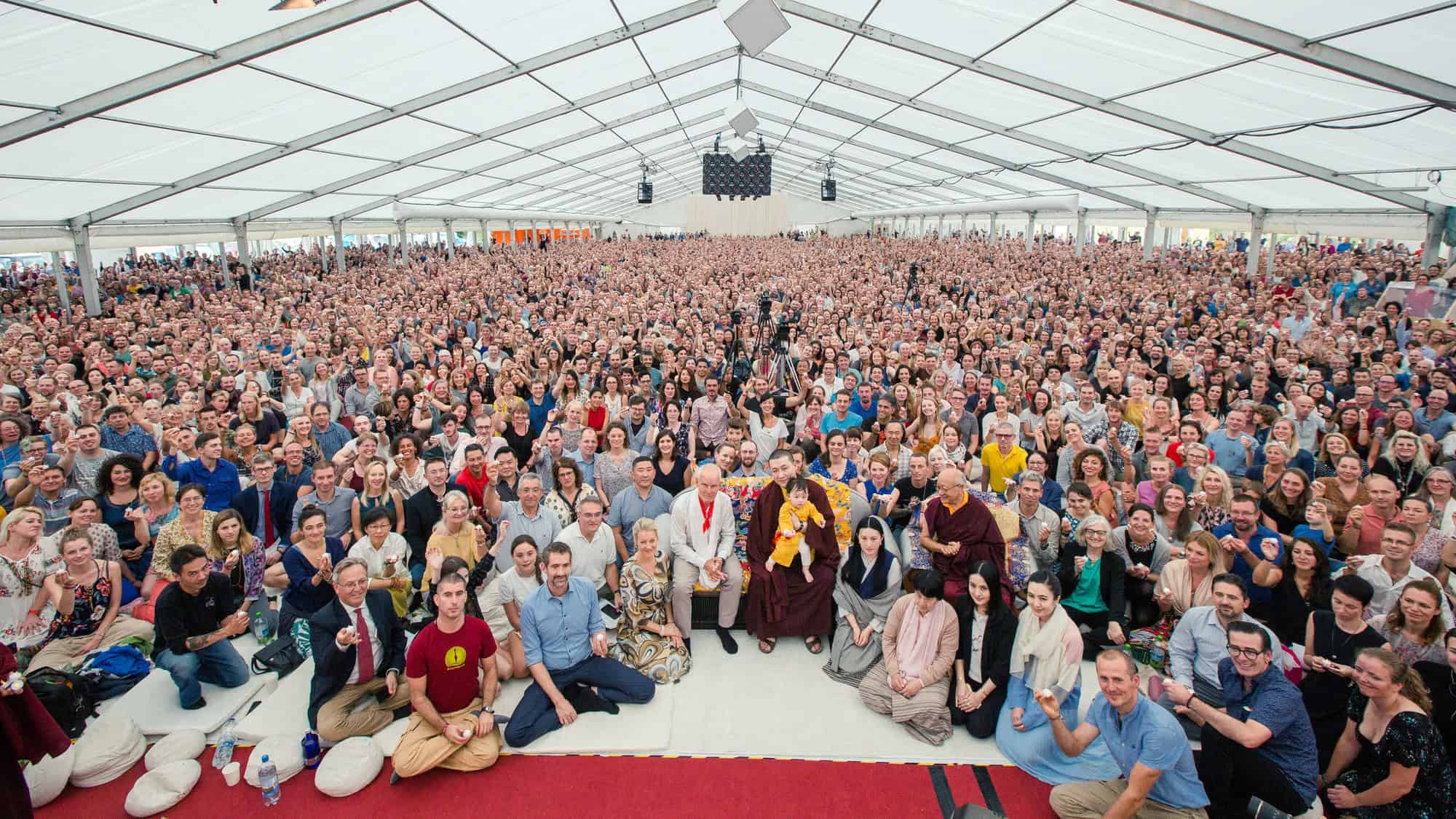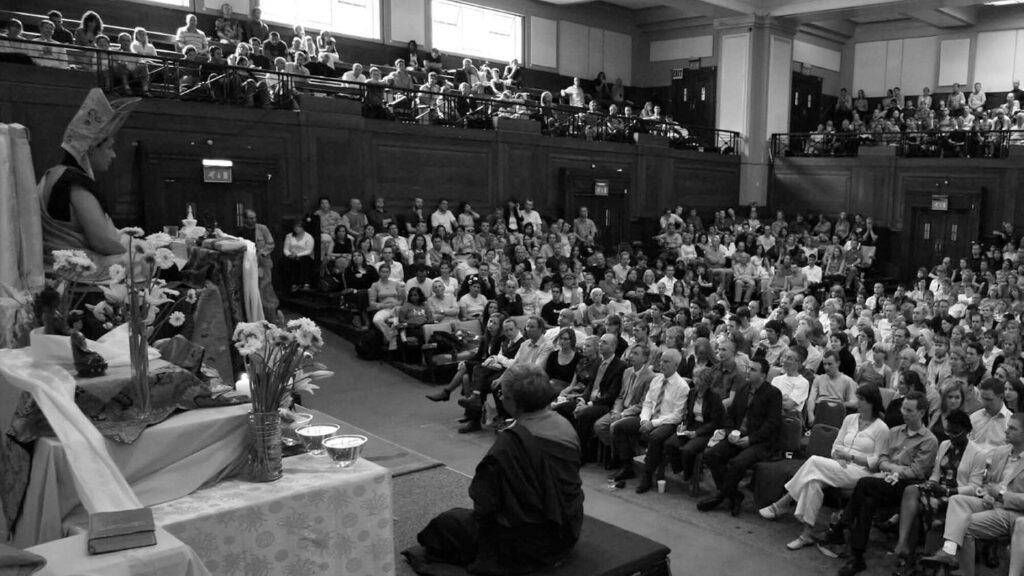
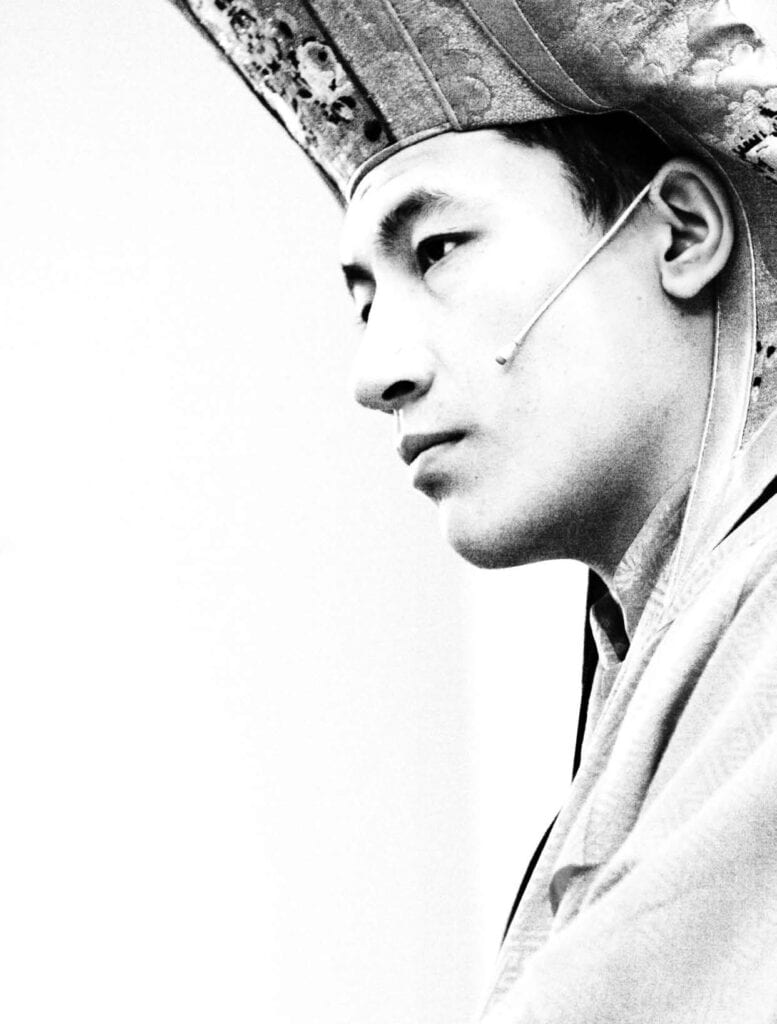
On August 5, 2005, the United Kingdom welcomed H.H. the 17th Karmapa Trinley Thaye Dorje for the first time, for a busy and exciting weekend. There were many different events scheduled: public teachings, meetings with the sangha, press interviews and photo shoots, empowerments, as well as an Inter-faith Celebration of Friendship and Trust, where the Karmapa was guest of honor. Karmapa, whose name means “man of action,” was kept busy, going from one event to the next. Always keeping a smile on his face, he touched numerous people in the process.
Although it was Karmapa Thaye Dorje’s first visit to London, he was in fact welcomed back by the sangha. Upon entering the hall, Tsultrim Namgyal, the personal attendant to both the 16th and 17th Karmapas, and Lama Ole Nydahl both confirmed that in fact this was the very same hall where Thaye Dorje’s predecessor, the 16th Karmapa Rangjung Rigpe Dorje, gave the Black Crown Ceremony in 1977. Lama Jigme Rinpoche, who had been sent to Europe as the representative of the 16th Karmapa, brought with him one of the two brocades traditionally used for the throne of the Karmapas. This ancient cloth, which has been used by many previous Karmapas, had been kept in storage in France since the 16th Karmapa died. It was brought out to mark this auspicious occasion in London.

There was a four-day program, entitled “The Way of the Bodhisattva,” which Jigme Rinpoche opened with a lecture about the Karmapas and the Kagyu lineage. Over the weekend, Karmapa Thaye Dorje first gave teachings on Refuge, the starting point in Buddhist practice, and the Bodhisattva Promise, where one decides to work for the benefit of others. On Sunday he gave the empowerment into Marpa, one of the greatest masters of the Kagyu lineage. On both days, at the request of Karmapa, everybody offered flowers instead of the traditional Tibetan silk scarves or khataks. This was a return to the tradition in India at the time of the Buddha.
In between teachings, Karmapa had several press interviews, including with BBC Russia online, BBC China online, and BBC Radio Four, as well as with the national and local newspapers. The most widely seen article focused on both his spiritual and very humanistic qualities, calling him a “very modern Buddha,” rather than just looking at his role as head of the Karma Kagyu lineage. The impact of the inter-faith meeting and the press coverage of his visit was far reaching, as some of the interviews were heard and shown across the world. Taking the “Tube” to the airport to say goodbye to Karmapa, many friends said that they looked down the carriage and saw half the people looking at his smiling face and reading all about the “very modern Buddha.”
The Inter-faith Celebration of Friendship and Trust was kindled out of the festival of brotherhood and sisterhood that the Hindu tradition celebrates. It took place on Monday, August 8, 2005, in St. Ethelburga’s Church. In this celebration sisters present their brothers with a decorative wrist bracelet, and the men respond with a gift. It is a big celebration; and given the troubles in London, it was felt that it would be wonderful to extend the celebration to all faiths as a demonstration of friendship and trust. Karmapa Thaye Dorje was invited to attend as the guest of honor. Seven religious traditions were represented by their senior leaders—Buddhist, Christian, Hindu, Islamic, Jain, Jewish, and Sikh—and the events contained music, prayer, and dance as appropriate to the respective tradition. An amazing Japanese tapestry celebrating the diversity of culture was unveiled by the leaders in front of a throng of journalists and photographers, after a welcoming speech by the Bishop of London.
Finding our common ground and a common basis for respect was the main aim. Whereas among the seven religions there are clearly very different views of spirituality and its purpose, still there is a common ground, as Karmapa emphasizes clearly in his speech. After welcoming the honored guests, Karmapa gave the following address:

The purpose of this gathering is to develop friendship and trust among our spiritual traditions, not only here and now in London after the recent tragic events, but in all places and at all times. Our respect for one another’s traditions and views is extremely important, and this should be built on with friendship and trust.
I have been told that this building is an example of what happens when friendship and trust break down, as it was destroyed by a terrorist bomb in 1993. It has been rebuilt to become this Center for Reconciliation and Peace. Its focus is on the role that religious communities can play in solving such problems, and I am thankful for this vision. It is therefore a very appropriate venue for this meeting at this time.
Friendship and trust are words that exist in all languages, but they can have different meanings in different cultures.
For friendship, we should first look to our shared values. Regardless of our background, we hold dear certain basic humanistic behavior—where all beings are viewed as equal. These inspiring values are the backbone of our cultures and the foundation of civilization. By coming here today, we celebrate these common values together.
Friends support each other through their solidarity. They share in each other’s happiness, and also know when we suffer and stand beside us. We too can share in each other’s happiness, even though we may hold different beliefs.

Friends have to be honest with each other and help one another understand the world and one’s position within it. It can be very revealing and beneficial when friends remind us of our shortcomings and show us how the world sees us.
Through the common positive experience of friendship, trust also grows. Confidence is built when doubts and fear are removed. For this we need wisdom; we need to explore and experience how things really are, rather than rely on fixed ideas, rivalries, and prejudices. On this basis, we can understand how and why we act differently from each other and as a consequence respect each other’s behavior.
It is important for all humanity that confidence and trust can be put in the various spiritual traditions. It is our duty to do and say the same thing so that our behavior and our words support each other, which in turn brings about trust. Where face may be lost, we should lose it in favor of honesty—no matter how high our title. How else is trust to be developed? This can only happen when our motivation is pure and clear—that we wish the best for all beings.
In the Buddhist tradition, the highest level of friendship is the understanding that every single being seeks happiness and wants to avoid suffering. From this understanding we can generate true compassion, compassion that goes beyond the liking of some and the disliking of others, but that encompasses all beings everywhere.
More than 2,500 years have passed since the historic Buddha of our era, Buddha Sakyamuni, was born on the border between Nepal and India. After reaching enlightenment he taught extensively for approximately forty-five years, and Buddhism spread to most Asian countries. In the 12th century, Buddhism declined in India due to the barbarism of war, but it then grew in Tibet.
Now, Buddhism has come to the West. People are not only examining Buddhism, but the independent and bright minds of our new generations are examining all faiths and belief systems with the desire to improve their situation—be it material or spiritual. In these troubled times, where many parts of the world experience war, and extremism is on the rise, it is important that there is a commitment from us all to build friendship and trust.
Everyone wants peace as well as freedom in this world, and this can be achieved through developing compassion and wisdom—the wish that all beings should be happy and without suffering, and a true knowledge of how things are. It is not through improving the outer world, in terms of raising living standards and the like, that world peace will be achieved. Our aspirations for the welfare of all, however, must know no boundaries. Our compassion should be a compassion for all sentient beings without exception. This kind of compassion brings about true happiness, and it is my deepest wish that our gathering today helps beings achieve that state.
Thank you.