The next six verses will be about the “Six Paramitas.” They are a practice to support the development of bodhicitta.
Twenty-Fifth Verse
If those who wish for enlightenment have to give up even their physical bodies, there is no need to mention material objects. Therefore, giving generously without expectation of karmic results or returns is the bodhisattva’s practice.
This verse is about the paramita of generosity. “Those who wish for enlightenment must give up even their physical body” means that we are practicing the way of the bodhisattva and are striving to reach enlightenment. For that reason, we would even give up our own physical body; therefore, “there is no need to mention giving up material objects.” Our physical body is our most treasured and cherished possession. If you’re able to give this up, then you’re able to give up everything—fame, position, wealth or any kind of material object.

“Giving generosity without expectation of karmic results or returns” refers not only to generosity but to the following five paramitas as well. Whenever we are accumulating positive merits through generosity, meaningful behavior, patience, or any other kind of positive deeds, we make sure that it is untouched by expectations of karmic results. That means that most of the time, we understand how, when we do positive things, we get positive karmas, i.e., we are in some small way expecting something positive in return, either in this life or in our next lives. But since we are practicing the ways of the bodhisattvas, it is important that we don’t indulge ourselves in such an expectation of returns.
We are talking here in general about generosity, but there is also talk about giving up our body. I don’t know if any of us here would be able to do that right now. But eventually, if we try hard enough and understand the value of achieving bodhicitta, we will be able to do so. As beginners, it is difficult to understand that we have to be able to do such things, even though we have heard many stories and recorded histories of Buddha’s former lives and great bodhisattvas who gave up their physical form. Even though we have heard these things, it is still hard to imagine. I even have a tendency to avoid the bite of a small mosquito, even though it’s just a small bite. So, we can imagine how difficult it would be to give up our entire body. But, as I said before, it is definitely not impossible.
We all are able to do this because we have this great potential. The way to achieve that potential is to do what we can, every day, in some small way. As beginners, we are not completely accustomed to performing great acts of generosity, such as giving up one’s own body. Therefore, we start to perform the act of generosity by giving away things that are not a part of us and that are not highly valuable, like needles and threads. Then in time, as we get used to it, we are able to give away more and more things. The reason we begin with less valuable things is that, no matter how small or invaluable it is, we still have the satisfaction of having done something positive, and we can rejoice over that and not feel stingy about it. The very opposite of generosity is this stinginess, that we are not able to let go. This method helps us develop a pattern of doing something positive, and then slowly we can do greater things.
The next verse is about the paramita of meaningful behavior.
Twenty-Sixth Verse
If one cannot achieve one’s own purpose without meaningful behavior, it is comedic to wish to achieve this purpose for others. Therefore, guarding meaningful behavior without samsaric motivation is the bodhisattva’s practice.
This second paramita is important and we must strive to achieve it because it goes hand-in-hand with the paramita of generosity. Without it we cannot perfect the practice of generosity. “If one cannot achieve one’s own purpose” means practicing meaningful behavior and striving to achieve a pleasant existence such as human existence or a god realm for one’s own benefit. It would be comedic or laughable for all the buddhas and bodhisattvas if we would say we’re trying to help all sentient beings achieve their purpose, while we ourselves did not have any kind of meaningful behavior in our life to achieve our own purpose.

“Therefore, guarding meaningful behavior without samsaric motivation is the bodhisattva’s practice.” First of all, it is understood that one has to have perfect meaningful behavior. In Tibetan, it is called tsultrim, and in Sanskrit shila. It means having peace of mind or being in a peaceful state free of unpleasant circumstances. The aim of meaningful behavior is that we try to guard our “three doors” of body, speech and mind from engaging in negative acts and karmas; guarding ourselves constantly will bring the result, later in this life and for sure in our next lives, that we will obtain a precious existence like the ones we have right now. As I said before: First we have to have this pure and profound meaningful behavior. Once we have that, it is of utmost importance that our motivation is very clear. In this case, as in all the paramitas, it means that we should not have a samsaric motivation. Therefore, the verse says, “…without samsaric motivation is the bodhisattva’s practice.” The opposite of having meaningful behavior is being careless and not having mindfulness. We have to guard against this at all times.
The next verse is about the paramita of patience.
Twenty-Seventh Verse
All obstacles are like a treasury of jewels for a bodhisattva who desires the wealth of merit; therefore practicing patience without resentment or discriminating against anyone is the bodhisattva’s practice.
For bodhisattvas, or individuals who are becoming bodhisattvas, all obstacles will appear as mines of jewels. For bodhisattvas, the obstacles will appear in this way because “they desire nothing more than the wealth of merit” for the benefit of sentient beings. “Practicing patience without resentment or discriminating anyone is the bodhisattva’s practice.” Our samsaric way of developing patience is that we are discriminating. We have a very strong habit to discriminate and to resent individuals. In our usual way of practicing patience and kindness, there is always a separation and lack of equality. Since we are trying to become bodhisattvas, it is important to lose all kinds of discrimination and resentment. It is on that pure and genuine path that we then must practice patience.
The opposite of patience is anger. Shantideva1 said that there is no worse act than anger. This afflictive emotion is one of the most powerful ones. It has so much force that it can bring down the very root of merit. In order to nourish and strengthen the root of positive karma, there is no better virtuous act than patience. Patience is the very key and root to developing all kinds of virtuous deeds. Whenever bodhisattvas come across obstacles, for them, it is like coming to a treasure mine.
The next verse is about the paramita of joyful effort or enthusiasm.
Twenty-Eighth Verse
Merely for the sake of achieving one’s own purpose, the shravakas and pratyeka-buddhas apply effort as though they are extinguishing a burning fire on their own head. Seeing this, it is the bodhisattva’s practice to apply diligence towards the source of all qualities of enlightenment for the benefit of all sentient beings.
In this verse the author is giving an example of how the paramita of joyful effort is applied by the individuals who are trying to attain the liberation of the arhats. Their primary goal is to achieve liberation for their own sake, thus they are referred to as followers of the Hinayana or Theravada. But even though it is just for their own purpose, when they apply the paramita of effort, they are diligent with such enthusiasm as if their head were on fire and they had to extinguish it.
There is another example given in a commentary by Professor Sempa Dorje: if a snake falls into the lap of a coward, his fear is so strong that he will try to get rid of the snake immediately. Just like that, the pratyeka-buddhas and the shravakas try to achieve their liberation by applying the paramita of effort with such an enthusiasm. Since all of us are trying to achieve enlightenment not just for our own purpose but to benefit all sentient beings, we have even more reason to apply even more enthusiasm. We must make a point of applying diligence and effort far more than what we witness with the pratyeka-buddhas and the shravakas.2 The verse says, “By seeing this, it is the bodhisattva’s practice to apply diligence towards the source of all qualities of enlightenment, for the benefit of all beings.” We all know that the greatest challenge for us, when it comes to applying this enthusiastic effort, is none other than laziness. So it is something that we must approach with great effort.

For most of us, laziness might come from having too much pressure in one’s life. Aside from having the life of a practitioner, even in our regular day-to-day life, laziness starts when we begin to ponder too much all the responsibilities and the years of work that we must go through. Whenever we think of all those impossible tasks, we tend to give up. That is the very source of laziness, and we forget the joyful effort.
It works in the same way for a practitioner, because we have even greater pressure. In our regular life, our only pressure is that we have to save our own skin. When it comes to becoming a bodhisattva, the responsibilities are not only ensuring one’s own happiness, but also trying to benefit all sentient beings. Therefore, the responsibility and pressure become too much, and we give in to laziness. The most practical way to apply enthusiasm would be to divide up our responsibilities into many small segments and to organize them into days or months or years, according to our own capacity. Then it becomes much easier; we don’t have to think too far ahead. We know what we have to do within a week’s time, in a month’s time and so on. We set ourselves achievable goals within a certain period of time.
Now we come to the paramita of meditation.
Twenty-Ninth Verse
Knowing that vipassana based on strong shamatha perfectly subdues all defilements, the meditation of shamatha that goes greatly beyond the four formless states is the bodhisattva’s practice.
One-pointedness—achieved through shine meditation — 3 is a state of mind where mind is calm and has the ability to concentrate on one thing. The opposite of this state is when one is not able to concentrate because of strong dullness and distraction. These are the two hindrances against obtaining one-pointedness.
Dullness is the state in which we cannot concentrate on anything at all. This is similar to falling asleep, or when feeling too heavy from too much food or from the heat.
A second hindrance is being completely distracted. This is when the mind is not being pulled back or retreating, but is too open. Mind is going here and there and everywhere, totally untamed. Shine, the one-pointed state, is when the mind is not too dull and at the same time not too active, not too distracted. In this state the mind is tamed, as it were. This is achieved through the ability of samadhi, of deep absorption, and in time we are able to tame our mind and finally be able to focus.
“Knowing that vipassana based on strong shamatha perfectly subdues all defilements.” This is actually quite difficult to explain clearly in English. For now, I will try to keep it very simple: In summary, the whole point of this verse is that without this one-pointedness, this focused state of mind, we are not able to understand the nature of our mind. Shine is the very key, the tool that unlocks our mind. Otherwise, we are either too distracted or too dull, having too much ignorance. In order to develop perfect wisdom, one needs to practice one-pointedness as the very foundation. Without it, we are not able to develop the highest knowledge and the primordial wisdom. One has to develop one-pointedness beyond the samsaric state: The existence of the beings within the form-realms and the formless-realms are based on meditation, on a very dense and strong one-pointedness. But their one-pointedness does not have the basis to develop the vipassana. In order to develop our primordial wisdom, you must try to develop the wisdom that is beyond the four formless realms. As the verse says, “… the meditation of shamatha that goes greatly beyond the four formless states is the bodhisattva’s practice.”
Finally, we have the paramita of wisdom.
Thirtieth Verse
Without wisdom, with only the first five paramitas, one cannot reach perfect enlightenment. Therefore, it is the bodhisattva’s practice to cultivate wisdom combining the method without concept of the three wheels (subject, object, and action).
The first five paramitas are the means, the very basis that we need to develop an unlimited amount of merit. But without the last paramita of wisdom we are unable to achieve the ultimate goal of enlightenment. Wisdom is the very foundation for developing primordial wisdom, yeshe in Tibetan. If you just concentrate on the first five paramitas, the result will be that you only achieve positive circumstances in this and future lives; but the benefit gained will only be temporary and will be the cause for the cyclic existence of samsara. On the other hand, if you just concentrate on wisdom and not the five previous paramitas, then you will only achieve the enlightened state of the shravakas and pratyeka-buddhas and nothing more. Wisdom alone is not the cause of the ultimate enlightened state of the buddhas.

Since we are practicing to become bodhisattvas and aiming for attaining enlightenment for the benefit of all beings, it is of utmost importance to combine the five first paramitas with the last paramita of wisdom. The meaning of “cultivate wisdom combining the method without concept of the three wheels (subject, object, and action)” is quite simple: The subject would be yourself, the one generating the wisdom. The action is the generation of the wisdom itself. The object would be the subject matter of the wisdom.
“Without the concept” means that a samsaric being tends to have a very strong blind belief that subject, object, and action exist separately. From this dualism we developed a strong clinging or grasping. Since we are trying to reach the absolute or ultimate wisdom, we have to free ourselves and let go of this concept of the three wheels. Only then are we able to achieve the ways of the bodhisattvas.
The following five verses are advice on what to avoid when trying to become bodhisattvas.
Thirty-First Verse
It is possible to be non-virtuous in a religious disguise if one does not analyze one’s own mistakes. Therefore, it is the bodhisattva’s practice to analyze one’s own mistakes and to abandon them.
A previous verse already said something about being able to analyze one’s own state of mind, the state of one’s three doors, and then guarding them with awareness and mindfulness. To check one’s own condition is a bodhisattva’s practice. The verse says, “It is possible to be non-virtuous in a religious disguise,” which means that as a beginning practitioner of the bodhisattva-path, it is on a relative level necessary to have a certain path to follow, something like tradition, commonly known as a “religion.” The Buddhist teachings are also taught in a “religious style,” although on the absolute level this is of course merely a concept.
When one is following the traditional way and does not check oneself or analyze one’s actions and conditions, it is very easy to be allured and fooled by one’s own un-awareness. In not being mindful enough, we might continue making mistakes over and over again. Having a spiritual friend who can point out one’s mistakes is a luxury, but most of the time we don’t have that. We only have ourselves. Therefore, it is very important to constantly check and analyze one’s own state. Otherwise, this concept of “being a buddhist” or “being a bodhisattva” could become a religious disguise and nothing more. One could start to lose one’s essence and dignity. Eventually, it will lead us to a point where we will lose our most important aim, which is to reach enlightenment for the benefit of all sentient beings. Therefore, abandoning our mistakes through thorough analysis is very important for a bodhisattva.
The next verse is about avoiding criticizing others, especially other individuals on the bodhisattva’s path.
Thirty-Second Verse
I will diminish myself if, driven by defilements, I speak of the faults of other bodhisattvas. Therefore, not to mention the faults of others who have entered the great vehicle (Mahayana) is the bodhisattva’s practice.
In general, it is good to be critical, but we have to know how to be critical and how to use criticism in the right way and to a positive advantage. The samsaric way of our habitual patterns is to be critical only of others but not of ourselves. In Tibetan, we have a saying that we can witness others’ mistakes even if they are the size of a tick, but we ourselves can have mistakes as big as a yak and we won’t see them. Negative criticism in this way of our habitual patterns brings about a lot of chaos.
It is even more important not to discuss the faults and mistakes of other bodhisattvas while practicing the way of the bodhisattvas. Even though one sees them, one must remind oneself that right now we are not enlightened and are not in a position to judge. There is a saying from the Buddha, that an individual will never be able to judge an individual. This is because we will never exactly know their state, what they are thinking. Therefore, it is very difficult for us to judge if someone is good or bad, and so the best action is to leave it just as it is. If you do spot any kind of mistakes or faults on any fellow practitioners or other bodhisattvas, it is important to not discuss them or point them out, because it just brings about one’s own downfall. In some ways becoming a bodhisattva is about becoming a very decent individual and becoming very noble. Starting to discuss others’ faults is not noble, is not decent, and it is the root of all disharmonies. If one is not satisfied unless able to criticize something, then one can put up a mirror and be very critical about what is seen in the mirror, namely oneself. The main advice here is to not be critical of others but of oneself.
The next verse is advice about letting go of the attachment to one’s sponsors, benefactors, relatives, and basically one’s home.
Thirty-Third Verse
If one is influenced by receiving offerings and respect, it will cause a dispute; and the activities of study, contemplating, and meditating will degenerate. Therefore, it is the bodhisattva’s practice to abandon attachments to households, friends, families and sponsors.
When we are practicing the way of the bodhisattvas, it is important that we keep a distance from friends, family and sponsors. It is through the generous and kind relatives and sponsors that we get praise, respect, and offerings. Even if we get genuine praise and so on, then as a beginner we have to be mindful of this. It could become a disadvantage, a cause for us to develop pride and attachment towards such respect, praise, and offerings. It could be a cause for dispute among fellow practitioners and generally everyone. Therefore, we should try to avoid that right from the beginning. And if the circumstances are just like that, then we should at least keep some distance. Most important is to be very mindful.
The next verse is about avoiding harsh words.
Thirty-Fourth Verse
Harsh words occupy the minds of others and degenerate the bodhisattva’s natural behavior. Therefore, it is the bodhisattva’s practice to abandon harsh words, which are unpleasant to others.
Generally, harsh words, thoughts and actions should always be abandoned, but it is even more important for a bodhisattva to do so. Harsh words can really disturb someone’s state of mind. To make someone experience unpleasant words is far more dangerous than using any other tools. One can be very physical of course, and that could be very unpleasant and is something to avoid. Also, our motivation can be very harmful, and of course this is also advisable to avoid. But connecting with individuals on a day-to-day basis, it is especially very important to do one’s best to abandon harsh words. First of all we are practitioners of the bodhisattva’s way and that means that we have to make sure that whatever we do is for the benefit of all sentient beings. Even if our intention is positive but our choice of words is harsh, then it could bring about great obstacles or hindrances.
The verse says it will “degenerate the bodhisattva’s natural behavior.” The bodhisattva’s natural behavior is noble, gentle, and decent. Using harsh words shows that one does not have the quality of loving kindness and compassion.
Most of you will have extensive experience that harsh words you receive from others hurt us the most. One could receive harsh physical treatments, and it is very concrete and strong at that moment. But after some time you forget it and it doesn’t matter anymore. But harsh or mean words can really cut deeply into our heart. They take root in our heart and stay for a long time, sometimes for generations. They are like a strong disease, and therefore even on our worldly, samsaric level, very harmful. It is very important for a bodhisattva to give up harsh words, because of this understanding.
The topic of the next verse is about how to prevent afflictive emotions before they take strong root, like a preemptive strike.
Thirty-Fifth Verse
Once defilements become a habit, they are difficult to defeat. Therefore, it is the bodhisattva’s practice to use the weapon of mindfulness and conscientiousness as an antidote and to pacify the defilements and attachments in the moment they arise.
As beginners with a lot of emotions we can easily get dragged along with these emotions, because we cling to pleasant experiences and want to avoid painful ones. As beginners, we have not yet purified the seed of disturbing emotions. We have not let go of ignorance, attachment and aversion. When we encounter objects that we are virulently attracted to or repelled by, then our tendencies will arise as a matter of course, because we are not trained enough. Thus disturbing emotions arise in us.
And once they start to take root, they are very difficult to abandon. Thus, it is important that the tools of mindfulness and awareness are used to eradicate or purify the popping up of the emotions, before they take hold. With mindfulness, we are able to remind ourselves of what to avoid and what to engage in. Awareness supports the aspect of being mindful. With these two tools we are able to deal with the afflictive emotions and eradicate them.
Now we have completed the words of advice for avoiding that which we need to let go of. The next verse is a summary of the purpose of the text.
Thirty-Sixth Verse
In brief, wherever I am and whatever I do, being mindful and conscientious of the usual state of one’s own mind is the bodhisattva’s practice to achieve the purpose of others.
This verse gives a summary of the very aim of the whole teachings. No matter where we are and what we do, it is always important to come back and analyze and examine our state of mind with the tools of mindfulness and awareness. In some ways this is very general advice, but it is also very crucial advice for all of us, because we all are playing our part and keeping our responsibility in whatever way we can. We may be a benefactor, student, teacher, family member, friend, businessperson, a monk, a nun—we are all doing our part to benefit all sentient beings. Therefore, it is important to be mindful and aware of what we are doing daily.
Before we go to sleep each night, we should do an analysis of what we have done during this particular day, starting from the moment we woke up. First we check what kind of motivations and intentions we have developed during the whole day. From that, we ask: What kind of positive or negative speech have we used? Then lastly, we check if the physical actions we have taken were towards a positive or a negative path.
Without that, our daily chores and responsibilities are too big. It becomes too hectic, and we are not able to recall exactly what we have done. As we lose more and more mindfulness and awareness, in that moment our disturbing emotions creep in very passively and slowly and before we know it we are caught and deep into it. Most of the time we are too late, and then we begin to give up hope and develop reasons to not do the beneficial things. To always be mindful and aware is very important, no matter where we are and what we are doing. Through this we can be sure that we will be able to benefit other sentient beings.
The next verse is the dedication. The base, the “material” that we are going to dedicate, is our root of merit. One can think of all the merit that we have developed in past lives, from beginningless time until now. Then we think of all the positive accumulations in this life, from the point we can remember until now, and finally also about the future accumulations that we will be adding. We combine all these three and make sure that we dedicate them for all sentient beings. That is the bodhisattva’s practice.
Thirty-Seventh Verse
Dedicating to enlightenment the merit that I have achieved through these efforts, with perfect wisdom and absence of the three wheels and in order to dissolve the suffering of all sentient beings, is the bodhisattva’s practice.
The root merit is the “material” that we dedicate to all sentient beings for the purpose of their enlightenment and to purify their countless sufferings. The way in which we dedicate this is making sure that we do it in absence of the “three wheels” of the giver, the receiver and the material. At the same time we make sure that we do not develop expectations out of such positive dedications. We don’t expect any returns in this life or in our next lives. That in itself becomes a great wisdom. If we are able to do the dedication in combination with this wisdom, then our wish will be fulfilled. Therefore, to dedicate in this way is the bodhisattva’s practice.
We have now completed the main content and have four more verses, which cover actually five other matters.
The first is the reason that Gyelsay Togmay Sangpo composed these verses.
Thirty-Eighth Verse
From the meaning taught in the sutras, tantras, and shastras, and guided by the instruction of the Great Ones, I wrote these 37 Practices of Bodhisattvas for the sake of those who are willing to practice the bodhisattva’s path.
The sutras refer in short to the Tripitaka. The tantras refer to the four main tantras, and the shastras are all the commentaries composed by many great bodhisattvas. “Through the instructions of the Great Ones” means that the author has composed these “37 Practices of Bodhisattvas” in 37 verses, putting in them the essence of all of these teachings—the essence of the sutras, the essence of the tantras, and the essence of the shastras. The reason that he has composed this, as he says in the commentary, is to be able to learn the path of the bodhisattvas for his own sake and for whoever is willing to practice the way of the bodhisattvas. That means that he wrote it for the benefit of both himself and others.
The next verse is to show that the content, the meaning, is authentic and without mistake.
Thirty-Ninth Verse
Because of my lack of wisdom and education, the syntax of this composition may not be enjoyed by scholars. However, I believe there are no mistakes in regard to the bodhisattva’s practice because it has been written according to the sutras and the Great Ones’ instructions.
Gyelsay Togmay Sangpo is of course very humble, while talking about the authenticity of the text. He says “my lack of wisdom and education” because in comparing himself to other great beings, to other teachers and fellow practitioners, he sees his own lack of wisdom and education. Therefore, how he has composed the text may not be that amazing in the eyes of great beings or great scholars. However, he believes that there are no mistakes because the essence that he has tried to put in is from the essence of all the sutras. He has made sure that through the Great Ones’ instructions he took the essence and put it into this text.
In the next verse Gyelsay Togmay Sangpo asks for forgiveness and apologizes if there are any mistakes in the text, even though he has done his very best to make sure that there are none.
Fortieth Verse
Even so, for a person like me who lacks wisdom, it is difficult to measure the vast deeds of the bodhisattvas. Therefore, please, Great Ones, accept my apologies for any contradictions, inconsistencies, and mistakes.
This is very true. Ordinary practitioners, ordinary beings like us, are not able to judge or to understand the wisdom or depth of the vast activities of the bodhisattvas. Gyelsay Togmay Sangpo himself is a great and realized bodhisattva, but in accord with the nature of a bodhisattva, he is very humble. So he says that for a person like him, who lacks wisdom, it is difficult to measure the vast deeds of those great beings. For that reason he apologizes genuinely and from his heart for any mistakes or inconsistencies.
The next verse is again about the dedication of this text, of the merit accumulated by Gyelsay Togmay Sangpo for having composed this text.
Forty-First Verse
By the merit coming from this, may all sentient beings, through absolute and relative bodhicitta, become equal to the protector Avalokiteshvara, and not remain in the extremes of peace (nirvana) and samsara.
By composing this great text he has accumulated a great amount of merit, and he wants to dedicate it to all sentient beings. He wishes that this would be a cause for all beings to reach the enlightened state of Avalokiteshvara. He wants to dedicate these merits through relative and absolute bodhicitta. Through the relative bodhicitta one will avoid the extreme of peace, of nirvana. Through the absolute bodhicitta one will avoid or free oneself from samsara. In this case nirvana does not mean the fully enlightened state, but the state of the arhats. Through this great dedication he wishes that all beings reach the enlightened state of Avalokiteshvara.
The last verse then is the afterword.
Forty-Second Verse
Togmay, a monk who taught the scriptures and logic, composed this text to benefit himself and others, writing from Urgyen Rinchen Phuk.
Urgyen Rinchen Phuk is the place where Togmay was. Togmay was a monk who taught the scriptures and the logic of dharma, and composed this text for the benefit of all sentient beings.
With this we have concluded the text. I hope that whatever I have taught and mumbled, whatever gibberish4 I have explained to all of you, has been and will be of some benefit. My wish is of course that it will benefit you in countless ways. But even if not that, I still hope that in some ways it will definitely benefit all of you.
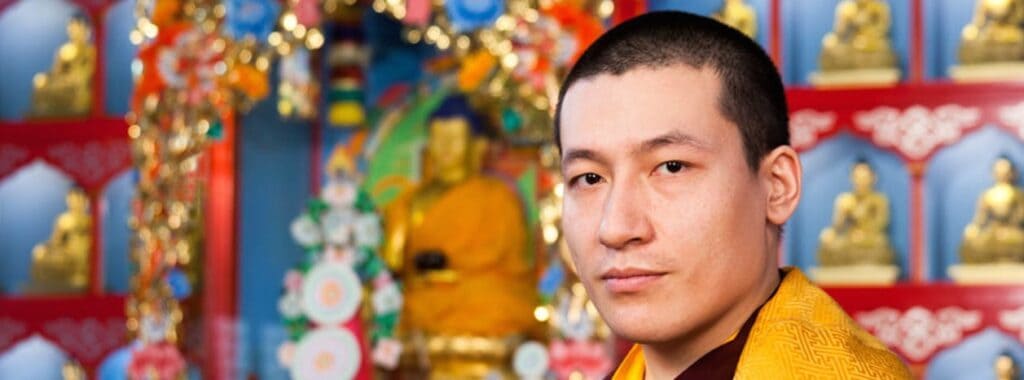
Finally, I would like to thank you for being here, and it was a great pleasure to be able to teach all of you something as precious as this. Of course all dharma teachings are equally valuable, but out of the many this is one of the more special teachings I have encountered. When I first came to India and was living here in New Delhi in the Karmapa International Buddhist Institute (KIBI), I was 12 or 13 years old. One of the first scriptures I was taught was this one, the “37 Practices of Bodhisattvas.” It has helped me in many ways to learn how to avoid many of my imperfections and to develop kindness and bodhicitta. I can assure you: I would not deny that it is not a cakewalk, but definitely a difficult journey, to make sure that one does not lose the authenticity and the purity of the bodhicitta. At the same time I feel that it is definitely due to the compassion of buddhas and bodhisattvas that I have this opportunity to be able to share all of this. Of course, it is also because of my own positive accumulations that such a precious existence is here.Therefore,e I hope that you all will be able to understand this and that you will be able to understand more than I have understood and that it will benefit all of you.
Taught by Gyalwa Karmapa in English, transcribed by Rachelle and Jim Macur, edited by Kenn Maly and Detlev Göbel, and at the request of Gyalwa Karmapa proof-read and corrected by Khenpo Ngedoen.
Further reading:
The 37 Practices of Bodhisattvas, Part I
The 37 Practices of Bodhisattvas, Part 2
The 37 Practices of Bodhisattvas, Part 3 (The Six Paramitas)
- Shantideva was an 8th-century Indian Buddhist scholar and an adherent of the Madhyamaka philosophy of Nagarjuna. ↩︎
- Pratyeka-buddha (Skt.) means literally “for oneself” but is more commonly translated as “solitary realizer,“ those who practice on their own without the use of teachers and for their own benefit. Through meditation on dependent arising, they realize the absence of true existence of the self and achieve liberation from conditioned existence. However, because they do not realize emptiness, they do not reach full enlightenment. They appear only in ages when there is no Buddha and the Buddhist teachings are lost. Shravaka (Skt.) means “hearer.“ Their goal is to attain liberation from the sufferings of conditioned existence through hearing, and reach the level of an arhat. ↩︎
- The Tibetan term for the fifth paramita is samten, not to be confused with shine. Samten and shine are related: Shine uses different methods to calm the mind, to pacify it, and to cultivate mindfulness and awareness. Samten is the liberating action to be aware of one’s mindstream and then to not get distracted by negative thoughts, but to the contrary consciously increase good thoughts. In that way shine provides the basis for being able to practice samten. ↩︎
- Following the traditional Eastern style of Buddhist teachers, the Karmapa here is being extremely modest and humble about himself and his teachings. For this reason these expressions here are not to be taken literally. ↩︎