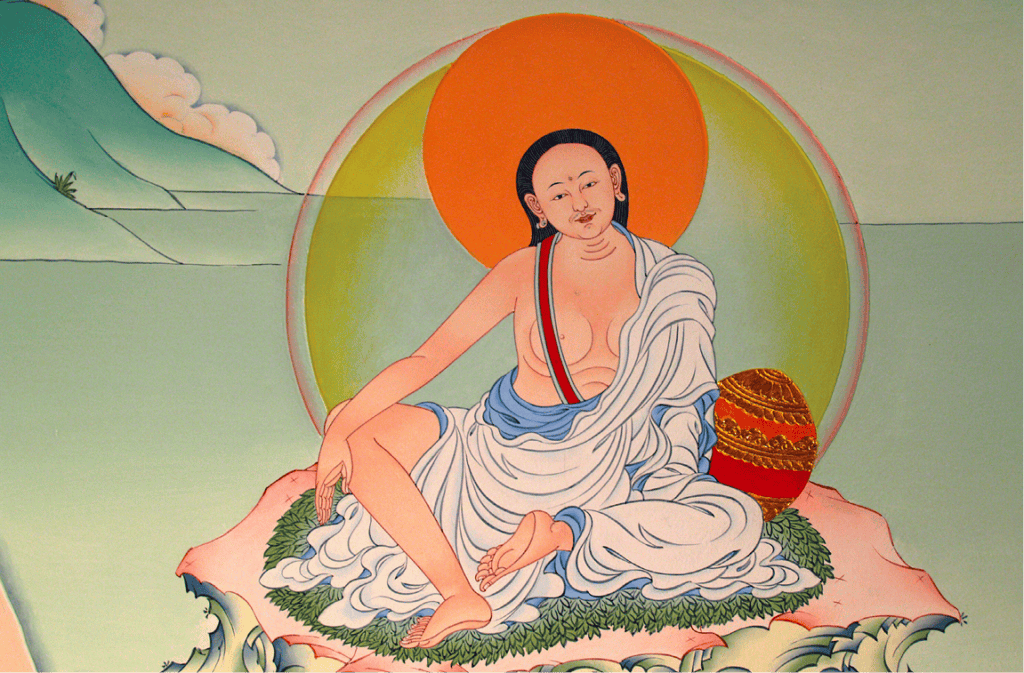
Everyone who has ever visited the big meditation hall in Karma Guen Retreat Centre in Spain has felt like being in a Pure Land among buddhas and bodhisattvas, or in the best museum in the world. Perfect proportions, smooth transitions from darker to lighter tones, pastel colors, enlightened images resting in the vastness of space—these are just some of the characteristics of the Karma Gardri1 style of art (sometimes called Karma Gadri) for creating the excellent wall paintings in this gompa.
Images of buddhas leave strong imprints in the minds of those creating and beholding them. Therefore, Buddhist art is not just about creativity but above all about following a tradition. It means that an artist refers to past experience. Its successful preservation depends on strict adherence to canons of iconometry (“measurement of images,” a system of proportions) and iconography (topics, composition, symbolism) transmitted by Buddha Shakyamuni himself as well as on examples of style created by past masters. There have been many highly realized Buddhist teachers, with even lineage holders among them. In the case of the Karma Gardri style, these were the outstanding lamas of the Kagyü tradition of Tibetan Buddhism. It is said that the artist Namkha Tashi played the key role in forming Karma Gardri style. But its creation and development were based on the vision of high bodhisattvas. For example, Namkha Tashi, who lived in the sixteenth century, got instructions from the 5th Shamarpa Köncho Yenlak, and Gyaltsab Rinpoche. These teachers referred to the ways of combining some elements of art of three countries: India (proportions and forms), China (pallet and shading technique2), and Tibet (landscapes and composition).
The other source of Karma Gardri tradition, including its name, is the activity of the 7th Karmapa Choedrak Gyamtso. He spent almost all his life traveling throughout Tibet. Thousands of his students—lamas, monks and laymen—followed him. During their stops they lived in tent encampments, which were a kind of a traveling monastery. Huge tents served instead of halls for holding important ceremonies and empowerments. Smaller tents became fully functioning art workshops where thangkas, statues and other objects of Buddhist art were created. The Tibetan word “gar” (Tib. sgar) is translated as “encampment.” These were the conditions in which the “tent” or Karma Gardri style had its start. “Karma” signifies belonging to Karma Kagyü transmission, “gar” is translated from Tibetan as an encampment and “dri” (Tib. ‘bri) means “to draw.”
Further flourishing of this art tradition was maintained by such amazing artists as the 8th Karmapa Mikyö Dorje, the 6th Shamarpa, and his great student the 10th Karmapa Choying Dorje.3 Later contribution to spreading and developing the Karma Gardri tradition of art was made by the 8th Situpa Chökyi Jungne, a great artist who lived in the 18th century. The enlightened activity of all these masters was clearly reflected in their art.
One of the living masters of this art style is Dawa Lhadripa,4 the descendant of a noble family into which some 300 years ago the 8th Shamarpa Palchen Chökyi Döndrub was born. Master Dawa Lhadripa keeps the traditions of Buddhist art as carefully as did his great predecessors and teachers.
Dawa lives in Sikkim, India, not far from the Rumtek monastery established by the 16th Karmapa Rangjung Rigpe Dorje. But the artist spends a lot of time away from home, creating wonderful masterpieces in different monasteries and dharma centers. The Diamond Way retreat center Karma Guen in Spain has unique examples of his art work: wall paintings in the big meditation hall, in the Mahakala room, and in the corridor leading to it. Among these paintings is a big thangka of Mahakala painted by him especially for this place.
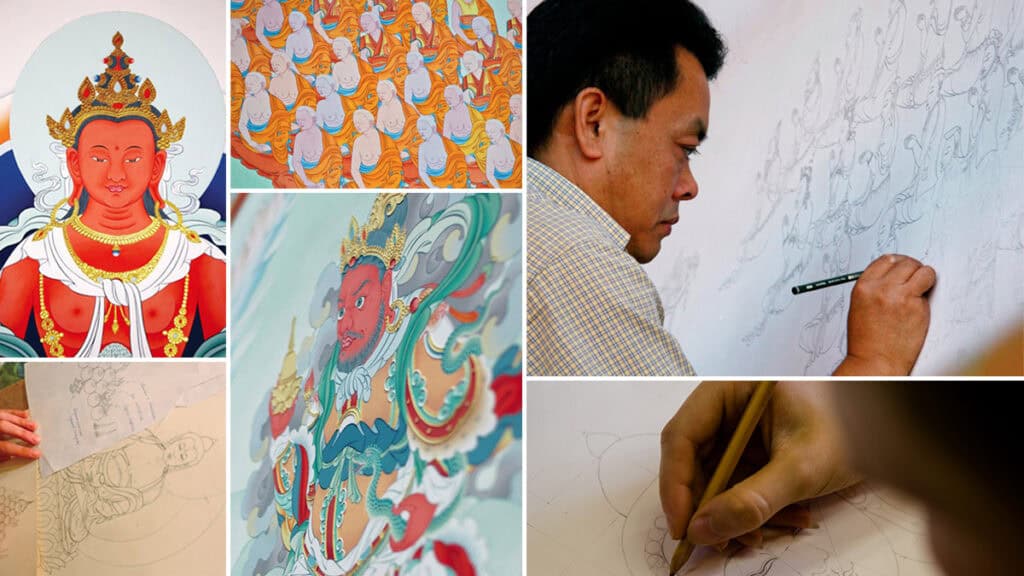
At the age of five, Dawa started remembering how he had painted Buddhas some time in the past. He admired the work of his grandfather, who was a lama and a master of the Karma Gardri style. But Dawa’s parents didn’t see how strong their son’s proclivity was and only when he was thirteen years old did they help him begin his art education. According to Dawa, the learning process was not easy, because he had to look for teachers himself, since back then there were no art schools. Teachers were hard to find, and the young artist often had to travel quite far away from home and sometimes had to combine his learning process with work. Lama Jigme was Dawa’s first teacher, and he spent a year and a half with Lama Jigme. After that he continued learning all the ins and outs of Buddhist art from other masters, and his last teacher was the renowned Gega Lama from Kathmandu.

Buddha Amithaba in Kathmandu.
But it’s not enough to master usage of pens, brushes and colors, and be well-versed in canons of Buddhist iconometry, iconography and symbolism. A Buddhist artist must study dharma for some years. Therefore, Dawa had to find spiritual guidance too. For a few years he studied in Yolmo Gangra and Kathmandu (Nepal) as well as Rumtek (Sikkim, India) where a brilliant assemblage of high lamas, including the 16th Karmapa, have resided since the 1960s. It was there in the 1970s that different teachers, including Nedo Kuchung Rinpoche, started telling Dawa that his works belonged to the Karma Gardri style. And already back then the artist understood that the 16th Karmapa wanted to keep this art tradition alive, and Dawa took this wish deep into his heart.
In the middle of the 1990s, Dawa went to Kalimpong, where he met the young 17th Karmapa Trinley Thaye Dorje. The 17th Karmapa repeated the request of his predecessor, the 16th Karmapa, namely that Dawa should continue the work of preserving the Karma Gardri style and create an art school. During that meeting he already mentioned Kathmandu as the best place for this. Karmapa’s wish was in line with Dawa’s intention not only to work as an artist, but also to transmit his knowledge to younger generations with the idea of doing it in the best conditions of an art school.
In former times in the East, a full education for a Buddhist artist lasted thirteen years, or at minimum nine years if there was not that much time. A student used to practice drawing one element for three years, and only after that did his teacher give him further instructions. This was a serious practice that lasted a whole lifetime. Nowadays, art education is not a long process; everyone tries to finish it within a short time. For this reason, in the modern world in both the East and the West, it is not easy to preserve this traditional art together with its specific ways of transmitting knowledge from generation to generation. But it is important to stick to them, because Buddhist art is not meant only for interior decoration. It also serves as support for meditation practice, makes strong imprints on our minds and helps us get a clear idea of how buddha aspects look.
Studying Buddhist art is similar to dharma practice. On one hand, one should get oral transmissions from his or her teacher, spend time near him or her, and see how he or she works. On the other hand, it is also important that a teacher has a chance to observe his or her student working. But according to Dawa, the Buddhist artist’s way to perfection differs from the way to perfect enlightenment. It is said that through dharma practice a skillful teacher and his or her very devoted student can get enlightened simultaneously. In art, even if it is Buddhist art, strong devotion to one’s teacher is not enough. No one can bring you to mastery while holding you by the hand. An artist spends all of his or her life perfecting painting techniques as well as knowledge and skills.

A long time ago, master Dawa Lhadripa decided not only to create art but also to teach, and therefore he founded his Rangjung Dawa Art School. At first, he was sure that there would be a chance to have it in Rumtek, the place where the 16th Karmapa did so much to preserve the Karma Kagyü tradition of Tibetan Buddhism, including Karma Gardri style of art, and where Dawa enriched his knowledge in many ways. Many years ago, Dawa’s family settled near Rumtek monastery. They built a house and reserved one floor with rooms and classrooms for the young generation of thangka painters. Dawa’s students could go there and spend time sharpening their skills. After several years of diligent but fruitless efforts to officially establish the art school in Sikkim, Dawa realized that already in the 1990s the 17th Karmapa had directed him to Kathmandu, since the Karmapa saw this city as a place to carry out the project. The master already had an idea of how the art school should look: a two or three-story building with big windows, built on land belonging to the school and functioning independently of any monastery, dharma center or private house. There is no such place for regular learning in Kathmandu but there are several students and supporters ready to come to Nepal’s capital to help Dawa.
Rangjung Dawa Art School is already registered as an official organization. Dawa is a wonderful teacher with his mild and encouraging style of schooling. His students are from Russia, Ukraine, Czech Republic, Slovakia, Germany, Hungary, Lithuania, Denmark, Spain and some other countries. Until there is a big educational center in Kathmandu, Dawa transmits his knowledge in Karma Gardri art while meeting his students in different parts of the world. The best conditions for this appear at thangka painting courses. In 2000 such a course was held in Singapore. In 2011 two courses were held in Germany: there were fourteen participants in the Europe Center and thirty participants at the Braunschweig event. In 2013, Dawa spent a whole month at the Europe Center. There he started working on a big thangka depicting the Refuge Tree of the Karma Kagyü lineage. His Western students had a chance to stay after the course and learn from the master. Dawa also visits Budapest from time to time, but Karma Guen retreat center in Spain is the main place for his art activity in the West (and possibly for his teaching activity too).
The cooperation with this place started by fulfilling Pedro Gomez’s request to paint a big Mahakala thangka for the center. Later, Dawa was invited to create wall paintings in the big meditation hall (500 square meters in total). After receiving instructions from the 17th Karmapa Thaye Dorje, he started his work in 2004. Later he continued creating exciting art in the Mahakala room downstairs. In the spring of 2017, Dawa finished the unique wall paintings in the corridor leading to the Protector room. According to the 17th Karmapa’s wish, the artist showed Mahakala’s path to enlightenment and the life story of the 2nd Karmapa Karma Pakshi. This cannot be found on the walls of any other monastery or dharma center of the Karma Kagyü lineage. Karma Guen is developing as a place to preserve this Buddhist tradition in its entirety, therefore Karma Gardri art is so important there. Dawa’s students have their own studio. It’s a spacious room with big windows, an excellent view over the Kalachakra Stupa and special tables for young artists. After the 17th Karmapa visited and blessed the art studio, everything was ready for holding the first thangka painting course in Karma Guen in September 2017. Dawa joyfully taught forty students, most of whom got their first introduction into the world of the Karma Gardri art.

Russian students of the master also have opportunities to receive his knowledge. They meet Dawa annually at two thangka painting courses in Russia. In 2010, he visited the country for the first time and guided a course on the basics of Tibetan pictorial art of the Karma Gardri style (held in Karelia retreat center). In 2012, Dawa came to Askat retreat center for the first time. A community of Lama Ole’s artistic students has gradually formed in this picturesque place in the Altai Mountains. They eagerly learn from Dawa and aim at building their own atelier on the territory of the retreat center. Each painting course in Russia attracts thirty to thirty-five people. They spend two weeks in the powerful Altai Mountains or ancient woods of Karelia, devoting many hours each day to learning the ways of depicting enlightened forms and everything surrounding them. Experienced students of Dawa take part together with those making their first steps in the world of Buddhist art. The master generously shares his knowledge with everyone, since depicting buddhas helps calm down the mind, concentrate on its inner processes, and plant good impressions.
Dawa is creating his school for the next generation of Buddhist artists, and they are supposed to follow his example so that the transmission line won’t be interrupted, and Karma Gardri style continues to exist. Lama Ole Nydahl has known Dawa since the days when he and Hannah stayed in Rumtek. Understanding the importance of this project, he supported the idealistic work of Dawa and his students in 2011 by writing an encouraging letter. There he stated that his art schools set up in different countries “…bring the Buddhas close and are fine gifts to our transmission by an excellent and skilled artist.”
Dawa Lhadripa has painted walls, statues, thangkas and mandalas in various monasteries and dharma centers in the East and the West, including Nepal, India, Singapore, Malaysia, the USA, Germany, Hungary, Russia and Spain. The master and his students continue working hard and they move step by step towards their goal of establishing the Rangjung Dawa Art School. At his courses he often jokingly says in Tibetan “kale, kale” (Tib. ga le)—slowly, easily, gradually. These were the favorite words of one of his art teachers, Tenga Rinpoche. For three years and seven months Dawa painted his monastery in Kathmandu, getting guidance and advice from Tenga Rinpoche. This work marked the end of Dawa’s artistic education: he was clarifying many fine details and learned to work with no haste, understanding that “there is a time for everything.”
Efforts of the master and his students are supported by Gyalwa Karmapa’s blessing for the project of the Rangjung Dawa Art School to proceed. Thus, elegant Karma Gardri art will be preserved for the next generation of Buddhists and art connoisseurs. Such is Karmapa’s big wish, and he asks that this work continue.
Information for the article was taken from lectures and interviews with Dawa Lhadripa, talks with him and his students, as well as the project’s website: www.karmagardriarts.com

If the reader wants to be a part of this project, either becoming a student of Dawa or supporting his work, please visit karmagardriarts.com/support or contact him at rangjungdawa@gmail.com.
- Karma Gardri art is the crown jewel of the Kagyü tradition, the way to make visual support for the practice so beautiful and inspiring that the wish to look into the mirror of the mind appears naturally, and perfection of our qualities becomes obvious. ↩︎
- This art term that signifies the technique of creating smooth transitions from one tone to another using lots of small brush strokes. ↩︎
- The thangka depicting Buddha Shakyamuni and the statue of the Bodhisattva Chenrezig by the 10th Karmapa are kept and sometimes exhibited in the State Hermitage Museum in Saint Petersburg, Russia. ↩︎
- The word “lhadripa” (Tib. lha bris pa) is literally translated from Tibetan as “a man who paints deities;” in English the word “artist” can be used instead. ↩︎