
The beginnings of the Karmapa’s healthcare project
In December 2004 we took Buddhist refuge with Lama Ole Nydahl. At that time it was our wish to do something for the 17th Karmapa and his work. We had not yet met the Karmapa and knew him only from photos.
Pia’s job at the time was naturopathic medicine, and Peter was working in photography and technology. Given this background and that both of us are pretty good organizers, we decided to put our wish into practice by doing something for Karmapa’s people in Asia.
The next step was to meet Hannah Nydahl, who knew so much about the Karmapa and the situation in Asia. When we met with her and explained our wishes, she approved of our plan. As she sent us to meet the Karmapa in Kalimpong1, India, she asked with a chuckle if we had a sense of humor!
We met H.H. the 17th Karmapa Trinley Thaye Dorje early in 2005 when he invited us to a working session about the proposed project. This led to the establishment of the Karmapa Healthcare Project–the KHCP. Karmapa decided that we should spend some time in his shedra2, where we would have contact with everyone and be able to discuss our ideas. We regularly reported to the Karmapa. Thus there emerged a rough framework of what needed to be done. The name “Karmapa’s Healthcare Project” was made official in a letter from the Karmapa. In this letter, he authorized us to do all that was needed to bring healthcare to his monks and nuns—specifically to find sources of funding in Europe, to acquire and bring medical equipment and supplies to India, to find and engage medical professionals to volunteer for the project, and to generally be responsible for coordinating this project.
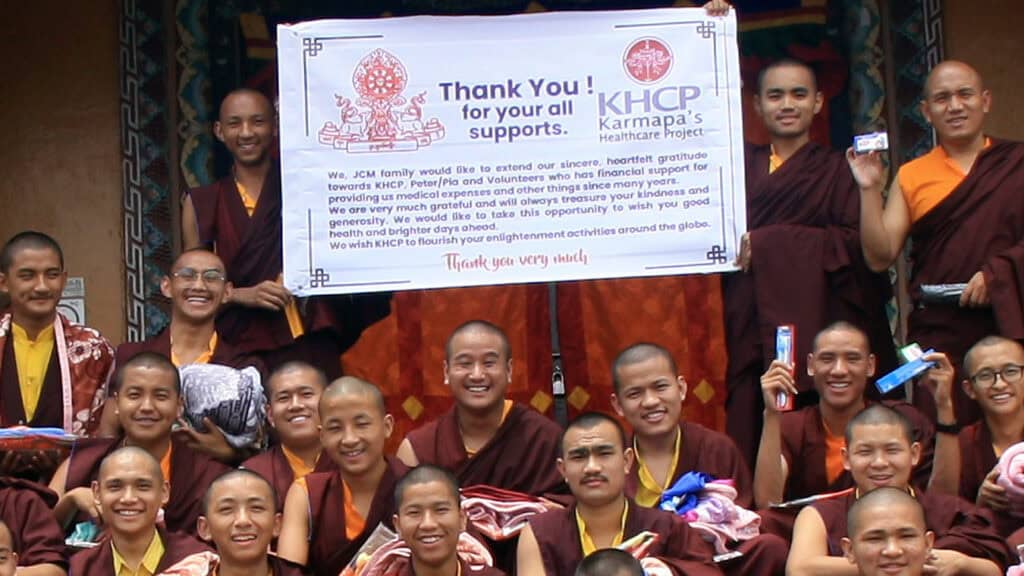
Karmapa has several institutes in the Himalayas. These are partly also under the supervision of Shamar Rinpoche. An example is the shedra in Kalimpong. When they are finished with their studies there, the students become khenpos3. Then there are schools in Darjeeling and in Rumtek, Karmapa’s school for nuns, a monastery in Ladakh, and the Mahavihar in Swayambhu in Kathmandu, Nepal.
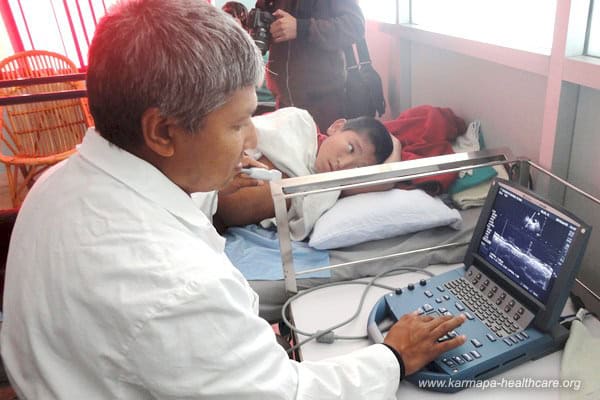
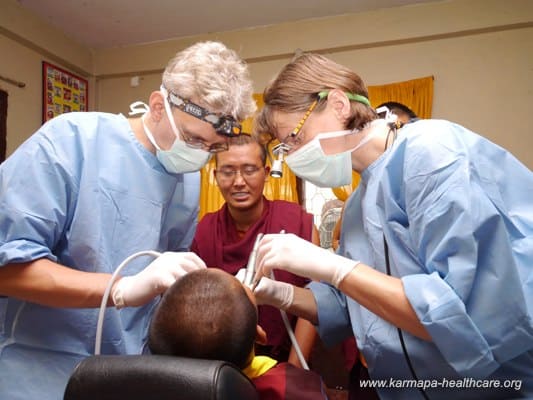
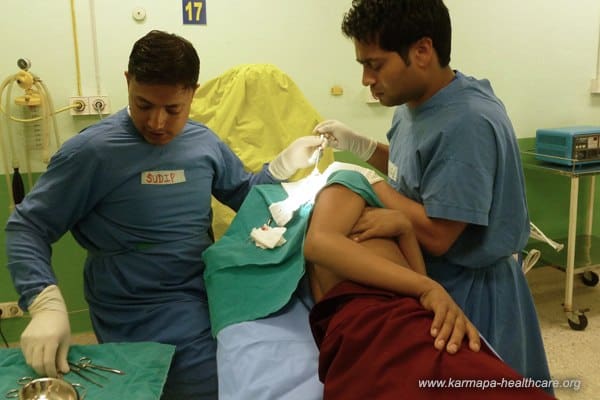
All of these institutes were without any organized healthcare. Founding this project was intended to change this situation. Over the past three years, we have succeeded in bringing about this improvement. Now, in all of the institutes, there are regular checkups and vaccinations by doctors and dentists. In some places, the water quality has been improved, or the supply of electricity has been guaranteed by purchasing a large generator. Then, in 2008, we established a health camp in Bodhgaya during the Kagyu-Monlam. The medical volunteers from Europe make this happen, and this camp will take place every year from now on.
Since it is important that our work aim toward self-reliance, the monks in Kalimpong organize their annual checkups on their own. The nuns in Rumtek use the funds that we provide for visits to the doctor and for their medications. All in all, our friends in Asia are learning to pay more attention to their health.
How we do our work
We live a little bit like nomads. From spring to October we are in Europe, where we try to attend many of Lama Ole Nydahl’s courses. People can contact us at these courses, and they can experience what it is that we do—and even participate, including making contributions. Whoever has medical training is most welcome. For example, pharmacists and opticians gather medications and eyeglasses. We are also looking for English teachers. Whoever works with us or travels with us has to pay their own way, including us. Using these methods, we quickly created a network of very qualified people.
Then, during the winter, we go to the sites. We try to visit all of the projects in order to find out what is needed, and then to organize together how to deliver them. For the large Monlam camp, much planning is necessary. Friends from Europe that we meet along the way are often so excited that they spontaneously join our work. It was in this way that we found an English teacher from Hungary for the Mahavihar mentioned earlier. Those who have joined us and provided their services include students of Lama Ole, as well as others from France and Southeast Asia.
At the moment we are working on building a small infirmary in Kathmandu. We have also been asked by Beru Khyentse Rinpoche, the head of the Karma Kagyu monastery in Bodhgaya, to build a small infirmary there.
We have had some interesting projects in Europe as well. Lamas were given a physical checkup at the Europe Center, and we organized a physical checkup in the university clinic in Hamburg for Sherab Gyaltsen Rinpoche.
Very quickly, there emerged a whole team of doctors, nurses, pharmacists, opticians, teachers, technicians, and translators. So you see, the project can be supported in many ways. For example, now, in the small clinic in Bodhgaya, we are looking for a lot of expertise, and we are pleased that our doctors give us such good counsel. At the medical camp in Bodhgaya, the European Kagyu team received a lot of support and gratitude from the Karmapa, as well as his rinpoches and lamas. And the people in the institutes also offer major support.
In order to manage and organize this big project, we end up traveling a lot. This calls for good planning and some thrift—and not taking jetlag so seriously! And we get energized when we see the results at the various sites. For example, at the Monlam camp, our staff of nine saw more than 4,000 people in seven days. When this happens, you don’t think so much about whether you are tired or not.
Regular contact with the Karmapa
We attribute our success to the confidence that Hannah Nydahl gave us, as well as support from Lama Ole, who lets us set up information booths at his courses. Above all, however, we are grateful to the Karmapa, who gave us a lot of freedom to develop this project.
Naturally, it is quite joyful to be able to report to the Karmapa. This we do regularly, so that we can coordinate new ideas. For example, Sherab Gyaltsen Rinpoche’s school in Kathmandu with ninety children—mostly orphans—was recently affiliated with KHCP. This is a big responsibility and will require continual discussions.
We also meet with the rinpoches and lamas of the institutes. They offer enormous support, otherwise the progress that we have made would not be possible. This is another bridge between East and West, where expertise and accountability, as well as the quality of life, is valued.
The website and its connection to KHCP
We wanted to build a platform to show the various activities that grew out of the KHCP project. The name of the website—White Umbrella4—has a bit of a romantic origin. The empowerment of the protectress Dukar—known in English as White Umbrella—was our first empowerment from the Karmapa, at a course in Kassel, Germany. Later, in a working session with the Shamarpa in Kassel in 2006, this name was made official.
In connection with the website, we have made short films and photographic reports, as well as blogs and interviews. Using our talents as a theatre director (Pia) and photographer (Peter), we quickly turned down this path. Karmapa saw this documentation of the project as a good way to show his work in Asia. The website, with all its dimensions, might inspire people to go to Kalimpong to meet the Karmapa or to visit the Karmapa International Buddhist Institute (KIBI) in New Delhi.
Our films communicate mutual impressions between East and West. For example, we showed 4,500 Kagyus in Bodhgaya a film about the work done in Europe by Lama Ole and Sherab Gyaltsen Rinpoche. We hope to make many friends in both the East and the West, and to motivate people to help KHCP.
Photo credit: KHCP
- Kalimpong is in the northwest of Bengal, in the district of Darjeeling, where the Karmapa lives and has his main monastery. ↩︎
- Buddhist university ↩︎
- The chief instructor or spiritual authority in a monastery. ↩︎
- White Umbrella is now Karmapa’s Healthcare Project ↩︎


