

From among the different Karmapa incarnations, the Third Karmapa, Rangjung Dorje, was one of the most influential. He was of special importance for the continuation and enrichment of the meditative tradition. Detailed presentations of his life story often stress his close connection to yogic practice in remote places, similar to that of the famous Kagyu yogi Milarepa. In fact, according to his autobiography, Rangjung Dorje strongly emphasized the practice of meditation. He founded a number of retreat centers and spent several long periods of his life in retreat. In his teachings, he commented extensively on the Buddhist Tantras which serve as theoretical background for the practice of Diamond Way (Skt. Vajrayana) Buddhism.
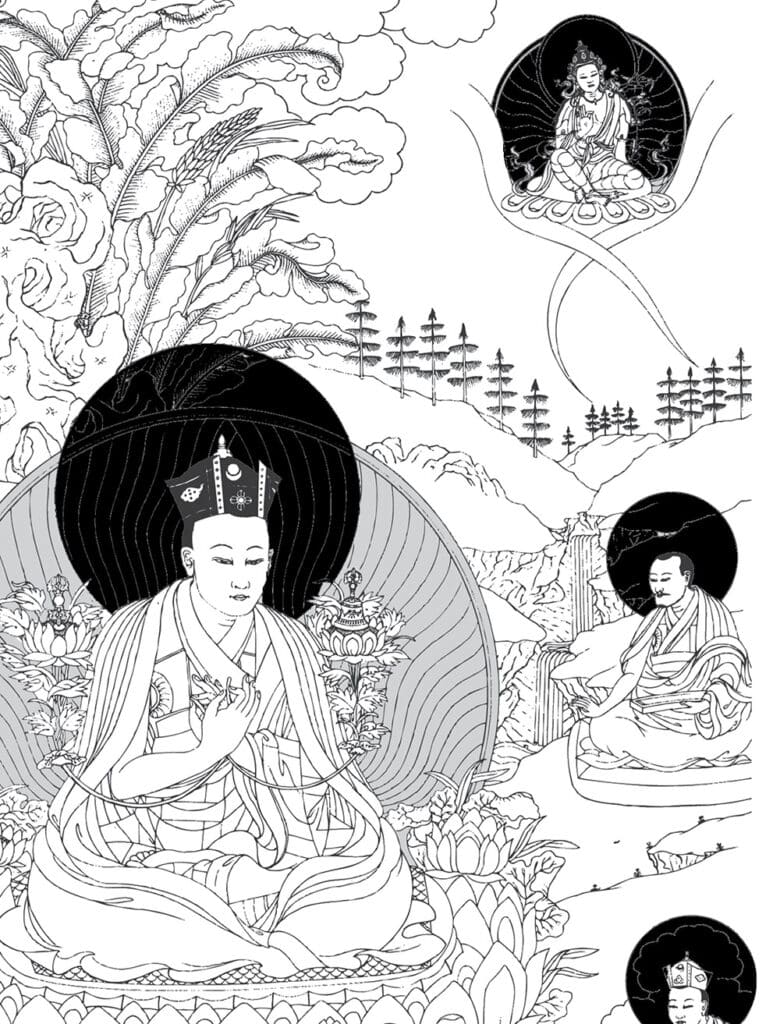
At the same time, he introduced a high level of intellectual understanding as part of the practice. The impact of his philosophical treatises on the practice-oriented lineages of Tibetan Buddhism cannot be overestimated. He is regarded by many Tibetan and Western scholars as one of the main promulgators of the “Empty of Other” (Tib. shentong) philosophy in Tibet. Like a few other masters in the early fourteenth century, he collected all available teachings, practiced them, and brought the essential teachings into a form widely used in various lineages of spiritual instruction. But, unlike most other masters of his time, he became a lineage holder of all major practice lineages of Tibetan Buddhism, and several of his commentaries from this time onward became important sources of learning and practice in these lineages.
Looking at his life story in summarized form, on the level of his outer activities Rangjung Dorje worked in many ways for the benefit of beings. He cared for the establishment of the Buddhist teachings in Tibet and China by founding and repairing several monasteries and retreat centers. He pacified conflicts among hostile tribes and saved people from the danger of fire, earthquake and other calamities. Rangjung Dorje even built a bridge over the Sog chu river and practiced the Tibetan system of medicine as an expert in physical and mental healing. Tibet and China also benefited greatly from the Third Karmapa in many other ways. On the inner level of being a holder of various spiritual transmissions, Rangjung Dorje was able to receive and impart the essential teachings of the so-called “eight original practice lineages” (Tib. drub gyu shing ta gye) of Tibetan Buddhism. In one of the most famous compilations of these essential teachings called The Treasury of Essential Instructions (Dam ngag dzod) by the First Kongtrul Lodroe Thaye (1813-1899), the commentaries of the Third Karmapa appear in the context of nearly all lineages. Kongtrul also refers back many times to Rangjung Dorje’s teachings in his other four textual collections, which—together with the first compilation—are called The Five Treasuries.
In the Treasury of Precious Rediscovered Teachings (Rinchen Terdzod) Kongtrul especially mentions that the Third Karmapa unified the traditional Great Seal teachings (Skt. Mahamudra, Tib. Chag chen) of the Kagyu lineage with the Great Perfection teachings (Skt. Maha-ati, Tib. Dzogchen). Until his time, these had been transmitted nearly exclusively through the Nyingma lineage. This means that Rangjung Dorje’s role as a treasure revealer and lineage holder of the Nyingma transmissions was to combine essential teachings of both traditions into one stream. This made him the founder of a completely new transmission lineage called “Karma Nyingthig,” which still exists today.

On the level of his secret life, according to his autobiography he had deep meditation experiences, such as visions, and was able to meet many buddha aspects face to face. He demonstrated extraordinary abilities, such as an unhindered awareness of his previous lives, the ability to speak right after his birth, and reading the thoughts of other people. In one instance, he clearly saw the future and used it to warn people against an earthquake. Karmapa often performed miracles, for example showing his face on the full moon during the night following his death, and in this way guided his students in their meditation practice towards liberation and full enlightenment.
At the age of 35, in 1318, when staying at the Garuda Castle Hermitage (Tib. Kyung Dzong wenpa) of Tsurphu, the connection between the timing of the inner winds and the cycle of planets and stars in outer space clearly appeared to him. As a result of this experience, he composed a commentary summarizing the whole of astrology. The calendar calculations, including the determination of all special days throughout the year in Tibet, follow two main systems of astrology—the Lhasa or Central Tibetan system and the Tsurphu system. The latter, to this day, is based on the calculations contained in the treatise (and its commentaries) by the Third Karmapa, Rangjung Dorje.
His extensive scholarship found its expression in his ability to clarify, structure and reformulate the key concepts of several lineages of spiritual instruction, especially of the Karma Kagyu lineage, and in the tremendous literary output he left behind—according to the latest research he authored probably more than 300 works. After having received a vast number of teachings and transmissions, Rangjung Dorje composed many commentaries in order to elucidate this material and to facilitate the understanding and practice of these contents for his followers. Since the period of translation of texts from Indian sources had come to an end, it was obviously the right time to collect all available written and oral transmissions and to assess their authenticity and reorganize them for easy access. Only the most capable scholars and meditation masters of an inspiring time, who possessed encyclopedic minds, could perform such an enormous task.
In the Karma Kagyu lineage, his most famous compositions are the Deep Inner Meaning (Tib. Zab mo nang gi don), a summary of all Buddhist Tantras, and the Great Seal Wishes or Aspiration Prayer of Mahamudra (literal translation: The Aspiration Prayer for the Definitive Meaning of the Great Seal, short Tibetan title: Chag chen mon lam). These two treatises have frequently been designated as his masterpieces. Therefore, because together with several associated texts they represent the Way of Methods and the Way of Liberation, Rangjung Dorje’s two main treatises teach the viewpoint and meditation as practiced in the Kagyu lineage up until today.
The general meaning of the Great Seal Wishes can be explained in the following way: In the commentaries of many masters, the Great Seal instructions are said to be the essence of all Sutra and Tantra teachings of the Buddha. The development of the viewpoint and meditation practice of the Great Seal contains a sequence of methods enabling the practitioner to arrive at a clear and direct experience of the nature of reality. The study and practice of these teachings especially fosters the qualities of compassion and wisdom.




The Great Seal teaching is presented in terms of the three aspects of basis, path and result. Basis is the awareness of buddha nature and the so-called pure view, focussing on the understanding of the enlightened qualities inherent in the nature of mind. Path means the application of the methods related to the Great Seal practice. Based on the development of mental stability (Tib. shine) and higher or profound insight (Tib. lhaktong), an experienced teacher (la ma) is able to directly introduce the student to the nature of his/her mind. This experience then has to be cultivated until full realization is accomplished, which is said to be an awareness of the inseparability of subject, object and action. The result can also be described as freedom from all disturbing feelings and conceptual obscuration, the manifestation of primordial wisdom with respect to all phenomena or the three states of a buddha.
The Third Karmapa expresses these three aspects in his Great Seal Wishes in the following way (verse seven): “The basis of purification is mind itself, its union of clarity and emptiness. The method of purification is the Great Seal, the diamond-like practice. The object of purification is the fleeting illusory impurities. May we accomplish the fruit of purification, the perfectly pure truth state!” Thus, Rangjung Dorje formulated these profound teachings in a way which, together with the explanations of an experienced teacher, enables direct access to the realization of the nature of mind. Lama Ole Nydahl commented extensively on the Great Seal Wishes. At the end of the introduction to his book The Great Seal: The Mahamudra View of Diamond Way Buddhism (German edition), he states: “The following twenty-five verses on this experience [of the buddhas and the Great Seal] have been composed by the 3rd Karmapa Rangjung Dorje seven hundred years ago. They point to the nature of mind and are as fresh as if they would have been composed just now.”
Rangjung Dorje’s text elucidates all the essential points of the viewpoint, practice and accomplishment of the Great Seal teachings and provides clear instructions on how to reach the goal of the Great Seal. This is the reason it became extremely influential in all lineages of Tibetan Buddhism. All lineages still study and practice the Great Seal Wishes of the Third Karmapa today.


