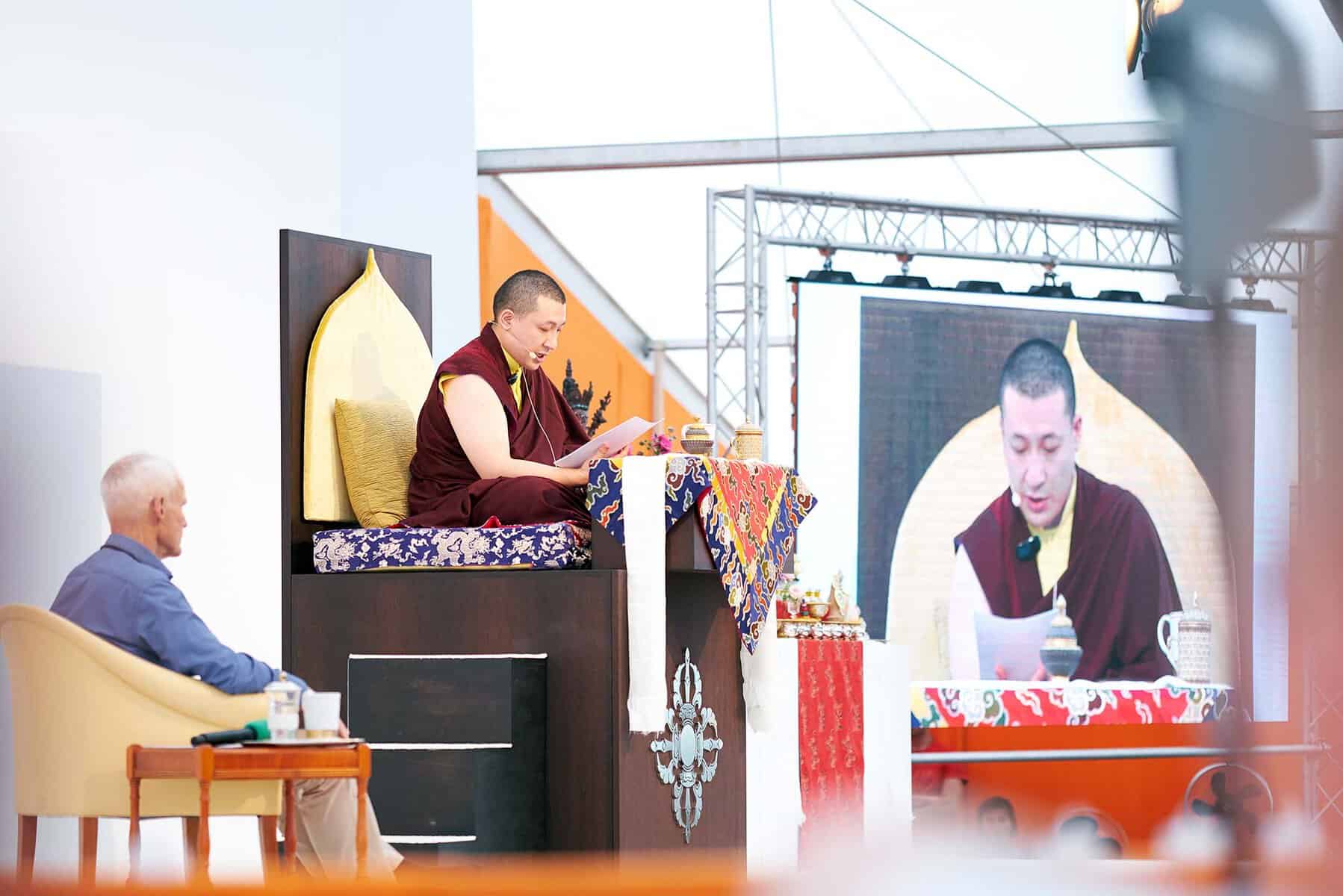
The 15th Karmapa Khakyab Dorje (1871-1922) had several consorts and two sons who were the rebirths of great masters (Tib. tulkus). To date, there has been very little published about them in Western languages, and what exists is contradictory and incomplete. Most available information has been passed down orally in Tibet, and there are no texts in Tibetan which fully address this topic either. Thus, a lot of what one might hear about this subject is based on rumors and misinformation.
For the first time, this article compiles information about this topic from the existing authentic written and oral sources; the latter being primarily from the personal attendant of the 16th and 17th Karmapas, Gyamkhar Tsultrim Namgyal.
Editor’s Note: We are excited to present this article, a Buddhism Today first, on the wives, consorts, and children of the great 15th Karmapa, Khakyab Dorje. As is the case with many aspects of the Tibetan Vajrayana (Engl. Diamond Way), the proper historical and spiritual context is essential for a correct understanding of the meaning and value of these exceptional teachings. Buddhist Tantra, throughout its history, has always been perceived as unorthodox or disruptive by bourgeois moralists. However, in old Tibet, it nonetheless found a unique place in the center of polite society.
In this specific article, it’s important that we take a moment to focus on the literal meaning of the word consort, as well as our intentions behind its usage in the text below. In English, consort refers to the spouse or partner of a reigning monarch. While the Karmapas were never temporal or political leaders, we feel that this description is appropriate considering the spiritual authority held by the Karmapas for over 900 years. It is also fitting considering how highly regarded these women were by the Tibetan people of the day. While old Tibet’s political structures were generally patriarchal, there was an inherent cultural value about the unique importance of women and, as such, great female practitioners were often revered as accomplished yoginis. These yoginis were the kind of women that came to stand by Karmapa’s side and play an influential role in the history of the Karma Kagyu Lineage.
With that all in mind, we hope our story below brings insight and inspiration.
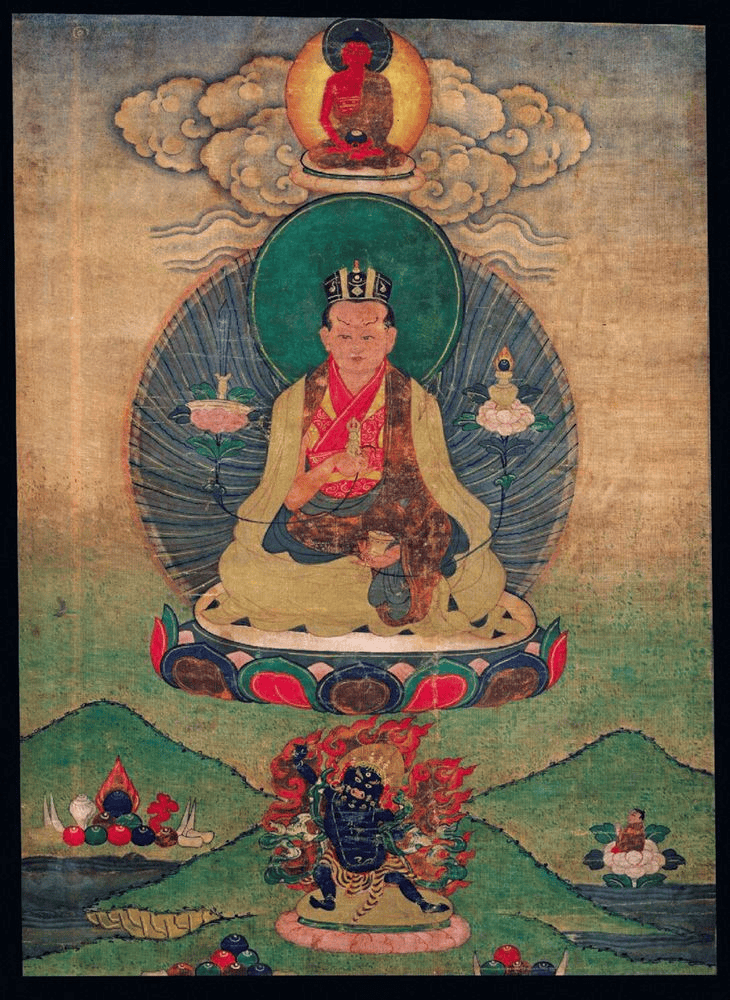
Buddha Shakyamuni taught his students three lifestyles, which correspond to the three Buddhist paths: the monastic style for monks and nuns in the spirit of the Small Vehicle (Skt. Theravada), which focuses on retreating from worldly life and avoiding harmful actions. For laypersons with families and livelihoods, there is the Great Way (Skt. Mahayana), which emphasizes remaining in the world while not getting caught in its illusions. Instead, one uses these in order to benefit others in a broad sense. The lifestyle of the yogis and yoginis corresponds to the Diamond Way (Skt. Vajrayana). It builds upon the Mahayana and uses identification with the highest goal, the view of our buddha nature— in every situation in life and in every moment.
Buddhist masters choose different lifestyles for themselves, depending on their inclinations and their individual circumstances. The first three Tibetan lineage holders in the Kagyu tradition were examples of three different lifestyles: Marpa was outwardly a lay person with a family and farm. Milarepa was the most famous yogi in Tibetan Buddhism, and Gampopa was the first monk in our lineage. Most lineage holders thereafter lived outwardly as monks. However, on one level, it can be understood that these highest masters each chose their respective lifestyles as skillful methods for their activity according to the requirements of the time, but, on the level of their view, they were all yogis.
In the sutra “Mother of the Victorious Ones” (Tib. Gyalwa Yum Gyapa), it is said, “Some bodhisattvas need [for their activity] a father and a mother, but no partner. Some bodhisattvas need father, mother and partners, but no sons and daughters. Some bodhisattvas require father, mother, partner, sons, daughters, servants and all manner of pleasant things.”
There is no valuation in regard to these lifestyles, and Marpa Lotsawa, for instance, was considered to be the third variety of bodhisattva.
Most of the Karmapas were monks, but the 10th Karmapa Choying Dorje changed this for the first time in the history of the Karma Kagyu lineage. At the beginning of his life, he was a monk, but after thirty years in exile in China, he returned to Lhasa as a married layperson with a child,1 which many people found surprising.
The 15th Karmapa Khakyab Dorje was the second Karmapa to marry and have children. This had to do with the fact that it was prophesied that he would be a terton, a finder of hidden teachings or “dharma treasures,” called termas in Tibetan. The origin of the termas was Guru Rinpoche (Skt. Padmasambhava). This fully enlightened teacher was invited by the Tibetan King Trisong Detsen in the eighth century to come to Tibet from India, and he made significant contributions to establishing Buddhism in Tibet.2
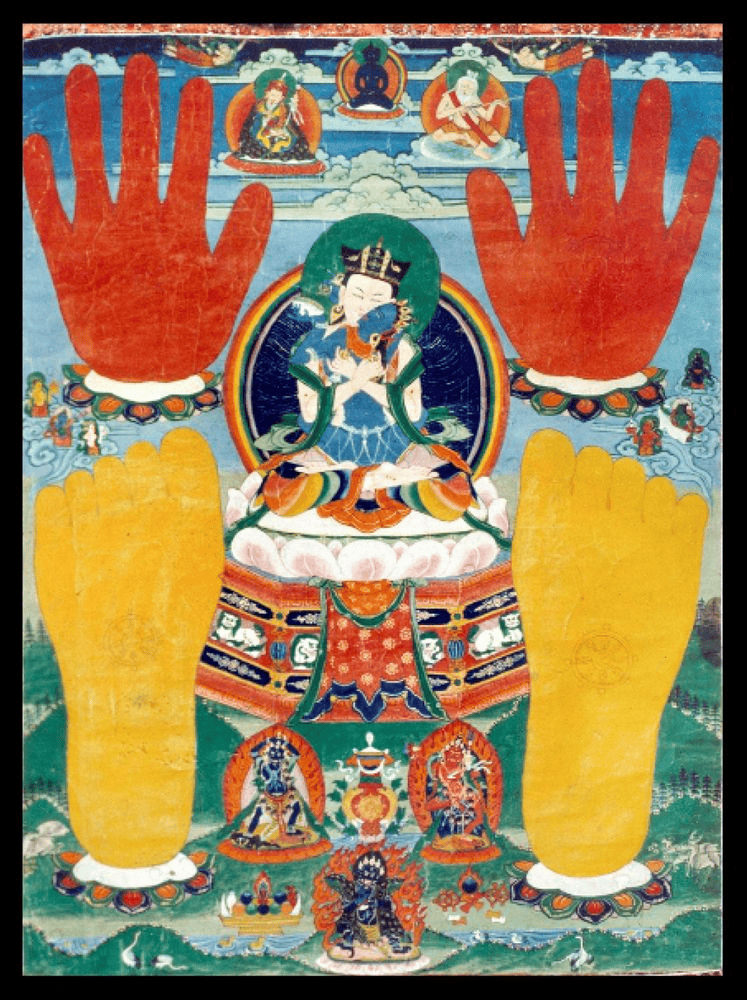
Guru Rinpoche foresaw a dark time in Tibet in which the dharma would largely be destroyed, and so he left termas all over the Himalayan region which could be found in the future and be of benefit to beings. With his consort Yeshe Tsogyal, he hid them in the elements—in rocks, in water—but primarily in the minds of his students. Through his blessing, it was possible for his students to find them again under the right conditions and at the right times. The termas are sometimes objects such as statues, phurbas, etc., but they can also be dharma texts, as well as visionary experiences. They can be relatively simple transmissions as well as huge meditation systems (such as Dorje Phurba, Lama Gongdu or Kagye), which today make up a large portion of the Nyingma transmissions. Some of these are used in the Kagyu lineage, such as the phowa practice, which was taught by Lama Ole Nydahl for many years, the meditation on the 2nd Karmapa, the Green Tara practice used in Kagyu monasteries and even the famous Emaho invocation for rebirth in the pure land of Dewachen.
Consequently, tertons are always rebirths of the previous students of Guru Rinpoche and, with few exceptions, one of the special requirements for men to find termas is to have a consort. Female wisdom and inspiration are usually necessary for this endeavor. There are stories about tertons who knew that there were certain termas that were “waiting for them,” so to speak, but it only became possible to actually discover them once they had found a suitable partner.
The 15th Karmapa was such a terton, and he was destined to find termas and bring them into the world. At the time of Guru Rinpoche, Karmapa, (who was already a buddha at that time), appeared under the name Gyalwa Choyang, and was one of the twenty-five main students of Guru Rinpoche. Many lamas see Karmapa and Guru Rinpoche as inseparable and the 8th Karmapa once said, “Sometimes I am Guru Rinpoche, sometimes Saraha,3 and other times Karmapa.”
Additionally, there was a prophecy from Yeshe Tsogyal, the primary Tibetan consort of Guru Rinpoche, which stated that the 15th Karmapa should have a tantric consort. Initially the 15th Karmapa would not consider marriage, as he feared that such a move would not be easily accepted in Tibetan society, nor in the monasteries. Almost all of the previous Karmapas had been monks.4 In Tibet there had often been highly venerated great masters who were married, but sometimes it was difficult for monks to have complete trust in them.
Without a consort, Karmapa could not fulfill his function as terton, which brought the energies in his body out of balance and made him very ill and even close to death. Some lamas interpreted his illness as a result of the dakinis (the female protectors of the termas) being upset that he was not fulfilling his mission as a terton. Many great masters were finally able to convince Karmapa to marry, because otherwise he might die. That was in the year 1892, when he was about twenty years old.

Officially, it is reported that Karmapa had five consorts, but according to oral sources, there were many more. The relationship of such masters with consorts (Tib. Sang Yum), or literally “secret consorts,” cannot be compared to normal partnerships. The consorts are always women who are already on a very high spiritual level and who are actually realized dakinis.
Karmapa fathered two high tulkus, (conscious rebirths of great masters), and he also discovered many important termas. Tertons often go to special locations in order to find termas. In the case of the 15th Karmapa, it is reported that the termas were brought to him by the terma protectors, or that they flew to him, sometimes directly onto his desk. By the end of his life, he had accumulated 40 boxes of termas, texts and objects.
When Karmapa decided to marry, his first wife was Deden Wangmo,5 the oldest daughter of the noble family Gya in central Tibet. She was highly educated, which was not common for a woman in Tibet at the time, and became his consort so that he could find termas. She and Karmapa lived together in a normal social way as a married couple. Sometime later Karmapa also married the younger sister of Deden Wangmo. There is no further information to be found about his relationship with Deden Wangmo’s sister, or the circumstances surrounding it.
Deden Wangmo must have had a very impressive personality. Karmapa confided to close servants and students that she was in fact the Buddha aspect Red Wisdom (Tib. Dorje Phagmo) in person. In fact, during special rituals she would sometimes wear dakini costumes. Once when Karmapa was sick and his servants were looking after him in his quarters, they witnessed how she transformed into the form of Red Wisdom, with a skull cup and all her attributes. She took something from a box, formed medicine pills from it and gave them to Karmapa.
Many also considered her to be an emanation of the Lion-Headed Dakini (Tib. Senge Dongma), and it is said that she was able to perform miracles during the performance of the Lion-Headed Dakini ritual by having tormas (ritual offerings) burst into flames with just a movement of her hand. Her son, the second Jamgon Kongtrul, later said that he learned a lot from her, so she obviously had a comprehensive knowledge of the dharma.
At the same time, she often demonstrated bossy and short-tempered behavior. Deden Wangmo was very powerful in Tsurphu and always made it clear to Karmapa’s other wives that she was his main wife. Sometimes, she presented herself so assertively that people were intimidated by her. Oral tradition has it that her relationship to Karmapa was not necessarily characterized by humility and servility. She is even said to have hit him once.
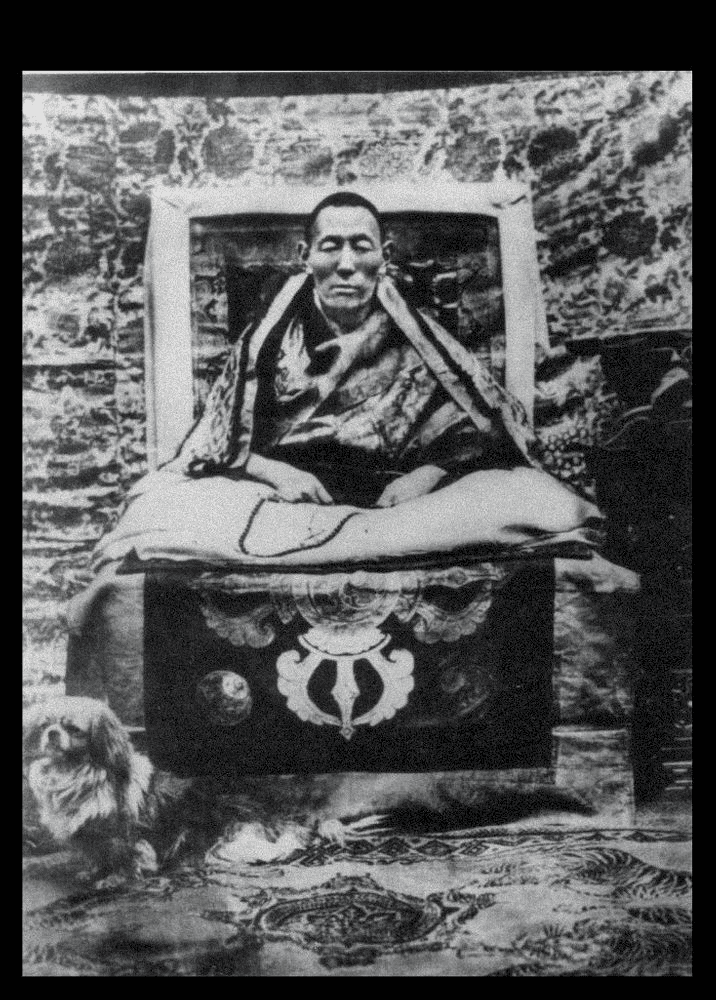
Deden Wangmo had several children with the 15th Karmapa. Their two sons were Thugse Jampa6 and Jamgön Kongtrul Khyentse Özer, the rebirth of the 15th Karmapa’s root lama, Jamgön Kongtrul Lodrö Thaye. Once, in Derge, following a mandala offering, the 15th Karmapa requested of his root lama that he either remain in the world until Karmapa’s next incarnation could meet him, or that he be reborn as Karmapa’s son. Jamgön Kongtrul agreed to this and after he died in 1899, he returned as the son of the 15th Karmapa in 1904.7
Karmapa knew from the beginning that it was the rebirth of his root lama, and the child demonstrated very visible and special signs that he was no ordinary child. After a lengthy hesitation, Karmapa enthroned his son as the second Jamgön Kongtrul in 1915. He also became known as Karse8 Kongtrul. His brother Thugse Jampa was a layperson and later became the general secretary of Tsurphu. He died in 1947 and his brother, the Second Jamgon Kongtrul, was present at the time. He wrote that Thugse Jampa remained sitting in meditation for three days after his death. Apparently, nobody had been aware of his high realization during his life.
The 15th Karmapa had another son in 1892 named Thugse Jamyang with another consort.9 The child was the 12th Shamarpa, about whose life, however, no information is available.10
Later in life, the 15th Karmapa became ill once again and a terma from the terton Zilnon Namkhai Dorje from Surmang monastery stated that he should take a certain dakini as consort. This would then prolong his life by three years. Karmapa’s students set out to search for her and found her in a valley near Tsurphu.
According to another source, Karmapa’s first meeting with her was a bit more dramatic. One day while traveling in the north of Tibet, Karmapa ordered his servants to take a white chuba (a common kind of Tibetan clothing) with them. During the journey, a naked girl came to the group, went straight toward Karmapa and grabbed the reins of his horse. They gave her the white chuba and many gifts at Karmapa’s behest and sent her home. On her way home she was robbed, as they later discovered, but sometime later she appeared at Tsurphu monastery. From this moment on, she became one of the most important of Karmapa’s consorts.
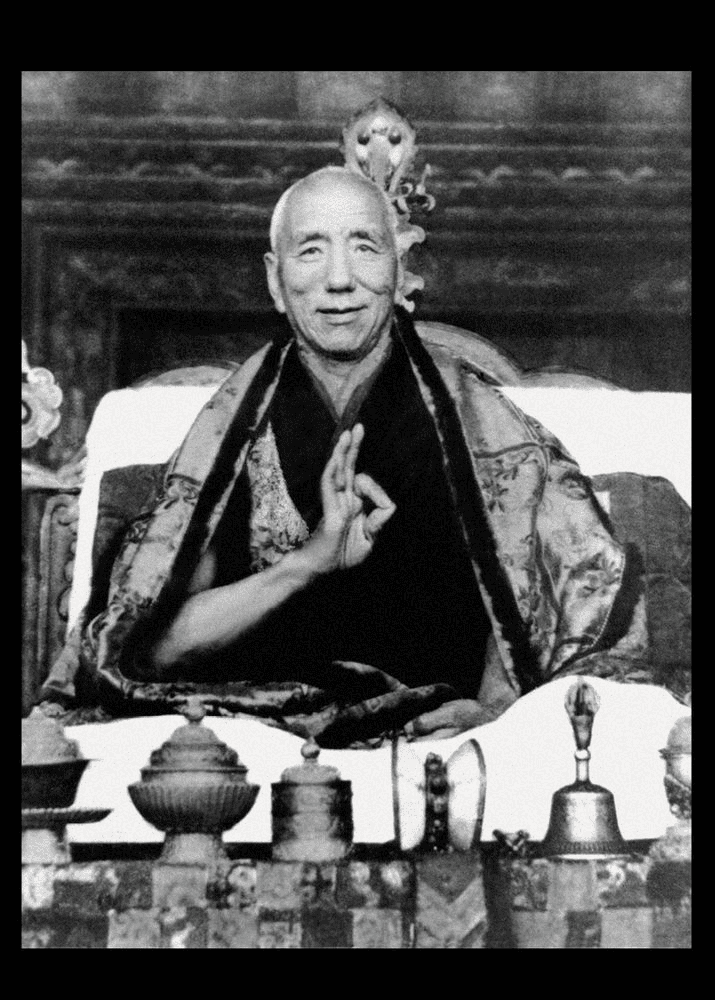
Her name was Urgyen Tsomo and she was later called “The Great Dakini of Tsurphu” (Tib. Tsurphu Khandro Chenmo). She was considered an emanation of Yeshe Tsogyal, the main consort of Guru Rinpoche in Tibet. Every time that Karmapa became ill, she came to him, and he regained his health within a few days. Karmapa met her in 1919 and he passed away in 1922. Apparently, she had in fact prolonged his life by three years.
Khandro Urgyen Tsomo is described as very beautiful and a great practitioner who was highly venerated in Tibet. When she travelled, many thousands of people would come to meet her and receive her blessing. At the invitation of the Royal Family of Bhutan, she also visited that country and then travelled on to Gangtok in Sikkim. There she had been invited by Jamyang Khyentse Chokyi Lodro Rinpoche (also called Dzongsar Khyentse). During large ceremonies, she would sit on a throne of the same height as the thrones of Khyentse and Kongtrul Rinpoche.11
Dzongsar Khyentse had already met her once in Tsurphu, where she had received many teachings from him, along with Urgyen Rinpoche and many other lamas. He bowed down in front of her and ordered his servants to do the same. She was the holder of special termas which the 15th Karmapa had found, and Dzongsar Khyentse requested the transmissions from her, as he had not been able to meet the 15th Karmapa before he died. She said she had never given an empowerment before and would do so only with the permission of the 16th Karmapa. Karmapa agreed and so Dzongsar Khyentse received the empowerments from her. The fact that he, as a high Rinpoche, requested and received an empowerment from a woman, and that he had bowed down in front of her, was unheard of in the rigid monastic hierarchies of the time, (although no reason for this can be derived from the dharma).
Khandro Urgyen Tsomo must have been very impressive indeed. Jigme Rinpoche, who had met her when he was a child, says that her presence was so powerful and that she was considered such a serious practitioner that even great lamas would become intimidated in her presence. The brother of Khandro Urgyen Tsomo, Lama Ozer Wangchuk, was himself a great lama and very skillful in Vajrayana practice. He held the position of a Vajra Master for many years in Tsurphu and was apparently also a teacher of Topga Rinpoche.

About one year before his death, the 15th Karmapa wrote a prophecy letter about his rebirth. He asked three of his students who among them would take the letter and later take responsibility for finding the reincarnation. Khandro Urgyen Tsomo, then just 19 years old, said that she was still too young for this responsibility. A lama named Khenpo Lekshe also shied away from the big task. Thus, it went to Jampel Tsultrim.
About one year later the Karmapa passed away and Khandro Urgyen Tsomo was so devastated that nobody dared to even ask her about a letter from the Karmapa. Khenpo Lekshe was in retreat at the time and Jampel Tsultrim was far away in Golok. As a result, it took a long time until the authentic rebirth of the Karmapa could be found, and for this reason great problems arose.
After the death of the 15th Karmapa, Khandro Urgyen Tsomo spent most of her time in meditation retreat and fled Tibet in 1959 with the 16th Karmapa. As part of his 160-person entourage, she traveled with him to Bhutan and then to Sikkim. She practiced in retreat in Rumtek and died there in 1961. The 16th Karmapa recognized her reincarnation as Khandro Rinpoche, the daughter of the great Nyingma master Kyabje Mindrolling Trichen Rinpoche. Today, Khandro Rinpoche is a famous teacher. She holds both Nyingma and Kagyu transmissions, speaks English very well and travels in the West.
Another consort of the 15th Karmapa was a very highly realized practitioner, who spent most of her life in the mountains in retreat. Karmapa did not spend much time with her. Her name was Lochen Chonyi Sangmo and she was also known as Shugsep Jetsun Rinpoche (1852–1953). She had achieved such a high level of realization that it is said she could go to any location instantly by simply thinking about it. One day, she felt that she absolutely had to meet the 15th Karmapa and visited him by means of her miraculous powers, without his servants becoming aware of it. Her meditation companions also thought that she was sitting in her retreat cave the whole time. The meeting with Karmapa must have been very profound because some lamas came to view her as a consort of the Karmapa afterwards.

Later, when the 16th Karmapa was about 21 years old, he visited her, while on a pilgrimage to Mount Kailash. They mutually gave each other empowerments for long life. After she passed away, she was reborn in Sikkim. Gyamkhar Tsultrim Namgyal, the soponla of the 16th and 17th Karmapas, taught her reading and writing there.
The 15th Karmapa had a number of further consorts about whom little to nothing is known. One of them came from Kongpo and it had been foretold that she would be a consort for the practice of union, and had all the special signs as they are described in the tantras. However, due to unfortunate circumstances the connection could not be made in the best possible way and was only maintained through correspondence. It was so special, however, that Karmapa was healed from an illness solely from this contact through letters. It is also reported that every time Karmapa got sick, she would burn one of her hairs and Karmapa would then get well again.

Things did in fact turn out as Karmapa had foreseen as a young man. Monks with an impure view began speaking badly about Karmapa and his consorts, and monastic discipline began to weaken in some monasteries. Great masters in Tsurphu tried to counteract this trend. One nephew of the 14th Karmapa, Tulku Pal Kuntu Sangpo, would sometimes place a shoe of one of Karmapa’s ladies on his head after she had taken it off and left it in front of a temple. Then he would circumambulate a temple or stupa with the shoe on his head. Two brothers of the 14th Karmapa, both of whom were important lamas in Tsurphu, are also said to have done this to demonstrate their strong reverence for these women to the other monks. According to Gyamkhar Tsultrim Namgyal, the 16th Karmapa was very strict with his monks in Tibet for a long time in order to reestablish discipline in the monasteries.
Now a Karmapa has officially married and fathered a child for the third time in the history of the Karma Kagyu lineage. In 2017, the 17th Karmapa married the Bhutanese lady Rinchen Yangzom, and she bore him a son, named Thugsey, in 2018. On January 11, 2019, at the Karmapa International Buddhist Institute in New Delhi, he received refuge from Luding Khenchen Rinpoche, one of the foremost Sakya masters and an important teacher of the 17th Karmapa. His refuge name is Jigme Chokyi Trinley.
Although, as of our copy deadline for this article, there has still been no official recognition, much less enthronization, there is increasing speculation that the son of the 17th Karmapa Thaye Dorje is the 15th Shamarpa. The End.
References
Oral explanations from Gyamkhar Tsultrim Namgyal and Jigme Rinpoche.
Tulku Urgyen Rinpoche, Erik Pema Kunsang, and Marcia Binder Schmidt. Blazing Splendor: the Memoirs of the Dzogchen Yogi Tulku Urgyen Rinpoche, as Told to Erik Pema Kunsang & Marcia Binder Schmidt. Kathmandu, Nepal: Rangjung Yeshe Publications, 2007.
Gabriele Coura. “The Fifteenth Karmapa Khakyab Dorje—Some Glimpses of His Life, Death and Rebirth”, Unpublished manuscript., n.d.
Topga Yulgyal Rinpoche. “Supplement to the Moon-Like Crystal Garland of Numerous Life Stories of the Golden Rosary of the Kagyu Tradition.” TBRC: W19988.
Kim Yeshi and Acharya Tashi Tsering. “The Story of a Tibetan Yogini, Shungsep Jetsun 1852-1953.” Chö Yang, 1991.
Lama Kunsang, Lama Pemo, Marie Aubele and Maureen Lander. History of the Karmapas: the Odyssey of the Tibetan Masters with the Black Crown. Ithaca, N.Y: Snow Lion Publications, 2012.
Dilgo Khyentse Rinpoche and Orgyen Tobgyal. The Life and Times of Jamyang Khyentse Chökyi Lodrö: the Great Biography by Dilgo Khyentse Rinpoche and Other Stories. Boulder, CO: Shambhala, 2017.
We wish to thank the following people for their contributions: Rabjam Rikki Catty, Gabi Coura, Gerd Bausch, Dawa Tsering, Gönpo Tashi and other friends for their support!
- Kunzig Shamarpa wrote about this in his book Golden Swan in Turbulent Waters, and in it, he quotes the autobiography of the 5th Dalai Lama. ↩︎
- It is often said that he brought Buddhism to Tibet, but that is not really correct. The dharma was spread in Tibet a century before, but it was only able to gain a strong foothold once Guru Rinpoche removed the obstacles. ↩︎
- The so-called “King of the Mahasiddhas,” who is considered a previous incarnation of the Karmapas. ↩︎
- However, not continuously. There are indications that the 1st Karmapa, for instance, discarded his monastic vows for a time during his student years in order to do union practice with a consort. (Duff, Tony. Gampopa Teaches Essence Mahamudra Interviews with His Heart Disciples, Dusum Khyenpa and Others. Kathmandu: Padma Karpo Translation Committee, 2011.) ↩︎
- She is sometimes called Dechen Chödrön. ↩︎
- Not to be confused with Thugse Jamyang, the 12th Shamarpa, who was also a son of the 15th Karmapa, but from another woman. ↩︎
- According to another source, Jamgön Kongtrul had indicated that he himself would be reborn as Karmapa’s son. ↩︎
- Karse = Karmapa-son ↩︎
- Until now, it has not been possible to determine with which consort, despite much research and many inquiries with various lamas and rinpoches. ↩︎
- As a result of political difficulties with the government in Lhasa during the lifetime of the 10th Shamarpa, it was not possible to officially recognize the 11th and 12th Shamarpas, who carried out their Buddha activities without publicly holding the Shamarpa title. The 12th Shamarpa died in 1946 and his rebirth, the 13th Shamarpa, died as a child. The 14th Shamarpa, who many of us knew, was born in 1952 and passed away in 2014. ↩︎
- In Tibet, the height of thrones was a very important way of expressing the place of teachers in the spiritual hierarchy. ↩︎