Lama Shang (1122–1193) was a figure about whom it was not easy to be neutral. He was a man of extremes and contradictions: poet and military commander, iconoclast and traditionalist, solitary recluse and public leader, master of words and denigrator of verbal knowledge, charismatic visionary and bureaucratic administrator, meditation master and institution-builder, preserver of peace and perpetrator of “fierce activities.”1
The life stories of the great masters of the Karma Kagyü school continue to inspire Western practitioners of Tibetan Buddhism. Many of these stories could provide exceptional material for exciting movies, including the stories about Lama Shang. Lama Shang was one of the most fascinating and powerful, but also one of the most controversial, personalities of the Kagyü lineage in the twelfth century. According to Lama Ole Nydahl, he was not just a friend and colleague of the 1st Karmapa Düsum Khyenpa, but he was also an emanation of the Karmapa himself. Both the 3rd and the 5th Dalai Lamas identified themselves as rebirths of Lama Shang.
As a sign of the highest recognition of the Kagyü school, a special relic was given to him. He became the holder of the meditation hat2 of Gampopa. Gampopa had given this to his nephew Gomtsul (the abbot of Gampopa’s monastery Dhagla Gampo), who had chosen to pass it on to Lama Shang rather than to the other three heads of the Kagyü lineage that followed Gampopa.
In fifteenth-century Tibet, the term “the three jewels of Tibet” came into use. This referred to Tsongkhapa, the founder of the Gelugpa school; Phagmo Drupa Dorje Gyalpo, the founder of the once-powerful Phagmo Drupa Kagyü school; and Lama Shang as the third “jewel.”

Background
Lama Shang was the founder of the Tsalpa Kagyü lineage, which no longer exists as an independent school. The first Tibetan holder of the Kagyü lineage, Marpa, brought two transmission lineages from India in the eleventh century: the so-called “short” lineage, which came from Tilopa and Naropa, and the “long” transmission, which came from the masters Ratnamati, Saraha, Nagarjuna, Shavaripa and Maitripa. In Tibet, Marpa’s main student was Milarepa, whose main students were Gampopa and Rechungpa, with Gampopa as the official lineage holder.
Until Gampopa’s time, one referred to the Marpa Kagyü lineage because it was Marpa who brought these teachings to Tibet. Later, one spoke of the Dhagpo Kagyü because it was due to Gampopa (also called Dhagpo Lhargye, “the doctor from Dhagpo”) that the Kagyü lineage became firmly established and very large in Tibet.
The four main students of Gampopa then founded four different Kagyü lineages. This was not a schism but was simply due to the fact that these students built monasteries in their home regions where they taught and gave their transmission their own names. There were no major differences: all of them practiced Mahamudra, the Six Yogas of Naropa, Guru Yoga, etc.
Thus appeared the four major Kagyü lineages:
- The Karma Kagyü with the 1st Karmapa
- The Baram Kagyü with Baram Dharma Wangchug
- The Tsalpa Kagyü with Lama Shang3
- The Phagdru Kagyü with Phagmo Drupa Dorje Gyalpo.
From the Phagdru Kagyü, there were eight main students of Phagmo Drupa from whom the so-called eight minor Kagyü lineages appeared: The Drikung, Taglung, Trophu, Drukpa, Martshang, Yelpa, Shugseb and the Yamsang Kagyü.
Lama Shang4 was born in 1122 CE south of Lhasa, about twelve years after the birth of the 1st Karmapa, with whom he would later develop a close connection. He came from the clan of the Nanam, which held the title “Shang.” This title was given to families whose daughters married into the royal family of the king. Lama Shang thus came from a good family, but the biographies do not tell of great riches or high social status—his father was a lay Vajrayana practitioner and his mother had once been a nun. Later, however, Lama Shang would do things that completely destroyed the reputation of his family, as he himself reports.
At the time of his birth there were already signs that he was a special child; for example, his mother had meaningful dreams during pregnancy. Even as a small child, Dharma Drak (as he was then called) was considered a tulku, a conscious rebirth of an enlightened teacher, and people often asked for his blessing.
It is said that as a two-year-old, he had already experienced the dreamlike nature of all phenomena. As a three-year-old, he heard his father speak of the suffering of the paranoia realms and ran to the house altar, where he began doing prostrations and took refuge.
At four years of age, he was asked for teachings for the first time in a private context. He gave a Maha Ati teaching and said that in order to reach enlightenment, one has only to really understand that one is already a buddha.
Although he obviously brought a lot of potential into this life, there were obstacles to be overcome at first. In his autobiography, Shang says that as a child, he had the tendency to torture small animals. He traced health problems later on in life back to these actions.
When he was ten years old, he received many Buddhist teachings and, in the following years, studied many important texts of the sutra and tantra. Of this he later said with a wink, “I didn’t understand any of that.” Of course he had indeed understood them, as one would later see, but it became his special style of teaching to put less emphasis on formal studies and focus more on the direct experience of Mahamudra itself.
At this age, he was strongly drawn to tantric meditation, rituals, magic, and visionary experiences. Already at the age of eleven he had a strong experience of the power field of the Buddha of Highest Joy (Skt. Chakrasamvara, Tib. Khorlo Demchog), when he happened upon someone who was practicing this Buddha aspect and was building up this mandala. At the age of fifteen, he also had visions of the protectors.
Until he was eighteen years old, everything developed well in his life, but then some difficulties arose: A family dispute broke out between some closer and more distant relatives, and Lama Shang thus learned black magic in order to harm the opponents of his close family. For three years, he practiced this so intensely that the reputation of his family was completely destroyed, as he later reported. During this time, his parents, as well as some of his teachers, died, and because of his sorrow, he left his homeland in Central Tibet and traveled to Kham, where he spent between six and eight years. He saw a correlation between his negative actions and the death of his parents, which depressed him.
Although he took the novice monk’s vows in Kham, he soon took up black magic practices again. These even included animal sacrifices, which gave him a dubious reputation and the title “the great magician of Central Tibet.”
During this spiritual low point in his life, it became clear to him that he could not continue the way he was going. He also had visionary dreams that showed this to him. He opened a dharma center, but just two months later fell back into black magic, again with animal sacrifices. When he came to himself afterwards, he decided to put an end to it once and for all, and this is exactly what he did. Around 25 years old at this time, he decided to take the complete monastic vows. When one looks at his later life, it seems that he was a layman or yogi practitioner, but according to his biography, at least during these years, he was a staunch monk in his outer lifestyle.
During his travels, Shang met many great teachers and received instructions and empowerments. Among these teachers, five were especially important for him.

Ga Lotsawa Shönnu Pal
Ga Lotsawa was an important teacher of the 1st Karmapa, to whom he taught the Six Yogas of Naropa. Lama Shang learned these from Ga Lotsawa as well as meditations on the Buddha of Highest Joy, on The Wheel of Time (Skt. Kalachakra, Tib. Dükhor) and on a form of the protector Mahakala.
For the first time, Lama Shang committed himself to a teacher-student relationship and had strong emotional experiences when his teacher showed him his own pride. Sometimes, in the presence of his teacher, his devotion was so strong that he uncontrollably burst into tears.
Mal Yerpawa
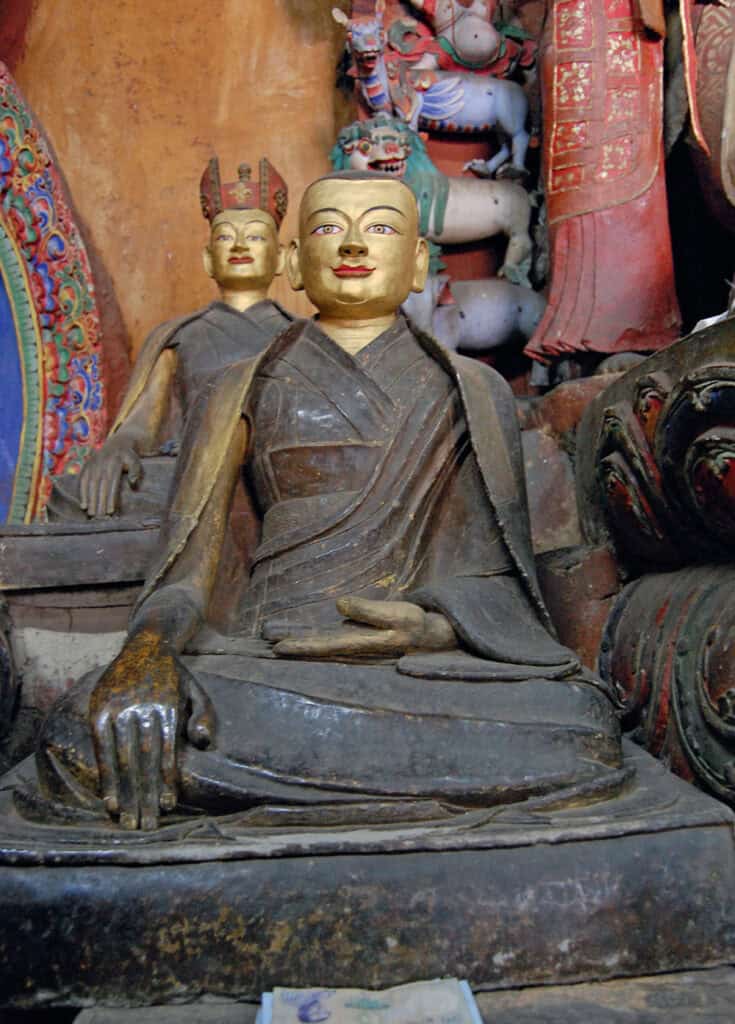
After Ga Lotsawa went into a long retreat and Lama Shang experienced obstacles in the Inner Heat practice, at the age of 28 he sought a teacher to obtain advice. Mal Yerpawa had a good reputation in relation to this practice. He lived like Milarepa as a yogi in the mountains and was, in fact, a student of Rechungpa and other direct students of Milarepa. Mal Yerpawa was able to help Lama Shang, gave him further explanations and invited him to wander through the mountains with him.
Once when his meditation hut was snowed in during a heavy snowstorm, Lama Shang practiced the Inner Heat so well that the irrigation ditches of the village below flooded because he had melted so much snow. For this reason, the farmers in the village asked him to leave the area. It was then that Lama Shang left footprints in rock for the first time.
Among the many transmissions Lama Shang received from Mal Yerpawa was the Thunderclap Mahamudra—a special technique to introduce qualified students to the experience of Mahamudra at one stroke rather than slowly and gradually. This and similar techniques later formed Lama Shang’s special teaching style and separated him from other famous teachers of the time in the Kadampa and Sakya schools, which put a greater emphasis on study. Through Lama Shang and Gampopa, these techniques became a kind of trademark of the Kagyü school and later drew hefty criticism from scholars and particularly from Sakya Pandita.5

Olkawa and Vairocanavajra
Lama Shang was able to develop strong compassion with Olkawa as his teacher. He had meditated with Gampopa and Rechungpa but held transmissions of the Sakya lineage as well. Olkawa was famous for his mastery of the Phowa Trongjug practice, which Marpa had brought back from India. With this meditation, it was possible to project one’s mind into the body of the deceased and even walk around in that body. Of course, there are numerous funny anecdotes about such a practice, which in itself has deep meaning and significance. For instance, a yogic competition is recounted between Lama Shang’s teachers, Ga Lotsawa and Olkawa, in which the latter projected his mind into a goose, which had just died, and flew around.
The Indian teacher Vairocanavajra, who was also a teacher of the 1st Karmapa, introduced Lama Shang to the Indian tradition of the Dohas, the songs of the great tantric masters. Often translated as “Vajra Songs” called Gur in Tibetan, they became famous above all through Milarepa and his 100,000 songs. In this way, enlightened masters spontaneously expressed their experiences in poetic form with moving melodies.
His most important teacher
Gompo Tsultrim Nyingpo, known as Gomtsul, was a nephew of Gampopa and became Lama Shang’s most important teacher. Lama Shang heard about Gomtsul when he was 32 years old and had already been practicing hard for a number of years with good results. He had heard that the teacher had a special non-tantric Mahamudra transmission.
As soon as Lama Shang met him face to face, because of his devotion, his hair stood on end and his body became numb. Gomtsul gave him a very simple and direct Mahamudra teaching and Lama Shang’s experience of this was so strong that he later said: “All my previous meditation was just superficial knowledge. Now, I thought, I have become a real meditator.”
Gomtsul said to him, “In our Kagyü lineage, meditation is not based on intellectual analysis, but on blessing. Supplicate the lamas of the lineage for this blessing and then practice Mahamudra.” When Lama Shang later received the entire Mahamudra transmission, he recognized the nature of his mind.

Practice and enlightenment
He began to wander through the mountains and to practice the teachings Gomtsul had given him of tantric methods with the inner energies of the body, and the transmission of the formless Mahamudra meditation in order to cultivate and stabilize his experience of the nature of mind. During this time, he lived an extreme lifestyle, and at one point, he even stopped preparing nourishment for himself.
Once when three wolves lay down in front of his cave, he took his fear of them as the object of his meditation. It became clear to him what a great obstacle this fear of bodily harm was. However, when he later shared this insight with his teacher Yerpawa, he only said: “What, how can that be? There is no greater obstacle than being eaten by a wild animal. Stop thinking like that. From now on, be more careful in the presence of wild animals.”
During this period, he was also plagued by demonic visions and fears. These were perhaps his last purifications as he increasingly had deep insights and dreams, finally culminating in a vision with which he attained enlightenment.
Lama Shang dreamed that he was searching for Oddiyana, the homeland of Guru Rinpoche. First, he arrived in the god-realm “Heaven of the 33,”6 where he received teachings from a form of Mahakala. Then he continued in the direction of Bodhgaya and there met Red Wisdom (Skt. Vajravarahi, Tib. Dorje Phagmo). His body was transformed into the red Tibetan syllable hung, which was pulled up against his will into the vagina of Red Wisdom, where he began a journey through the power centers of her body.
In her navel center, he saw—like images in a mirror—all beings in the realms of existence, his previous lives, his 1,008 teachers in those lives, his present life, and everything that he would do in the future, including his own death.
In her heart center, he saw a million worlds, with a million Bodhgayas and a million Lama Shangs making millions of offerings.
In her throat center, he saw infinite pure lands, in each of which he saw himself as Buddha Vairocana giving dharma teachings.
In her head center, he finally saw the pure land of Oddiyana in the west, where there was a ruby palace and the power circle of the seven aspects of Red Wisdom. Through this, all of his impurities disappeared.
Then began the journey back, and in each center, he received one of the four empowerments of the highest Diamond Way level. He was “reborn” out of her Lotus in the form of a Heruka, a powerful buddha aspect with three eyes, bell and dorje. Red Wisdom then gave him instructions, and when he awoke, his body was completely transformed. His usual body, which was the result of maturing karma, had been transformed into an illusory, magical body and his mind had attained buddhahood.
- Yamamoto, Carl Shiego, Vision and Violence: Lama Zhang and the Politics of Charisma in Twelfth Century Tibet, Ph.D. dissertation, University of Virginia, 2009. ↩︎
- Referred to in many texts as a “crown.” ↩︎
- To be precise, Lama Shang was not a direct student of Gampopa as were the other three, but was a student of Gampopa’s nephew Gomtsul. ↩︎
- His full name was Shang Yudrakpa Tsöndru Drakpa. Also called Gungthang Lama Shang. ↩︎
- K. Sørensen and Guntram Hazod, in cooperation with Tsering Gyalbo, Rulers on the Celestial Plain – Ecclesiastic and Secular Hegemony in Medieval Tibet A Study of Tshal Gung-thang. Verlag der Österreichischen Akademie der Wissenschaften, 2007. ↩︎
- This is the name of a specific god realm in the Tibetan canon. ↩︎
Bibliography
Yamamoto, Carl Shiego. “Vision and Violence: Lama Zhang and the Politics of Charisma in Twelfth-Century Tibet” (Ph.D. thesis, University of Virginia, 2009).
Broido, Michael. “Sakya Pandita, the White Panacea and the Hva-shang Doctrine.” Journal of the International Association of Buddhist Studies, Vol. 10 (1987): 27-68.
Jackson, David. Enlightenment by a Single Means. Tibetan Controversies on the ‘Self Sufficient White Remedy’ (dkar po chig thub)”, Wien Verlag der Österreichischen Akademie der Wissenschaften, 1994.
Martin, Daniel. “Twelfth-century Tibetan Classic of Mahamudra: The Path of Ultimate Profundity: The Great Seal Instructions of Zhang.” Journal of the International Association of Buddhist Studies, Vol 15 (2) (1992): 243-319.
Martin, Daniel. “Wrapping Your Own Head. Problems of Context and Individuality as Pre- and Post-Considerations for Translating The Path of Ultimate Profundity, The Great Seal Instructions of Zhang, a Twelfth-Century Tibetan Verse Compendium of Oral Instructions on Mahamudra.” Translating, Translations, Translators from India to the West, Cambridge, Department of Sanskrit and Indian Studies, Harvard University (1996): 59-73.
Mathes, Klaus Dieter. “Blending the Sutras with the Tantras: The Influence of Maitripa and his Circle on the Formation of Sutra Mahamudra in the Kagyu Schools”, Tibetan Buddhist Literature and Practice: Studies in its Formative Period 900-1400 (Roland M. Davidson/Christian K. Wedemeyer) (proceedings of the Tenth Seminar of the International Association for Tibetan Studies, 2003, vol.4), Leiden, Brill, S. 201- 227, 2006).
Prax, Andrea. Edition und Übersetzung von Lama Zhangs Blitzschlag [gleicher] Mahamudra. Wien, 2013.
Blue Annals on life of Zhang (711-715).