
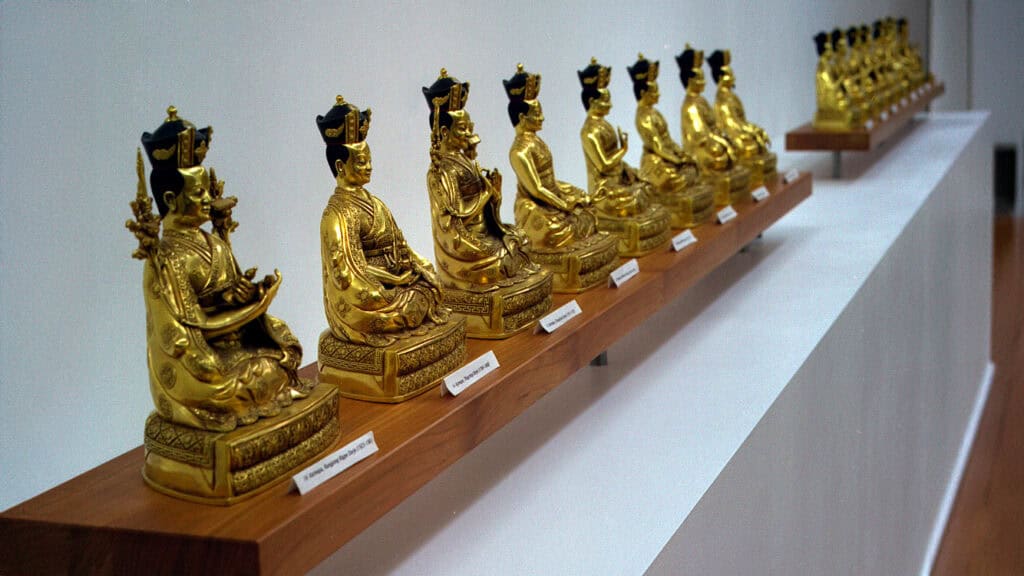
I will first take the opportunity to explain to you the benefit and importance of this ceremony. It is important to note that this is a once-in-a-lifetime celebration for all of us here, as we will not likely be alive to celebrate the one-thousandth anniversary of the 1st Karmapa Dusum Khyenpa. In fact, the number nine is considered auspicious by Tibetans (3+3+3).
We have organized this event to take the precious opportunity to recall with reverence the source and the continued stream of blessings in this remarkable lineage of the Karma Kagyu as established by His Holiness the 1st Karmapa Dusum Khyenpa. The benefit of such an event is that when you think of this great Bodhisattva you will receive his blessing as if he were truly present here and now. This blessing will eliminate any chance of falling into lower realms in the next life and help ensure that you will be reborn in the Buddha’s pure land and eventually become enlightened. Therefore, this is why we have all gathered here to participate in this great supplication of Dusum Khyenpa and his lineage, the Karma Kagyu.
Dusum Khyenpa was born in east Tibet in an area called Trehor, which nowadays is in the Sichuan province of China. He was born into a simple agricultural family. When he was just a small child he had already begun to perform many miracles. He used to proclaim while tending the flocks: “I have come to this world to liberate sentient beings. I am here to look after them as I do these sheep.” When he reached the age of sixteen, he took the novice vows of a monk and began his formal education in Buddhist studies. At the age of twenty, he met the great master Palchen Galo. Through training with masters like Palchen Galo and Chokyi Senge, he became a great Buddhist scholar. He later met Rechungpa, one of the two chief disciples of Tibet’s great yogi Milarepa, and received from him the Vajrayana instructions of the lineage of Marpa and Milarepa. Afterward, he met the great master Gampopa, the other chief disciple of Milarepa, and became his student. Upon meeting Dusum Khyenpa, Gampopa announced to a gathering of five hundred advanced practitioners that this Dusum Khyenpa (knower of the three times) was not just any ordinary human being. Gampopa explained, “He is pretending to be a disciple of mine in order to hold my lineage for future sentient beings but, in actuality, he has already accomplished the goal of the path.” Gampopa revealed that Dusum Khyenpa was the emanation of a buddha who had achieved enlightenment many eons ago and was known as the great Bodhisattva who wears the Black Crown and was prophesied by Buddha Shakyamuni to return to liberate sentient beings. Dusum Khyenpa lived and taught for eighty-five years. Before his passing he left a will for his disciples saying, “In order to preserve and spread these teachings I will reincarnate again.”
As his will had stated, the 2nd Karmapa appeared in this world, introducing himself as a reincarnation of Karmapa at a very young age. The 2nd Karmapa, Karma Pakshi, was known in the history of Tibet and China as a great mahasiddha. The story behind his fame is as follows.
Karma Pakshi was invited to China by the emperor Kublai Khan. The emperor ordered Karma Pakshi not to teach people that the emperor found unfavorable. With a sharp tongue, Karmapa refused the emperor’s demands, replying, “I am here for all sentient beings, not only for one man.” Due to this challenge to the emperor, he was put to trial. During the trial Karma Pakshi performed many miracles in front of the court and, as hard as they tried, they failed in every attempt to punish him. Finally, Kublai Khan had to surrender and bow to Karma Pakshi, inviting him back to the palace as the emperor’s guru.

The 3rd Karmapa Rangjung Dorje taught many people in Tibet. He was the teacher of Longchenpa, the founder of the “Seven Treasures” tradition of the Nyingma school. Such was Longchenpa’s devotion to the Karmapa that he requested, “When you, the Karmapa, are the 6th Buddha to appear in this world, I pray, and ask that you pray for me as well, to be your first student.” The 3rd Karmapa was an accomplished scholar and composed the treatise Sabmo Nangdon that is famous for its profound clarity on the Vajrayana topic of how the mind functions through the nervous system. Incidentally, this masterpiece of Buddhist literature can serve in these modern times as a bridge between Buddhist theory of the function of mind and neuroscience. While teaching to his disciple, the emperor of China’s Yuen Dynasty (and his court), the Karmapa announced that he would be leaving them. He retired to his living quarters, where he passed away in the palace of the Yuen emperor. The following day was a full moon, and as the moon rose that evening, all who gazed at the sky could see the Karmapa’s face inside the moon. The emperor commissioned a painting of this event, which has been a treasure of Chinese history and art to this day.
The 4th Karmapa Rolpe Dorje initiated the great Tibetan saint Je Tsongkhapa and, while giving the initial five precept vows, spontaneously announced that he “would open the doorway of Buddhist teachings in all ways.” This proved to be a very accurate prophecy about this patron saint of the subsequently founded Gelugpa tradition.
All Karmapas have had a very unique and profound way of expressing their activity to help sentient beings in their lifetimes. The 5th Karmapa Deshin Shegpa, among all the Karmapas, was an extraordinary lama in Tibet and China. He was respected by all the Tibetan spiritual leaders as well as kings in Tibet. He was invited by the first emperor of the Ming Dynasty of China to give teachings in Beijing. At the emperor’s request, Karmapa gave eighteen consecutive days of teachings. On each day, miraculous sights to behold of colorful clouds and rainbows appeared in the sky for all to witness. To commemorate this, the emperor of the Ming Dynasty commissioned the best painters to copy the scenes observed during these teachings. Instructions to accompany this now-famous painting are written in four different languages (Chinese, Tibetan, Mongolian, and Turkish). The painting can still be seen today in a museum in Lhasa. At that time, the emperor saw Karmapa in the form of a buddha with a Black Crown above his head. The emperor requested permission from Karmapa to have a physical replica of the crown he witnessed during his vision of the Karmapa and asked whether such a crown would be beneficial to sentient beings. The Karmapa granted his permission for the crown to be made and said that it would indeed be beneficial for sentient beings if he were to give blessings while wearing this crown.
This is the now famous Vajra Crown of the Karmapas that was brought from Tibet by the late 16th Gyalwa Karmapa to India and kept in Rumtek monastery in Sikkim until 1993. I hope very much that it is still there. We will only know for sure if the crown is still in Rumtek after the completion of the ongoing court case. It is possible that it was lost due to mishandling by the then-corrupt government of Sikkim, that had collaborated with a Taiwanese businessman/ politician named Chen Luan. At any rate, the court case is drawing near to an end now.
The emperor and disciple of the 5th Karmapa tried very hard to unify Buddhism in Tibet under one school—that is, under the Karma Kagyu as the supreme lineage. However, after several tries, the emperor was dissuaded by the Karmapa’s strong disapproval of his naive ambition to unify Buddhism.
The 1st Karmapa Dusum Khyenpa emphasized the qualities of meditation. Therefore, the Karma Kagyu school became one of the preeminent schools of Buddhist studies for meditation in particular. Later, during the lives of the 7th through the 10th Karmapas, the Karma Kagyu school became the richest Buddhist culture in Tibet, having its own distinct expression of art, a highly developed system of astrological views and philosophy, methods for studying Sanskrit through the Tibetan language, advanced medical practices, a unique system of logic, etc. All of this was accompanied by an exceptionally complex understanding of the traditional Buddhist categories of study, such as Madyamaka, Abhidharma, Vinaya, and Prajnaparamita, viewed from the perspective of the Karma Kagyu school.
After the 1630s, due to the Mongolian assault on Tibet at that time and Tibet’s subsequent defeat at the hands of the Mongolian overlords, much of the rich cultural tradition of the Karma Kagyu was lost. However, in the seventeenth century, the 8th Shamarpa Chokyi Dhondrup and his student, the 8th Situpa Chokyi Jungne, managed to restore and revive much of the lost treasure of the lineage, which was upheld strongly until 1959 when communist China annexed Tibet in a destructive wave of political ideology.

After the invasion of Tibet, His Holiness the 16th Gyalwa Karmapa moved to India and settled in Sikkim, where a new sort of revival of the Karma Kagyu lineage took place and thrived on Indian soil. In the time of the 16th Karmapa, the Karma Kagyu tradition expanded throughout much of the world, especially toward Europe and America.
The Karmapa International Buddhist Institute (KIBI) in Delhi has recently completed more than twenty years of service in providing significant knowledge of the foundation of Buddhist philosophy and practice for individuals throughout the world who have participated and continue to take part in the annual courses.
In India and Nepal, Lama Sherab Gyaltsen Rinpoche, who is a disciple of the late 16th Karmapa and was trained in Rumtek, has been very successful at masterfully managing the retreats of many lamas who practice the Six Yogas of Naropa in the Karma Kagyu tradition, as well as leading thousands of lay devotees throughout the Himalayas in the practice of Chenrezig. Sherab Gyaltsen Rinpoche is not only a Karma Kagyu Lama but is respected by all schools of Himalayan Buddhist tradition.
We have organized a Karma Kagyu Buddhist College in Kalimpong—in the wake of the attack and takeover of Rumtek monastery in August 1993—on land offered by Mr. Gyan Jyoti Khangsarkhan, who was a very strong devotee of the late 16th Karmapa and also appointed as a Trustee of the Karmapa Charitable Trust by the 16th Karmapa. Unfortunately, he passed away in 2004 but his wife and children are very much present here today. Approximately two hundred monastic students presently study at the Shri Diwakar Vihara Buddhist Institute in Kalimpong, and in November of this year, we celebrated the institute’s first class of graduates, to be followed now annually by another group of students. One of the most respected and distinguished Buddhist professors in India, Honorable Sempa Dorje, has taught at the Institute, covering the major subjects of Buddhist higher education as written and commented on by great masters of India, such as Nagarjuna, Vasubandhu, Shantarakshita, and Shantideva.
Through my wishes and efforts, I have recently managed to complete the collection of Mahamudra texts written by great masters of the Mahamudra, such as the great Indian mahasiddha Saraha and other great mahasiddhas of Tibet, such as Milarepa. These texts comprise eighteen volumes and are solely on the profound subject of meditation in the Mahamudra tradition. To accompany this compilation, I am presently in the process of collecting all of the lineage instructions that coincide with these treatises on the famous Mahamudra tradition of the Kagyu lineage. I have also commissioned a one-of-a-kind thangka painting to be made depicting these great masters of the Mahamudra.
For this collection, I was greatly helped by Khenpo Mirti with the arrangement of the sequence of these various volumes—putting them in order, checking the spelling, etc. I am also very grateful to Khenpo Karma Lhabu from Tsa Tsa Gompa in Tibet who skillfully managed the tedious task of searching through numerous paintings that portray these great masters of the Mahamudra tradition and extracting their likenesses to be compiled in this one-of-a-kind thangka I have commissioned. All of this has been done in order to preserve the great Kagyu tradition of the Mahamudra. It has been said that when receiving the oral transmission from these texts, if one is practicing awareness and listening with clarity of mind, one may achieve the realization of the nature of mind at any time. Mahamudra is a topic that focuses exclusively on meditation and eliminates the afflictions of the mind. This is the very meditation that the Buddha himself practiced.
I have developed a meditation center in Nepal (Sharminup) and have organized volunteers who have committed themselves to complete dedication and the strict discipline of the full 253 vows of a renunciate. These practitioners will have perfected their meditation practice and will be the ones who will uphold and preserve the recently gathered collected works of these masters of the Mahamudra for the benefit of every society in the world who has a genuine interest in authentic meditation practices.
As an author, particularly in regard to my book Creating A Transparent Democracy: A New Model, I have offered my suggestions to His Majesty the King of Bhutan and His Holiness Dalai Lama, through his representatives, that Buddhist education should be provided in the normal school curriculum. Such texts as the great scholar Mipham Rinpoche’s Gateway To Knowledge, a book on the Buddhist subject of the Abhidharma, would be suggested as course material for those completing their twelfth year. If done properly, the students would have a complete foundational knowledge of Buddhism. Then the retreat center should be helped and supported by any well-wishers in society, as it is a place of solitude where one can truly learn and practice meditation. It is for those who have renounced their worldly lives. Those who seek and accomplish attaining the designation of a Buddhist scholar, or Maha Pundit, should be well paid. Of course, there can be a tantric ritual community on a small scale, mainly for ceremonial purposes and cultural preservation. High lamas with little to no meditation accomplishments, who are not proper renunciates, and have thousands of monks under their supervision—without a proper and complete meditation curriculum of education for the monastic sangha—are not beneficial for the community or society.
We celebrate the 1st Karmapa Dusum Khyenpa’s memory today so that we may rejoice in the bodhisattva commitments he made for all sentient beings. We do so in this blessed place where the Buddha himself was enlightened. May the merit generated here today spread throughout the world as a source of relief to eliminate all the natural disasters and the tribulations that accompany them, and to stop all wars, famines, crimes and injustices. May peace, and finally ultimate peace, prevail for all. Thank you very much and I wish you all a very happy New Year.
Photo credit: Sergej Podrojkin


