

Education and Literacy
Healthy education balances different types of wealth—inner wealth and outer wealth. Yes, we need to educate ourselves and use material (outer) wealth as a tool to meet our own and each other’s basic human needs. But there is a risk that if we emphasize too much on this aspect of education that the world becomes more materialistic, without nurturing the value of values.
Education shapes our minds. If we don’t teach values and nurture inner wealth, then when there is a crisis, we often find that, first and foremost, there is a crisis in values.
The purpose of our life is much more than to survive, much more than sustaining the physical body—it is to help develop consciousness. The emphasis and direction of education should, therefore, be not just about accumulating information to serve outer wealth but to help develop consciousness to help young people nurture their innate values of wisdom and compassion for the benefit of society.
Literacy is crucial to building understanding in our world. Becoming literate—from basic reading and writing skills to developing a broad understanding of the issues we seek to address—is important for all of us.
Without literacy, we can fall into misunderstandings and judgments, small problems like family problems, or problems on a larger scale, such as with countries and nations.
Inner Wealth
Inner wealth is a term used to describe your innate values of compassion and wisdom. Compassion and wisdom might seem to belong to spirituality and have nothing to do with wealth. However, we are so used to connecting wealth to material resources that we have lost sight of its relevance for other things, such as loving-kindness and other nonmaterial values.
Inner wealth is our mind, our consciousness. I believe that this mind is like a wish-fulfilling jewel. If we know how to utilize this mind, it can produce the most beneficial effects. The best way to utilize and develop this mind is to absorb knowledge, and the most important kind of knowledge is the one that makes us a kind person, a decent person, a person worthy of respect.
Nonmaterial Values
Outer wealth—that is, material wealth—can be a beneficial tool if used in an appropriate manner. But it is essential that nonmaterial values are supported to help us cultivate balanced and beneficial human beings who also use their material wealth for the greatest benefit of our fellow human beings.
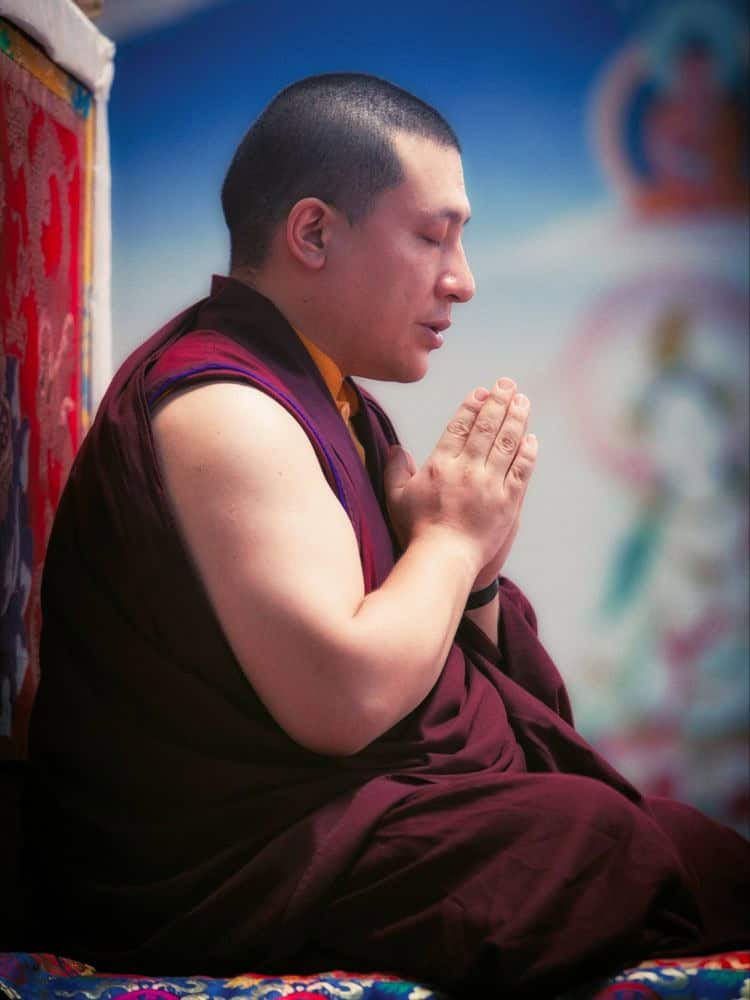
When we support the development of nonmaterial values, as highlighted in the Wealth of Europe initiative, we can see clearly how values such as nonviolence, compassion, dignity, community and family can help build a more balanced and beneficial future for all of us.
His Holiness the 17th Gyalwa Karmapa Trinley Thaye Dorje teaching in the Diamond Way Retreat Center Karma Guen, in Velez-Malaga, Spain, in 2017
Empowering Young People
From the moment they are born, young people are living, walking, talking sponges. They absorb everything there is to learn. So, this is a very special time of life when they have great exposure to nurturing inner wealth—a unique opportunity for peace.
If there is richness within each and every one of us—inner wealth—then there is an almost limitless supply in the vision and values of our young people.
Skillful Means
Aspiration and dedication: these two are such skillful means, such unsurpassable phenomena or qualities of the mind. Whereas it would normally take an eon to accumulate a certain amount of merit, with aspiration and dedication, we are able to reduce that eon of hard work to just one lifetime.
Generosity, patience, ethics, effort and meditation—all five are like friends. They are skillful means to generate happiness, compassion, and loving-kindness. When these five skillful means are combined with wisdom, then one will be able to bring forth all the wonderful qualities of the enlightened being.
The Nature of Mind
The nature of a tamed mind is like space. When a practitioner’s mind is tamed—that is, enlightened—the practitioner’s mind, as well as all of its experiences of samsara, ceases to exist, just like a dream. It is important to notice the words like space because space is used here only as an example, and one is not referring to space itself; otherwise, it could mislead practitioners into misunderstanding enlightenment as a great numbness.
Interdependence is another way to introduce the idea of emptiness. When we talk about emptiness, it can draw a lot of confused and unwanted thoughts, fear, and all kinds of unnecessary conclusions. So, that’s why another way of interpreting it is by using the word interdependence, because it naturally shows that there is no one separate entity that is autonomous or independent. Each of the components must depend on another, and therefore there is no singular entity. This is emptiness. Everything happens due to a cause, and due to that cause, there is an effect. Between the cause and effect, there also need to be the conditions—leading to all these chains of dependency. So, that is another way of showing that everything is impermanent, everything is empty.
Whatever the case, if there is a cause for the mind to continue its stream, then whatever that mind has learned or understood during one’s particular lifetime, all of that is never wasted or lost. It carries on forward.
Life After Death
In general, although the body decays at the end of one’s life, the stream of one’s consciousness goes further onwards,if there is a cause. Most of the time, there is a cause, either by karma or by aspirations—but for most of us, by karma.
With practice and by getting to know more about the Buddhadharma, one slowly learns and realizes that death is actually a part of life. It is not separate. If it were separate, then it would be some thing, but it is not. And there is no way to separate life from death or death from life. Peace can only come and the contradiction can only dissolve when we can accept that. Often, the hardest part is to accept it. And because we don’t want to accept, then we want change. We will do anything to change, sometimes not even realizing what it will take to change. So, that’s why in the end it is really about accepting it. Of course, this is easier said than done, but nevertheless, we can accept it. We can trust that all of us have the power to do so—all we need to do is make sure that we don’t put pressure on ourselves in any way and take things one step at a time.
Every day, every moment, we accept a little form of death, a little form of the reality of life. Then there is no contradiction anymore, and then even death itself is peaceful, meaningful. Just like living is meaningful, death will also become meaningful. And this will become the perfect example for others. And probably that’s what I could say is the greatest legacy to leave behind: teaching others how to die peacefully and properly.
Finding meaning in our lives is not just about being watchful of cause and effect in this life but using the means of causality to find happiness in future lives as well. With this kind of progression, we become more and more aware, more and more bent on accumulating merit, not just for this life, but for future lives as well. And in this manner, we become more and more noble as a person and eventually find meaning in our lives.
The Future Is Also Now
Think of the individuals in one’s life who have shown great generosity in the way a well-grounded person would understand—a person who is down-to-earth, easy to relate to and understand. Think of their kindness and what they’ve gone through to give you that kindness, and appreciate it. Then, we also have the ability to make wishes or aspirations, which sow wonderful seeds for the future—future doesn’t mean after many years, but the next moment. The very next moment.
We have to really rejoice and appreciate that due to our merit, due to our own sweat, due to our own strength and courage from our past lives, we have all these opportunities here now. We also have to appreciate the timeless aspirations made by all the buddhas, all the bodhisattvas of the past and present, because it is really due to their wishes, due to their aspirations, that our efforts have a result. So these two wonderful conditions have come together. This is our result, this is why all of us are here. The End.
Compiled from karmapa.org and facebook.com/theKarmapa


