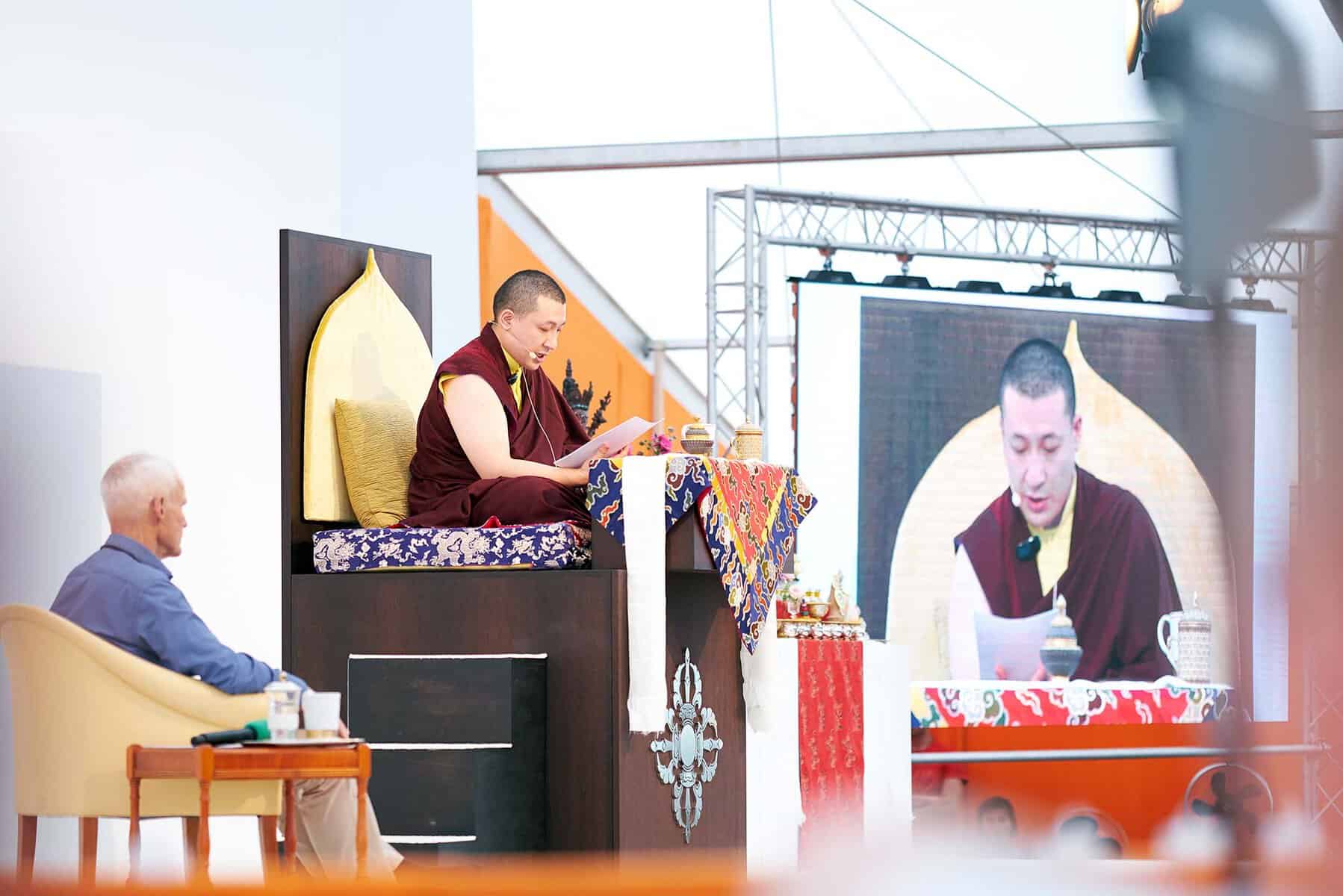
In Summer 2019, the Copenhagen Diamond Way Buddhist Center celebrated the inauguration of a Victory Stupa in the backyard of the center. The building of a stupa in Copenhagen is a direct result of Buddhist teachings finding a solid foundation in the West. Fifty years before the stupa was inaugurated, a young Danish couple, Ole and Hannah Nydahl, began to bring back to Europe what they had learned from high lamas of the Karma Kagyu school of Tibetan Buddhism in the East. Since the early 1970s, this activity has generated more than 700 Buddhist centers around the world. The Copenhagen Buddhist center is known as “the mother center,” as it was the first of these centers.
There are many Buddhist teachings regarding the nature of both the inner workings of the mind, as well as how the physical reality we perceive functions. On a most fundamental level, there is no separation between mind and observed phenomena. The observer, the object of observation, and the act of observing are all part of the same totality of awareness. This Buddhist view of reality has been increasingly discussed as compatible with scientific inquiry, in particular with interpretations of quantum mechanics.
Well before Ole and Hannah’s journey to the East, Copenhagen was already the epicenter of scientific interpretations of reality. In fact, Copenhagen is not only the mother city of Buddhism in the West but also the birthplace of modern quantum physics. Werner Heisenberg said that “the Copenhagen spirit of quantum theory… has directed the entire development of modern atomic physics.” Since the early 1920s, the so-called Copenhagen Interpretation has been the leading explanation of what quantum physics really means regarding the nature of reality. The founding father of the Copenhagen Interpretation is the Danish physicist Niels Bohr, but Max Born, Werner Heisenberg, and other famous physicists made important contributions to atomic physics while working in the capital of Denmark. One hundred years after its assertion, the Copenhagen Interpretation of the quantum world remains the most widely accepted amongst physicists.
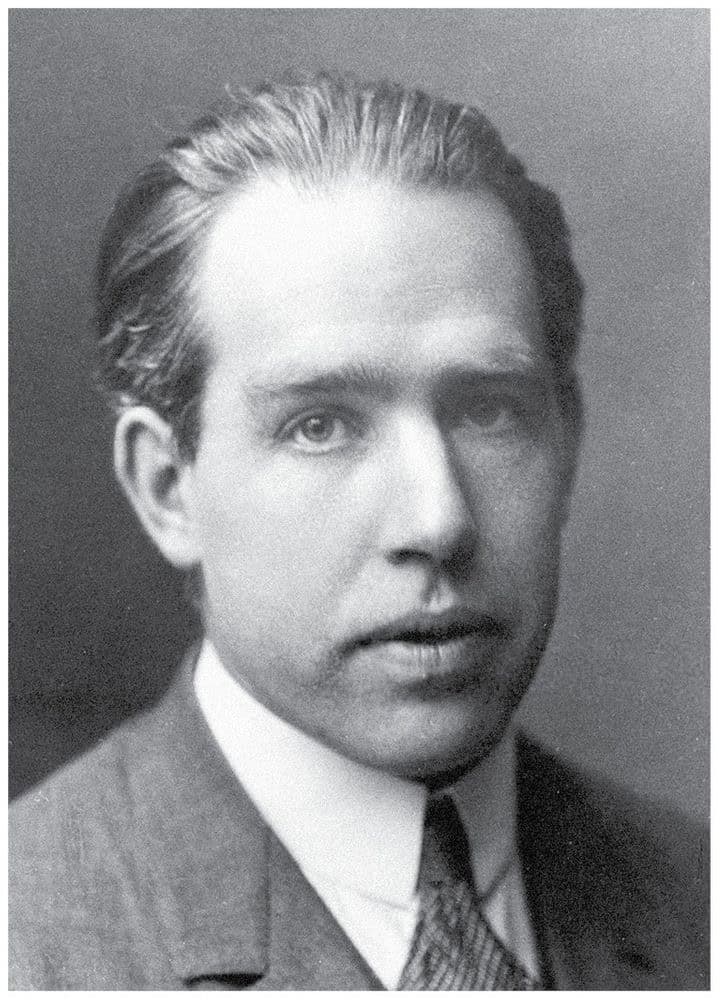
Niels Bohr, the founding father of the Copenhagen Interpretation, was a Danish physicist who made foundational contributions to understanding atomic structure and quantum theory, for which he received the Nobel Prize in Physics in 1922. Bohr was also a philosopher and a promoter of scientific research.
What is the Copenhagen Interpretation? The Copenhagen Interpretation is an expression of the meaning of quantum mechanics. It remains one of the most commonly taught interpretations of quantum mechanics and is discussed in nearly every quantum mechanics physics textbook. (Quantum physics, or quantum mechanics, is a fundamental theory in physics which describes nature at the smallest scales of atomic and subatomic particles.) According to the Copenhagen Interpretation, physical systems do not have definite properties prior to being measured or observed. Before the observation, a particle exists in all possible states at once. It is only when an observation is made and the wave function collapses, in a sense, that the particle is forced into a particular state. Quantum mechanics can only predict the probability distribution of a given measurement’s possible results. The act of measurement itself affects the system, causing the set of probabilities to reduce to only one of the possible values immediately after the measurement. This is called collapsing the wave function, and it’s a concept that is totally absent from our everyday experience. A very commonly taught illustration of the Copenhagen Interpretation is known as Schrödinger’s Cat. This thought experiment presents a hypothetical cat trapped in a sealed box, and the outside observer cannot see inside it. The unfortunate cat is trapped with a radioactive substance which may or may not randomly activate and kill the cat. Therefore, before we even open the box, the cat might be still alive or it might already be dead. From the Copenhagen point of view, the cat is both simultaneously alive and dead, a state known as a quantum superposition. Only upon opening the box and observing the “state of the cat” do we force it to take a definite value, either dead or alive. The example of an alive-and-dead cat in a box seems silly and morbid, but it illustrates how the Copenhagen Interpretation describes a quantum system. The quantum system remains in a superposition of all states until it interacts with, or is observed by the external world. Schrödinger’s Cat is intended to illustrate the absurdity of the existing view of quantum mechanics in light of our everyday understanding.
Scientists in Denmark were at the forefront of interpretations of quantum reality in the 1920s. In 1920, Niels Bohr founded the Institute of Theoretical Physics at the University of Copenhagen, known today as the Niels Bohr Institute. The Institute for Theoretical Physics became the key place for research and debate surrounding the ideas and experiments in quantum physics at the time. Quantum physics arose over several decades, beginning with attempts to explain observations which could not be reconciled with classical physics, such as the observed spectra (particular frequencies of light) emitted from atoms. Quantum physics is formulated in various developed mathematical formalisms. In one of them, a mathematical function, the wave function, provides information about the probability amplitude of position, momentum, and other physical properties or states of a particle, such as an electron or a proton.
Experiments in quantum mechanics depart even further from our everyday experience when we also learn that particles do not have even well-defined locations or momenta and can seemingly affect one another at great distances at faster-than-light speeds (quantum entanglement). This is just the beginning of the “quantum weirdness” that scientists in Copenhagen, such as Bohr and Heisenberg, as well as other physicists at the time, like Erwin Schrödinger and Albert Einstein, were all attempting to understand. Einstein, in particular, considered quantum mechanics to be an incomplete theory due to its indeterministic nature and its ostensible violation of causality. Some aspects of quantum mechanics, such as probability theory and matrix mechanics, have very specific and understandable meanings, at least to mathematicians. But how can we reconcile our everyday experience of the world with what quantum experiment and theory are telling us?
Albert Einstein was one of the strongest opponents of the Copenhagen Interpretation. In response, he is famously quoted as saying, “God does not play with dice.” He rejected the concept that the state of a physical system depends on the experimental arrangement. Einstein held the view that there is one objective physical reality, which every observer sees from his own perspective, while Bohr’s view was that the observer co-creates physical reality. The vibrant Einstein-Bohr debates paved the way for the Copenhagen Interpretation to become the foremost interpretation of quantum mechanics from both the philosophical and scientific points of view. As a result of these debates, Einstein produced a series of papers in which he states his objections, the most famous of which is the 1935 paper titled “Can Quantum-Mechanical Description of Physical Reality be Considered Complete?”
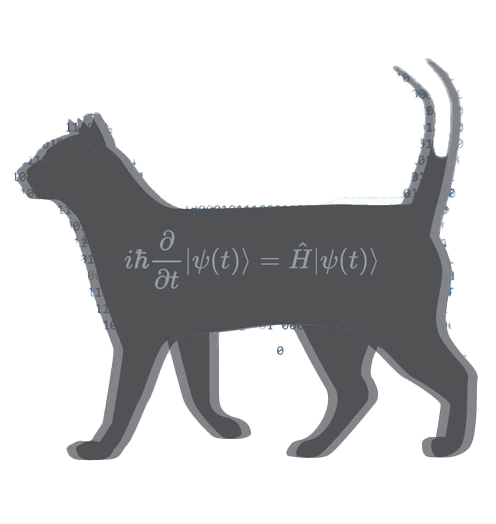
This paper is the basis of the famous Einstein–Podolsky–Rosen (EPR) paradox. The EPR paradox attempts to mathematically show that the wave function does not contain complete information about physical reality, and hence the Copenhagen Interpretation is unsatisfactory. Bohr’s view prevailed and most physicists today believe that the EPR paradox is perceived as a paradox only because our everyday intuition does not correspond to physical reality on quantum-scales and that quantum mechanics is not an incomplete theory, at least on the atomic scales.
Today, the Copenhagen Interpretation is mostly regarded as synonymous with indeterminism, the inescapable link between phenomena and experiment, and a probabilistic interpretation of the wave function. Therefore, the Copenhagen Interpretation is partially compatible with Buddhist views of reality. Cause and effect and determinism are cherished ideas in both Buddhism as well as in classical physics, but they are absent from Copenhagen Interpretation or at least are not easy to reconcile with a probabilistic interpretation of reality. On the other-hand, the inseparability of observer and object is a well-known Buddhist teaching. Many early founders of quantum mechanics were interested in Buddhism and other eastern religions of experience, and it is easy to speculate that these philosophies also found their way into quantum physics interpretations. For example, on the topic of matter, Erwin Schrödinger expressed his views as follows:
What we observe as material bodies and forces are nothing but shapes and variations in the structure of space. Particles are just appearances. The world is given to me only once, not one existing and one perceived. Subject and object are only one. The barrier between them cannot be said to have broken down as a result of recent experience in the physical sciences, for this barrier does not exist.
Although the Copenhagen Interpretation has remained the most popular explanation of quantum mechanics over many decades, it is not the only one and others are now gaining ground. One such example is the Many-Worlds Interpretation (MWI), which asserts that there is no wave function collapse happening at all. MWI claims that every possible outcome of quantum measurements are all realized in different worlds or universes. Philosophically, MWI is starkly different from the Copenhagen Interpretation in that it preserves determinism.
Regardless of which interpretation is correct, there is no debate over both the historical significance of Copenhagen as the birthplace of modern quantum mechanics and the effectiveness of quantum mechanics as a scientific theory. Quantum mechanics is wildly successful at predicting the behavior of the physical world. Those successes have infiltrated our daily lives via practical technology. The intellectual scene in Copenhagen from the 1920s onward situated the city as a haven for creativity in many fields, and undoubtably made it amenable to receiving some of the first visits of Tibetan Buddhist teachers to the Western world.
Additional Reading
Becker, A. What is Real?: the Unfinished Quest for the Meaning of Quantum Physics. S.1: Basic Books, 2019.
References
Einstein, A., B. Podolsky, and N. Rosen. “Can Quantum-Mechanical Description of Physical Reality Be Considered Complete?” Physical Review 47, no. 10 (1935): 777-80. https://doi.org/10.1103/physrev.47.777.
Heisenberg, W., C. Eckart and F.C. Hoyt. The Physical Principles of the Quantum Theory. New York, NY: Dover Press, 1949.
Moore, W.J. Schroedinger, Life and Thought. Cambridge: Cambridge University Press, 1989.