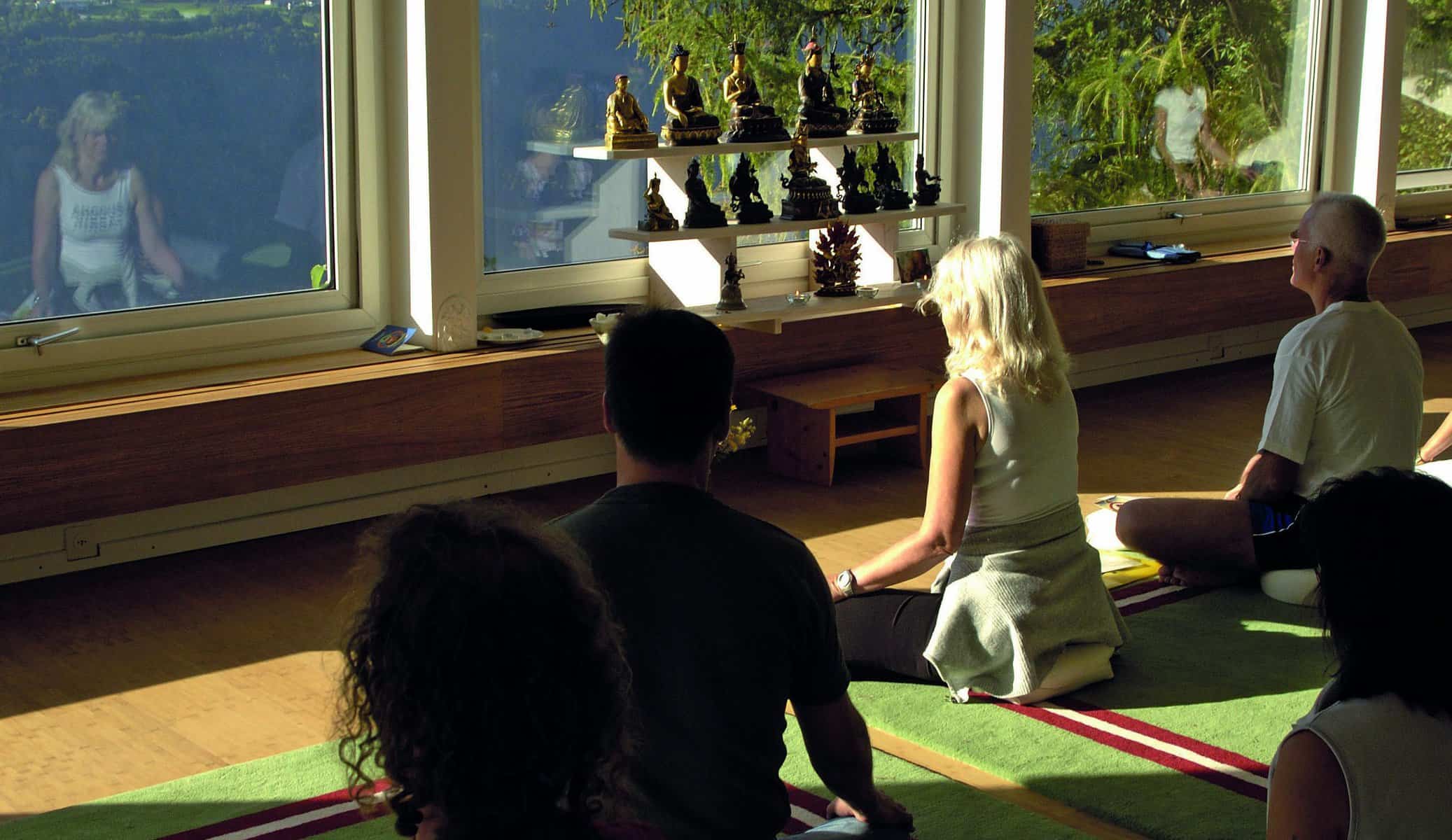
What is the basic function of Diamond Way Buddhist Centers?
Buddhism has only one goal: to support the development of mature and independent people. It has no other function than that. Religions of belief build churches or temples for their gods; some of whom are more pleasant and others who are less pleasant, and some of whom protect freedom more, others who protect freedom less. We do not make our centers and stupas for Buddha, since he is always beyond all personal wishes for himself. Rather, we make them out of gratitude and for ourselves so that there are places where beings can grow and learn. For that to happen, it is important to have openness, freedom, the maturity that comes from freedom, and as much Buddhist knowledge as possible. Lasting growth is only possible with transparency and without doubts. For that situation to happen, trusting in the abilities of all participants is indispensable. If we treat them like children, they will remain children. But when we make them aware of their inner richness, give them the methods that support independence, and give them responsibility for their own path, then enthusiasm and growth flourish. The point here is to offer a place where people can let their inherent qualities unfold.
It is essential to meditate together once a week or more and that people can ask the questions they need to ask. The feeling of space and surplus that comes from that enhances the meaningful qualities of everyone in the group, and one learns on both conscious and unconscious levels. We should strive for whatever people can do together well and joyfully, and at the same time, let everything that we have learned flow into our own daily lives. Those who live in our centers or look after them should also enjoy the possibility of being able to do for others what is especially meaningful in the long run.
Why do you establish centers?
Practice is what is essential for Kagyus. Many people develop confidence by listening to talks and reading our books—and if they then want to meditate, they should be able to go to centers and talk to people with experience. There, they can reinforce this confidence, work with both visitors and teachers alike, and, together with the friends, go deeper.
We now have 630 groups and centers worldwide that offer surplus to many people, which improves their lives, deaths and rebirths. The methods that we use for this have been handed down by Buddha Shakyamuni through the Karma Kagyu transmission lineage. These methods are 2,550 years old and have been used very effectively in Tibet since 1050. In order to preserve the treasure of knowledge and methods—and above all because the great 16th Karmapa asked Hannah and me to do this—I consider the building of centers to be indispensable. Even though I do not have vacations or weekends (other than twice a year when I ride BMW motorcycles with friends through the Alps or the USA for three days at a time)—I live well. I am totally excited by the teachings and enjoy the development of countless friends.
You once said that a modern Mahamudra works through the centers. What do you mean by that?
All of us on the Diamond Way are bound together by more and more experiences of space as bliss. This creates deep bonds among people. On the one hand, the bonds are created because people see one another often and enjoy one another’s company, while on the other hand—and this is very meaningful—because through the groups, through the local teachers, and through the connection with me, people come into Karmapa’s powerfield.
Those who visit a group like this learn about the Buddha’s teachings as well as about themselves. The foundation remains the view of the Great Seal (Skt. Mahamudra) that liberates all beings: we thus understand that the experiencer, what is experienced, and the experience itself are timeless expressions of the same whole. Thus a visit to the center is either a necessary cleansing of hindrances or a blessing to be passed on. But it is always a mirror that shows us our own face. This is why the Tibetans say that it is better to meditate in the center or by oneself than to sit at the feet of the lama in a scattered frame of mind.
When you do your best, hold the bonds, and use the methods of the lineage in a skillful way and for the benefit of all beings, the teacher is present.
Clearly growth will happen even when there is not much connection to a teacher or to a Buddhist center, but the “push” will not be very strong. That is why experienced students travel so much, in order to be with the teacher. In that way one can stay on track and learn a lot beyond one’s own habits. This enriches one or dissolves wrong ideas. Every group that works well represents the timeless experience of Diamond Way.
When one does not have much time, is it better to cooperate in the work of the center or to do one’s own practice?
I would try to do both. Why let concepts limit you from the start? When there is a lot to do in the center, we can say mantras while helping. Things that are actually for the benefit of all will take place, and then we can go deeper in the practices.
But to go back to your question: The best thing is to do your own meditation in the center. That way you learn from the development of the others, hold your bonds, and exchange with your friends. In addition, new people will understand what it means when experienced members use the center too. One should not give the impression—as happened once in a center—that after the basic practices the next step was “computer use.” That applies only to those who have already become rainbows!
We call the group that is active in the center a mandala. What does that mean?
Mandala (Tib. Kyilkor) means “the middle and what surrounds it.” Mandalas are self-arisen powerfields of the buddhas’ enlightenment. One also uses this designation for people who belong to the powerfield, in that they work for the principle of enlightenment. Referring to the groups I work with, that means: as long as we stay friends, are honest with one another and mutually trust one another, then what happens in the centers is a developmental expression of the protective field of the Karmapas. That also means that we do not work in a hierarchy, but rather that through the powerfield everyone is in the right place at the right time—and from there can help other people in a relaxed and meaningful way. That makes for the highest possible human development.
What is important here is that these mandalas work in a beyond-personal way. There is a Danish proverb that says, “The cemetery is full of irreplaceable people.” So, as often as we may think, “everything depends on me, him or her; without us nothing can happen,” that is shortsighted. As soon as the responsible people go away, there is something of a shift in the powerfields, and others carry on the work. The powerfields remain, while new points of view and activities appear—and if the last idealist has not died, that might work even better than before.
Some might think that the “doers” in the center are making sacrifices, working only for other people. So, while praising the “doers,” these people stand on the sidelines, because they try to find enough time for their own development. Center work is as useful to oneself as it is to others, and every involvement with the teachings leads to growth. Whoever manages to become an appealing example at all times—and does not get despondent if there are always other people who come wanting to have or hear something—will be especially powerfully enriched by what can be conveyed beyond our own comfort level. In this way we experience real growth.
What type of person is meant to live in the centers?
Someone who sees people on a high level and wants to engage with them, because of successes in former lives. Everyone—guests as well as those who live in the center—can sense whether a person has the necessary surplus to allow him or herself to address the wishes of others in a relaxed, mature and natural way, while at the same time keeping in mind that visitors as well as friends are raw material who can provide pleasant surprises.
Having a meaningful and worthy goal in this life is an important bridge to other people. If someone has traveled and/or has international connections, deals with the themes of the day in a politically incorrect fashion and sees the large global movements and dangers—these are also bridges. In that case we only need good sources of income, knowledge and experience with Buddha’s teachings, and friendship and enthusiasm for cooperating with others in the center. What’s needed is a feeling of responsibility that is pleasant and not sticky; then everything fits. Fortunately, it is these kinds of people who represent our centers, because Buddhists are often judged by the first person they meet at the door.
What is the future role of our centers?
Our centers will always be places of freedom—whether that means freedom of thought or speech, written or spoken. Centers should teach people how to think intelligently, but not what they must think. We work with the mind, meditate, learn, and teach—but do not want to become a political group or to found a Buddhist political party.
The Buddhist center is the powerfield for those who are open to Diamond Way. If someone has never worked with mind in any life and someone tells them that mind is clear light, they will get nothing from that. It took many lives for us to get to this point and to be inspired by Diamond Way Buddhism, and it is very rare in the world. That brings responsibility and automatically makes us noble. At this point in time, the people with the best karma live in the West, where we have the best education, the most freedom and the most idealism.
Everyone who feels at home with Diamond Way Buddhism can help in our centers. They will receive a lot, share their surplus with new people, and enable others to have experiences leading to enlightenment; and then those people will share this surplus with others. This is how everyone always grows: with human connections and by meeting on the level of personal views. We can touch others only if we are affected ourselves. We can convey something meaningful to others only when an experience beyond words has been conveyed to us and can grow in us.
The main work of our centers is to impart Diamond Way teachings and meditations. We work with the most encompassing and powerful exercises for dissolving the confinement of ego through the experience of space as bliss. This happens by means of the specific method of identification: we act like buddhas with body, speech and mind until we have become buddhas.