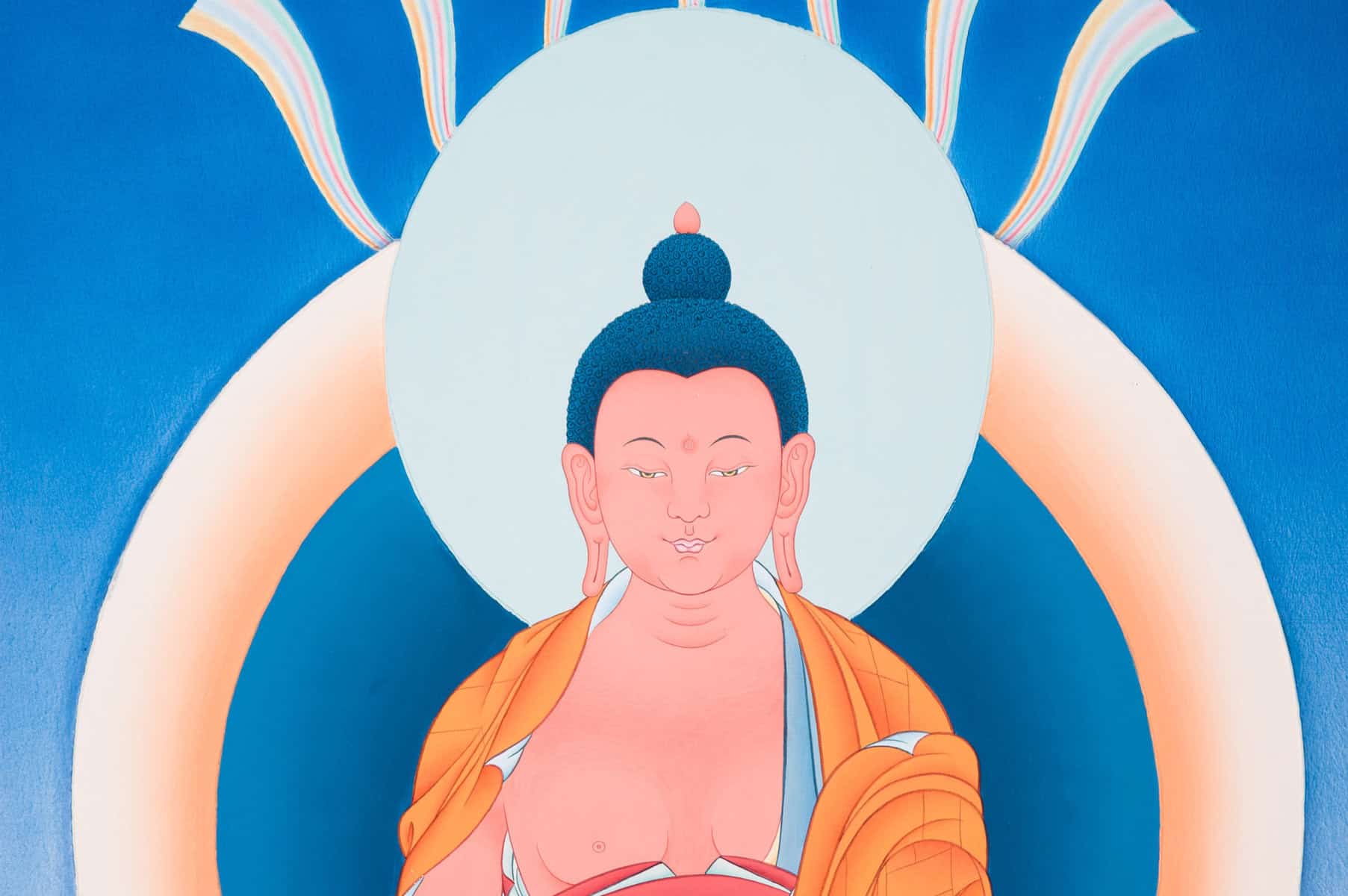
The Nature of Mind
It is tempting to think that the brain, the heart, or the body is the source of mind, but this is not the case. The natural state of mind of all beings is clarity and emptiness. Let us look at these terms more closely. We easily connect the term “emptiness” with some sort of vacuum, like an empty house waiting for a new tenant to arrive or simply an absence of existence. Neither of these two examples applies to the mind. In regard to the word “clarity,” this does not refer to luminosity. What, then, makes up the mind? It is a collection of qualities: a presence without form or substance that is pure intelligence, clarity, compassion, and emptiness. In other words, the qualities of wisdom and kindness are inherent to the mind. No one and nothing added them. They are like the hue of a lawn. The gardener did not paint the grass green; it naturally grew that way. Thus, the mind, in its original and stable state, is clarity and emptiness, what we also call Buddha nature.
We can conclude that we do not succeed in remaining with this essence because we are agitated by the emotional and conceptual occurrences that arise in our minds. Why? The mind falls into the trap of its own functioning. The quality of clarity allows the mind to perceive all things, but we do not have direct access to this dimension. It is obscured by several veils: emotions, karma, habits, and knowledge acquired over time. These different layers of obscuration accumulate on top of our original state over the course of our past and present lives.
The process of apprehending an object triggers various mental occurrences. Once the mind registers the presence of an object (either physical or mental), these adventitious obscurations take over the information and interpret it according to their own criteria, which prevents us from remaining in the natural dimension of our minds. The process of life as we know it thus begins.

The cause that triggers this mechanism lies in the belief in the existence of a self, often translated as “self-clinging.” This profound conviction perpetuates itself and then solidifies based on the different experiences we undergo. Self-clinging, or ego-clinging, notably manifests through identification with our bodies, our names, our feelings, and our opinions. It is the habit of identification with ourselves. The simplest example to become aware of it is the example of our names. Our names are so familiar to us that they seem to be part of us, to be ourselves.
Let us consider a concrete example to better understand how this clinging operates. Imagine buying a new car. When we own a brand new car, we are extremely concerned with not damaging it. We take care to not give it the slightest scratch, and we wash it as soon as it is even a little dirty. We become sensitive to all of these precautions immediately upon buying a new car. Furthermore, if we have to park it in an unsafe neighborhood, we constantly worry about it. On the other hand, our experience will be different if we understand that our car is liable to get scratched at any moment and will inevitably be scratched at some point or another, and this is not a crisis. The unpleasant feelings of worry will not overwhelm us in the same way. We will be able to maintain perspective with our anxiety. The same is true of the mind. Understanding and accepting this identification with a self makes us free.
Our excessive attachment governs the emotional and conceptual occurrences of our minds. These occurrences sometimes push us in a beneficial direction and sometimes in a harmful one. Anger, jealousy, pride, desire, fear—just to name a few— and our experience of life in general arise based on this attachment.
Reading or listening to this explanation is not sufficient for it to have a concrete effect on our daily lives. We must acquire a personal experience of the teachings. In this case, genuine change occurs naturally. We can acquire this experience through observing our minds and identifying the feelings and other occurrences that emerge. As long as we have not integrated this explanation, there is no real freedom. The signification of clarity and emptiness is that we no longer experience any identification with a self.
In Buddhism, liberation is not something mystic-filled with fantastical experiences. In contrast with this notion, Buddhist liberation is a definitive understanding of the absurdity of this self. When we realize that it is not necessary for this clinging to define us, the way we perceive life completely changes.
The Nature of Other Phenomena
On the basis of this first understanding, the teachings offer us a little space in our minds and allow our reality to become less solid and fixed. At this point, it is useful to more closely observe the objects of our perception—both material objects and those that arise in the mind. Do they truly have the reality we accord them? The teaching Placing the Focus Closest to Four [Objects] shows that external objects, along with our feelings, do not exist as solidly as we tend to believe. What we call a “table” today was a tree yesterday and maybe firewood tomorrow. Just like ourselves, external phenomena arise from the unification of causes and conditions and are subject to the passage of time.
Furthermore, our partial perception leads us to construct our own versions of things. When we drink water, we only experience our personal version of water, which is not the same as the reality of water. We think that what we perceive truly exists as we experience it, but in truth, we project our own concepts on reality.
This realization may seem strange since our perceptions seem real to us, just as our “I” seems to exist. Continuing to function based on the certainty of our perceptions means solidifying the basis for our unhappiness. Bodhisattvas, on the contrary, adopt a state of mind that is counter to our ordinary functioning. They know that external objects do not have any permanent reality and that the natural state of mind is beyond any categorization. If we integrate this reality, we no longer experience dualistic perception. We no longer function in terms of a person who perceives an object that is truly present. We become free from our fixed personal ideas and our individual versions of reality. We are able to apprehend things as they truly are. Freedom from attachment naturally arises. Because there is less self-identification, the causes for the manifestation of attachment, discontent, and dissatisfaction disappear. We cut off unhappiness at the root. Bodhisattvas live according to this understanding, beyond the typical ideas of human beings.
Not Giving In
Due to this understanding, a bodhisattva does not suffer from any arrogance, even if he is famous, respected by all, and living in great luxury. He understands that his possessions and his fame are nothing other than conditioned phenomena that are subject to change. Not succumbing to pride protects him from the errors that this sentiment can bring.
Free from rejection or judgment, a bodhisattva perceives phenomena in the same way as a rainbow. We all know that the appearance of a rainbow is a temporary effect of atmospheric conditions. We all appreciate its beauty, but no one is surprised when it disappears. A bodhisattva sees all phenomena in this way, including those that are pleasant and attractive. They manifest, but they have no ultimate reality. He does not give in to attachment, which can develop based on personal preference. Approaching phenomena this way prevents them from being a source of unhappiness for him.
When an object fascinates us, it attracts us and preoccupies our minds. We want to enjoy it as much as possible and to possess it. However, if we change our opinion later on, the same object that seemed essential to us before then becomes unimportant and is no longer capable of fascinating us in the same way. Yet the object itself is the same. Realizing this allows us to see that our own perceptions delude us more than the object itself. We assign a reality to our passing feelings and commit ourselves accordingly. Understanding this is essential. This functioning does not only apply to insignificant attachments; it is identical for everything that we experience. Though we manage to find solutions for the basic problems of everyday life, this does not resolve the fundamental problems caused by this perpetual process of appropriation. They continue to imprison us and cause us unhappiness.
When we realize that external phenomena function more like the imagery of a dream than a truly solid reality and that our states of mind fluctuate based on the intensity of our grasping, we gain perspective on our own mental discourse. Through this training, we can weaken the hold of our beliefs and opinions on our minds and become more flexible. When this self loses ground, it leaves space for less agitation and greater stability.
On this basis, we can establish a new relationship with attachment and rejection. We will even experience suffering in a different way. A bodhisattva considers the difficulties that he encounters with the same understanding of illusion as he does pleasant things. As he is aware of the genesis of unhappiness, he does not give in to or identify with the appearance of its causes. Suffering is the result of a sequence of emotions and concepts based on attachment to the self. A bodhisattva clearly sees the unreal aspect of this process, which dissipates the rejection of an unpleasant feeling or the attachment to a pleasant one.

A precise understanding of these notions does not occur in the space of a few hours. The objects that surround us, the feelings we experience, and the beliefs which we hold make up our daily universe. It is only possible to properly question them through profound reflection. If we do not understand this, we risk terminating our investigation upon our very first conclusion.
Furthermore, understanding develops through the process of daily meditation. Meditation allows us to experience a way of knowing beyond words. Without this aspect of practice, the boundaries of intellect and of our beliefs restrict us. The problem, though, lies in these very approximations and this lack of precision, which reinforces confusion.
Meditation based on reflection allows for an understanding that is different than our habitual representations. However, for this clarification to occur, we need a long-term habit of meditation. Then, based on our experience and the instructions, we will eventually realize that each of our individual versions of the world is not an objective reality. We will see that it is the product of our veils which obscure the nature of mind. Our interpretations of the world arise based on our obscurations, and we take this vision to be reality. Regular meditation practice gives us the opportunity to break free from this unreliable version of reality. Of course, it is important to remember that we cannot force the result. Understanding appears based on our own abilities and rhythm. By practicing with respect to this, our relationships to attachment and rejection change naturally. In addition, practicing in accordance with our own capacities prevents us from falling into the trap of fascination.
In one of the chapters of The Jewel Ornament of Liberation, Gampopa explains that bodhisattvas continue to dissolve their obscurations all the way until they become enlightened. Even if we eliminate the most basic obscurations, the most subtle remain. Becoming free from our habitual functioning takes time for all of us.
Attention and Awareness
Bodhisattvas rely on two indispensable tools to evolve beyond their fundamental habits: attention and awareness. As in meditative training, attention means being present to oneself, and awareness implies recognizing the occurrences that arise in mind. Generally, meditation allows us to train in not letting the mind wander. We acquire the ability to identify the feelings and concepts that are present so that we do not follow them. A bodhisattva’s great experience in this practice allows him to apply it in daily situations. As soon as a feeling or perception appears, he immediately sees it and recognizes its origin.
Emotional and conceptual occurrences naturally and instantaneously arise in the mind. Once they settle in and take root, it is difficult to remedy them. Therefore, the goal is not to let these habits perpetuate themselves. We do so based on a presence of mind that is both attentive and aware.
Consider an example of how to use the tools of attention and awareness. For no apparent reason, we feel discontent. Attention allows us to identify this feeling as soon as it emerges. We then begin to look for the cause of this unhappiness, solitude, boredom, etc. Due to this lucid analysis, we become aware that a specific unsatisfied desire is at the source of this dissatisfaction. We then seek out the source of this desire. Where did it come from? What triggered it? If we follow the thread back, we will arrive at the source: profound attachment, which is, in fact, self-grasping. Through this observation of the origin of our experience, we can act on the causes of our final discontent.
For this method to be efficient, we must apply it regularly in different contexts until we see that this process permeates all of life. Our difficulties, as well as our joys, are directly connected with this fundamental attachment. So long as we do not realize that this grasping is unnecessary, our emotions continue to fluctuate in accordance with it. Our states of mind change ceaselessly and cause our various dissatisfactions.
Constantly armed with attention and awareness, a bodhisattva cuts off habits before they become unmanageable. Whatever the circumstances, he stays fully conscious of his current state of mind. Because he is less emotionally entangled in the situations he encounters, he is more present to others and, thus, more available for them. At our level, the objective is not to be perfect but rather to clearly see our imperfections in order to act on their causes.
Dedicating Beneficial Actions
Improving our understanding of the nature of phenomena and of our minds gradually weakens duality’s hold over us. Another practice of bodhisattvas leads in this same direction: dedicating beneficial acts, also called merit. This practice consists in dedicating the benefit we and others accomplish to all beings. In the beginning, this means thinking of others according to the perspective of enlightened mind. Creating this habit directs the mind toward others without an expectation of personal gain. In consequence, this leads to a certain freedom from attachment; we offer our best actions for others. In this way, the ego can no longer appropriate them for itself.
Most of the time, we expect a reward for our actions. Whether consciously or unconsciously, we anticipate a response, most often a gesture of gratitude. The perspective of enlightened mind excludes all personal expectations or calculations of “return on investment.” For example, the practice of generosity means serving beings without manipulation or ulterior motives. We tend to easily slant things to our own advantage. Enlightened mind proposes another way of being. As we are committing to a gradual path of training, we each begin at our own level in order to evolve toward unconditional action. Additionally, it is useful to keep in mind that there is no qualitative scale for actions, with certain actions ranking as more beneficial than others. From the moment that the motivation is sincere and the action just, the benefits are identical. Furthermore, dedicating the benefit of an act for all beings amplifies its value.
This dedication of merit takes on another dimension when carried out by a bodhisattva. In this case, it occurs on the basis of an understanding of the nature of phenomena and of mind. The mind is the instrument that allows the dedication of merit. If the mind is not limited or subject to self-attachment, the dedication transcends a simple thought. It truly comes to be and thus completes the beneficial act.
The mind must be constantly vigilant—in the moment that the intention for an act arises, during the accomplishment of the act, and also after, by accompanying the act through its conclusion by dedicating its benefit. Maintaining a quality of presence throughout these three phases protects us from the influence of ego-clinging and helps us plant the seeds of enlightened attitude.