Buddhism has always changed on its way through different cultures. Do you think that it will change even more in the West and that we are heading for a specifically Western Buddhism?
The foundation of Buddha’s teachings is timeless and beyond all external influences, such as cultures and fashion. Whatever benefits and harms us on the level of cause and effect matures as compassion and wisdom and leads to the ultimate enlightening view. This always stays the same everywhere. It is simply the way things are. Buddha taught many paths to get there because people are very different. By its nature, Buddhism is beyond specific cultures. To get access to its timeless possibilities, one should know the changing totems and taboos in different times and places. If one knows what each culture understands—when, by whom and how—and what it tends to embody, then the outer image of Buddhism changes all by itself because, in their access to an all-encompassing teaching, people discover the level and the teachings that they can use best.
Here in the educated and less superstitious West, it is always a question of understanding the teachings of the Theravada and Great Way as the foundation and not to dilute the comprehensive and effective methods of Diamond Way. In Diamond Way it is always about the highest view, but the methods and technical terms used in various schools are often different and confusing. If we do not recognize this, we waste years plodding through them while barely gaining anything.
Are there specific Western difficulties on the way?
Here, it is often hard for people to strengthen their inner experiences and include them in their lives. The outer impressions change too quickly. But today, this is also the case in the East, except for those who have been trained in this or in previous lives. Generally, the best approach is probably devotion or gratitude. But there must be power behind it! Everybody is inundated with so many impressions that some of the traditional Buddhist methods are hard to apply, especially when they come across as boring or so weird that under all circumstances, we want to hide it from our friends. Since mind is timelessly playful, we will for sure continue to find appropriate methods among the 84,000 teachings. I am sure about this.
Mind does not automatically change when one starts a Buddhist group. One can lead such a group like a totally conservative club.
Yes, this is possible. But the stated goal of Buddha is freedom, and it should be able to benefit many people. Therefore, in the long run either what is offered fits the people who make up a group, or it doesn’t. If the style is too constrictive for them, experience shows that a new group develops out of the existing one, for those who want more freedom. Therefore, my goal is “flat” hierarchies of friends who know one another, enjoy working together, and prefer to hear about solutions rather than problems—unless one wants to know how to proceed in the future. For the next steps then, I have more advice. Centers guided from above simply do not survive long with us, but idealistic friends who trust one another develop enormous skills and are our future!
For the different types of people, Buddha gave us different ways and methods for development. However, what they all have in common is that it is worthwhile to dig deep in one place instead of scratching the surface everywhere. I think that holistic offers of Buddhist methods and ways have never been more known, accessible and comprehensible than they are today. Except perhaps shortly after Buddha’s death, when Mogalana, Vajrapani and others arranged the different levels of his teachings, which they wanted to pass on. Today, these offers fill many bookshelves, and everyone can find suitable methods for oneself.
What kind of person is the 17th Karmapa Trinley Thaye Dorje?
The 16th Karmapa once told Hannah and me: “My next rebirth will be much milder. “We answered: “Why milder? We have so much fun with you.” His answer was: “At that time, people will be even more thin-skinned and confused than today. So I’ll have to.”
Given that the 16th Karmapa was about six feet tall, his charisma was very powerful and he had strong bones. When he laughed—mostly on his own, probably because he saw something what the rest of us missed—one could hear him five or more houses away.
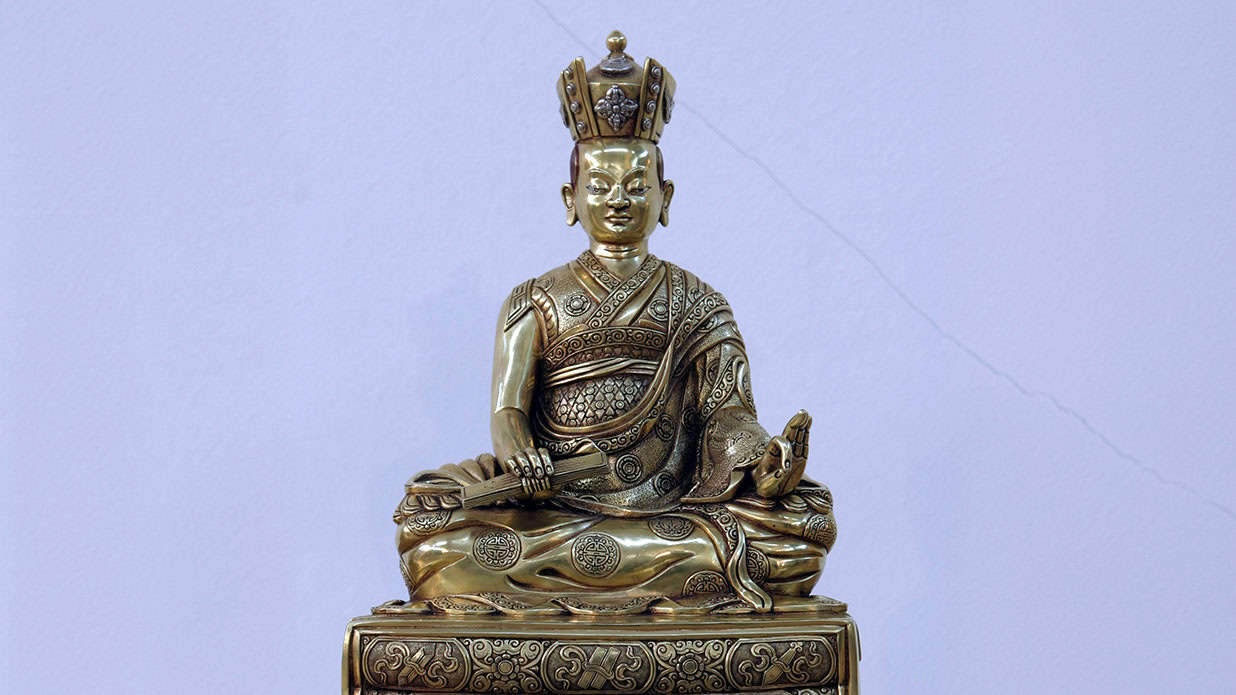
The Karmapas are not “persons,” but rather, they are like water that gets into every opening and appear wherever they are needed. With the present Karmapa Thaye Dorje—who in his previous incarnation was for twelve years like a father to us, giving us exciting tasks—Hannah and I were sure, for countless reasons, that we have his correct incarnation. Of course, as the Tibetans say, one cannot see the top of a higher mountain from a smaller one; but a few observations are hard to avoid. He is really good and at home in everything that he does. There is nothing hypocritical or pretentious. He teaches what he has learned and is exactly what is needed today. He is open to all and learns from everything and everyone. He is completely without the pride that usually throws powerful people out of balance and is deeply grateful to be able simply to be of benefit. Everything flows naturally with him. I think we definitely have the better Karmapa model, but we have no help from the Chinese and no influence of the press to market him. But on the other hand, about six hundred fifty Diamond Way centers are developing very well.
By the way, are there any lamas whose reincarnations have been found in the West?
Young ones? Yes, several. But most of them do not want to accept the monastic training, do not want that discipline, and therefore never get a chance with the Tibetans. The world is simply too exciting for them to learn a lot of books by heart, whose contents can be made available much more quickly with today’s methods of communication. It corresponds neither with their idea of education nor that of their parents. There was, for example, an American, the child of hippie friends in Kathmandu. He was the speech emanation of the teacher of the 8th Karmapa Mikyö Dorje and looked like an American marine. He had already undergone a lot of classical training but then disappeared on his skateboard in New York. He just wanted to live.
What really worries me is that a lot of the really capable, mature and fun-loving accomplishers, with whom Hannah and I were able to spend so much time, passed away decades ago, and for years now their successors mostly acquire simply book knowledge. Not much wild transmission, to really wake up their strength. Often one detects in them their desire for it, but where can they go? Maybe—the thought just comes into my mind—it is this way because I myself have become one of the old ones. The Tibetans treat me like a force of nature, move close to the throne for teachings, listen obediently, without translation, for hours and bring meter-long cloths as gratitude for the blessings.
And, I myself also work to transmit in a modern style the teachings that I received from the Karmapa, Lopön Tsechu Rinpoche, Kalu Rinpoche, Tenga Rinpoche and so many others. Because that’s the point: This power in Diamond Way, this unbroken transmission of blessing that one really feels, is what is at stake. The West is looking for that with strong determination: the power of experience and not book knowledge.
Do you have a successor?
Yes, a few dozen very close students, and there will be more. Together, they have everything. Their challenge now is to understand one another, to be friends and to learn to use their different skills with a good perspective and view. I have a lot of trust in this group of hopeful, mature, and increasingly experienced people. It will grow, experts will complement one another in all areas, and until Hannah and I reappear in new packaging, they know very well what our common task is. The human bonds, the protective minimal level of organization, and the style we have established are good and getting better. The friends put their heads together and clarify everything in this way.
By the way, when my students ask me what will happen after my death, I always say: “When I’m ninety, I will run away with your girlfriend.” Some even take that practice over from me!
Will you be reborn?
Here, I say, partly as a joke: While the girls are still sweet, and I can still outwit the speed limits, then I’ll be back. Otherwise it is too boring—and what would I do here? I would only disrupt things.
Okay. I will pass that on …
I am quite sure that I will come back. There are so many friends here and so much to do. Even if I enjoy the power of mind in highest bliss in the Pure Lands, old promises would certainly bring me back again.
Do you think you’ll then be at home again in Tibetan Buddhism?
In my last life, I was that, as protector of the population and of the 15th and 16th Karmapas near Kantze in Eastern Tibet. Hannah was also there. This was verified for us. The only thing which really touches me is recognizing mind. I’m definitely a desire type, and therefore I think that almost everything in the world is exciting, if nothing else. But when it comes to what really counts, I want people to know that their mind is indestructible clear light. Then they can develop fearlessly, joyfully and for the benefit of all. That’s my job.
If you could wish something for the future, what would it be?
What I have been advising everywhere and every day for many years already: to implement birth control in poor countries, by paying the parents to have only one or at most two children. Add to that a prohibition of every inhumane and anti-women ideology, even if it calls itself a religion. For my friends I would like to see that they develop in a well-rounded way and keep their bonds. If they do this, they will have the strength, the blessing and the transmission—and the work will go excellently.
Can your students also pass on the blessing they receive?
They cannot avoid it! And it increases. We have good women and men. From every direction comes praise of their strength and maturity. They experience it constantly on a more beyond-personal level, but nevertheless bring the blessing of transmission into the world, each in his or her own way.
They know that I myself try to transmit the blessing with my gao, filled by the 16th Karmapa for this purpose, as often and as much as possible. That means that people do not lose the blessing, even if I do not match their ideas of a saint. For new people who come to us, it is useful to understand the blessing as beyond personal because if they experience a purification and have bad experiences afterwards, they do not think that the lama is bad. They will not be upset over the gao, the container of relics. So the work can continue. The more one connects the good experience with people who are living, the easier it is—by liking and disliking—to limit oneself. That it is beyond personal protects the blessing and thus the foundation for development.
It is really a pity that we do not have a culture of blessing here. I am familiar with the everyday blessings from Ireland, which is very natural and really neat … A blessing can carry spiritual teachings in a way that touches people deeply and gives them something to take along on the way, which in turn has an effect in the world.
Yes, and in Buddhism that mainly happens by guiding meditations. It creates an experience of the inherent richness of mind that everyone can comprehend. The image of a revered buddha form in front or above—in our lineage especially the 16th Karmapa, who showers white, red and blue lights into us—touches many people straight away. They also recognize more clearly that they are meeting their own qualities and that bliss and insight have always dwelt inside them. In this way, these experiences are not of the outer world, and one consciously looks into a mirror. This creates a growing maturity, and one soon meditates on one’s own!
What is detectable here is the power of transmission, where the inner and the outer insight meet. This works on many levels, changes the whole person, and is the main root of Diamond Way.
Can one—which admittedly sounds pretty cynical—say that the Chinese invasion of Tibet was actually a stroke of luck?
For the world, the spreading out of the lamas meant access to levels of consciousness that were unknown until then. But for Tibet, it was the end.
But without the invasion, the Buddhist teachings would probably never have come out of Tibet. Or would they?
According to the law of probability and the laws of human development, there must always have been far-sighted teachers, like the Lama Kazi Dawa Samdup who passed on the highest Diamond Way teachings to the American researcher W.Y. Evans-Wentz in Sikkim from 1914–1918. But the ruling party in Lhasa would not have given much of their more philosophical knowledge to the West voluntarily, until after the destruction of the country in 1959 the Dalai Lama sent several scholars to Western universities as professors. Tibet was just a lonely island—or even several islands—almost completely isolated from the world.
This is still the case with the refugees. A Tibetan sees himself first as a member of a village, then of a region, then of a territory, and only in the end as Tibetan. It was understandable. The East Tibetans were warriors, the Western Bönpa people were more peaceful and oppressed, as generally happens in feudalism. If they wanted to communicate, they often had to do this in writing, because even the language differences from valley to valley were huge. Everybody was for himself, and this also applied to the rest of the world.
Do you think that religions will always have significance in our world? Or can you imagine that future generations will look back to our time and consider Christianity, Islam, Buddhism, Judaism and other religions similarly as we today, for example, look at the geocentric model? Can you imagine that the time of religions will eventually be over?
Hardly, because they already fulfill the deep wishes and tendencies of many people. After I completed my degree in philosophy—very enthusiastically and with the best grade at the University of Copenhagen—I expected the quick end of all faiths, and at the time, I barely knew anything about the religions of experience in the Far East. Seekers who follow the bad examples of their prophets in their striving, or hope for redemption by noble teachers like Jesus—these will probably always exist.
How do you try to keep your students from seeing you as a guru?
By making it clear again and again that they can only see what is inside themselves, and that it is a constant joy to awaken pleasant experiences in them. If, as Karmapa’s representative, I can pass onto them the richness that he gave me, nothing would make me happier! By showing that I see myself not as a person, but as the accomplisher of a task—a task that I and my friends promised to fulfill many lifetimes ago—of protecting the Karma Kagyü Diamond Way lineage and by demonstrating that we actually have no other choice but to accomplish this. But most important are the friendships and the confidence, on which we build in the lineage, that we show our cards and everybody passes on what nourishes his own happiness. Here a quotation from Shakespeare’s Merchant of Venice is useful: “If you prick us, do we not bleed? If you tickle us, do we not laugh?” We show that there is nothing mystical about us. That is surely fitting.
Some people do not understand why it is that I like to wear military clothes. Some think that I must want to step on the toes of the do-gooders, or I that I am a militarist, but I’m not. Although I was in the Danish army long ago, they were glad to get rid of me. I simply like the practicality of army clothes. Today almost everything is made to wear out quickly, and one has to buy new things. Army clothes are rarely fashionable, but they last for many years. They are comfortable, with large pockets that hold everything. By the way, the English winter uniforms are far better than all the others!
I was definitely not very popular in the army! As friends later found out, in the case of an emergency, they would have used me as an observer for the 120-millimeter mortars, where I was machine gun operator. There, in front of the lines, life expectancy is forty-five seconds!

But along with insubordination you have a strong protective aspect to your personality.
In an emergency, my brother and I were not bad at fighting, as one can still hear about in some pubs in Copenhagen Old Town. It’s in our genes. But the training in the army was not particularly inspiring, and one did not know anything about inner guidance and leadership in 1960. Enough nuclear missiles were targeted at my parents in Copenhagen, against which one could not do anything, so one really felt expendable. As I have already mentioned, I know—and this has been confirmed by the highest lamas—that I protected the population in Eastern Tibet in my last life. Also, my encounters with people and the Chinese authorities there, along with other signs from before and after, are convincing.
In the winter of 1986, an officer with many medals came to us in the ruins of the temples of Kantze and approached Hannah and me. He demanded that we come immediately to his guardhouse. Some Tibetans had been standing on the side and watching us for a while, and I thought, “Now I strike a blow for them!” He repeated that we should now report to his guardhouse down in the city and the police would then tell us what we were allowed to do.
I slapped him on the back, jovially, repeatedly and vigorously, and said, “Old boy, we will not do that. We have come here to see what you have destroyed. And later we will camp overnight down there next to the trucks—then you can come to visit us.” This was impudent, but I could not help it. Somehow everything was like a rerun of an old movie, and I wanted it that way. After this kind of cordial fraternization, the officer left long skidmarks from accelerating his motorbike, and no one came to visit us later. The Tibetans, who had witnessed it all, were thrilled that the white man was in charge. They were completely relieved and happy. For them, it was certainly unique to see that not all people bow down before the officials. Not even in front of those with many medals on the chest.
The inclination to protect is part and parcel of who I am. All over the world, when I walk into a lecture hall, my first thought is: “If anything happens here, how do I get the people out of here”? This is my first thought at every lecture, and I give about three hundred lectures a year. I was born with a large black birthmark on my forehead, which, for the Tibetans, is a sign of the ability to protect. I’ve always had this feeling, certainly in the last life as well, and probably also in the next.
The insubordination that you have just talked about is generally your way, right? You also have not become submissive in Tibetan Buddhism.
No. I would have to learn submissiveness first. It is in not in my nature.
Instead, you have actively changed things, something that some people have definitely held against you.
Change is not always welcome. Many people prefer sleeping undisturbed and thinking about their next vacation. As citizens, they do not want to read statistics and can, therefore, have little imagination for the future of their countries and for freedom. On the spiritual level, on which I work, the ones who have difficulties with straightforward statements are also the ones who tend to surrender their responsibility to the spin doctors. This works until they are forced to act, and then they crack down shortsightedly and unnecessarily hard, out of fear and lack of overview.
Such an attitude is totally allowed and is even supported by the politically influenced media, but one does not attract independent people with this view. Those who are most suited find us: those are allowed to think for themselves, courageously go for independence, and are bothered by having “peace, joy and harmony” without taking real responsibility. Every freedom has to be defended and expanded against ideologies and bureaucracy, worldwide day by day, otherwise we bequeath to our successors a prison. Parts of Aldous Huxley’s Brave New World and George Orwell’s 1984 as viable future possibilities have not lost their validity.
But back to your question. Hopefully, I do not make your work difficult because I always think of the general before the personal. Although I feel deeply free, there is a constant factor from which I am never released: my promise to my parents, teachers and students to always do my best, without any artifice and just as I experience the blessing stream of our lineage. This gets easier and more natural every year, and in this I certainly draw on earlier lifetimes. For spiritual teachers, this attitude makes all the difference!
I have watched modern gurus in America and elsewhere for more than forty years. Whoever claimed that his teacher could not teach him anything is already history and, unfortunately, also often left smoking ruins among his faithful students. For me as a lama, everything is instantly clear with such statements. When people come to me who are too proud or immature to be able to learn, I always praise them a lot and then send them on. This creates at least a pleasant connection, and then I can perhaps help them in the next life. One can compare a transmission with earning money. If one has worked for one’s money, then one appreciates it. It is a connection to the world and a method of exchange. If one has gotten it without gratitude, it trickles through the fingers, and one does not honor or enjoy it. It is the same with transmission. If one honors it, then one is grateful, and the transmission also accomplishes something. Gauging who survives how many rounds against the ego is a huge responsibility of the lamas, and here, in the end, only real-life experience counts.
What would you advise a beginner on the way?
Look at what you really want to achieve in your life. Look at what you are striving for. When people come to me who want to be controlled from the outside, want a guru who makes decisions for them, then eventually I have to send them elsewhere. For them, there are other ways of salvation and other teachers. For those who are inclined to be sweet and soft, I might recommend finding a capable Hindu teacher. If people with Christian tendencies come, I recommend in free countries, where state and church are separated, that they choose one of the main churches. I praise their philanthropic work around the world and maybe explain a few points that make it more palatable for them. Of course, I advise against every ideology that suppresses freedom and human dignity.
As I said earlier, it is a big responsibility. But if one leaves people space to speak, they themselves offer important hints to what would be suitable for them. I do at all not want everyone to become Buddhist. But on the other hand, I do not want to convey a “we are better than you” impression. I explain the teachings of my transmission lineage, but those for whom the hat does not fit, they have to find a different one. I would always advise everyone: Think! Be honest with yourself! Use your freedom and find what has meaning for you!
Freedom seems to be very important for you.
Yes, it’s like air. How else can one live? In Diamond Way we do almost everything as a team, partly so that the many bright minds meet. But it is also true that adapting to the world without an overview makes every behavior robotic, and I would not tolerate that from anyone. Idealists like to work together for good things, but conforming always destroys character and results. When they clear away my remains, I would like my obituary to say: “He has set many people free.” This is my goal, and I hope that the result of my life will really be that many people set themselves free.
This is a beautiful goal and a good end for this book. Thank you for your time and your openness.
Thank you. You did a great job, and I have learned a lot.