To build up the causes for enlightenment means to both remove all the causes of suffering and to practice the way which leads to the cessation of all suffering: to lasting happiness. In the Smaller Vehicle, the goal is liberation because the illusion of a true personal self, together with all gross defilements, is dissolved. In the Greater Vehicle, the goal is full enlightenment. On the basis of the wish to liberate all sentient beings from suffering, even the subtlest veils of ignorance are removed and the state of highest wisdom, of complete omniscience, is obtained. This highest wisdom is nothing but the true nature of our mind.
If we have very strong confidence in the nature of mind, we can directly identify with the fruition itself: the different qualities of enlightenment which already now belong to the nature of our mind. Based on the teachings about the buddha nature which is present in all sentient beings, the tantric methods of the Diamond Way bring about a very quick result. It is said of the Diamond Way that the best practitioner can reach enlightenment within one single lifetime. This is extremely fast, especially when it is compared to the sutra approach where enlightenment can only be obtained within eons. But not every practitioner is able to use such powerful methods. Most traditions in the Mahayana are based on the sutra approach. Only Tibetan Buddhism uses and transmits all the tantric methods given by the Buddha.
Enlightenment expresses itself in different forms. All buddha aspects that Buddha Shakyamuni taught can be summarized into the five Buddha families, and these five families can be condensed again into Vajradhara (Tib. Dorje Chang), the tantric form of Buddha Shakyamuni himself. All buddhas of the ten directions as well as the high bodhisattvas manifest a pure powerfield around themselves, which is their own pure land. Buddha Shakyamuni described the qualities of these pure lands in detail. He taught different methods to connect with the buddhas and their pure lands because, compared to other methods, the practice of the pure lands is an easy way to reach enlightenment.
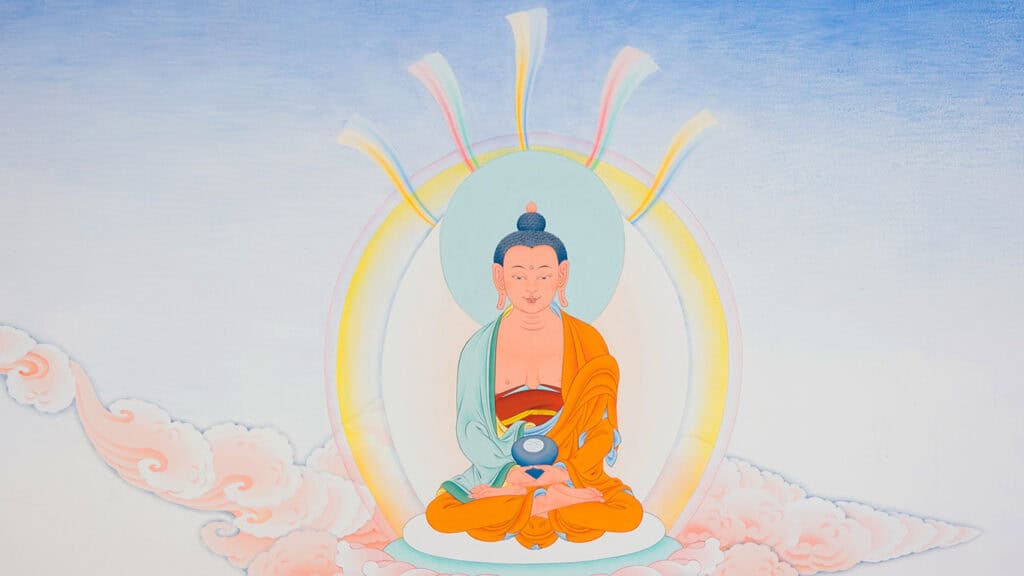
Within the circle of the five Buddha families, the Buddha Amitabha (Tib. Öpame, Eng. Limitless Light) is the Buddha of the Western direction. He bears this name because the light radiating from his body pervades all pure lands of all buddhas of the ten directions. Many eons ago, under the name of Dharmakara in connection with his Bodhisattva Promise, he made extremely strong wishes that he would be able to manifest a pure land that combines the qualities of all the other pure lands, and that all beings who made corresponding wishes would be reborn there easily. As a result of these strong wishes he manifested the Pure Land of Great Bliss (Skt. Sukhavati, Tib. Dewachen) when he accomplished buddhahood.
The teachings about the qualities of Buddha Amitabha and his pure land are found mainly in the Smaller and Larger Sukhavati-vyuha, the shorter or longer Description of the Pure Land of Great Bliss (1st and 2nd century CE), and in the Amitayur-dhyana-sutra, the Sutra of the Meditation on the Buddha of Limitless Life (3rd century CE). In addition to these three Sutras the method of getting in connection with the pure lands and taking rebirth there is praised in numerous Mahayana sutras. These include some 200 sutras and commentaries, such as the Avatamsaka, Surangama, Lotus and Prajnaparamita Sutras, etc. Also, the Treatise on the Awakening of the Faith by Asvaghosha explains this practice very clearly.
In general, there are four causes for a rebirth in the Pure Land of Great Bliss. The first and main cause is the wish to be reborn there. To call to mind the Buddha and his pure land as clearly as possible is the second cause. The third cause is to avoid negative actions and to practice positive actions. Finally, the fourth cause is to develop bodhicitta, the enlightened attitude. This is the wish to obtain enlightenment for the benefit of all beings on the basis of love and compassion. However, based on these general teachings there exist many different levels of practice that the Buddha gave in correspondence with the different capacities of his students. These practices can be divided into the two main categories of sutra and tantra as described below.
The Sutra Level
In regard to the Amitabha practice, the Pure Land School is based on sutra-level teachings and is the biggest Buddhist school in the world, with more than one hundred million followers. This school’s main practice is the recitation of the name of the Buddha Amitabha, together with three kinds of accumulations.
The first accumulation is to have confidence in the Western Pure Land and in the Buddha Amitabha’s promise to rescue all who recite his name, as well as confidence in one’s own nature, which is intrinsically the same as his. A principal teaching of this school is: “To recite the Buddha’s name is to recite the true nature of mind.” It refers to the fact that Buddha Amitabha is an expression of the timeless qualities of the nature of mind.
The second accumulation is to make wishes or to develop the determination to be reborn in the Pure Land, in one’s pure mind, in order to be in the position to save oneself and others from all sufferings.
The third accumulation is to practice, which means that one mainly has to recollect the Buddha Amitabha, reciting the Buddha’s name to the point where one’s mind and that of Buddha Amitabha are in unison, i.e., to the point of single-mindedness. Stable meditation and insight are then achieved. Besides recollecting the Buddha Amitabha, it is also necessary to study the sutras of the Mahayana and to do various kinds of positive activities. In this way, one can build a bridge to Dewachen. But one can also say that these three aspects—confidence, wishes, and practice—are actually one and the same in essence, as the one contains all and all are contained in one.
The main practice in the Pure Land School is to recite the name of Amitabha, but there are also three other types of practice where one recollects the Buddha while looking at a statue or form of the Buddha, by calling the Buddha to mind, or by meditating on the true nature of mind. The recitation of the name of a Buddha has the same effect as reciting a mantra. The recitation practice thus represents the connection to the Tantric or Esoteric Schools. The Buddhist masters of different traditions often commented, “The method of reciting the name of a Buddha encompasses the Meditation (Zen), Sutra Studies, Discipline (Vinaya), and Esoteric Schools.” This is because when reciting the Buddha’s name, one rids oneself of all delusions and attachments, which is the meaning of Zen. The sacred words “Amitabha Buddha” contain innumerable sublime teachings, hidden in and springing forth from those words, which represent the Sutra Studies School. Reciting the Buddha’s name on a deep level purifies and stills the three karmas of body, speech and mind, which is the essence of the Discipline School. (The Esoteric School will be explained in the context of the tantra level.)
The formal title of the Pure Land School in China is Ching-t’u Tsung, corresponding to the Jodo Shu in Japanese Buddhism. Devotion to Buddha Amitabha was, prior to Hui-yüan (334–416 CE), an optional practice within Buddhism. Hui-yüan established this practice as an independent activity, and developed a Buddhist school around this practice by founding the White Lotus Society in the year 402 CE. He emphasized the Buddha Amitabha’s promise to cause all faithful beings to be reborn in his pure land, focusing on the practice of repeating the phrase known as the Nien-fo: “Na-mo A-mi-t’o Fo,” literally meaning, “Homage to Amitabha Buddha.” This practice is also used in the Japanese version of the Pure Land School, where it is called Nembutsu (Namo Amida Butsu).
The eminent 16th-century Zen Master Chusang Hung said: “This (Pure Land) is the most primal and the most subtle and wondrous. It is also the simplest. Because it is simple, those of high intelligence overlook it. Birth and death are not apart from a single moment of mindfulness. Consequently, all the myriad worldly and world-transcending teachings and methods are not apart from a single moment of mindfulness. Right now take this moment of mindfulness, and be mindful of Buddha, remember Buddha, recite the Buddha name. How close and cutting! What pure essential energy, so solid and real! If we see through where this mindfulness arises, this is the Amitabha of our inherent nature. This is the meaning of the patriarch coming from the West (the meaning of Zen).”
In Zen Buddhism one has to understand the truth of “self-nature Amitabha,” “Mind-Only Pure Land.” As the Vimalakirti-nirdesha-sutra states: “When mind is pure, the buddha land is pure.” Rebirth in the pure land is, ultimately, rebirth in our pure mind. This high-level form of pure land is practiced by those of deep spiritual capacities: “When the mind is pure, the Buddha land is pure … to recite the Buddha’s name is to recite the mind.” Thus, at an advanced level, Pure Land and Zen are the same in essence.
The Tantra Level
On the tantra level, or the level of the Diamond Way, there are also many different forms of practice. The main focus of the Diamond Way is identification: to behave like a buddha until one becomes a buddha oneself. Even though one can do the practice without a lot of special prerequisites, because the Buddha Amitabha made such strong wishes for all sentient beings, the practice actually becomes more powerful if one receives an authentic transmission from one’s teacher. This transmission consists of the Amitabha empowerment (Tib. wang), the oral transmission or authorization for the practice (Tib. lung), and the exact explanation how to practice in a correct way (Tib. thri).

Every tantra practice can be divided into two or three parts. The two parts are the development phase, where one builds up a certain visualization, and the completion phase of the meditation, where one dissolves whatever one has called to mind and lets the mind rest in its own nature. When divided into three parts, the aspects of practice are called mudra, mantra, and samadhi in Sanskrit, and the mantra recitation is then distinguished from the development phase.
The first part, mudra, involves building up the form of the Buddha with all details in one’s mind, and functions to purify the defilements of the body. As a result, the pure aspect of the body manifests which is the emanation state of a buddha (Skt. nirmanakaya). Secondly, the mantra recitation fulfills the purpose of purifying the defilements related to speech and to manifest the pure aspect of speech which is a buddha’s body of enjoyment (Skt. sambhogakaya). Finally, the function of the dissolving or completion phase (samadhi) is to purify the defilements related to mind and to manifest the truth state or the body of phenomena of a buddha (Skt. dharmakaya). These functions are basically the same, whether one takes a short, a medium, or an extensive form of Amitabha practice. The longest forms can last a whole day or more. They include many different kinds of rituals like offerings, etc. Because the meaning of these practices is very profound, it is not possible to explain all aspects in this context.
The Diamond Way also contains a very special form of practice, one of the most profound teachings the Buddha has given. This is the “Transference of Consciousness” (Tib. Phowa), or the practice of conscious dying. In the Kagyu tradition of Tibetan Buddhism this is taught in the context of the Six Teachings of Naropa, and it is also taught as a part of the tantric teachings of the Nyingma lineage given by the great Indian master Padmasambhava who was the main founder of Buddhism in Tibet.
During Phowa practice, one learns to direct one’s mind towards Buddha Amitabha and to transfer one’s consciousness into the Pure Land of Great Bliss. Thus it is possible to establish a definite connection with the Buddha Amitabha and to arrive at a direct experience of this extremely pure and joyful state. This is especially useful at the time of death. Instead of being driven through the intermediate state (Tib. bardo) into a new rebirth in the cycle of existence, one goes directly into the state of highest bliss, from where one can freely choose whether or not to come back for the benefit of beings. Being in the state of the Buddha himself one receives further teachings and develops very quickly towards the level of full enlightenment.
However, through this kind of practice it is even possible to gradually realize the pure nature of one’s mind, which means to manifest the pure land here and now. In that case one doesn’t need to send one’s consciousness to the Pure Land and one needn’t wait for the result to come when one builds up the causes. Instead, in this lifetime, from the state of realization one can develop a tremendous capacity to benefit others and to liberate them from all sufferings. This is the actual meaning of the Phowa practice. It is a great gift, and the most powerful among all the different forms of Amitabha practice.
Sources
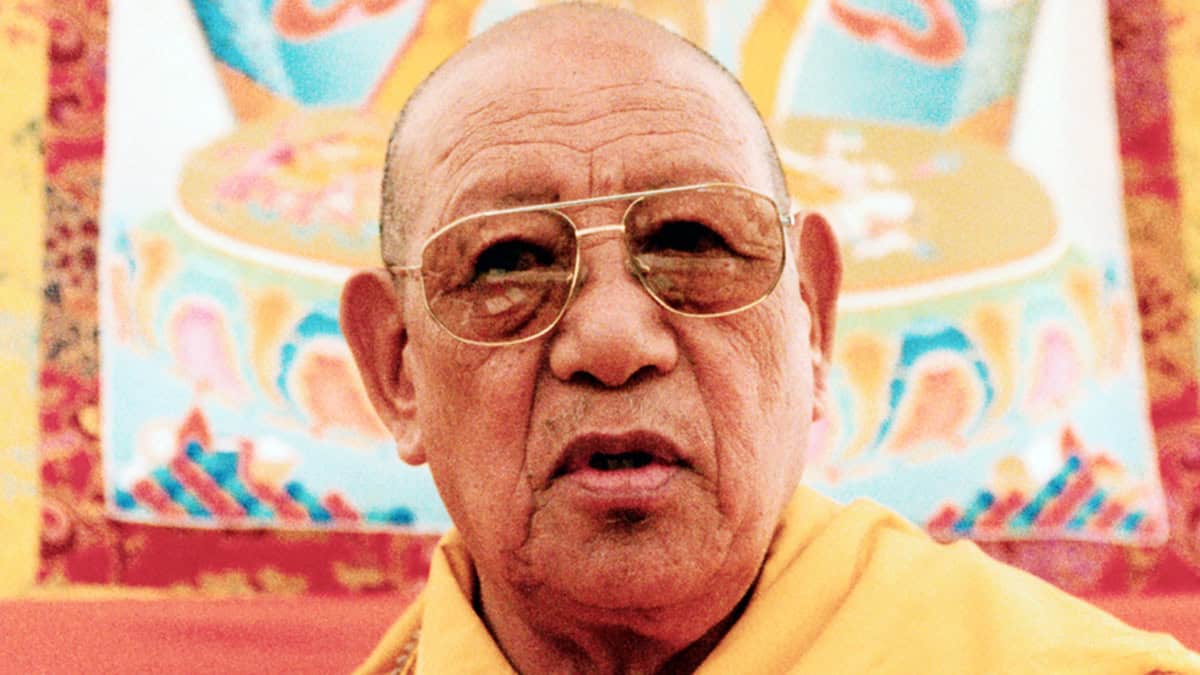
Teachings on Amitabha practice in the context of different empowerments and Phowa courses, given by H. E. Kunzig Shamar Rinpoche, V.V. Kalu Rinpoche, Lopön Tsechu Rinpoche, Ven. Tenga Rinpoche, and Lama Ole Nydahl
Teachings on Diamond Way (Vajrayana) practice given by Khenpo Lama Thubten, 1987
Lecture on the Buddhist Pure Land School given by the Chinese Anila Rev. Yi Hsiu, abbot of a nunnery in Malaysia, Karmapa International Buddhist Institute, New Delhi, 1995
Sutra & Tantra, by Ven. Tenga Rinpoche, 1989
Books and articles on Pure Land and Zen translated by the Sutra Translation Committee of the United States and Canada, NY 10468 (USA) and the International Buddhist Monastic Institute, Sepulveda, CA 91343 (USA)
Photo credit: Matt Balara | Marcin Muchalski