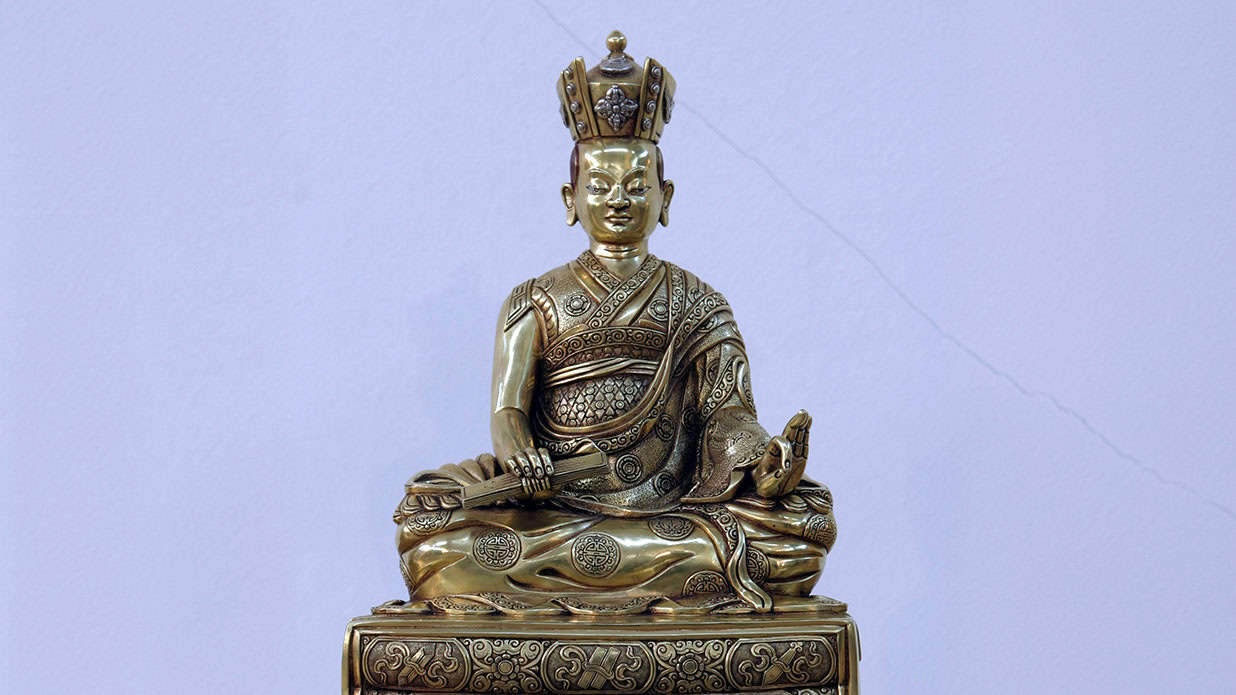
The life stories of the earlier Karmapas—the 2nd or 3rd or 5th Karmapa, for example—tell that they performed many miracles and in that way showed themselves to be buddhas. For example, when the 5th Karmapa was in China, he once displayed miracles every day, from the first to the fifteenth of the month, on a large scale—just as is verified historically with Buddha Shakyamuni. But many people who are in Karmapa’s presence do not see any miracles, and I am often asked, “When will Karmapa finally perform a miracle?” But Karmapa’s miracles are not magic tricks. I think that his presence is beyond the understanding of beings. He is already a miracle in himself, but we cannot recognize that with our limited capabilities.
In this connection, in 1972, I experienced something interesting. The king of Bhutan had just died, and Karmapa was asked to do something for him. Karmapa decided to go on a pilgrimage and to make offerings and pujas at the various sacred places. Shamar Rinpoche, Lopon Tsechu Rinpoche and I traveled with the Karmapa. Indira Gandhi provided a special train with a large living room, three bedrooms, and a kitchen. A sleeping car was added for the monks and Karmapa’s assistants. We traveled through India like that. We traveled to Bombay in order to visit the Ajanta and Ellora caves. As we arrived in Bombay, while still at the train station we were invited into the ashram of Baba Muktananda. Karmapa agreed. Muktananda was an important guru in India. We traveled to Ganeshpur, to Mutkananda’s ashram. When we arrived, there was a grand, very traditional welcome, with elephants, etc. We stayed there for three days, and one morning Muktananda asked Karmapa, “Could you please perform a miracle?” We all wondered what Karmapa would answer. He said, “Not today, but tomorrow at the crown ceremony.” None of us had ever experienced Karmapa announcing a miracle. Everyone was talking about it. “Tomorrow the Karmapa will perform a miracle!”
The next day at the crown ceremony there were several thousand people in a large hall—many Indians and some Westerners. As usual, Karmapa sat on a throne and Muktananda, dressed in his light Indian robe, sat on the other side on a raised seat. Karmapa performed the crown ceremony, but, even though we were paying close attention, nothing special happened. Things were as usual. We were a bit disappointed.
Afterward, Muktananda said that he was now totally convinced that Karmapa is the most realized person in the world. He did not say that just to be nice. One saw how serious he was—that he had never before in his life met a man like Karmapa. He was completely convinced that Karmapa is enlightened and, when speaking of other spiritual teachers, Muktananda said that they were very important but all of them were on the same spiritual level as he himself. He announced everywhere that Karmapa stood out as preeminent among them.
When Karmapa later traveled in the United States, Muktananda also came and visited him. He was really totally convinced about Karmapa. Muktananda must have experienced something special at the crown ceremony, something that convinced him. If not, he would likely have been angry over an unfulfilled promise. He was not a Buddhist, and there was no reason at all for him to experience this devotion to Karmapa.
At that time, I did not immediately understand what was happening. Later, I thought that Karmapa is actually always performing miracles in order to help beings, but that we are not capable of seeing them. Karmapa’s miracles do help us, even when we do not see them. We humans always need something visible in order to have more confidence—be it merely a kernel of rice from Karmapa, a piece of his clothing, or something similar.
Namkhai Dorje was a major supporter of the Beru Khyentse Rinpoche’s monastery in Tibet. He told me that he, along with other people, were once en route in a remote area of Nepal, the Lower Mustang. The group was on a narrow mountain path with a river about one thousand meters below. One horse slipped and plunged five to six hundred meters down the steep slope. The horse had a kernel of rice from the Karmapa around its neck, and Namkhai Dorje shouted, “Karmapa Chenno, Karmapa Chenno.” Namkhai Dorje had a lot of devotion to Karmapa and thus had hung a pouch with a rice kernel blessed by Karmapa in it. The horse did not crash into the river and was not even injured. They pulled the horse out using another path.
There are many such stories. People who really live with this devotion are continually in the Karmapa’s blessing field and experience miracles. It is a permanent condition. But, if one expects to be offered fantastic experiences, then it does not happen—it is a very individual thing.
It is similar with empowerments. When Karmapa gave empowerments, there were usually high lamas present (for example, Dilgo Khyentse Rinpoche, the former Sangye Nyenpa Rinpoche, and others). When they got an empowerment from Karmapa, each one of them experienced something unique, expressing that they had really received the empowerment. What each one experienced was very individual, corresponding to his individual devotion, their practice background, the timing, and their state of knowledge.
In conjunction with the guru yoga practice, one often speaks of “blessing.” This means that one’s understanding of the practice gets expanded naturally and without effort. All lamas say that, through the blessing, every type of understanding that we need is enlarged more and more. When Karmapa gave empowerments, we were always advised to concentrate well, because one thereby received a broad understanding of the meaning of the practice. That is always possible; blessing is always present. For the practitioners who really follow the Karmapa, blessing is very important. This is linked, above all, to the guru yoga (Tib. Lama Naljor). Depending on the degree to which one follows the guru yoga practice, the capacities of the mind grow and develop more and more.
While we were living in Rumtek, there was a war between Pakistan and India, and afterward, Bangladesh became an independent state. A few years earlier, an Indian colonel had often come to Karmapa. With much devotion he had asked Karmapa for protection and blessing, and Karmapa gave him blessed protectors. Later he took these along to the war in Bangladesh, where he once came under machine gun fire. He later said that afterward, his clothing was riddled with machine gun shots, but he himself not only survived but was not injured at all. Of course, the colonel was very happy and, after that, many Indian soldiers came to Karmapa and asked for a blessing. One day, an army chief got a blessing and protector. He said later that he hung the protector around the neck of a goat and then shot the goat. The goat did roll over but afterward was uninjured. After that, he had full confidence in the Karmapa.
When such stories are told, sometimes people do not believe them. No one believes that a goat survives when it is shot by a heavy weapon. But something like this did happen, because people had confidence, albeit with some doubt. This officer told us that he had a lot of confidence after his experiment with the goat. Later, many important people who were in dangerous situations came to Rumtek and to Karmapa, asking for blessing—from Sikkim, from Nathu Pass,1 and from Bhutan. Even though they were mostly Hindus and not Buddhists, they had confidence in the Karmapa. All kinds of people came to Karmapa for blessing. Some of them were even very traditional Sikhs from Punjab. In India, there is an expression that translates to something like “like a god.” They often used this expression for Karmapa.
The followers of the Jain religion, too, sometimes came from Siliguri to Gangtok since there were many Jains there. In principle they never used cars, but hiked. However, since it was very difficult for them get from Gangtok to Rumtek on foot, they asked Karmapa to come down to them every few years and to meet them at the bridge. Karmapa came and gave them blessings there, even though the Jains did not actually have confidence in Buddhism. They really only trusted themselves and are strictly religious in Jainism. But they trusted Karmapa. This strong devotion that many in India had to the Karmapa—whether Hindus or Buddhists or others—was something totally natural. No one had created propaganda about it; the people simply spoke of the Karmapa and they all came. In the end, he became very important in the entire region.
Lama Ole and Hannah met the 16th Karmapa for the first time in Nepal. Karmapa told us in Rumtek that a very special couple was coming. We thought, “What can that be for a couple?” and he said, “He is a big hippie, a strong person. We must prepare for their sojourn here.” Later, the Karmapa said, “He will bring a lot of benefit to Europe, and we must look after them.” At that time, I had no concept of Europe. When Ole and Hannah came, they did not seem particularly special to us. They were simply young people from the West. Hannah was very nice, very soft, and very young. I was also very young at the time. Right at that time we were having a Tibetan summer festival, with a kind of theater with performances on the history of the Karmapas. Lama Ole demonstrated a few jumps.
Karmapa often said that we should be like Lama Ole because his mind is one-pointed. Karmapa actually said that. I am not exaggerating. He always said, “When your mind is one-pointed, then you get results.” There was a very one-pointed and strong man from Kongpo, and Karmapa often said about him, “That is how you should be.” One-pointed means that one has a very strong devotion. But, at that time, we did not know what that meant exactly, so we just said, “Okay.” It took a long time before it became fully clear to me. Being one-pointed means that one is unchangeable. Karmapa said again and again, “This man is very dedicated and solid. You should also be as unchangeable and one-pointed. You should really be that way.” Karmapa gave this kind of advice when we sat together with him at night and he gave us teachings or counsel. It often lasted two or three hours, from 9 p.m. onward. Sometimes it even went until 2 a.m.
In 1971 Karmapa sent Ole and Hannah back to Europe. I remember how Karmapa gave the Bodhisattva Promise and then said to Hannah and Ole, “Now go back to Europe and spring into action.” Ole and Hannah left immediately, and this is also a sign of this one-pointedness. Karmapa himself said, “I gave them the Bodhisattva Promise, they left right away, and thus it will go well. They have much confidence, and therefore, I can also have confidence in them. They are very one-pointed and will have very good results.” I remember these utterances well.
This one-pointedness, which we already saw then in Lama Ole, has obviously led to good results around the globe. Many wish for such success, but very few accomplish it. Lama Ole and Hannah have done something very significant by bringing so many people around the world to the dharma. Through their connection with the Karmapa, they were able to convey to others an impression of the inspiration and the qualities of the Karmapa, as well as devotion to him. They were able to bring many people into contact with the Karmapa. Since, as I explained earlier, Karmapa is a tongdröl or thödröl,2 the connection to him prevents one from being reborn in lower realms of existence. And when one is reborn as human, then one is not reborn in wretched circumstances. Maybe in the past one gathered lots of negative karma, but when one meets Karmapa, one can be liberated from that quite easily. Of course, one does not immediately become a buddha, but one is freed from negative karma and will not be born in bad situations. Depending on how one then practices, one develops further, until one reaches enlightenment.
Many who are very strongly motivated dedicate their entire lives to bodhisattva activity, as Lama Ole does. Then one works very hard and gives his or her whole life to activity for the benefit of humans. After death, other people first go to the pure land, Dewachen. Whichever direction one chooses depends on individual wishes. But with contact to high bodhisattvas or buddhas like Karmapa, one always has certainty. All through Tibetan society one speaks of how this connection liberates one from old karma. When we then make one-pointed wishes and strive in the direction that Karmapa has shown us, we can develop strong abilities.
When I came to Dordogne3, there was only a farmhouse. It was November, very cold, and we had no heater, only some firewood. Several months later the elder son of Dudjom Rinpoche, Dungse Trinley Norbu Rinpoche, came to visit. He said to me, “You should not stay here, for if you do, endless suffering awaits you.” First, I thought that he was making a joke, but he was serious and said, “You will have only problems here. Rather go back to India or build a center in an easier spot—the United States, for example. I will also do that.” He repeated this again and again for a few days. Then he suddenly said, “I must tell you something very important: Your root lama sent you here. You should follow him and therefore stay here. Do not leave!”
Later I often had to think of this conversation. Always when it was very difficult, I thought to myself, “Right now it is difficult, but it was my own choice. I follow Karmapa and, therefore, continue. Actually, it is also not really so difficult and I can manage.” With this counsel, he really helped me. From a normal point of view he was right in the beginning. What normal human being wants to expose himself to so many unnecessary difficulties? But it is something else when one makes his own decision to follow his root lama and thus stays, regardless of what happens. It was an obligation that I chose for myself, never to say no when Karmapa expressed a wish to me, but rather simply to follow. It was my own decision, and if problems arose later, I always thought, “I myself chose this and I will stand my ground.” This has helped me a lot.
To be honest (Rinpoche laughs), I was tempted to avoid Karmapa Thaye Dorje a little in the beginning, when he was still very young. I knew that I would have to say yes if he would ask me for something. I could never say no, and therefore, I was on my guard. Recently one morning, Karmapa asked me, out of the blue, if I would take over the position of his general secretary. Of course, once again, I could not say no. Even though I am really not so healthy anymore and also have a lot of work here in Europe, I said yes and will do my best.
When one has decided on something, one never turns back. I learned that when the 16th Karmapa said, “Lama Ole is one-pointed.” When Dudjom Rinpoche’s son then said, “Do what the lama told you, even when it is difficult,” I said to myself, “A good idea. I will never say no to the Karmapa.” That is my promise, my commitment, which I have always followed.
If one can follow the lama one-pointedly, one gets a result that becomes an example to others of why it is good to follow the lama. We have to keep our noble goal before our eyes, which is to avoid unnecessary suffering. We do not want to be reborn in Africa or as animals. We want to become decent and useful human beings, and we have to work hard for that. We need this commitment. Otherwise, we only dream of our wishes and they will never take place. One can make a promise at any time, but it becomes real only when one sticks to it even in difficult times. Furthermore, that will enable a good and useful human life, with the capacity to help all beings. Naturally, for that, we do not have to expose ourselves unnecessarily to extra suffering. Then, whatever relative suffering comes to us is no longer so important.
This is merely an example of how Karmapa sometimes gave us advice with just a few words. If one gradually internalizes this, one sees how significant the advice actually was. When Karmapa said to me, “You must be one-pointed,” I did say, “Yes.” But I had not yet fully understood what he meant. One understands something like that only with time, after one has his or her own experiences. One-pointedness leads us to liberation and helps our work. With such a simple sentence, Karmapa shows an important direction. If one can follow it, one is protected and can help many beings and develop oneself further in understanding and realizing the dharma.
I am happy to see how many people around the world cherish and work in the dharma. That is very important because beings suffer everywhere. When someone travels around the world, helps beings and sows good seeds, then the seeds grow everywhere. Something like this is the biggest wish of the bodhisattvas, which Karmapa stressed a lot. I remember when Ole and Hannah asked him if they should make a three-year retreat and he answered, “No, do not do that. You should open centers all over the world.” That conversation took place while we drove through Berlin. At the time I was surprised at his response and only later did I understand it.
In truth, Karmapa did not have any private life at all. The only time he spent privately was taking care of his birds. At the time Karmapa was in Rumtek, he got up at four or five o’clock in the morning. He did some practice and already around seven or eight o’clock the first visitors came, from all over Sikkim. Throughout the whole day there were always people with Karmapa, wanting blessings and crown ceremonies. Some who came were happy, others unhappy or sick. Around five o’clock in the afternoon Karmapa did the Mahakala puja and spent the evening with the young tulkus and with us. He gave advice and teachings, sometimes until midnight or even two o’clock in the morning.
This is how we experienced Karmapa’s daily routine. But, at the same time, Karmapa also had a completely other level, which was not visible to us. This became clear, for example, on the occasion when the king of Sikkim brought a special guest from England. The woman was related to the English royal house and apparently had visions. She was a kind of medium. Together with two other guests of the Sikkim king, she came to meet Karmapa. We later learned from the person looking after the guests that this woman was quite shocked. We had not noticed anything peculiar during the gathering. Karmapa sat together with the three women and they drank tea. But after they left, the woman, totally shocked, asked, “Who was the naked woman in front of Karmapa?” She was told that there was no naked woman there. But she insisted that she had seen her. She said that this naked woman sat in front of the Karmapa with a bowl. Karmapa was chewing tobacco and spat into the bowl. We had not seen anything like this and did not know what we should say. I believe that it was Topga Rinpoche who then said that the naked woman must have been Red Wisdom, Dorje Phagmo.
In everyday life with Karmapa we saw certain things, but, as I said, at the same time he also had a totally other level that we could not see. One time, a general came to Rumtek. He came from southern India, but he was stationed in Bhutan, where he also lived. He wanted to introduce an important Indian guru from the south to Karmapa, and Karmapa agreed. Dressed in white robes, the guru came with approximately ten to fifteen followers including the general and some officers. They all sat on the floor in front of Karmapa and the guru sat next to him. I was standing at the door and heard what they were discussing. Suddenly the guru said to me, “Come here!” I went to him and suddenly, in some mysterious way, he produced a white powder. He offered some to Karmapa and sprinkled some on my head. Then he said in Tamil something like, “Vishnu is here.” But the translator said, “Chenrezig is here.” We did not understand what he meant, but Indians often see Chenrezig as Vishnu. The guru then took Karmapa’s mala, first put it in my hand, and then started to rub it, until suddenly yellow rice fell from the mala. I took that for magic—it was, I assure you, very strange to see rice falling out of Karmapa’s mala. Nobody said a word, not even Karmapa. I kept some of the rice and thought to myself that it would disappear if it had only been a magical illusion. But the rice has not disappeared to this day; I still have it with me.
In 1965 Karmapa traveled through all of Ladakh, by official invitation. Near Leh, in a large field, he gave a crown ceremony, and all the while many of the participants saw sitting on the throne a man clothed in white, with a long beard and long hair arranged as if in a turban on his head. Later all kinds of things were said about this, but what Karmapa actually did was to show himself as Saraha.4
Dudjom Rinpoche5 visited Karmapa shortly before his death, in the hospital in Hong Kong. Later he told me, “I prayed for Karmapa and had a vision. A man with a long white beard and white hair that lay like a turban on his head sat under a tree. All the while it was raining. What do you make of this?” With this, Dudjom Rinpoche actually wanted to tell me that Karmapa would not remain with us. The appearance as Saraha meant that Karmapa would not remain in his human body and instead would show himself as someone else. Rinpoche shared this with me in the form of a story of a vision. I thought for a moment: Why does he not understand the meaning for he is a very high lama? But then it became clear to me. Karmapa could manifest as the 16th Karmapa or, for specific reasons, sometimes as Saraha. Most of the time we saw him doing everyday things in a normal human manner. But, at the same time, there was this other level with him, and on this level he was surrounded by Red Wisdom or by Liberatrice or he could simply show himself as Saraha. Karmapa had all these levels simultaneously, and different people could see different manifestations of him.
At the end of this course Lama Ole will give the Bodhisattva Promise.6 Once one has made the promise, one begins to work according to one’s capabilities. Right now we are merely normal humans, with the corresponding limited capabilities. But through practice our capabilities grow and, in accordance with that, working for the benefit of all beings will become the main focus of our activity. Through our guru yoga practice we are connected with the Karmapa and work to strengthen our bodhisattva attitude, bodhicitta. We make wishes that we can support Karmapa’s activity to help beings. In the moment one can perhaps not do so much yet. But one makes the bodhisattva promise and begins to apply the teachings and to develop bodhicitta and through guru yoga merges with the great Bodhisattva Karmapa. One always keeps this bond in mind and, whatever happens, one deals with it accordingly.
In this way, there emerges in us very important habitual tendencies, as orientation for our continuing life. Depending on our individual capabilities, we develop our understanding, our knowledge, and our activity more and more. Karmapa’s activity is spread over the whole world today, and we become increasingly capable of participating in it and of helping. If, in addition, we also wish to be able to apply the methods for practice, then that is the very best that one can do.
- There had been skirmishes between the Indian and Chinese armies at this pass. ↩︎
- See Part I in Buddhism Today No. 29 ↩︎
- Following the wish of the 16th Karmapa, Jigme Rinpoche built the dharma center Dhagpo Kagyü Ling, in southern France. It was the European headquarters of the 16th Karmapa. ↩︎
- Saraha is a yogi from the 8th century. Born in Bengal, he became a Buddhist monk and eventually the head of the Mahamudra lineage. He was a predecessor of Tilopa, Naropa, and Marpa. ↩︎
- At that time, the head of the Nyingma lineage. ↩︎
- Jigme Rinpoche gave these teachings during the 2011 New Year’s course in Hamburg. ↩︎