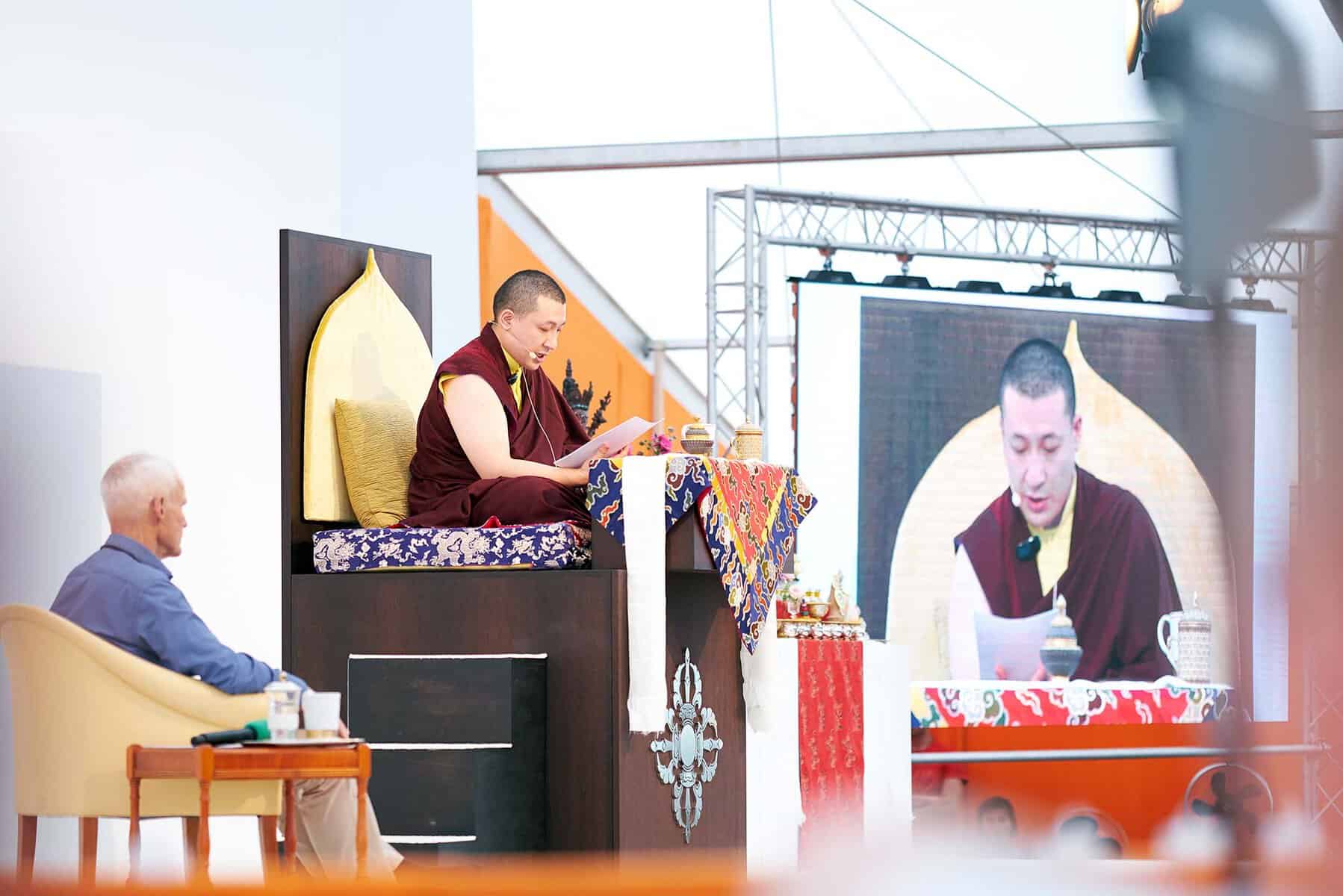
In the Kagyu school, the lineage holders are referred to as the Black Crown Karmapa and the Red Crown Karmapa, the latter being the Shamarpa, for the name Shamarpa means the Man with the Red Crown. Among the lineage holders of the Kagyu school, the Shamarpas were the earliest to hold this function among the Karmapas, and then until the 10th Shamarpa, they were usually the lineage holders. The Karmapas and Shamarpas always had a very close connection, sometimes even being born in the same family. Their function as lineage holders was to hold the teachings and find each other’s rebirths. This is also very important for us today, because the current Shamarpa1 found and recognized Thaye Dorje, His Holiness the 17th Gyalwa Karmapa.
The name of the 2nd Shamarpa was Khachö Wangpo. He was a disciple of the 4th Karmapa Rölpe Dorje and became the teacher of the 5th Karmapa Deshin Shegpa. Khachö Wangpo began teaching from his earliest youth. If you look at the life stories of our masters, you can see that this happened often because they had special qualities even as children. The Karmapas often said at a young age that they were the Karmapa. The 17th Karmapa Thaye Dorje also said it even as a toddler, and his parents even had to stop him from doing so, because under the Chinese occupation in Lhasa this could have led to great difficulties. The 2nd Shamarpa also said very early that he was the Shamarpa and taught even as a child.
Namah Sri Gurave2
All the vajra songs of our masters begin by thanking their teachers. The teacher-disciple connection is always the most important thing, no matter what level one is at. This is true until one attains the results, and even after attaining realization, one retains strong gratitude to one’s teacher. You all know this from the many songs of Milarepa, and we also find it here in the song of Khachö Wangpo. Of course, the language of the verses here is quite different from what we are used to, because the 2nd Shamarpa lived in the 14th century.

This luminous perception of the present
Is the very face of relative truth.
If one knows the unfabricated, natural essence of this,
That itself is the absolute truth.
In this song, he speaks a lot about relative and absolute truth and how these two are not different from each other. This is a very essential teaching for us. It is something we are all trying to understand. Right at the beginning, Khachö Wangpo fully defines what is meant by relative and absolute truth.
Whatever happens, whatever we see, whatever we experience in our lives and in our subjective world—that is the relative truth. The fact that everything can happen and the essence of it all—that is the absolute truth.
This means that there is no relative truth without absolute truth. It is not that one kind of truth would be here and the other kind of truth would be somewhere else. You don’t have to push one truth away to get the other, but we are aware of what is happening, and that is the relative truth. Through our practice, we come to understand the essence of it all, and thus we realize the absolute truth. Through this realization, we are thus liberated and no longer bound in any way. Then we are no longer slaves to cause and effect. In relative truth, that is, in everything that happens here and now in our ordinary world, cause and effect are infallible. They just happen all the time; we can’t avoid it. But we can improve the causes and then improve the effects, and so we can free ourselves from this bondage and really understand the absolute truth.
These scholastic sophists with their two truths,
Though including a lot of quotations and logic,
Do not understand the main point.
Here Shamarpa Khachö Wangpo talks about how it’s not enough to just analyze relative and absolute truth intellectually and just know a lot about what they mean theoretically. The Buddha gave many different kinds of teachings and some of them, at the sutra level, are very analytical. One comes to an intellectual understanding of what the nature of things is, and what exactly is meant by that, through close examination. However, if one is satisfied with that, one does not evolve, because analyzing alone is not enough. One must also meditate on this understanding and truly integrate it into the mind. Theory can point you in the right direction, teach you the right view, give you some clarity—but the real result is the actual experience. It means fully understanding it and really seeing things that way. Just having an idea of it is not enough, you have to go further.
Throughout the centuries, there have certainly always been people who stopped at the level of the scholars and others who went further; these were the meditators. The Buddha’s teachings always aimed at attaining wholeness, and for that one must not go to one of the extremes. It is always emphasized that you cannot get results without the experience. Without meditation, one can neither be liberated nor enlightened.
In our Kagyu school, the combination of these two aspects is taught in such a way that the view has the function of guiding us in meditation. It is recommended to develop the right view, not as an end in itself but so that one knows what one is doing. One must know the view in order to meditate in the right way and get the results.
The 2nd Shamarpa makes it very clear here that it is not enough to be very learned, because one does not become enlightened by that. This point is also important because for many people it is normal in their human development to become proud when they know a lot. It can easily happen that you think you already know everything, and this is a big obstacle that really blocks you in your development. If you know a lot, there is definitely a danger of becoming proud instead of letting the knowledge take you down the path. That’s something you always have to warn against.
By grasping dualistic distinctions they
corrupt non-duality.
Here again the same point is touched. If one stops at analyzing only on an intellectual level this dualistic view—”What is relative truth, what is absolute truth?”—one blocks the experience of what is not dualistic.
They continue samsara’s confusion of
conceptual accepting and rejecting.
Our confusion in samsara involves always wanting or not wanting something. We function in such a way that we always have this pattern of liking and not liking. No matter what happens, we either like it or we don’t like it. This habit is the root of samsara and you can only break it with meditation. Nothing else can solve this very subtle problem.
If we keep this liking and disliking in our dharma studies and in our meditation, we won’t get anywhere; we might as well be reading a comic book. Even if we move to high levels of fine words, meditate a lot, etc., we would be making a mistake if we were completely torn, even unconsciously, between liking and not liking. This would be the case, for example, if we wanted to dwell in our wonderful meditation but hated it when the meditation was not so beautiful.
This verse is about the connection with the teachings. If we approach the teachings with this approach, then we are not developing. We have to break this habitual pattern of accepting and rejecting, and of course that is extremely difficult. If it were not, we would all no longer be here but already fully enlightened.

The two truths according to our pith oral instructions,
I shall now plainly point out and so bring to the path.
Shamarpa Khachö Wangpo will now explain how to refer to the two truths in the correct way.
The guru is the glorious Vajradhara in person.
The essence of his mind is continuous.
Our Lama is the embodiment of the combination of the two truths, that is, the enlightened mind. He appears—for example, in the center of the refuge tree—in the form of the Buddha Diamond Holder, (Tib. Dorje Chang, Skt. Vajradhara).
He is the basis, the vajra body of indivisible
wisdom and method.3
The vajra body, or the diamond body, is an indestructible body. This means that it is an expression of the inseparability of wisdom and methods. Diamond Holder, after all, holds his arms crossed in front of his chest, with a dorje in his right hand and a bell in his left. The dorje represents the means, the methods, and the bell represents wisdom. This means that Diamond Holder is an expression of their inseparability.
Diamond Holder does not really stand for the relative and absolute truth, but the two express themselves in this way: wisdom is the absolute level, and the means are the way it expresses itself, that is, buddha activity. With the means, you can help beings when you have realized the wisdom of the absolute truth.
He is the four important points united into one,
This point is the secret of the secrets of relative truth.
I won’t say much about this, because I might say something wrong. (Hannah laughs) I don’t want to make something up, because it should be correct.
The wisdom of practicing this is absolute truth.
Through the experience in our practice of going beyond concepts, ideas, and analysis, we will come to attain the absolute truth. This happens when, in meditation, we break this pattern of liking and not liking, and the mind is able to just rest within itself. Then, on the very subtlest levels, our mind is no longer trapped by its own ideas and concepts.
Coming through the energy wheels4 of the inner four Buddha states,5
This great and supreme secret is ripened at the apex of the energy wheels,
One is ornamented by the energy wheels of the completely pure world,
And goes beyond the apex of the four dhyanas.6
Here Shamarpa Khachö Wangpo touches on the subject of tantric practice. The Diamond Way methods work with the different energies in the body, and here we can attain realization through very skillful means. As I said, Buddha gave different kinds of teachings. On the sutra level, we come to an understanding through reflection and analysis, whereas on the tantra level, one needs confidence in the methods. The means themselves cannot be analyzed, but we must trust them and apply them. If we do that, if we really use them, then they will bring the results, because they are very skillful. This is a very different approach from the sutra level.
The teachings are given in that order—first sutra, then tantra—because you need that confidence to practice tantra. You can’t just sit down and meditate on the different Buddha forms, because then you might start thinking, “Why am I meditating on this form?,” “What does it actually mean?,” “Why does this yidam look like this?,” or “Why should I meditate on it at all?” In meditation itself, however, these kinds of questions are not appropriate. In this type of practice, the Diamond Way, they should be clarified beforehand, not during meditation.
Shamar Rinpoche talks here about the chakras and Buddha states, and he explains how the different meditations bring the result of realization. Our realization will be expressed as the truth state, the joy state, the emanation state, and the essence state (which means the first three states together). The actual realization is the understanding of the true nature of things, which is the truth state. The joy state and the emanation state show how our realization benefits other beings: bodhisattvas are born in the emanation state (tulku) as people we can contact and show up in the joy state as bodhisattvas we can meditate upon.
As for the two truths, according to the profound path of the tantras,
Besides the outer, there is the inner and secret meaning,
Which only comes from the lips of the lord guru.
To refresh my memory today, I sing this song.
Shamar Rinpoche does not explain here what this inner and secret meaning is, because this is about tantric methods such as the meditation on buddha aspects. When one meditates on a yidam in retreat, one goes through different levels of practice: first the so-called outer practice, then the inner practice, and finally the secret practice. First one identifies with the buddha aspect, then one meditates on the internal energy channels in the body, and at the secret level, one identifies more with the mind of the buddha aspect. These are the skillful means of the Diamond Way that we talked about.
In the Kagyu lineage, we have the transmission of the various yidams, the Six Teachings of Naropa, and the Great Seal, the Mahamudra. They are all given in different ways. Here Shamarpa Khachö Wangpo talks about the transmission of the yidams and yogas, that is, the Inner Heat (Tib. Tummo) and such practices. Through these means we can attain full realization and, in this way, understand the levels of relative and absolute truth.
I am a son who has accomplished the oral instructions of his guru.
Not suppressing my blazing meditation experiences,
And unable to hold back such secrets, I sing this song.
Rejoice, O host of dakinis!
As in the beginning, here again we see that these songs are an expression of the actual experience as well as a praise and thanks to the teacher and the dakinis. They are songs of inspiration.
- The then-current Shamarpa was the 14th Shamarpa, Mipham Chokyi Lodro (1952-2014). ↩︎
- Meaning: Homage to the radiant Lama. ↩︎
- Wisdom (Skt. prajna) and Method (Skt. upaya). To ease reading of the verses, most Sanskrit terms are given in footnotes. ↩︎
- Energy wheels in the body, (Skt. chakras). ↩︎
- Buddha States (Skt. kayas); the dharmakaya is the truth state, the sambhogakaya is the joy state, the nirmanakaya is the compassionate emanation state, and the svabhavikakaya is the essence state. ↩︎
- The Four Dhyanas (Tib. Samten Shi) are four levels of non-liberating meditative absorption, as practiced in the god realm of pure form. ↩︎