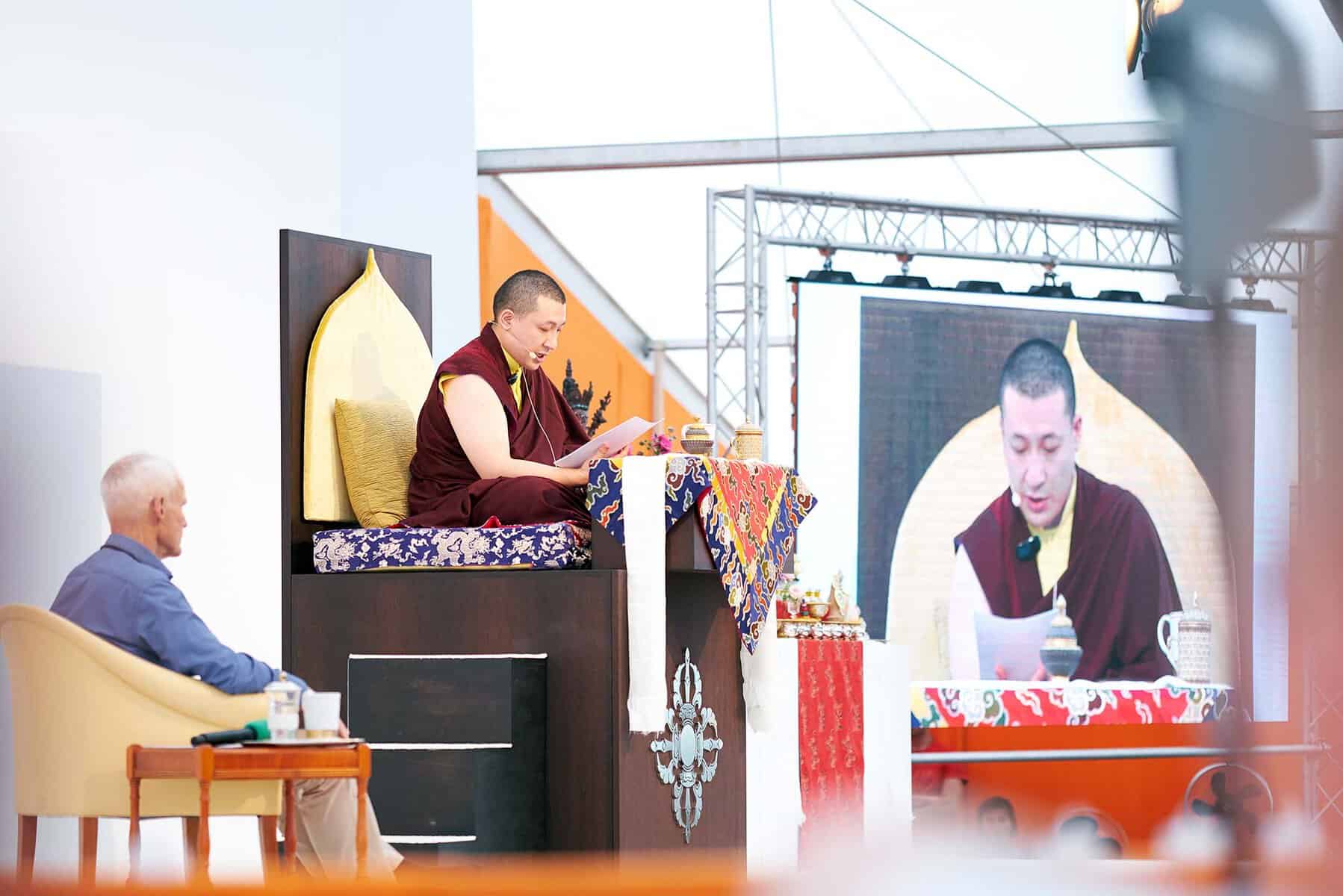
Gentle breeze, bright sunshine, the blue sea on the horizon and an unchanging feeling of freedom and lightness. This is Karma Guen. Populated by Phoenicians 3,000 years ago and later inhabited by Spaniards and Arabs, the last battles between Spaniards and the Moors took place here in the late fifteenth century. Today, a Diamond Way retreat center of the Karma Kagyü tradition is situated here in the mountains of Andalusia, and its purpose is the preservation of this Buddhist transmission in its entirety. The 16th Karmapa had foreseen the appearance of Karma Guen in southern Spain, and it was revealed to Mipham Rinpoche in early visions while living in Tibet. Karma Guen still attracts thousands of Buddhist practitioners from all over the world with its pristine beauty, blessing and the telling of legends that one may listen to endlessly.
In 1981, Pedro and Dorrit Gomez and their young son Peter had no idea that they would find themselves creating a unique Buddhist center on the site of the almost deserted Aldea Alta village. Standing at the top of the mountain and looking at the dry land with a tiny dilapidated village populated by few original inhabitants, Pedro half-jokingly asked Peter, “Shall we buy it or not?” He had his reasonable doubts if this deal would bring any success and needed a sign in order to make the decision. But to Pedro’s surprise, his son enthusiastically answered, “Yes!”
The history of Karma Guen begins far from Spain. Karma Guen was first the name of one of Karmapa’s three main seats. It was founded in 1184 in eastern Tibet during the lifetime of Düsum Khyenpa, the first incarnation of Karmapa. These three seats represented the enlightened activity of his body, speech and mind, and Karma Guen was connected to the activity of speech (the Sambhogakaya level). It was this other Karma Guen which had inspired Pedro when he was on a secret journey to Eastern Tibet with Lama Ole and Hannah in 1986. Already, the most incredible ideas had started coming up in his mind, including the necessity of building a Kalachakra stupa—the same one he saw next to the Chinese–Tibetan border. Later, back in Denmark, Lama Ole asked Pedro about the place he liked the most, expecting him to say Tsurphu, the main monastery. All Lama Ole’s attempts to out-argue his friend failed; Pedro had fallen in love with Karma Guen.
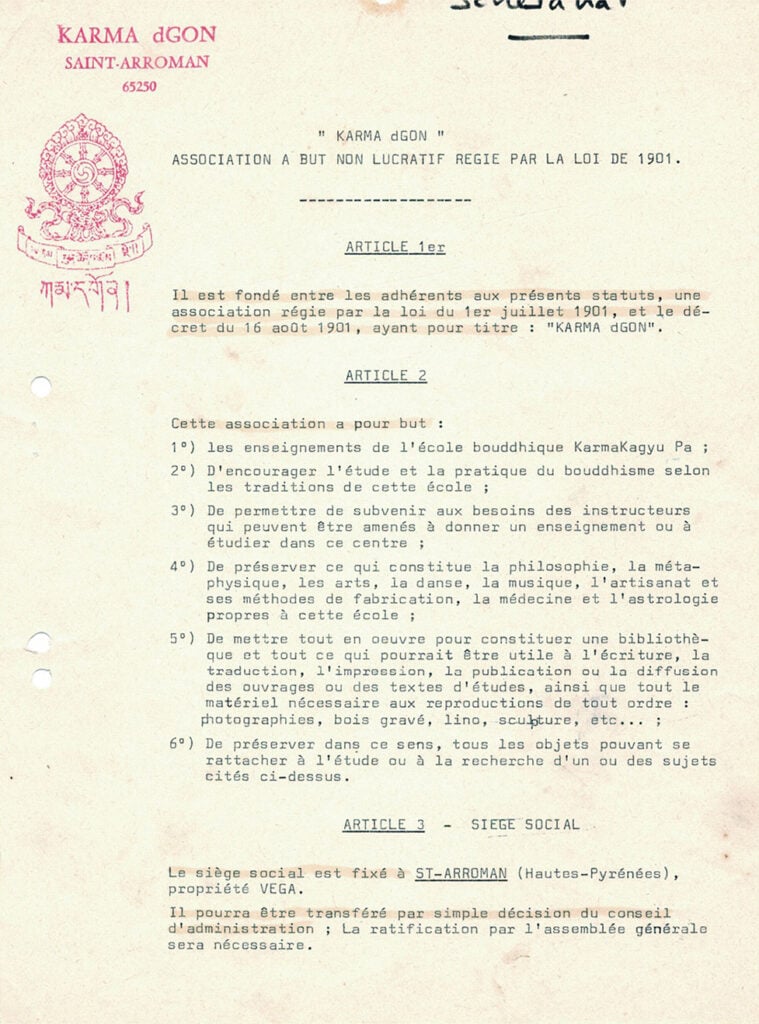
The first attempt to establish such a center in Europe was made in the French Pyrenees. Erwan Temple, a French student of the 16th Karmapa, bought a big estate and donated it to his teacher. Following the wishes of His Holiness, Temple founded a Karma Kagyü center there. Karmapa gave it the prestigious name of Karma Guen and, in 1975, wrote the Articles of Association specifying his view on the role of this place as well as other Western centers of the Karma Kagyü tradition. The non-profit association founded in Karma Guen had the following goals which were stated in the second article of this document: transmitting the Karma Kagyü teachings; studying and practicing Buddhism according to the traditions of this lineage; preserving its knowledge in philosophy, metaphysics, arts, dance, music, crafts and manufacturing methods as well as in medicine and astrology; establishing a library (including any activity connected to creating texts, translations, book printing, publishing and distribution of treatises and texts); providing materials for reproduction of photographs, engravings, linotypes, sculptures, etc. and preserving all objects associated with the aforementioned items.
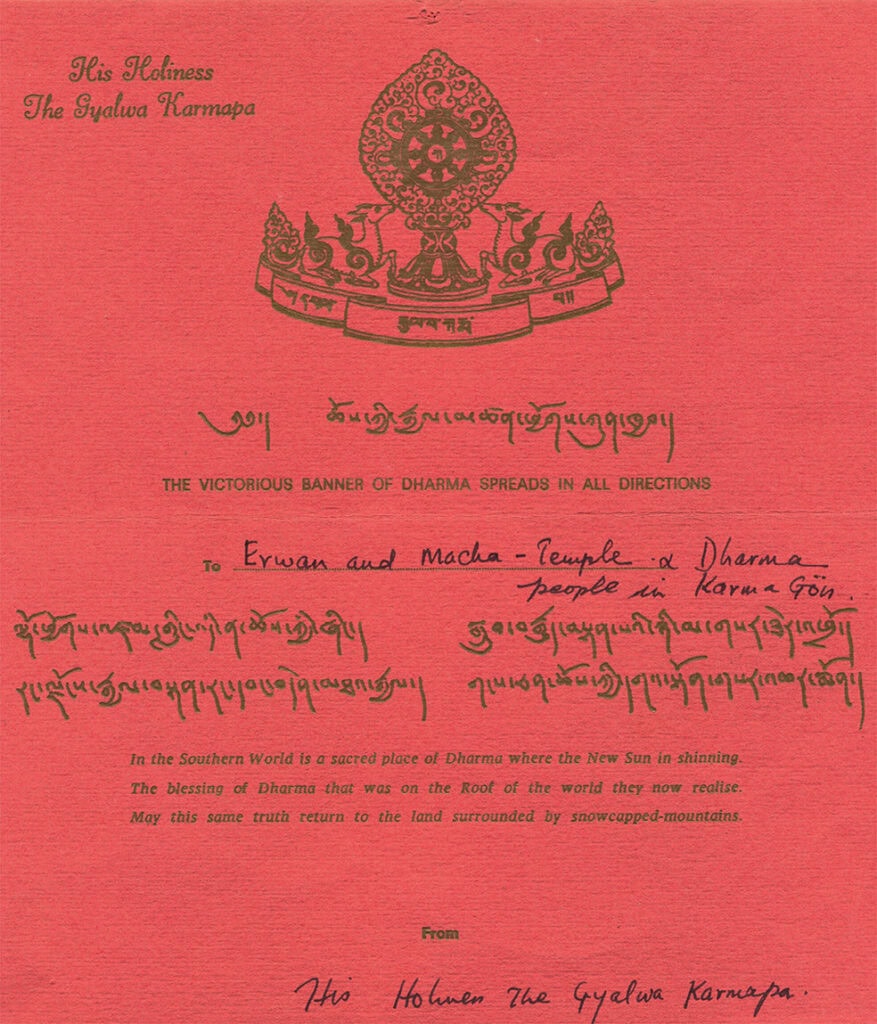
Erwan created the best conditions in the French Karma Guen, but high lamas rejected his invitations to visit the place, with the idea that a single Buddhist center in the West should not bear such a prominent name. Mr. Temple tried several times to pass Karmapa the documents of title for the real estate of Karma Guen in France, but circumstances prevented him from getting them into the rightful owner’s hands. At that point, Erwan decided that he had done everything he could and gave Karmapa the keys to the estate. Later, as a result of certain events, the center was sold for a price unheard of at that time. Unfortunately, the money was never delivered to Karmapa.
Thus Karma Guen disappeared once again from the face of the earth. But Karmapa insisted that Erwan Temple continue his work. He told his student that it would appear in the south and wrote a prophetic poem which was translated from Tibetan into English in Rumtek in the 1970s. Here it is:
Already in the 1970s, Karmapa made sure that Karma Guen was protected—he presented Erwan Temple with an ancient phurba made of three kinds of metal. He took it from the mandala of 108 phurbas situated in a special room in Rumtek. After Karma Guen disappeared from France, Mr. Temple placed this ritual implement on his private altar. It is reported that on at least two occasions this phurba miraculously saved him from the outcomes of bad intentions of an ill-wisher. After that, the phurba was called “the flying” one.
Erwan Temple visited the Spanish Karma Guen in 2005. Pleased with what he saw, he understood that this retreat center was the sacred place in the south mentioned by Karmapa in his prophetic poem. Fulfilling the wish of his teacher, Erwan handed over to Pedro and his wife Dorrit the original text of the prophecy and the precious phurba meant to be kept at Karma Guen.
During the 1970s, Karmapa foresaw the appearance of such a center in the south of Spain—an analog of the place called “Karmapa’s seat” in Tibet—denoted by special auspicious characteristics. In 1959, His Holiness was looking for them while searching for the plot of land for the new Rumtek monastery. He described the following characteristics, having in mind the land near the old Rumtek built in the times of the 9th Karmapa, Wangchug Dorje. “This place possessed all auspicious attributes needed for the site of a seat of the Karmapa: seven streams flowing towards it, seven hills facing it, a mountain behind, snow ranges in front and a river below, spiraling downhill like the form of a conch-shell.”
Tenga Rinpoche was the first Tibetan lama to visit Karma Guen in Spain. It was in 1988 when he saw that the surrounding landscape corresponded to Karmapa’s description. The next lama to visit the retreat center was Jigme Rinpoche, who confirmed Tenga Rinpoche’s words. Not long before this, in 1986, Lama Ole Nydahl came to Karma Guen for the first time. He discovered how good this place was for focusing and working with mind; within several hours, he managed to do what usually took him much longer.
Upon reading Karmapa’s prophesy both in the original and in English, Jigme Rinpoche confirmed that the Spanish Karma Guen was intended by this poem. In 2012 during a tea party with Francisco Bonilla, the mayor of Velez-Malaga, H.H. the 17th Karmapa Trinley Thaye Dorje said something which was a surprise even to Pedro and Dorrit Gomez, the founders of Karma Guen: “My predecessor [the 16th Karmapa] saw this place. He wanted to make a place like this, and Pedro came and fulfilled his wishes.”
Despite all auspicious signs, conditions in Karma Guen in the late 1980s and early 1990s were quite harsh. First, residents and founders of the center were annoyed by the pesky, ever-present mosquitos. Moreover, in a place where people had been living and fighting with each other for 3,000 years, powerful local energies seemed to be raging and ghosts from the past seemed disturbed.
Once, in the early 1990s, Björn Nydahl telephoned Pedro, who was in Copenhagen, asking him to come back. He said that strange things were happening in Karma Guen. The atmosphere had become unbearable; window shutters and doors banged even in calm weather, and it seemed that all elements had become hostile; residents of the center were in panic and didn’t want to stay any longer. Pedro arrived in Karma Guen, bringing special Mahakala (Black Coat, a protector of the lineage) incense with him. At midnight on the evening of the full moon, he headed to the place where Phowa courses were normally held. On his way, he was attacked by some invisible but absolutely tangible energy; he was hit by it in the lower back. Without any fear, Pedro invited the unexpected guest to follow him. Then he performed the Mahakala puja, meditated, made incense offerings and thus managed to pacify the energy.
According to Pedro, the situation improved in 1994 after the first visit of Lopön Tsechu Rinpoche and especially after the inauguration of the Kalachakra Stupa, which was marked by miraculous signs. Most participants in this memorable event witnessed unusual phenomena, like a rain of flowers, three suns dancing in the sky and the appearance of sixteen eagles that vanished in thick clouds. Explaining the real meaning of the signs, Lopön Tsechu Rinpoche added that it was hard to even imagine how many conditions had to come together for such a stupa to be built. He also said, “Be aware that we actually have this very blessed object here, that this is a sacred place, so please use it.”
The special blessing of the Kalachakra Stupa in Karma Guen not only fully pacified the local energies but also made the most revered Christian saint in Spain a protector of Buddha’s teachings! This is the incredible but true story about Santiago Matamoros, or Saint James the Moor-slayer. In Catholic Spain, he is considered to be a protector because miraculous visions of him as a knight with a sword riding a white horse helped the Christian warriors of Spain defeat the Moors in several significant battles. During construction of the Kalachakra Stupa, meant for protection of freedom and maintaining peace, some people saw an unusual man wearing an old-fashioned hat and riding on a luminous white horse. He used to appear at the Stupa, bow down to it, circumambulate it and disappear, respectfully walking backward.
In 2005 Mipham Rinpoche helped bring to light the mystery of this story. One winter day, the Spanish sangha got together in the big gompa to celebrate the Tibetan New Year. Rinpoche asked everyone to do the Diamond Mind meditation. When the meditation lasted too long, it became clear the master had entered into samadhi, the state of deep absorption. Later, Mipham Rinpoche said that while in that state, he met the rider in the old-fashioned hat who entered the gompa, approached him, and asked to take Refuge. Rinpoche fulfilled his wish and, after that, found himself a guest in a beautiful palace where floors were covered with fine carpets. It belonged to the noble stranger and was situated on the big Maroma mountain, visible from any spot in Karma Guen. Mipham Rinpoche said that this local protector promised to help the lineage and act as a patron.
Later, Pedro and Dorrit visited Mezquita, the Mosque-Cathedral in Cordoba, and took pictures of the sculpture of Saint James the Moor-slayer on horseback. Seeing this photograph, Mipham Rinpoche exclaimed, “This is the man who took Refuge!” Thus the legendary Santiago became a protector of Buddha’s teachings. He dwells near Karma Guen (not accidentally), for the last Muslims left Spain through the “Lion’s Gate” or Zafarraya Pass that can be seen from Karma Guen.
Karma Guen is a power place filled with the blessing of enlightened teachers and the good wishes of many dharma practitioners who come here to meditate. According to Lopön Tsechu Rinpoche, the Kalachakra Stupa will stay here until the coming of the next historical Buddha! Sherab Gyaltsen Rinpoche has also confirmed these words.
Karma Guen undoubtedly keeps other amazing secrets and stories. Come for a visit—once you do, an ineradicable wish to return again and again arises in you, to breathe this air of freedom, to touch miracles in real life and develop a deeper understanding of our mind’s true nature.
The author has drawn on stories taken from lectures and interviews with Pedro and Dorrit Gomez, as well as correspondence with them.