On April 25, 2015, a major catastrophic earthquake with a magnitude of 7.8 hit the region of Lamjung in Nepal. More than eight thousand people were killed and more than twenty-three thousand were injured1. The earthquake triggered an avalanche on Mount Everest, which killed nineteen people, and another avalanche in the Langtang Valley, where it is estimated that 230-250 people died.
Two more earthquakes occurred soon after, both causing further damage and deaths. In June, aftershocks were still being experienced on a weekly basis.
Hundreds of thousands of people have become homeless and entire villages have been flattened across many districts of the country. Centuries-old buildings were destroyed at the UNESCO World Heritage sites in the Kathmandu Valley, including some at the Kathmandu Durbar Square, the Patan Durbar Square, the Bhaktapur Durbar Square, the Changu Narayan Temple, and the Swayambhu Stupa.
Why is this event so important for Buddhism? Nepal was the birthplace of the historical Buddha, Buddha Shakyamuni, who was born in Lumbini over 2,550 years ago. Buddhism then spread to and grew in Nepal, eventually spreading to Tibet, India and Southeast Asia. Nepal is the home of very important sites and holy places for all Buddhists around the world, and the Karma Kagyu lineage is especially rooted there. High lamas and masters of the lineage have lived, taught, meditated, and achieved liberation and enlightenment in Nepal.
The blessing carried in Nepal can be felt upon arrival. Centuries-old Buddha statues welcome you at many corners. Stupas that are thousands of years old protect and bless the area, and caves where masters like Guru Rinpoche, Tilopa and Naropa achieved levels of realization can be seen in the mountains that overlook the Kathmandu valley.
For Diamond Way Buddhism, this is the place where it all started. Nepal is the place where Lama Ole and Hannah Nydahl met Buddhism for the first time. They went to Nepal for their honeymoon in 1969, where, without expecting to, they met Buddhism. Here, they first studied under the great Lopön Tsechu Rinpoche, whose monastery luckily still stands in Kathmandu. Kathmandu is also where they met H.H. the 16th Karmapa Rangjung Rigpe Dorje during a traditional Black Crown ceremony at his monastery near the Swayambhu Stupa. Sadly, this building did not survive the earthquake, nor did Shamar Rinpoche’s monastery at the same place. Sherab Gyaltsen Rinpoche’s new monastery in Nala was ready to be inaugurated when the earthquake struck, and it suffered extensive damage. Demolition and construction crews have been working steadily since, and the delayed inauguration was held on November 2, 2015.
During the Sofia Stupa inauguration in Bulgaria in August 2015, Sherab Gyaltsen Rinpoche told us that stupas are representations of Buddha’s mind. Honoring them in any way, be it by doing prostrations, walking around them, meditating near them, or by paying respect in any form, brings great benefit and purifies great amounts of karma. Visiting the caves of enlightened masters likewise allows us to connect directly with them, leaving good impressions in our mind and the seeds for our own liberation.
With this article, we would like to pay homage to all the formidable power places in Nepal. May everybody who wishes to do so find their way there and be able to meditate and make a pilgrimage where our lamas and lineage holders meditated extensively. The power of our lineage and enlightenment live there. Enjoy!
Swayambhu Stupa (Kathmandu Valley)
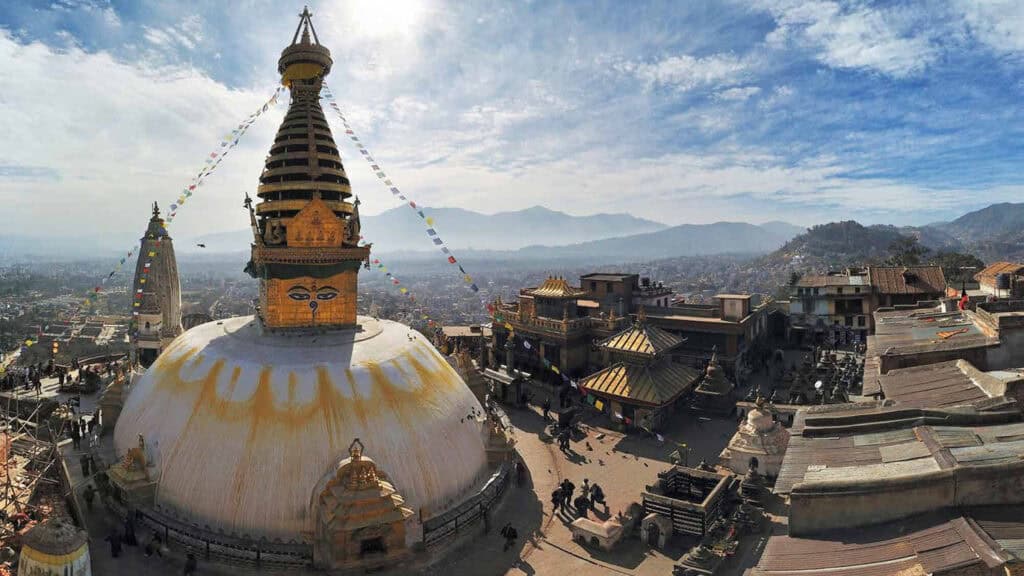
Stories tell us that Swayambhu Stupa manifested from the compassion of all buddhas even before the first historical Buddha appeared. Because the stupa is on top of a mountain looking over the Kathmandu valley, the whole mountain is seen as part of the stupa. Because of this, the traditional kora (circumambulation, walking around a stupa in clockwise motion) can be done not only around the stupa itself but also around the base of the mountain. This longer kora takes about forty-five minutes; along the way, there are prayer wheels, mantras, bells, and other stupas.
The stupa is a white dome topped by a thirteen-tiered structure that looks somewhat like a beehive. The dome represents the earth, while the tiers represent the thirteen stages that humans must pass through to achieve enlightenment.
Prayer wheels around the base are embossed with the mantra OM MANI PEME HUNG, which transforms all disturbing emotions into wisdom (OM purifies pride, MA jealousy, NI attachment, PE ignorance, ME greed, and HUNG anger). The same mantra appears on the prayer flags at the top of the stupa. Traditionally, these mantras are said to be carried around the world by the wind to benefit all beings.
Boudhanath Stupa (Kathmandu)
This stupa is the largest in Nepal and one of the largest in the world. Merchants from Tibet have made this stupa a stopover point for many centuries, and now it is one of Kathmandu’s most popular tourist sites. In the 1950s, Tibetan refugees settled in the area. Along with street vendors, Tibetan Buddhist monasteries and homes fill the narrow alleys around the base of the stupa.
The stupa is said to contain the remains of Kassapa Buddha, the third Buddha of our era.
Seen from above, Boudhanath Stupa looks like a giant mandala. The mantra of Avalokiteshvara—OM MANI PEME HUNG— is carved on the prayer wheels around the base of the stupa. From the bottom up, three platforms at the base symbolize earth, then two circular plinths represent water, and they are topped by a square tower with the omnipresent Buddha eyes painted on all sides. Above is the third eye, symbolizing the wisdom of the Buddha. Next is a pyramid with thirteen steps, representing the ladder to enlightenment. The triangular shape is the abstract form for the element of fire. At the top of the tower is a gilded canopy representing air. Above it is a gilded spire, representing ether and the Buddha Vairocana. Prayer flags tied atop this stupa also carry mantras and prayers around the world.
Buddha’s Place of Birth (Lumbini)
Lumbini is where the historical Buddha Shakyamuni was born and is one of the four main sites of Buddhist pilgrimage (the other three are Bodhgaya in India, where the Buddha reached enlightenment; Sarnath, where he gave his first teaching; and Kushinagar, where the Buddha passed away and reached Parinirvana2).
On the day of the full moon in May 623 BCE, the Buddha’s mother, Queen Mayadevi, was traveling through Lumbini when she went into labor. She stopped and gave birth to Buddha in a beautiful grove. According to Buddhist tradition it is said that Buddha spoke and walked seven steps immediately after his birth.
Today, the place of Buddha’s birth is marked by the Mayadevi Temple. Excavations inside the temple show remains of earlier stupas and temples, including remains of Ashoka’s stupa built in the third century BCE. South of the temple is a sacred pool (Puskarni) where Queen Mayadevi took a bath before giving birth and where nagas washed the newborn Buddha. Emperor Ashoka’s pillar is also near the temple, and the writings and engravings on this stone pillar are still in excellent condition.
Stupa Ramagrama, near Lumbini, is one of the eight original stupas containing Buddha’s relics. After the cremation of Buddha’s body, his remains were divided into eight parts and placed in eight stupas. The only one of these still intact today is the Ramagrama stupa.
Lumbini is near the border with India, near the town of Kapilavastu, whose name means “lovely.” The town grew until the ninth century, but then it declined as the region became first Muslim and later Hindu. The region is now predominantly Hindu, but there are many Buddhist monasteries and shrines in the area that belong to various schools of Buddhism from different countries.
Guru Rinpoche Yanglesho Cave (Pharping)
Yanglesho cave is situated on the road just before the exit to the town of Pharping, near Kathmandu. It is a strong power place, where Guru Rinpoche realized Mahamudra, and it is said that the second historical Buddha subdued demons and spirits.
It is said that, in preparation for his realization, Guru Rinpoche wanted to find a place as safe and geologically stable as Bodhgaya, but since Bodhgaya was too far away, he found a place with the same characteristics in Nepal. After the recent earthquakes, Pharping stood almost untouched by tremors. Inside the cave is the head imprint of Guru Rinpoche.
In the past, this area and the local population were tortured by local demons and nagas, so when the people heard about the great master Guru Rinpoche, who defeated nagas with his phurba (knife), they asked him to come and help them. When Guru Rinpoche came, he started to meditate in Yanglesho, where he killed the main demon with his phurba and turned him to stone. A huge stone in the form of a naga with three heads marks this spot today.
Guru Rinpoche Asura Cave (Pharping)
Before reaching realization in Yanglesho cave, Guru Rinpoche meditated in Asura cave. Asura cave is located above the town of Pharping. Legend tells us that the Yanglesho cave was not suitable for a long-term stay due to humidity, shade, and a north-facing orientation, so Guru Rinpoche meditated in the Asura cave until he almost realized Mahamudra, then proceeded to Yanglesho to continue his meditation there.
Manifestations of Taras and Ganesha appear in stone there, as well as imprints of Guru Rinpoche’s ornaments. These imprints started to manifest only fifty years ago: first a form of Ganesha (a Buddhist protector), then a Tara form, and now a second form of Tara. According to Shamar Rinpoche, all twenty-one Tara forms should appear there. Outside the cave, to the left of the entrance, there is a handprint, which some sources say is from Guru Rinpoche, but other sources deny this.
It is said that this cave has extra blessing for the speech center, and that this is the place where Guru Rinpoche accepted the task of protecting Tibet and bringing the dharma there.
Vajrayogini Temple (Pharping)
Down the hill from the Asura cave, there is a Vajrayogini temple. Inside is a statue of Vajrayogini that it is said to be a speaking statue of her. The statue is red, although tradition says she should be white. The statue was painted red after a past restoration. Marpa visited this place and meditated there every time he traveled through Nepal.