
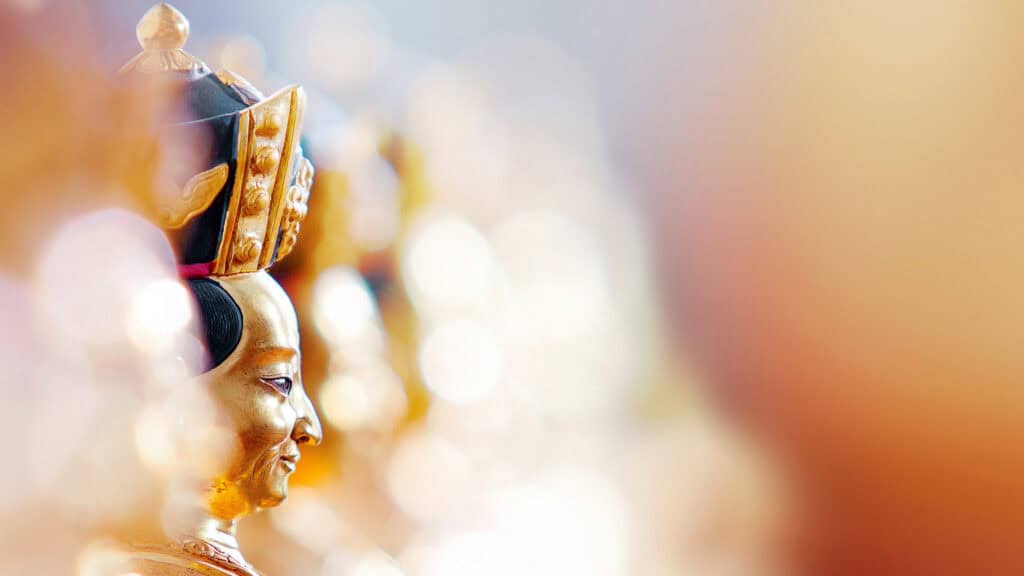
To begin, let’s briefly explore the historical context. The 8th Karmapa, Michö Dorje1 (1507-1554), was born at a time when Europe was just emerging—at least in some of its cultural achievements—from the Middle Ages. The Renaissance was blossoming in Italy with famous artists such as Michelangelo and Leonardo da Vinci. Educated Europeans became aware that Christopher Columbus of Genoa, commissioned by the Spanish Crown, had discovered not a sea route to India but, without knowing it, a new continent. This was called America (after Amerigo Vespucci) for the first time in Karmapa’s birth year 1507.
Immediately following this discovery, Spain and Portugal had begun to exploit the resources and people of this new world and forcibly Christianize the entire continent. In 1517, the German clergyman Martin Luther shook and reformed the Christian world with his 95 Theses, which was to lead to religious wars in Europe that lasted for several centuries. And a few decades before that, the confrontation between Christian Europe and the Muslim world had just reached two of its high points: in the east, in 1453, with the capture of Constantinople by the Ottomans—and in the west, in 1492, with the fall of Granada, the last Moorish fortress on the Iberian Peninsula, in the course of the Reconquista.
News of these developments, which were so important for Europe and large parts of the world, probably didn’t reach the highlands of Tibet very quickly. Nevertheless, in the Central and East Asian region of Tibet, Mongolia, and present-day China, similar developments were taking place to some extent; here, the relationship between Buddhism and secular power was causing some tension.
With the 8th Karmapa Michö Dorje, we find a person who in this historical period created inspiring works as a Buddhist teacher, lineage holder of the Karma Kagyu school, scholar, artist, and Mahamudra master and showed an enlightened example in his Bodhisattva behavior and Buddha activity. Today he continues to inspire Diamond Way practitioners all over the world.
“I am Karmapa!”

Kham, eastern Tibet. Damchu province. Satam, a village. There is a house with a juniper bush. At the entrance of the house, there is a spring with its opening facing east.
When a child was born in this place in the early morning of December 7, 1507, a rainbow-colored pillar of light formed above the roof of the house and a rain of flowers fell.2
Already eight to nine months prior, at conception, there are said to have been similar signs: A radiant ball of light had appeared above the roof of the house and, together with the sounds of cymbals, penetrated the interior through the windows. A light as bright as the sun-filled that room.
The mother had an auspicious dream that same night: she was in a vast meadow full of flowers, in the middle of which was a large tent made of rainbow light. In it, pearly stupas fell from the sky like snow and became a man, dancing adorned with the six bone ornaments. Beautiful jeweled dakinis made offerings to him, sang, and danced for him. The mother received a golden dorje glowing with light. She received a conch shell from a girl with blond hair, which she then blew and whose sound filled everything. The father and the surrounding people began to recite om ma ni pe me hung mantras.3 The parents as well as other people of the village experienced this and other auspicious dreams and miraculous signs.
Now the time had come. The mother managed the birth excellently, and the house and its surroundings were filled with a pleasant smell. The newborn child looked into the room and said, “I am Karmapa!”
The First Three Months of Karmapa’s Life4
The 7th Karmapa Chödrak Gyatso had died in 1506 and, relatively shortly before his death, had written in a prophecy where he would take rebirth. He, who was beyond birth, abiding, and death, would show these phases of human life to benefit beings, he promised Maitreya, the future Buddha, in a vision. And so he would be born as a human being with Buddhist parents5, who, however, on a secret level, were nothing other than the Buddha Highest Bliss and the Dakini Red Wisdom.
Only seven days after the birth of the 8th Karmapa, the baby was presented by his father Karma Situpa.6 The latter quickly found that the circumstances of the birth, the geographical location, and the signs of the place matched very well those predicted by the 7th Karmapa. However, since the names of the parents, as written, sounded very similar but were not identical, he wanted to subject the boy to further tests. To protect the child, he asked the parents not to tell anyone for three months. He also gave them blessing pills, tea, butter, incense, a silk scarf, and other blessed things for the newborn. They were to pay attention to what the child would say when they gave him these things later; it would be only a few words, only three or four sentences. Sure enough, the child would say, “E ma ho, don’t doubt me, I am the one they call Karmapa!”
Two Candidates for the title of Karmapa
When he received news of the rebirth of the 8th Karmapa, Gyaltsab Tulku, from the main Karma Kagyu monastery of Tsurphu, was drinking his morning tea in his tent as the rising sun shone on it. He saw this as an auspicious sign.
At about the same time, news reached him of a boy from Kongpo (in western Tibet, southwest of Lhasa) whose parents7 thought their child was the reincarnation of Karmapa. However, when he traveled there, he had several dreams and received signs that made him clearly doubt the new candidate. In conclusion, he also dreamed that the West was black and unsightly, but the East, the birthplace of the actual Karmapa, was brightly lit and radiantly beautiful.
The 4th Shamarpa, who never met the two candidates in person before the recognition of Karmapa, saw it similarly but could perceive the situation clearly thanks to his clairvoyance: He declared that the boy from the East undoubtedly would be Karmapa.
Thus, even though it may have been clear to the deciding Karma Kagyu lamas which of the boys was Karmapa, it still took about six years for the final, official confirmation of the child from the East as the actual Karmapa. The reasons for this were probably political: the supporters of the Western child were rich and had significant political, military, and religious influence at the time.8 They could also afford to provide monks in the Karmapa’s tent camp as well as Tsurphu Monastery, thus attracting them to their side.
The supporters of the boy born in the East, on the other hand, were rather poor. It is reported that they barely managed to provide Karmapa himself with food, clothing, and medicine when needed. These early experiences, however, seem only to have motivated Karmapa more strongly to reject superficial forms of Buddhist practice and to seek out the essential Buddhist teachings and methods, as well as truly qualified teachers. They may have provided an additional force for the extensive activity that Karmapa was to develop as a major teacher, author, and artist throughout his life.
Early Travels
Already in the first years of his life, Karmapa was invited to many places in eastern Tibet, such as Riwoche Monastery, the headquarters of the Taglung Kagyu lineage, which was near his birthplace, and a little further south to Lhorong, where he convinced the practitioners in many ways.
For example, Karmapa received the ritual objects bell and dorje as a gift from a disciple of his predecessor. This made Karmapa very happy; he was able to use them immediately in an excellent way, and he blessed those present with them. When asked what teachings Karmapa had given to this great meditation master from Riwoche, called Ser Phowa, in his previous incarnation, he answered straightforwardly and accurately, “Mahamudra and these six teachings of Naropa.” In a classic test for conscious rebirths, Karmapa impressed those around him with his ability to select the right statues, thangkas, robes, and other objects presented to him, which were possessions of previous Karmapas from amongst similar items wrapped in the same cloths. In addition, he recognized many people who had been in contact with the 7th Karmapa at the time. They had been his disciples, had received teachings from him, or were even related to him, like the 7th Karmapa’s sister. He could often recall surprising details and could clearly distinguish them from those who had had no connection with the 7th Karmapa.
In 1511, at the age of three or four, he met a lama named Sönam Rinchen on his way to Riwoche. Sönam Rinchen gave him a piece of turquoise and then asked him to reveal who he was. Karmapa responded with the famous statement, “Sometimes I am Padmasambhava, sometimes I am Saraha, and other times I am Maitreya.”9
The Official Recognition of the 8th Karmapa, Michö Dorje

By 1512 when Karmapa was five years old, he had a large following in eastern Tibet due to his persuasive demeanor. From this period, sources report a conversation Karmapa had with Önmo Gawa, the sister of the 7th Karmapa, with whom he was staying temporarily. When asked by the latter if the other candidate, the son of the lama named Amdo, was Karmapa, he replied, “I am Karmapa. The son of Amdo is the reincarnation of an incarnation from Surmang Monastery.” He added that this child had been his disciple in the last life as a monk.10
When Situpa died that same year—and Karmapa, by the way, knew about the latter’s death, of which he had not been informed—Gyaltsab Tulku became the decisive Karma Kagyu lama in charge of Karmapa’s recognition. Gyaltsab Tulku invited the boy from the East, the actual Karmapa, to a tent camp in Kongpo, where the other candidate had been staying with his followers for some time. The atmosphere there was very heated because of this conflict.
In 1513, Karmapa finally arrived at the camp.11 When he arrived, most people were so taken by the charismatic appearance of the young Karmapa that they spontaneously bowed and gave him silk scarves in greeting, some with tears in their eyes. This happened even though people had been forbidden to receive him like a high lama or buddha because the decision on who would be recognized as Karmapa had not yet been made.
This was to last for more than a month. Two groups took sides, sometimes vehemently, for one of the two candidates each. In this extremely tense atmosphere, the two boys were now subjected to various tests. For example, they had to answer questions and give blessings in front of a large gathering of people. Two sources describe Karmapa as fearless, steadfast, and compassionate in all situations, while the other candidate appeared tearful and confused. The latter’s intellectual and linguistic abilities, despite his training, were also unlikely to have been particularly strong; although two years older than Karmapa, he could say little more than “father,” “mother,” and “food and drink.” The two boys were also subjected to the classic test of selecting from similar objects those owned by previous Karmapas. In everything, Karmapa seems to have been clearly superior to the other boy.12
Even though, in retrospect, it seemed clear to all that the right boy had been confirmed as Karmapa, at that point, two groups still strongly sided with one of the two, so strongly that even an outbreak of open violence or war had to be feared.
Eventually, however, after some back and forth and many attempts by Gyaltsab Tulku to mediate, the supporters of the other candidate gave in, and the boy from the East was officially recognized as the 8th Karmapa.
Gyaltsab Tulku saw the face of the 7th Karmapa in the sun as a sign, and the people in the tent camp felt as if they had woken up from a bad dream. They wondered how they could have been so mistaken and were filled with great devotion to Karmapa. Karmapa ascended the throne of his predecessor, put on the black crown of the Karmapas, and, in accordance with a prophecy of Padmasambhava, received the name Michö Dorje—”Unshakable Diamond.”
Perfect Master, you master the four Buddha deeds, direct your wisdom mind to me—and already your blessing comes. Dorje Jangtschen [here Karmapa is addressed as “Loving Eyes”], you unite the realization lineage within you, radiant great Karmapa—think of me. (FROM THE TEXT OF THE 8TH KARMAPA MEDITATION)
Karmapa’s Basic Education, His Early Journeys, and Visions
Immediately after Karmapa’s enthronement in 1513, the auspicious news spread throughout Tibet, and all Karma Kagyu authorities were informed by letter. Karmapa received his basic training at this time under the care of Gyaltsab Tulku. He also took his first pledges on his way to monastic life. Karmapa received important Karma Kagyu initiations on male and female yidams and protectors, and he learned to read and write.
During his travels in eastern Tibet, Karmapa gave the first transmissions, including explanations of guru yoga, the practice on the lama. With about ten thousand people assembled before him in a marketplace, he transmitted the blessing of the Buddha Loving Eyes in a Gom Lung13. The Karmapas are considered emanations of this buddha form. At the age of seven, he wrote his first known text, a commentary on a song by Milarepa about the Great Seal (Skt. Mahamudra). He also met for the first time a lama who was to be among the most important in his life, Sangye Nyenpa.14
In 1515 Karmapa was just eight years old. He had numerous direct experiences of buddhas15 at that age, including of Buddha Shakyamuni himself with his main disciples, great yogis of ancient India such as Saraha and Tilopa, Padmasambhava, great Kagyu masters of the past such as Milarepa or the 2nd Karmapa, Karma Pakshi, yidams, and protectors. These include encounters with buddha power fields such as the blue Buddha Highest Bliss in union with the female Buddha Red Wisdom. He also encountered the main protector of the Kagyu lineage Black Coat, his consort Radiant Goddess, and many protectors in her wake. A further experience of the Buddha involved Highest Bliss with countless dakinis.
Karmapa Meets the King of Jang Satham
In 1516, Karmapa was invited by the king of Jang Satham.16 The descriptions of this encounter portray it as magnificent: The king, riding an elephant, surrounded by an army of thousands of soldiers, received Karmapa and his large entourage. A huge drum pulled by sixteen people was played; Karmapa and the king exchanged symbolic gifts according to their spiritual and worldly rulership, respectively. The queens, impressed by Karmapa’s transmissions, developed the spirit of enlightenment, and the king—previously skeptical and dismissive of Buddhism—promised not to engage in offensive warfare and to support the dharma for the next thirteen years. This included sending five hundred boys annually to Tibet for monk training and establishing one hundred monasteries and meditation centers. Karmapa promised the king to return after seven years.17
He then traveled throughout southeastern Tibet. One source reveals how Karmapa made use of the riches he received from his supporters, such as the king. In two places on his journey, he
gave five hundred gold pieces, fifty bricks of tea, and ten loads of copper for the construction of stupas, and he gave twice that amount for the construction of a golden roof over a buddha statue.
“Remembering my teacher day and night, I received the four initiations through the profound path of Diamond Yoga.”18 —KARMAPA’S DEVELOPMENT AS A SCHOLAR AND HIS PRACTICE OF THE GREAT SEAL
The following twelve years of Karmapa’s life were characterized by intensive study of Buddhist teachings and diverse practice. Among his four main teachers, Sangye Nyenpa is considered the most important. He was the lineage holder who gave him the essential transmissions, imparted the Great Seal, and with whom he established the close teacher-disciple bond essential to the Karma Kagyu lineage. He spent a great deal of time with Sangye Nyenpa in the three years from the beginning of this training until Sangye Nyenpa’s death in 1519.
Karmapa himself said about this period of his life:
“I have fully received and comprehended the teachings of the lineage, the various transmissions of Naropa and Maitripa, the six teachings of Naropa, the Great Seal, the [mantra] recitations [of the multiple buddha aspects], and Rechungpa’s accomplishments [accomplishing practices imparted through Rechungpa]. […]
During the three years, I devoted myself to the Great Buddha, Sangye Nyenpa, to attain all good qualities—there was no other way to be touched by his compassion than to practice pure vision. Through this, all kinds of wrong views were conquered. Through the wisdom that knows the teacher is without blemish, I was blessed, and saw his loving-kindness as incomparable.” [Rheingans (2017), p. 89f.]
In addition to the transmissions Karmapa received, it is clear here what the essential practice in the Karma Kagyu lineage was and still is: holding the highest view, seeing one’s Lama as a buddha, and thus also receiving the blessing of a buddha who brings one’s stream of consciousness to maturity. Pawo Rinpoche confirmed in a statement that Karmapa mastered this practice or, rather, that on the external level, by attaining this realization, he showed his already enlightened mind:
“[Karmapa] perfected the oral transmission of the blessing; the lineage of attaining the ultimate insight and receiving the blessing of the peerless Dhagpo Kagyüs was transmitted into his mind as one butter lamp lights the next.” [Rheingans (2017), p. 91.]
Karmapa once described his own realization as follows,
“Since early childhood, I have perceived the objects of perception as dreamlike, magical illusion. […] I travel in the vehicle of Vajrayana without having for a moment ordinary dualistic concepts.” [Cited in Bausch (2014), 354f.]
In the years following Sangye Nyenpa’s death, Karmapa intensified his studies so that he could also make significant contributions as a scholar in the field of debate and commentary. Among all the Karmapas, Michö Dorje is considered one of the most prolific. He authored many thousands of pages of writings on diverse areas of Buddhist practice and philosophy.
Karmapa also fulfilled his duties as a Buddhist master even in these young years, meditating in retreats (as an example to his students), visiting important Kagyu sites, appointing heads of monasteries, and finding and recognizing incarnations. These included the rebirth of his first important teacher Gyalstab Tulku, and especially of the later lineage holder, the 5th Shamarpa19, Könchog Yenlag, whom he met in Kham during his travels in eastern Tibet. He recognized Könchog Yenlag amidst a crowd of pilgrims pushing past him and greeted him with the words, “So Shamarpa returns!” Karmapa took the then two-year-old, who was filled with joy, with him. Shamarpa became his most important disciple.

In Kham, Karmapa, who also had a distinct artistic talent, made an image of himself out of marble, which, when asked if it resembled him, replied, “Yes, I do.” Then Karmapa took a piece of the remaining stone in his hand, which softened there like a piece of butter, giving it the imprint of his palm and fingers.20
Karmapa’s duties naturally included maintaining contact with the material supporters and patrons of the lineage, and in this connection, an interesting incident is reported: One day in 1519, an envoy from the Ming Emperor Wu Tsung, consisting of an army of five hundred soldiers as well as official commissioners, arrived at Karmapa’s door, presenting him with gifts and inviting him to his court in Beijing on behalf of the Chinese emperor. Surprisingly, Karmapa refused to travel to China at that time, which could well be considered an insult to the most powerful ruler of that Asian region at that time. Thus enraged, the envoys departed with their gifts.
From Karmapa’s writings, it is clear what his motives may have been: Karmapa, in his younger years, wanted to concentrate primarily on his education and, in his modesty, did not yet see himself fit to become the teacher of such a great ruler.21 Moreover, at that time, Karmapa had a dream of two pairs of suns and moons in the sky—one of them probably symbolizing Karmapa himself and the other the Chinese emperor. One of each pair fell, and he interpreted this as a sign of the imminent death of this ruler. And indeed, when the envoy reached the Chinese imperial court again in 1521, Wu Tsung had already died.22
Karmapa made further journeys through various areas of Tibet, visiting central Tibet as well. In Samding, he had an inspiring meeting with the female master Dorje Phagmo Tulku, an emanation of the female Buddha Red Wisdom, who put him in charge of a monastery. In central Tibet, he arranged for the much-needed renovation of its headquarters, Tsurphu. Everywhere he gave transmissions and also showed miracles, like the one when he visited the retreat site of the Nyingma master Longchenpa, who had lived about two hundred years before the 8th Karmapa. There, Karmapa immersed himself in deep meditation in this high cave, whose entrance was lined with wonderful juniper bushes, and left his footprints in the stone as well as the prints of his horse’s hooves.
In 1527, Karmapa sought out Karma Trinlepa, who would become another very important teacher for him. He gave him numerous Kagyu transmissions in buddha aspects and teachings in the Six Yogas of Naropa. Under Karma Trinlepa’s assistance, Michö Dorje was ordained as a monk at the age of twenty-one by another lama who was important to him, Kenchen Chödrup Senge. During this period, he also received detailed explanations from the latter into the “Shentong view”23 of Buddhism, which he focused on and spread at the latter’s request. In the three years or so that Karmapa spent with Karma Trinlepa, he also immersed himself in his Buddhist studies so intensively that he studied day and night and completed the philosophical training in just over a year, which normally would take three years.24
Karmapa was now an accomplished scholar who had comprehended all levels of Buddha’s teachings, especially the transmission passed down within the Karma Kagyu lineage. He developed extensive teaching and activity as an author of Buddhist texts and commentaries during the following decades of his life. He wrote treatises on the sutra level of Buddha’s teachings—with their “three baskets” of Vinaya, Sutra, and Abhidharma—on Buddhist Tantra or Vajrayana, Diamond Way, and on the Great Seal, the core and goal of our practice. It is said of Karmapa’s philosophical writings that he had the ability to reason according to the logic and insight potential inherent in each direction without mixing different approaches. However, Karmapa also wrote works on poetry, language, Sanskrit grammar, and art.
At the conclusion of his philosophical education, Karmapa again devoted himself more to meditation. During one meditation, he had the vision of dakinis that led him to the presence of Shavaripa, the master who had transmitted the Great Seal to Maitripa. Shavaripa showed Karmapa the nature of his enlightened mind and said, “Both samsara and nirvana arise in the mind. Your own mind is supreme wisdom. There are no differences in it. Everything arises in the mind.” [Karma Thinley (1980), p. 94.]
May I lean on you in all lives, radiant Karmapa Michö Dorje; and may I realize the oneness of joy and emptiness, on the path of the unsurpassable arising and completion stage —the diamond path, the secret mantra. (8TH KARMAPA MEDITATION TEXT)
Karmapa’s Buddha Activity
After completing his training, Karmapa developed an activity of transmitting Buddha’s teachings in the following thirty or so years of his life that is inconceivable to us. This could be done in direct discourse during his travels through Tibet, during the numerous initiations and transmissions he gave. This was done through his treatises on various Buddhist topics in an extensive corpus of writings. Karmapa also worked intensively at times to pacify local, violent conflicts that arose between various political or Buddhist groups in Tibet. He promoted Buddhist art, inspired one of his disciples to develop the Karma Gadri style of thangka painting25, and had Buddhist meditation sites built or renovated. And he devoted himself intensively to meditation in retreats. Karmapa showed effortless and tireless buddha activity. He hardly needed sleep, never spared himself, and, in the last years of his life, it was especially important to him that all people in his retinue could have easy access to him; for this purpose, the strict etiquette given by tradition on how to approach him as a buddha was relaxed, and people could seek him out and ask him for advice at his request without much hindrance.
In his transmission of the Great Seal, Karmapa also referred to the 1st Karmapa, Düsüm Khyenpa, and his contemporary Lama Shang, who has come to our attention strongly in recent years through the Mahamudra transmission of Lama Ole Nydahl. Lama Shang’s inspirational influence on Karmapa in his later years went so far that Karmapa saw his actual root lama Sangye Nyenpa as an emanation of Lama Shang and the 1st Karmapa. In a remarkable passage of a guru yoga text, he said that Lama Sangye Nyenpa was inseparable from Lama Shang on the external level; one with the 1st Karmapa on the internal level; the experience of the Great Seal on the secret level; and on the ultimate level of suchness, the supreme joy of enlightenment.26
The importance of the 1st Karmapa for Michö Dorje is also visible in an experience he describes:
“At the age of thirty-two, on the night of the new moon of the seventh month, I had a dream in which the earth and sky swirled together, with lightning flashing: brilliant red, brilliant green, pure blue, and brilliant white. Supported by nothing, in the midst of the azure sky, Düsum Khyenpa suddenly appeared. He wore the three robes of a monk and the black crown; his hands were in the meditation gesture; his appearance was very lively; and his legs were loosely crossed. My mind was completely overwhelmed, and for some time no thoughts showed in it. Then, as thoughts resurfaced, Düsum Khyenpa dissolved into colorful hues. Rays of light of indescribable rainbow colors filled the sky, in the midst of which nectar rains and colorful flowers fell. Thus, I developed sure confidence to turn to the Jewel of the Teacher.
The following day I was completely fascinated by it from early morning until noon. I thought that I would not tell others about this experience; but then, because I was so overwhelmed with joy, I wrote down this account and invocation:
[…] From the day my mother gave birth to me until now, there is only one really meaningful thing that I have done. It has not grown out of personal effort, but from basic Buddha activity. Since this is free from samsaric concerns, I understand that this vision is a miracle that transcends the mind. I understand that this has given rise to trust. When you make invocations [to the lama], that alone is enough. You are the true Buddha who fulfills these wishes. Although I can hardly bear the burden of your pure teachings, only by turning to you, with such faith, and only because I did not go the wrong way, I have received the transmission of meaningful actions. I dedicate this transmission to the revered Lama, whose love is as boundless as space.”27
The Conclusion of a Full Life of Buddha-Activity
During the last years of his life, Karmapa made a pilgrimage to Tsari, one of the most important pilgrimage sites in Tibet, which is associated with the Buddha’s Supreme Joy force field. There, through yogic practice, he transformed his ordinary body into the wisdom body (Skt. Jnanakaya), and in connection with this, again had great visions of Red Wisdom, the Buddha Highest Joy, Padmasambhava, Lama Shang, and various Karmapas.
While visiting other holy places, he sang songs of realization for his disciples, wrote lyrics, and taught the Great Seal. In 1553, at the age of forty-six, Karmapa suffered an injury to his right shoulder and expressed to his disciples that he would not live much longer. They asked him to stay longer, and he promised them to do so for several more years. From 1554, however, the 5th Shamarpa already took more responsibility for the lineage. Since the political situation was tense, he had to reconcile the conflicting parties of a military conflict, for example.
When a leprosy epidemic broke out in southern Tibet, its main cause was believed to be naga energies28, which are associated with all skin diseases in traditional Tibetan medicine. As one of his last acts, Karmapa visited those people who could no longer visit him himself due to their illness. And he subdued the naga energy by placing a black stupa with a statue in the center of this disease-causing naga force. At the heart level of the tree of life in the middle of the statue, he had fixed relics of the 2nd Karmapa, who was famous for his magical abilities. Around it, four smaller black stupas, which were to control the four limbs of the naga, were erected. The remaining disease Karmapa took upon himself in order to banish the danger that other people faced from it. All this caused the epidemic in this region of Tibet to subside quickly.
After the prophecy of his next rebirth, which he delivered to Shamar Rinpoche29, and mahamudra teachings that he gave to his disciples, the 8th Karmapa died in 1554 in his forty-eighth year. His body was cremated at Tsurphu, and the resulting relics were kept by Shamarpa in a silver stupa.
The 8th Karmapa in our Diamond Way Buddhist Practice
The 8th Karmapa Michö Dorje authored two meditation instructions that are practiced extensively in our Diamond Way centers: the short invocation of the Protector Black Coat and the Guru Yoga meditation on the 8th Karmapa. When Lama Ole Nydahl and his wife Hannah began teaching in the West in 1972, they introduced these meditations as central elements of our Diamond Way curriculum at the request of the 16th Karmapa. They have been used consistently in our Diamond Way centers ever since, alongside the meditation on the 16th Karmapa.
The invocation of the Protector Black Coat was composed by the 8th Karmapa and has been practiced in this form without change ever since.
“The Meditation on the Lama in Four Sessions” (Tib. Tün Shi Lami Nalchor) was composed by the 8th Karmapa based on a meditation by the great Mahamudra master Lama Shang. The meditation on the 8th Karmapa is practiced as the main practice by most Diamond Way practitioners after completing the four foundational practices (Tib. Ngöndro) and fulfilling other requirements such as a joint meditation with Lama Ole and receiving practice explanations.
Looking at the life of the 8th Karmapa, one notices his enormous travel activity. The text and commentary on the meditation on the 8th Karmapa by Chagme Rinpoche include the explanation that this guru yoga meditation was practiced by the 8th Karmapa’s retinue on the journeys when circumstances permitted, in four (to six) daily sessions in the Karmapa’s tent city, often gathering hundreds or thousands of people.
Note by the author: I especially wish to thank Jim Rheingans for his valuable suggestions and feedback on this article about the life of the 8th Karmapa.
LIST OF SOURCES
- Lama Ole Nydahl: Oral transmissions on the life stories of the Karmapas in the context of various lectures.
- Sherab Gyaltsen Rinpoche (2009). Oral explanations of the life story of the 8th Karmapa during an 8th Karmapa retreat at the Europe Center.
- Jim Rheingans (2017). The Eighth Karmapa’s Life and his Interpretation of the Great Seal. A Religious Life and Instructional Texts in Historical and Doctrinal Contexts. Bochum/Freiburg.
- Jim Rheingans (2010). Narratives of Reincarnation, Politics of Power and the Emergence of a Scholar: The Very Early Years of Mi bskyod rdo rje and its Sources. In: Linda Covill, Ulrike Roesler, Sarah Shaw (Hg.): Lives Lived, Lives Imagined: Biography in the Buddhist Traditions. Boston: Wisdom Publications, S. 241-299.
- Michö Dorje (2015). The meditation on the 8th Karmapa. Root text. Translated by Jim Rheingans and Frank Müller-Witte. Darmstadt: Buddhismus Stiftung Diamantweg.
- Pawo Tsouglag Trengwa (2006). Biographie de Mikieu Dordjé. Extrait du Festin des Érudits (Kèpè Gateun). Ins Französische übersetzt von Droupeun Tendzin. Kundreul Ling, Boillet.
- Gregor Verhufen (1992). The biographies of the eighth Karmapa and his teacher Sange Nyenpa. A contribution to the history of the Karma Kagyüpa school of Tibetan Buddhism. Unpublished thesis in German.
FURTHER SOURCES
- A Short History of the Karma Kagyü Lineage (1994). New Delhi.
- Gerd Bausch (2014). Eighth Karmapa Michö Dordje. In: Djamgön Kongtrül Lodrö Thaye: Mahamudra. The Torch of Certainty. Badenweiler, pp. 354-356.
- Karl Brunnhölzl (2007). Straight from the heart. Buddhist Pith Instructions. Ithaca, p. 335-341.
- Nik Douglas und Meryl White (2005). Karmapa. König der Verwirklicher. Wuppertal.
- Karma Thinley (1980). The History of the Sixteen Karmapas of Tibet. Boulder.
- Lama Kunsang, Lama Pemo, Marie Aubèle (2012). History of the Karmapas. The Odyssey of the Tibetan Masters with the Black Crown. Ithaca/New York.
- Jim Rheingans (2021). The Life and Works of Karma ‘phrin las pa (1456-1539): Non-sectarian Scholar Mystic of Southern Tibet. Contributions to Tibetan Studies 14. Wiesbaden: Dr. Ludwig Reichert Verlag.
- The Rain of Wisdom (1989). The Essence of the Ocean of True Meaning. Boston and Shaftsbury, p. 16-26.
- Michö Dorje (2015), page 11f. ↩︎
- It is stated in the extensive biography of the 8th Karmapa Michö Dorje, written by his “moon-like” disciple, the 2nd Pawo Rinpoche, Tsuglak Trengwa, (1504-1566). [Pawo Tsouglag Trengwa (2006), p. 4.]—For this and all other sources on Karmapa’s life, see Rheingans (2017), pp. 43-70. “Blossom rain” usually means snowfall for Tibetans. ↩︎
- I paraphrase here the dream of Karmapa’s mother in my own words. This is presented in slightly different ways in Pawo Rinpoche [Pawo Tsouglag Trengwa (2006)] and in Situ Panchen’s Life Story of the 8th Karmapa [Verhufen (1992)]. ↩︎
- In this and the following chapters, I refer primarily to the academic research of Jim Rheingans on the life of the 8th Karmapa, who provides a very detailed account of the life of the 8th Karmapa, especially his early years, compared to life histories previously available in Western languages and who also closely examines the subject of his recognition as a Karmapa.—Rheingans (2010) and (2017). ↩︎
- The father of the 8th Karmapa was a disciple of the 7th Karmapa and had received Mahamudra transmissions from him. ↩︎
- The suffix “Karma” here refers to the ancestral monastery of the Situpas, Karma Gön, in eastern Tibet, which was near Karmapa’s birthplace. Situpa, along with Gyalstab Rinpoche, had received one of these letters from the 7th Karmapa, in which the latter had revealed the details of his future rebirth. ↩︎
- The father was a lama from Amdo. In this case Amdo means a small province north of Lhasa, not to be confused with the large region of the same name in eastern Tibet. The parents had auspicious dreams, and the father gave the little boy a good Buddhist education, i.e., he learned to read and write and had to memorize many Buddhist texts. But it was doubted that he really understood them well. The wealthy father also provided beer (Tib. chang) and barley flour (Tib. tsampa) to the monks in the Karmapa’s tent camp. ↩︎
- Among this influential group was probably the politically and militarily strongest figure in Tibet at that time, General Dönyo Dorje of the Rinpungpa family. They were promoters of the Karma Kagyu lineage or, in the religious field, the regent of the Palmo Drukpa family, whose political influence, however, was just on the wane. ↩︎
- Rheingans (2017), p.78.—Padmasambhava was the Indian master who first established Buddhism in Tibet around the year 750. The Indian Yogi Saraha is considered the “King of the Mahasiddhas.” He is part of the Mahamudra lineage. The Bodhisattva Maitreya will appear as the future Buddha. ↩︎
- Cf. Rheingans (2010), p. 275. – This was, at the same time, the first recognition of a rebirth that Karmapa performed in this life. ↩︎
- One of the reasons that this conflict could now be openly fought and then also decided may be seen in the fact that the general Dönyo Dorje had died shortly before in 1512. ↩︎
- At times, however, Karmapa refused to continue in this “competition” because it was actually beneath the dignity of a Karmapa. ↩︎
- In the Gom Lung, the blessing of a buddha is transmitted through a joint meditation with the lama. Lama Ole uses this method, especially in connection with the guru yoga meditations on the 16th and 8th Karmapa, through which one connects with the mind of the enlightened teacher. ↩︎
- Sangye Nyenpa, also known as Mahasiddha of Denma, was a disciple of the 7th Karmapa and, following Milarepa’s example in life, spent twenty years of his life in retreat in the mountains of Tibet. He became the lineage holder between the 7th and 8th Karmapa. ↩︎
- See Verhufen (1992), pp. 112-118. ↩︎
- This area, then the southeasternmost point of Tibet, is located in what is now the Chinese province of Szechuan or Yünnan. ↩︎
- In scholarly Buddhist studies, the Tibetan word for such relationships (chöyön) between Buddhist masters such as the Karmapa and regional princes or kings is translated as “religion-agent-offering-master relationship.” This means that the secular ruler assumes a role of protecting and supporting Buddhist teachings, while Karmapa accepts these offerings and becomes the king’s personal teacher, thus spreading his teachings throughout the respective realm. The connection that Karmapa established here with the king of Jang Satham was to be of great help to Karmapa in his later incarnations. When, at the time of the 10th Karmapa, the Mongols invaded central Tibet and destroyed Karma Kagyu monasteries to support the Gelugpa lineage close to them, the 10th Karmapa spent nearly thirty years in Chinese exile, including several years in the territory of this king of Jang Satham. ↩︎
- Rheingans (2017), p. 89. ↩︎
- See Nik Douglas and Meryl White (2005), p. 90.—The 4th Shamarpa had died in 1524.—The recognition of the 5th Shamarpa was also not without problems. Especially the monk community of Shamarpa’s main monastery Yangpatchen did not want to recognize the reincarnation of their main teacher found by Karmapa and first chose their own candidate from their immediate environment. This was probably also done out of material interest because the presence of such a high reincarnation in their own monastery ensured a stream of donations, gifts, and diverse material support, as well as political influence and military protection if necessary. ↩︎
- Both the statue and the molded stone are kept at Rumtek, the 16th Karmapa’s exiled monastery in Sikkim. ↩︎
- According to a prophecy of the 7th Karmapa, the Chinese emperor was seen at that time as an emanation of Karmapa; in order to protect the teachings, Karmapa also showed himself in this appearance as a worldly ruler. ↩︎
- Karmapa also did not accept a later invitation to the court of the Mongolian Khan. As a result, the connections of the Karma Kagyu lineage to the most powerful rulers of the time were reduced, and the Karma Kagyu lineage was increasingly displaced in its supremacy, which it held at that time in the Tibetan-Chinese cultural sphere in political-religious terms, by the up-and-coming Gelugpa school. ↩︎
- This empty-of-others view, or Shentong Madyamaka, emphasizes the clarity aspect of mind and provides the philosophical basis for the Diamond Way. In opposition to this was the view of the Rangtong Madyamaka, represented especially in the Gelugpa lineage, which emphasized the emptiness aspect of mind. As a result, there was also a famous and inspiring debate between the Karmapa and the renowned Gelugpa scholar Sera Jetsun. ↩︎
- That Michö Dorje entered into a very intense teacher-disciple relationship with Karma Trinleypa, is shown by the way he pays tribute to him in the spiritual biography he wrote about him. He sees Karma Trinleypa as a buddha. About their last meeting in 1538, he writes, “How I studied with this great teacher: from the age of 21 to 23, he expounded the perfect teachings of the Buddha. This opened [my] eyes of intelligence [to discern] who is [a true] teacher, what is [a true] teaching, and what is not. I attained unshakable confidence in the Three Jewels and certainty arose about the infallibility of cause and effect-I [could] never repay [his] kindness! Then, in the 32nd year of my life (1538), I met him [again]. This most superior educator of old made the following impression on me: his body [seemed] old and crooked, his voice hoarse and weak, and his mind [seemed] to have forgotten all worldly conventions. I offered [my] absolute devotion to him, [my] hope for blessings was fully met, and my wishes were fulfilled.” – Rheingans (2021), p. 99f. ↩︎
- The name Gadri refers in its first syllable to the Tibetan Ga, a word for the tent city traveling with Karmapa, where many thangka artists worked. The style is characterized by clear and expressive Buddha depictions that dwell in open space, often expressed in thangkas by the deep blue color of the sky. [See Lama Kunsang, Lama Pemo, Marie Aubèle (2012), p. 125.] ↩︎
- See Rheingans (2017), p. 177. ↩︎
- Cited from Rheingans (2017) p. 220f. ↩︎
- In traditional Tibetan culture, naga energies are understood to inhabit the water and the earth and to be the invisible spirits of nature that have an effect there. Often they are seen as the causes of disease and misfortune. On the other hand, nagas – when properly treated – are also seen as protectors of meditation and the dharma, especially in the Nyingma lineage. ↩︎
- Shamar Rinpoche explained these prophecies about the 9th Karmapa as follows: In appearance, the 9th Karmapa would be born in a Nyingma family, in reality he would be near a Kagyu monastery, secretly he would be a Bodhisattva. ↩︎


