What is the meaning, symbolism, and basic importance of stupas?
Rinpoche: When Buddha Shakyamuni was still alive, his students were getting great benefit from circumambulating him, making offerings to him, and prostrating to him, but after Buddha passed away, there needed to be some symbols, some substitution for a living Buddha, for his body, speech and mind. Buddha himself said that there would be this representation or symbol left after his death, and that prostrating, circumambulating, and making offerings to stupas are as beneficial as if in front of Buddha himself.
What are the three symbols or three substitutions, to substitute for a living Buddha after he has passed away? Statues are representations or symbols of the body of the Buddha. The Buddhist texts, containing Buddha’s words, represent his speech. Stupas represent Buddha’s mind. The outer form of a stupa, from the bottom to the top, symbolizes the whole Buddhist path. For example, the three steps which lead to the Lion Throne are the foundation of a stupa. These three steps symbolize taking refuge in the Three Jewels, which is the gateway to the Buddhist path. On the very top of the stupa, above the moon and sun, there is a little pinnacle. The emptiness inside of this pinnacle represents the Dharmakaya, the Truth State of the Buddha. There is symbolism of the whole Buddhist path in every element of the stupa, from the entry point to the very end.
The stupa is the symbol of the Buddha’s mind. The benefit of a stupa is that it provides the four ways of liberation.

The first way of liberation provided by a stupa is called “Liberation through Seeing.” It means that, independent from the material that a stupa is built with, whether built from wood, from stone, or from precious material, just upon seeing this stupa, you get in your mind stream the seed of liberation. “Seed” means the potential to be liberated in the future. If some faith or devotion appears in your mind, then this plants the seed of liberation upon simply seeing the stupa.
The second way of liberation is called “Liberation through Hearing.” Upon hearing the story of erecting the stupa or upon hearing of its preciousness, benefit, or special qualities, then, if faith and devotion appear in your mind, this also plants the seed of liberation in your mind.
The third way is called “Liberation through Thinking,” i.e. through thinking about or remembering a stupa. The image can be the outer image of the stupa appearing in your mind or you can think about the symbolism of different elements of the stupa. If you get some faith and devotion through this, then the seed of liberation is planted.
The fourth way is called “Liberation through Touching.” This occurs when you touch the stupa with your forehead, while prostrating, or with your hand. Even if you stand nearby and there is a wind blowing across the stupa, this touch is transmitted to you. This also plants the seed of liberation in your mind. These are the four ways of liberation.
Therefore, there is benefit if you build a new stupa, restore an old one which has fallen apart, make an offering in front of it, circumambulate it, or make a prostration in front of it. These actions really remove a lot of obstacles and support you on the way to enlightenment. And finally, they help bring you to the state of a buddha.
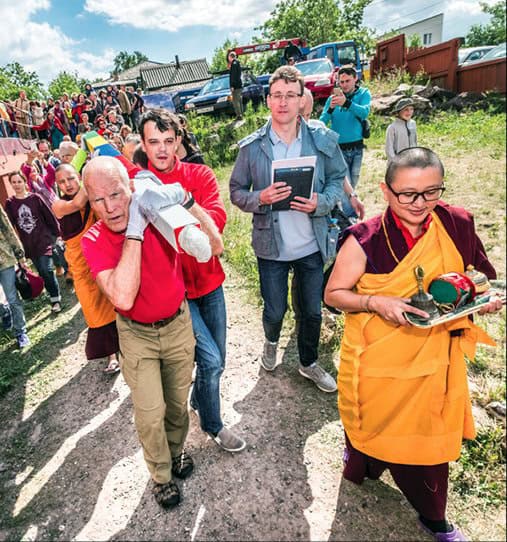
The stupa in Krasnoyarsk is the Enlightenment Stupa. How are the different types of stupas chosen for particular places?
As you say, there are many kinds of stupas. There are the Stupas of the Ordinary Persons, the Stupas of the Disciples, the Stupas of the Self-Enlightened Ones, the Stupas of Mahayana, and the Stupas of Mantrayana. Each has a unique shape and construction. But the Stupa of Enlightenment is the basis of them all, or the main one, because it first arose near the Bodhi Tree, the tree of enlightenment in Bodhgaya where Buddha reached enlightenment. The enlightenment of Buddha opened all other Buddhist paths. Similarly, the Stupa of Enlightenment is a sort of foundation for all other kind of stupas.
Are other stupas, like the Kalachakra Stupa or Stupa of Long Life, chosen because the place has a particular quality, or the people there have a particular quality? What are some signs?
It mostly depends on those who ask to build the stupa: what is their intention and motivation? If a stupa is supposed to be built to prolong somebody’s life, then it’s logically the Stupa of Supreme or Full Victory. If people are interested in the path of tantras and especially in the practice of Kalachakra, then for them a Kalachakra stupa can be built.
Sometimes the reason for building a Kalachakra Stupa is to pacify various doctrines or cults unfriendly to the Buddhist view. A Kalachakra stupa can also be built to pacify different quarrels and conflicts.
What is the benefit of a stupa for our wishes and our practice?
Circumambulating a stupa or prostrating in front of a stupa, cleaning the area around a stupa, cleaning a stupa, and generally taking care of a stupa help one’s wishes to be fulfilled, and benefit our practice.
How does the stupa help our meditation practice?
No matter what type of stupa it is, if you’re meditating in front of it—whether it’s calm abiding meditation (shinay), or insight meditation (lhaktong), or something else—your meditation gets extra power based on the stupa’s blessing. For example, in the case of shinay you will more easily get mind’s stability, and in the case of lhaktong meditation, you will more easily get the realization of the true nature of things.
There is a two-fold process. The first part is called “the man blesses the place” and the second part is called “the place blesses the man.” When you build the stupa, when you fill it up with all the special relics, when you finally consecrate it properly—that is “the man blesses the place.” When the man has charged and blessed the stupa, once it’s properly built and consecrated, then it starts to give the feedback, so to speak. It starts to bless the man. Then when you practice in front of it, if you circumambulate, if you make prostrations or offerings, then you get the blessing from the stupa. That is “the place blesses the man.” This is the two-fold process.
If Rinpoche would be so kind as to tell us how he became a master builder of stupas?
The first stupa I built was in my homeland of Manang, Nepal. It was not exactly a stupa, but rather a long wall on which different mantras and different special Buddhist encryptions were made. And with time, this wall started to deteriorate such that the mantras filling it had nearly fallen out of it onto the road. It was covered a little bit on both sides with earth and sand. I decided to repair it, so I took it down and built it totally new. Near to this place, I also built a three-storied stupa—a special kind of stupa mentioned by Buddha in some sutras.

Then in France in Montchardon, Lama Teunsang invited me to his center there and asked me to build the eight kinds of stupas in a row.
Next was in Kathmandu, near the Swayambhu Stupa, since it is such a precious, sacred place and there are so many people circumambulating the Swayambhu hill. On the route around the foot of this hill, I made a lot of attempts to buy a piece of land in order to build a stupa there, but I couldn’t buy it, so I finally built a stupa there on the government’s land.
The stupa I built there is about twenty-three meters high. Inside this stupa, there is a room in the foundation where the Lion Throne section is. I placed a big mani wheel inside.
Above this room, inside the stupa, there is first the Lion Throne, then there are four steps which symbolize the four immeasurables or four limitless qualities which you can develop yourself. These are four steps that symbolize four qualities. Above this room with the mani wheel, I placed two mandalas which are necessary for every stupa, and then the necessary elements above.
That was the first big stupa built on the circumambulation route around Swayambhu Hill. Now it is nearly full with many stupas and mantra-walls built there.
On the backside of Swayambhu Hill, there are three huge statutes of Buddha Amitabha, Loving Eyes, and Guru Rinpoche. Behind them, I later erected the big storied stupa. Inside this stupa, there is a room in which the wheel of the 100 million Diamond Mind mantras is installed. The walls of the room are covered with more than 500 images of Diamond Mind.
After that I started to build stupas for Lama Ole’s centers in Europe. The first one was in Becske, Hungary.
What is the benefit that Rinpoche sees this stupa will have on Krasnoyarsk and the Siberian region?
It benefits through the above-mentioned four ways of liberation. Information about this event that we had today is spread through the whole of Russia by mass media. Many people will see the stupa, or hear about it, so they will have the seed of liberation through that, whether they’re Buddhist or not, because in fact there are not so many Buddhists here. Mostly they are the followers of other religions. And generally, if such a stupa stays in the area, it decreases sickness and conflicts. Also, the wishes of people here will start to get fulfilled more easily.
Our final question for Rinpoche: We have many retreat centers in the USA, but no retreat center has a stupa, and we have a wish to one day build a stupa. What advice would Rinpoche give to us for preparing to build a stupa?
First you have to get money, second you have to get land, and third you have to get permission from the authorities so you can build the stupa.
Then you can slowly build the stupas. For example, in India or Nepal, once you get the land, then you can build stupas there: big, small, whatever. But in the West, it’s not always the case. Once you get the land, authorities won’t necessarily allow you to build the stupa even on your own land; therefore, permission from the authorities is also very important.
“The outer form of a stupa, from the bottom to the top, symbolize the whole Buddhist path.”