

The first article of this series on the Kagyu lineage mainly provided explanations concerning the roles of the Buddhist practitioners in Tibet and what constitutes a lineage or tradition within Tibetan Buddhism. The second article offered a short overview of the Indian origins and early Tibetan developments of the lineage up to the beginning of the fourteenth century. This third and last article elucidates the essential teachings of the Kagyu lineage, as they are available until today. Of course, in order to become effective, these teachings have to be studied and practiced with an authentic teacher, who is approved by the leaders of the lineage. The contemporary leader is Thaye Dorje, His Holiness the 17th Gyalwa Karmapa. The modern branch of the Karma Kagyu lineage that became known worldwide under the name Diamond Way is guided by Lama Ole Nydahl.
Regarding the content of the transmissions, in terms of Buddha’s teachings we can distinguish between a causal (sutric) approach and a resultant (tantric) approach to awakening. The sutric approach emphasizes the discriminative analysis of the nature of phenomena, in order to achieve the goal of liberation from suffering and ultimately enlightenment. The tantric approach applies direct identification with the qualities inherent in buddha nature on the basis of the Buddhist tantras. Therefore, the focus here lies on the qualities belonging to the nature of mind, such as fearlessness, joy, compassion, and wisdom.

In the Kagyu lineage, there are general representations of the Buddhist philosophical teachings that are equally applicable by all students in all lineages. They often serve as introductory instructions to develop a correct understanding of phenomena and especially of the mind, the underlying awareness of all things. They form a solid foundation for further Buddhist studies. The more specific philosophical teachings, which refer to one or the other tantric practice, build on the general ones. They gradually guide the respective students on their way to deeper levels of understanding, experience, and realization.
The view, which is trained as the background for the practice of the tantras and which is consistent with the qualities of the nature of mind, is called the pure view. It refers to the nature of mind and all phenomena being understood as pure or perfect. Thus, the development of the pure view serves as a training of insight into the buddha nature inherent in all living beings and at the same time as a practical guide for direct alignment with the qualities of enlightenment based on the Buddhist tantras.
As for the content of the Kagyu lineage regarding meditation practice, the Six Teachings of Naropa together with the Great Seal make up its core teachings. Naropa systematized the teachings on inner energies contained in several tantras as the so-called Six Teachings of Naropa (Tib. Naro Chö Drug). These six teachings comprise the following:
- Illusory Body (Tib. Gyulü),
- Dream (Tib. Milam),
- Clear Light (Tib. Ӧsal),
- Inner Heat (Tib. Tummo),
- Intermediate State (Tib. Bardo), and
- Transference of Consciousness (Tib. Phowa).
When distinguishing the two main phases of tantric practice, the development phase (Tib. kyerim) and the dissolving or completion phase (Tib. dzogrim), technically the Six Teachings of Naropa belong to the completion phase.
Other schools of Tibetan Buddhism also practice both teachings to a certain degree, the Six Teachings of Naropa and the Great Seal. For example, the Nyingma lineage also transmitted several of the teachings on inner energy, such as the Transference of Consciousness, and they still are taught quite openly. There also exists a Gelug/Kagyu tradition of the Six Teachings of Naropa, taught by Tsongkhapa (1357–1419), the founder of the Gelug lineage. The first Panchen Lama, Lobsang Chokyi Gyaltsen (1570–1662), mainly formulated a Gelug/Kagyu tradition of Mahamudra. However, the Kagyu lineage, unlike the other lineages, applies the Six Teachings and the Great Seal as its essential meditation practices.
In Herbert von Günther’s translation of and commentary on the life and teachings of Naropa, we find a seventh practice called Reawakening or Resurrection (Tib. Drong Jug), meaning to endow a corpse with life by transferring one’s consciousness into it. Most Kagyu teachers are said to treat the Transference of Consciousness and Resurrection as a single topic and add the Intermediate State as the sixth practice. Although the application of this practice officially ended with Marpa’s son Dodepa, in fact it was unofficially performed at later times also. For example, in his verse autobiography, the 3rd Karmapa alluded to his impeded application of this practice in the intermediate state before his birth at Dingri. In his Golden Garland of the Kagyu Lineage, he also mentioned this practice as counted by others among the transmissions received from Naropa: “Again others also speak about Illusory Body, Dream, Clear Light, Transference of Consciousness, Intermediate State, Resurrection, Inner Heat, and Great Seal.”
The Great Seal (Skt. Mahamudra, Tib. Chag Gya Chenpo) is considered the highest teaching in all Kagyu schools. Similar to the highest level of the Nyingma practice called the Great Perfection (Skt. Mahasandhi, Tib. Dzogpa Chenpo), the emphasis lies on a direct experience of the clear light nature of mind or awareness. At the end of the Marpa Kagyu section in the Blue Annals, Gö Lotsawa states with regard to the name of the Kagyu lineage: “Thus, this sub-sect known as Pal Dhagpo Kagyu does not represent the Lineage of the Word, but represents that of the Meaning (don). (The word) ‘meaning’ means here the ‘lineage of understanding of the immaculate “Great Seal” (Mahamudra).'” This quote makes it easy to assess the central role of these teachings in the Kagyu lineage.
According to tradition, the Great Seal is presented in relation to the three aspects of basis, path, and result. The basis is the awareness of the buddha nature and the pure view mentioned above, which focuses on the enlightened qualities inherent in the nature of mind. Path means the application of the methods related to the practice of the Great Seal. Based on the development of mental stability (Tib. shinay) and higher or deeper insight (Tib. lhaktong), an experienced teacher (Tib. lama) is able to introduce the student directly to the nature of mind. This experience must then be cultivated until full realization. The result is described as freedom from all disturbing feelings and conceptual obscurations, the manifestation of the primordial wisdom with respect to all phenomena.
Regarding the methods applied, two approaches have to be distinguished. The first is mainly based on the practice of the Buddhist tantras; the second is based on the sutras. Gö Lotsawa Shönnu Pal explained this distinction briefly in his Blue Annals:
The understanding of the “Great Seal” (Mahamudra) should be regarded as corresponding to the final or dissolving phase of meditation (sampannakrama, dzogrim). For it was during the time of Lord Marpa and Venerable Mila that the wisdom of the “Inner Heat” (tummo yeshes) and through it the understanding of the “Great Seal” (Mahamudra) was first generated. Dhagpo Rinpoche (Gampopa) produced an understanding of the “Great Seal” (Mahamudra) in those beginners (adikarmikas, le dangpopa) who had not received empowerment. This is the system of the Perfection of Wisdom (Prajnaparamita).
In the section following this quote, Gö Lotsawa based this distinction on several Indian and Tibetan sources. In this way, he finally refuted the criticism of Sakya Pandita, who, according to Gö Lotsawa, claimed that the knowledge of the Great Seal is exclusively knowledge born from an empowerment.
There has been a considerable amount of discussion on the Great Seal as taught by Gampopa. According to his Collected Works, Gampopa not only taught the aforementioned two levels of Sutra and Tantra Mahamudra but also a third level called Essence Mahamudra, or the Essential Path (Tib. Nyingpoi Lam), said to be an extremely quick path, especially for students of highest capacity. Therefore, the debate focused on the simultaneist (Tib. chig char wa) and gradualist (Tib. rim gyi pa) approaches in the Great Seal of the Kagyupas.
According to Klaus-Dieter Mathes, Gö Lotsawa tried to show that two controversial currents within Kagyu Mahamudra, namely the ones later classified as sutra-based Mahamudra and Essence Mahamudra, stem from Indian traditions and are not Chinese Chan Buddhism in disguise, a charge mainly leveled by the Sakyapas.
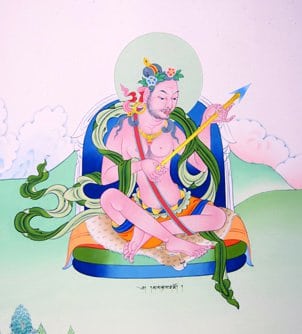
Dagrampa Chogyal Tenpa (1449–1524), one of the main students of the 7th Karmapa, Chodrag Gyatso (1454–1506), provided an elaborate discussion of this topic. He composed one of the most comprehensive commentaries on the Deep Inner Meaning (Tib. Zabmo Nang Gi Don) by the 3rd Karmapa. The title of the sixth chapter within the main part of his treatise is The Sixth Section Explaining the Connection of the Basis, Path and Fruit of Consciousness and Primordial Wisdom. In this context, the author in detail expounded on the Mahamudra view and practice in the Kagyu lineage. In addition to showing the identity of the topics of Mahamudra and Consciousness and Wisdom, he presented a wealth of reasoning and quotations from scriptures in order to support the Kagyu view as propounded by Gampopa and other earlier masters.
In order to complete this brief overview, it must be mentioned that according to the prominent and learned teacher of the Kagyu tradition, the late Kunzig Shamar Rinpoche (1952–2014), Gampopa very skillfully passed on the Great Seal teachings. He used the term Great Seal, specifically designating the resultant wisdom of the Great Seal (Tib. Chag Chen Gyi Yeshe), in general related to the tantras, as a title for the instructions on the path (pointing-out instructions, Tib. ngo tro pa). Gampopa and his students showed a similar shift of emphasis in the use of the term co-emergent practice (Tib. lenchig kye djor) instead of co-emergent wisdom (Tib. lenchig kyepe yeshe). His essential teachings, Introduction to the Conceptualization as the Absolute (Tib. Namtog Dondam Gyi Ngotro), also reflected this approach.
Another way of expressing the same teaching is to “consider thoughts as the truth state” (Skt. Dharmakaya). Pengar Jampal Sangpo (15th–16th century) has formulated this in his Supplication to the Dhagpo Kagyu (Tib. Dorje Chang Thungma): “As it is said, the essence of thoughts is the truth state – namtog ngowo chökur sungpa shin.” According to Dhagpo Tashi Namgyal (1512–1587), this instruction refers to “an awareness of certainty with respect to the co-emergence of thought patterns and their intrinsic emptiness.” These types of instructions, mainly provided by Gampopa, became the starting point for many discussions among scholars of various lineages throughout the centuries. It was on this background that the 3rd Karmapa composed his extremely influential Great Seal Wishes (Tib. Chagchen Monlam) and other Mahamudra treatises.
Conclusion
The Kagyu lineage practices and passes on a large part of the Old Transmission (Tib. Nyingma) as well as the New Transmissions (Tib. Sarma), which primarily Marpa the Translator brought to Tibet in the Kagyu tradition. In terms of the central practice, besides the path of methods, the Six Teachings of Naropa, and the path of liberation, the Great Seal, especially the meditation on the teacher (Skt. guru yoga, Tib. lame naljor) functions as a shortcut to enlightenment. Here there exists a meditation on almost every master in the long history of the lineage.
Today, the guru yoga on the 16th Karmapa Rangjung Rigpe Dorje (1924–1981) is the most widely used meditation in the Kagyu lineage worldwide. In this meditation practice, the development phase, in which Karmapa’s form is called to mind and his mantra is recited, unites all forms of practice concerning the inner energies (the path of methods), while the melting or completion phase of this meditation includes all forms of practice involving awareness or insight (the path of liberation). According to Tilopa, the development of openness or devotion towards the authentic teacher, who in the Diamond Way is seen as a buddha, is the ultimate path to realize the nature of one’s own mind and thus attain enlightenment in a single lifetime.
Selected Sources
Dwags rams pa Chos rgyal bstan pa (1449–1524) (1977). Zab mo nang don gyi ‘grel bshad. A detailed exegesis of the famed treatise on the anuttaratantra and its practice, the Zab mo nang don, by the Third Karmapa Rangjung Dorje. New Delhi: Karmapae Chodhey.
Jackson, David P. (1994), Enlightenment by a Single Means: Tibetan Controversies on the “Self-Sufficient White Remedy” (dkar po chig thub). Wien: Österreichische Akademie der Wissenschaften. Beiträge zur Kultur- und Geistesgeschichte Asiens 12.
Mathes, Klaus-Dieter (2006), “Blending the Sutras with the Tantras: The Influence of Maitripa and his Circle on the Formation of Sutra Mahamudra in the Kagyu Schools.” In: Buddhist Literature and Praxis: Studies in its Formative Period 900–1400. Ed. by Davidson and Wedemeyer. Leiden: Brill, pp. 201–227.
Namgyal, Dakpo Tashi, transl. by Lobsang P. Lhalungpa (1986), Mahamudra: The Quintessence of Mind and Meditation. Boston: Shambhala Publications.
Nydahl, Lama Ole (2004), The Great Seal, Limitless Space & Joy: The Mahamudra View of Diamond Way Buddhism. San Francisco: Fire Wheel Publications.
Panchen Lama, Lobsang Chokyi Gyaltsen (1570–1662), (1975), The Great Seal of Voidness: The Root Text of the Gelug/Kagyu Tradition of Mahamudra (Geden kagyu rinpoche chagchen tsawa gyalwe shung lam), with Commentary by Geshe Ngawang Dhargyey. Dharamsala, India: Library of Tibetan Works & Archives.


