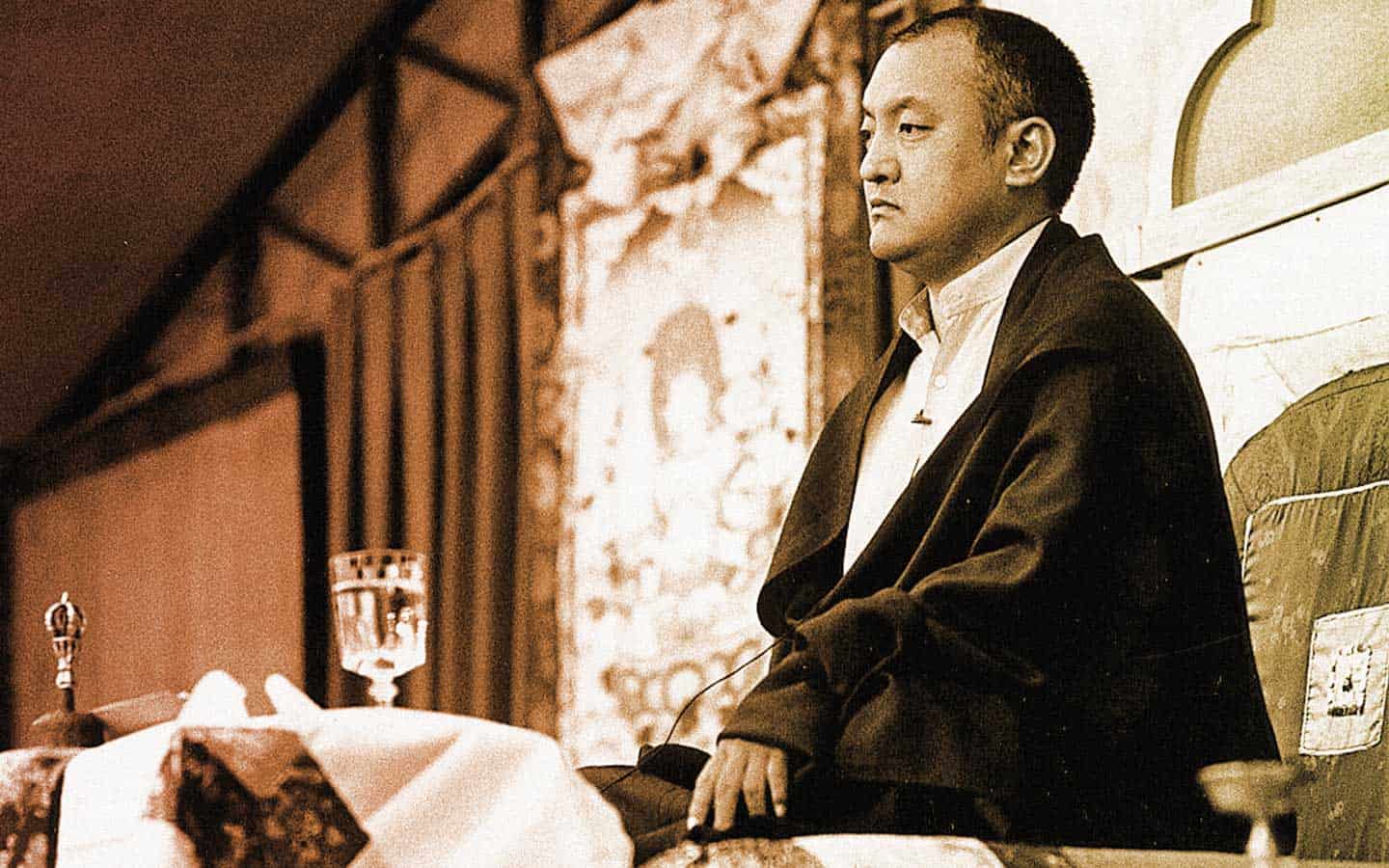
Kunzig Shamar Rinpoche had just finished giving a course during the first weekend of June, with over four hundred participants, when, on June 11, 2014, sitting at breakfast in the Bodhi Path Center in Renchen-Ulm, he suffered a heart attack. Doctors were immediately called but could not do anything for him.
Following his death, Rinpoche remained for a little more than two days in the thugdam, a meditation state that highly realized masters enter after they die. One sign of this is that the body sitting in meditation posture stays warm, especially in the region of the heart center. The ability to maintain this state is a sign of the full experience of the true nature of mind, of the buddha state. Shamar Rinpoche’s leaving the thugdam state on June 13, 2014, is an auspicious sign. This year one of the highest Buddhist holidays—in Tibetan called saga dawa düchen—fell on this day. This is also the date dedicated both to Buddha’s enlightenment and his parinirvana (his death).
It is clear that Shamar Rinpoche had foreseen his death and had been making specific preparations in advance. He had even astonished a lama in Shar Minub, the large monastery complex that Rinpoche built and established in recent years as his headquarters (sharminub.org) at the foot of the Nagarjuna Hills on the edge of Kathmandu. Rinpoche told this lama—without providing a reason—that the Karmapa would come to Nepal, including Shar Minub, for the first time at the end of July. He instructed the lama to buy a decent bed for Karmapa. An hour and a half before his death, Shamar Rinpoche called the lama and confirmed that the bed, of which Shamar Rinpoche had received a photo by email, should be purchased. Rinpoche spent the last evening before he died with a small circle of friends and told them that this would be his last dinner.
After he died, Shamar Rinpoche’s body lay in state in the mortuary of the Renchen cemetery, near the main center of his organization, Bodhi Path. Over nine days, various lamas conducted ceremonies that are customary during the first forty-nine days after the death of such a great master. Amitabha rituals, in particular, were conducted because Rinpoche was the emanation of the Buddha of Limitless Light (Skt. Buddha Amitabha).
During this time it was possible for Rinpoche’s students to visit the mortuary and to say goodbye to their teacher. Thousands of people came to Renchen. Special signs manifested in the sky, including unusual cloud formations and circular rainbows around the sun—all signs that typically happen when an enlightened being dies.
The 17th Gyalwa Karmapa Trinley Thaye Dorje came to Renchen in order to accompany the body of his main teacher back to Asia. Karmapa spent several days there meditating next to the body of Shamar Rinpoche in the mortuary and conducting the rituals. Members of various organizations of the Karma Kagyu lineage, including Bodhi Path, Diamond Way, Dhagpo Kagyu and others, worked together organizing this event. On this sad occasion, such collaboration and cooperation demonstrated mutual trust and the wish to stand together as the Karma Kagyu family. All worked swiftly to rent a hall within walking distance of the mortuary and to arrange a two-day program that featured lectures about Shamar Rinpoche, guided meditations, and video presentations of Rinpoche’s lectures.
On June 19, the 17th Gyalwa Karmapa led the funeral procession from the Renchen cemetery. He walked in front of the hearse carrying the casket of Shamar Rinpoche with Shamarpa’s brother, Jigme Rinpoche, walking behind. Hundreds of mourners lined the streets of this small town.
On June 22, Rinpoche’s body arrived at the Karmapa International Buddhist Institute (KIBI) in New Delhi. Gyalwa Karmapa again led the funeral procession. Jamgön Kongtrul Rinpoche, Beru Khyentse Rinpoche, Sherab Gyaltsen Rinpoche, and many other rinpoches received him. Karmapa led the ceremonies until July 1, giving Shamarpa’s students the opportunity to say goodbye.
On July 1 Gyalwa Karmapa accompanied Shamar Rinpoche’s body—the kudung, as the Tibetans respectfully call the corpse of a great master—from New Delhi to northern India. In a convoy of forty cars, he was carried from the Bagdogra airport near Siliguri to Kalimpong. The streets were lined with thousands of people bidding farewell to Shamarpa. Rinpoche lay in state in the Shri Diwakar Vihara Buddhist Research and Educational Institute, which he had established and where the 17th Karmapa and other rinpoches conducted daily ceremonies.
Many students from this region, as well as from Bhutan, Nepal, and other Asian countries, came every day to say goodbye to Shamar Rinpoche. Delegations from monasteries of other lineages, such as from the Nyingma monastery Sangdog Pelri in Kalimpong, also paid Rinpoche their last respects. In the evenings, a candlelight procession often made its way around the shedra, the Buddhist name for university. Visitors included members of the Bhutanese royal house, reflecting the long-time close connection between the royal house and the shamarpas and the karmapas since the second king of Bhutan. Also, Chökyi Nyima Rinpoche, head of the large monastery Ka-Nying-Shedrub Ling at the Bodhnath Stupa in Kathmandu and a son of Urgyen Rinpoche, visited the 17th Karmapa on July 9.
In the first days of July, Gyalwa Karmapa delivered a video message to his and to Rinpoche’s students honoring the passing of their great teacher. (See inside front cover.)
The planned July 13 transport of the kudung to Kathmandu—where the cremation had been set for July 31 in Shar Minub—was postponed. There were reports in the media that Nepal had withdrawn permission for the cremation because of pressure from China. In response, on July 15, the international Diamond Way Buddhism Foundation, the Bodhi Path centers, and the Dhagpo Kagyu Ling centers wrote a joint letter to the Nepalese prime minister. They explained the situation to him, reminded him of the close connection that the shamarpas have with Nepal, and asked him to reconsider the withdrawal of the permit. In a further appeal to the prime minister, an online petition gathered 13,000 signatures worldwide within a few days.
Meanwhile, daily rituals were performed in Shar Minub by Chökyi Nyima Rinpoche, his brother Tsikey Chokling Rinpoche and others, with the hope for approval from the Nepalese government.
On July 27 Rinpoche’s kudung was flown to Bhutan for two days in order to give his students there the chance to say goodbye. For two days he lay in state in the royal palace Ugyen Pelri in the Paro valley. Many people came to pay their respects. On July 28 the king of Bhutan, His Majesty Jigme Khesar Namgyel Wangchuck, and his wife prayed before Rinpoche’s body. Throughout these days, one repeatedly saw awe-inspiring, beautiful rainbows over the palace.
Finally, on July 28, the good news of the approval for the cremation in Kathmandu arrived. On July 29, Gyalwa Karmapa traveled to New Delhi and KIBI. The body of his teacher was flown to Kathmandu.
After landing in Kathmandu, the kudung was driven past the Boudhanath and Swayambhu stupas to Shar Minub in a procession that included many of Shamarpa’s students, high lamas and rinpoches. He lay in state there so that his students could say goodbye.
Last rites were performed in Shar Minub until the day of cremation on July 31—again, one of the big Buddhist holidays. This is the day when one celebrates Buddha’s “turning the wheel of dharma,” i.e. when he gave to beings the teachings of liberation and enlightenment.
On the day before the cremation, Karmapa addressed his students via an internet recording from New Delhi. Then he traveled to Kathmandu in order to lead the cremation ceremony (see the message below).
All can find comfort and motivation in Shamar Rinpoche’s final lecture when he said: “You do not need to be afraid of death if you know how to practice in death.”