Question: You are working on research about meditation. Can you tell us why science is interested in research about meditation?
There are several reasons for the growing scientific interest in meditation. First of all, research increasingly shows that different therapeutic programs that integrate a meditation component are very successful in improving the situation of patients or clients. First and foremost, we should mention here the mindfulness1-based stress reduction (MBSR)2 program, which has proven to be effective in many situations, in particular when people suffer from chronic conditions such as chronic pain, stress, or anxiety. Based on the MBSR program, which was developed by Jon Kabat-Zinn in the US, colleagues in the UK developed mindfulness-based cognitive therapy (MBCT) by combining the central components of MBSR with cognitive therapy. This approach turned out to be very effective in treating patients with recurring depression and has become a recommended treatment within the British healthcare system. Initially, these programs primarily used mindfulness meditations, but more recently, practices that aim at fostering loving kindness and compassion—first for oneself and then expanding to also include others—are being integrated.
The second reason why science gets interested in meditation research relates to the fact that experienced meditators tend to have more insight and control over their states of mind, making them very useful when investigating the link between brain function and mental states. Here, the whole field of “neurophenomenology”3, that was established by Francisco Varela, can benefit. The hope is that new insights into the relationship between brain and mind states will emerge when highly specialized measurement technology is combined with highly developed introspective insights into the functioning of mind.
Finally, a third reason is that psychologists and neuroscientists view meditation as a special type of mental training or exercise. Currently, researchers focus primarily on studying attention and related cognitive functions. Here, the interest mainly concerns the question of whether there is something special or different in training attention by means of meditation rather than other training methods and how this is reflected in the brain. Increasingly, the interest expands to also include the question of how emotional processes are influenced by the training.
I think it is quite obvious that these three research questions, although different, are strongly interrelated, and results gained in one area will contribute to understanding in other areas, too. In some cases, several of these questions are also combined in a single study.
Since when and in which institutes has research on meditation been happening? And what kind of research do they do? What are the subjects or methods?
With the exception of a few rare earlier studies, one can probably say that modern research into meditation started around the time of the new millennium, not much more than ten to fifteen years ago. In 2003 a landmark publication came out, which showed that eight weeks of mindfulness meditation changes relevant brain activity and even leads to improved responsiveness of the immune system. Since then, we have seen an exponential increase in published research on meditation.
There are quite a few research centers investigating one or the other of the research questions I outlined above. It is now happening all over the world, and it would be difficult to list them all or single out specific groups or centers. This field of study is currently very dynamic, and new groups are appearing everywhere. The one group certainly worth watching is the Center for Brain and Mind at the University of California, Davis. I just returned from a research visit there. They are running the most comprehensive long-term meditation study currently underway. Called the Shamatha Project, these researchers aim to study changes in many different life domains due to intensive meditation practice.
By addressing the research questions I outlined, one can, for instance, investigate whether a certain mindfulness program has advantages over other forms of treatment for a certain health condition. For this, colleagues use well-established standardized research protocols that are also used in medical or psychotherapeutic research. This is important work and really benefits patients, but in itself, it does not tell us clearly enough whether meditation is effective per se since all the programs that are being investigated include components other than meditation practice, and without dismantling these different components, it is not possible to say if the observed improvements result from the meditation practice or something else.
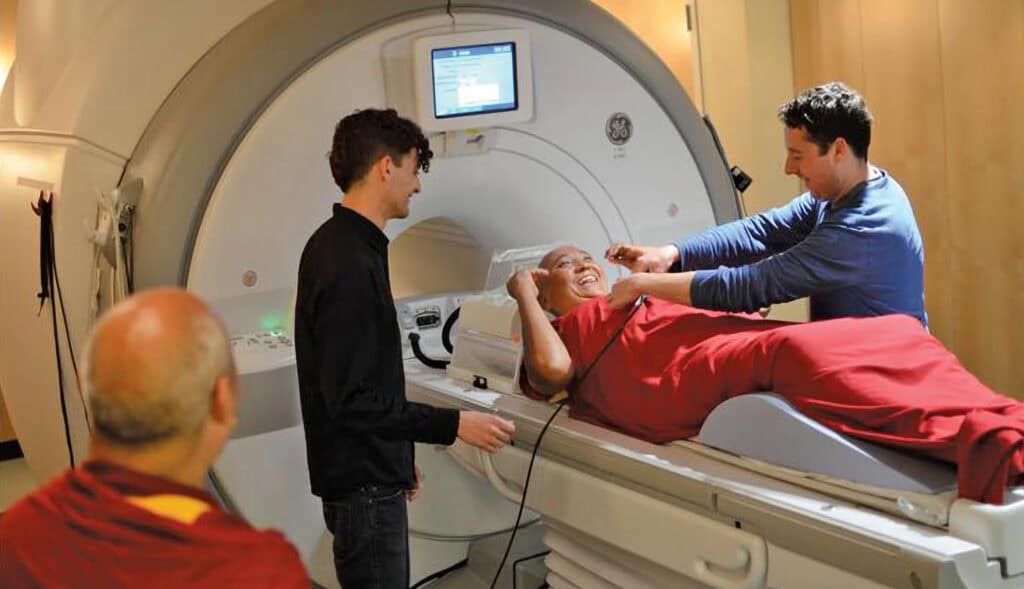
When one is more interested in meditation itself, one either investigates what happens while somebody meditates or studies the lasting effects that result from regular meditation practice, also outside of formal meditation practice. For both questions, the full arsenal of tools from psychology and human neuroscience is at our disposal—and they are all being used. This ranges from measuring improvements on various tests of cognitive performance, such as concentration or memory, to emotionally challenging tasks, tests of perceptual abilities; you name it! At the same time, one may measure brain activity directly by recording the electrical activity on the scalp with a method called electroencephalography or, more indirectly, by measuring local changes in blood flow in the brain that is related to changes in brain activity in specific brain areas using a method called functional magnetic resonance imaging or fMRI. Finally, it is also of interest to study changes to the brain structure that may result from meditation practice by means of structural MRI. An exciting, new application of that method is called diffusion tensor imaging, which focuses on imaging the neural interconnections in the brain. Because the functioning of the brain depends on these interconnections and they change as a result of practice and experience, this is a promising novel approach which is likely to yield important new insights.
What are the most evident results so far?
We have to be very careful with explaining the results. This research is still in its infancy and we are certainly not at a point where we could say much that is definitive. It is also important to be aware that we cannot make any general statements about what meditation does to us. There are so many different forms and types of meditation, and these will need to be distinguished and studied one by one.
What we can probably say with a certain degree of confidence is that Buddhist meditation practices—or those derived from it such as modern mindfulness meditations—improve attention. It has been shown in several ways that the ability to maintain the focus of attention over longer periods of time is improved, that the ability to control one’s automatic responses is improved, and that meditators are less prone to distraction. It also looks as if meditation may lead to reduced emotional reactivity, meaning that as a result of regular meditation practice, people are less caught up in their emotional states and experience more inner flexibility. We see such improvements as changes in performance tests but also on the level of brain activity and, very likely, even as changes in brain structure.
How could the research on meditation be of interest to a Western individual?
I think in the West, quite a few people are still skeptical regarding meditation and consider it to be something exotic that does not fit to our modern way of life. Some may also keep their distance because they don’t have much trust in the religions they have encountered. I think that with the research into meditation, we will be able to show that many tangible benefits can result from it, that one can use it without being religious, and that, in the end, meditation is just a smart way of working with one’s own mind and of improving one’s mental and emotional capacities. Meanwhile, we all accept that we have to exercise our body to stay fit and healthy. Hopefully, it will slowly sink in that meditation is a very smart way—if not the smartest way—of exercising our mind and unraveling its full capacity.
How can a lay Buddhist benefit from this research?
I have to say that personally, for my own meditation practice or my confidence in the benefits of meditation, this research does not add anything important. The evidence that our meditation really works comes from observing how my own mind responds in different situations and, even more importantly, from observing how the many friends who have gotten involved in meditation practices have brought benefit to themselves and then shared this with others. Also, seeing the abilities of great meditation masters removes every doubt. These observations are most convincing, and I don’t require any additional scientific evidence to be convinced.
However, it is encouraging that scientific evidence is starting to support such observations. Although, personally, we may not need additional evidence, I think it is good to have some awareness of what science has to say. I am quite convinced that more and more people find their way to meditation centers because of the growing scientific evidence. When these people appear in our centers, we will know where they are coming from and will thus be able to help and direct them in a more rounded way.
In short, I think the exciting developments in meditation research will open more and more doors for people to work in an effective way with their minds, find more inner strength and independence, and bring more of their potential into the world. It is a real honor to be part of this process.
- Mindfulness (online Oxford Dictionary): noun 1) the quality or state of being conscious or aware of something: their mindfulness of the wider cinematic tradition. 2a) mental state achieved by focusing one’s awareness on the present moment while calmly acknowledging and accepting one’s feelings, thoughts, and bodily sensations, used as a therapeutic technique. ↩︎
- Mindfulness-Based Stress Reduction (MBSR) (Wikipedia): is a structured complementary medicine program devised by Jon Kabat-Zinn that uses mindfulness to help people cope better and be more at ease in their life. It is thought to be effective for treating a variety of ailments, including alleviating pain and improving physical and emotional well-being for individuals suffering from a variety of diseases and disorders. While mindfulness has its roots in Buddhist teachings, the program itself is not spiritually based. Those who practice MBSR range in age, health, and beliefs, and it is made clear that anyone can practice the psychological principles of mindfulness. ↩︎
- Neurophenomenology (Wikipedia): refers to a scientific research program aimed to address the hard problem of consciousness in a pragmatic way. It combines neuroscience with phenomenology in order to study experience, mind, and consciousness with an emphasis on the embodied condition of the human mind. ↩︎
Photo credit: Bryce Johnson / Science for Monks