

Editor’s Note: Interview conducted for Buddhism Today by Jonathan Bradley, November 2009.
You’ve said often that during historical times religion has created more death than politics. Many would agree with that statement. In Diamond Way Buddhism, a great deal of emphasis is placed on devotion to the teacher or lama. From your point of view as a Diamond Way lama, how is this devotion correctly understood?
Well, devotion should actually be the wish to take over certain qualities that are considered meaningful and are shown convincingly by a teacher. This is exactly what makes the feeling so volatile, because if one is a bad person one will feel attracted to bad teachers and identify with their bad qualities. As a result we have holy wars, suppressed women and negative stuff like that.
On the other hand if one is open to a good teacher this is helpful and positive. From a living human example one can most completely take over valuable traits and behavior and thus directly become better able to benefit both others and oneself. It’s really a question of whether the object of one’s devotion is positive or harmful. In Buddhism, with its goal of liberation and enlightenment, teachers with a harmful motivation have always been the great exception. Also when teachers have been rough with their students it was not to take advantage of them for the teacher’s benefit, but to bring them through certain steps of their development very quickly. This is what Marpa did with Milarepa, and to a certain degree also Tilopa with Naropa. If one ever hears of personal pressure being used in closed groups today, it only works if the guru’s mind doesn’t change any more.
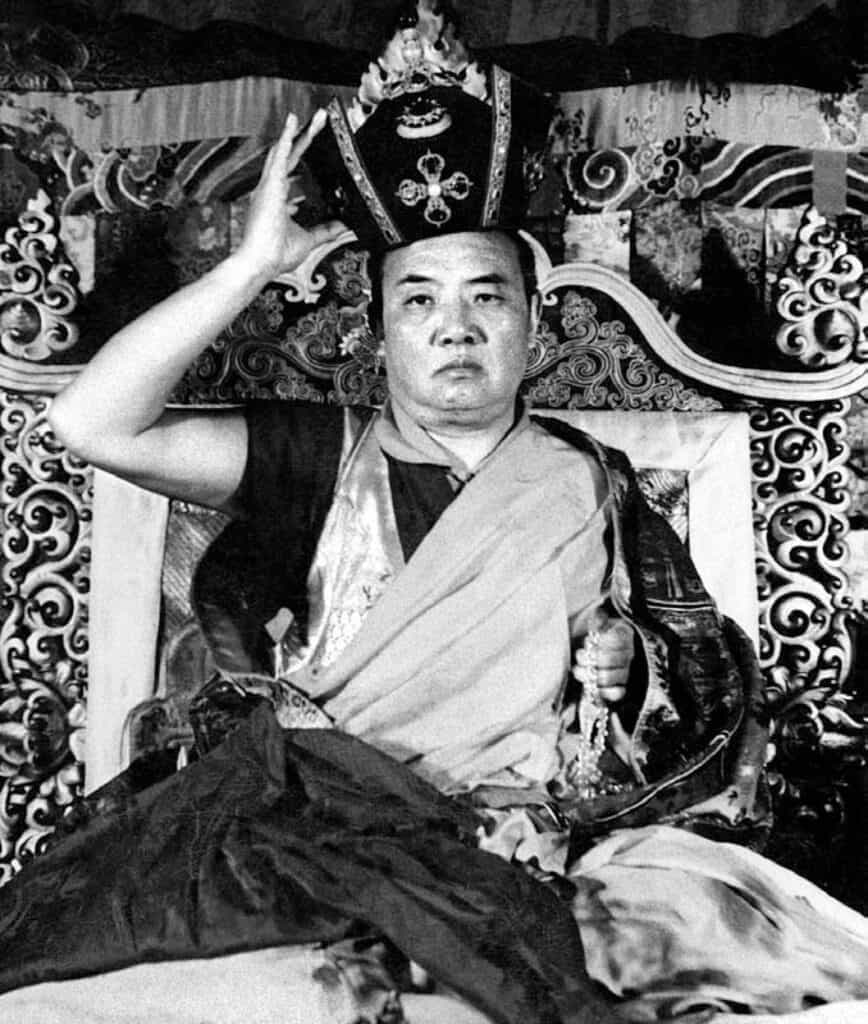
So here I would say that healthy feelings of devotion as we know them—as long as politics are not involved and situations remain transparent—do not need to be blocked. As it is really a question of identifying with fine human qualities, it has a positive effect as long as the teacher’s goal is to make their students independent and there is no pressure to make them cogs in their organization. The moment that devotion is used for control, personal enrichment or egotistical goals, however, this should be exposed. Using others is a temptation that as far as I know—I hope anyway—our Diamond Way Karma Kagyu school of Buddhism is too transparent for teachers to even try.
Healthy devotion occurs when one meets a trusted connection from a former life or finds something that corresponds to one’s deepest tendencies and clearly and positively reflects them, like when seeing one’s face in a mirror. We are inspired by kinds of communication and activity that we feel to be an enrichment for human beings and which would make us more convincing and useful to others. In turn others come to consider us as valid examples and feel good about taking over our qualities. Thus it is actually a hand-me-down system, which in our case started with the Buddha’s full enlightenment 2,450 years ago.
You’ve said in the past that in old Tibet they used to have ways to check the teacher, and that there was a system in place where they could do that fairly effectively.
First, a teacher should have a lineage based on an unbroken transmission of Buddha’s teachings. Secondly, as some Tibetans say, or said, “First the teacher checks the student for three years and then the student checks the teacher for three years and if they can agree, the exchange starts.” So after six years, you suddenly discover devotion? (Ole laughs.) Of course this is just a figure of speech, because from the moment you start checking the teacher, you are already learning, right? So, it’s not such a meaningful statement really, but a useful reminder for students to examine well and to not lose their critical senses. The teacher is the professional and it is his job and responsibility to see if the student fits, if he will essentially waste his time and get frustrated, or enter our groups like a skydiver, deeply at home in the radiant space we offer. If people appear wanting to have it all and now, I have to cool them, but I’m glad.

During the first meetings in the late-sixties—like probably all others—my wife Hannah and I were flashed out by the Big Men, first some Hindu gurus and then the rinpoches and lamas we met. They show one what is possible. Today, after 40 years on the Way and with massive responsibilities for Diamond Way Western Buddhism, I look first at the energy field around other teachers: the groups they make, how they behave, what kind of people go there, if I would steal horses with them, if they talk behind or about each other and not to each other, if the men look like men and the women like women, if there are heavily defined hierarchies, a lot of taboos, and stuff like that. Personally, I would not take mind-teachings from somebody with boring students. On the other hand, if the feeling is easy, there is a healthy exchange between the sexes, a robust sense of humor and no whispering in the corners, I would consider this group both valuable and meaningful because apparently there people find qualities of openness that are needed to uplift one’s life and make our years here rich and wonderful. So today I judge the tree by its fruits, because it really is the lama’s—or guru’s—field of accomplishment which we feel in the people who stay around them. It is their fearlessness, joy and unsentimental compassion which makes people free, while a feeling of immature imitation and submission in a group deeply embarrasses well-meaning people. The teacher radiates the essence of his transmission, and what he received from his teachers is what he passes on. One thus learns much about the teacher from his organization and students.
Even fifty years later in the West today, the four lineages attract the same human types as in Tibet.
Nothing works more deeply than full human contact within the inspired space of somebody who has a beyond-personal state of mind.
Why do you think that the 16th Karmapa emphasized guru yoga practice for our world when so many things have happened in the past?
Well, he emphasized it for the people who would become his students. It’s not for everybody. There are people who just don’t have that feeling for human perfection. They think one must be dead or nearly so to be holy. Holy, however, comes from whole or fully functioning and in the same way you would not discuss a rainbow with somebody who is color-blind, the Buddhist yogi-ideal is not something that inspires all people. But if one notices that certain students can develop well by going beyond their habitual boundaries, this is a very quick way and should be used when relevant, like occasional tandem- or bungee-jumps. Nothing transforms one’s character more quickly than identification. And nothing works more deeply than full human contact within the inspired space of somebody who has a beyond-personal state of mind.
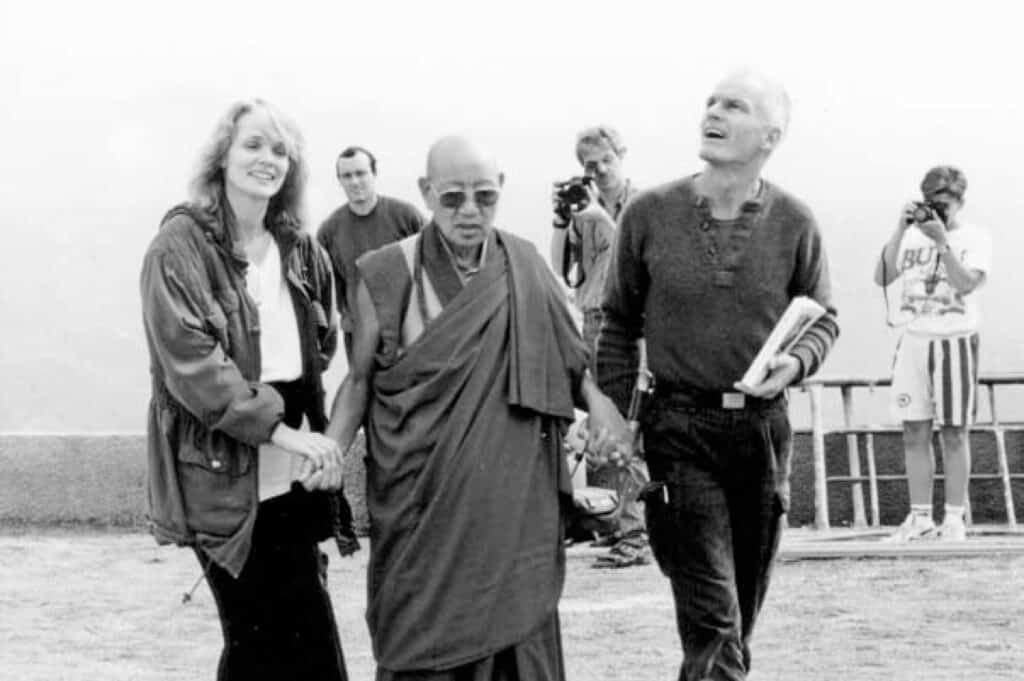
You see, the problem with devotion is often not so much on the student’s side—though there are many who have this. Usually, it is more difficult for the teachers to keep the style and be examples in all that they do, right? Here the secluded life of a monk is actually a major protection from constant observation, but I would like to tell about the student’s situation first. There are certain things he should check about the teacher quickly to see if—and on which level—he wants to learn. Will he now benefit from a period of contact on the intellectual Great Way level? Or should he/she try for a total meeting and full exchange by finding and identifying with one of the few teachers on the Diamond Way? If the latter opportunity is possible, checking the three following points is always essential: Is the teacher fearless? Is he (or she) naturally joyful? And are they actively compassionate, meaning do they work hard for others? These are the three qualities which prove one’s realization of mind. Whoever recognizes that which is between the thoughts, behind the thoughts, which knows the thoughts— the mirror behind the pictures and the ocean underneath the waves—will naturally become fearless as the awareness dawns that space is indestructible and cannot be harmed.
This fearlessness is the main liberating and enlightening insight, which the Buddha and your teacher representing him today are supposed to share with all. If that fearlessness isn’t there, the second choice for the student would be to share in the teacher’s treasurehouse of conceptual instructions. On the Diamond Way level the unshakeable fearlessness and trust which I enjoyed in many of my old meditation teachers from Tibet and Bhutan since 1968, and which is being recognized by my Western students today, is a result of their practice during former lives. Fearlessness expresses mind’s essential quality, its truth-state. From the certitude that mind, being space, is always and everywhere, joy will appear due to mind’s richness, potential and free play. Then we become kind because from this viewpoint it is evident that all beings want happiness, and because others are so many and we are just one, doing something for them is thus much more important than just doing for ourselves. These absolute qualities (fearlessness, joy, and active compassion), starting with fearlessness, are the ultimate goal, and, of course, one must help others discover that these absolute feelings are also their own.
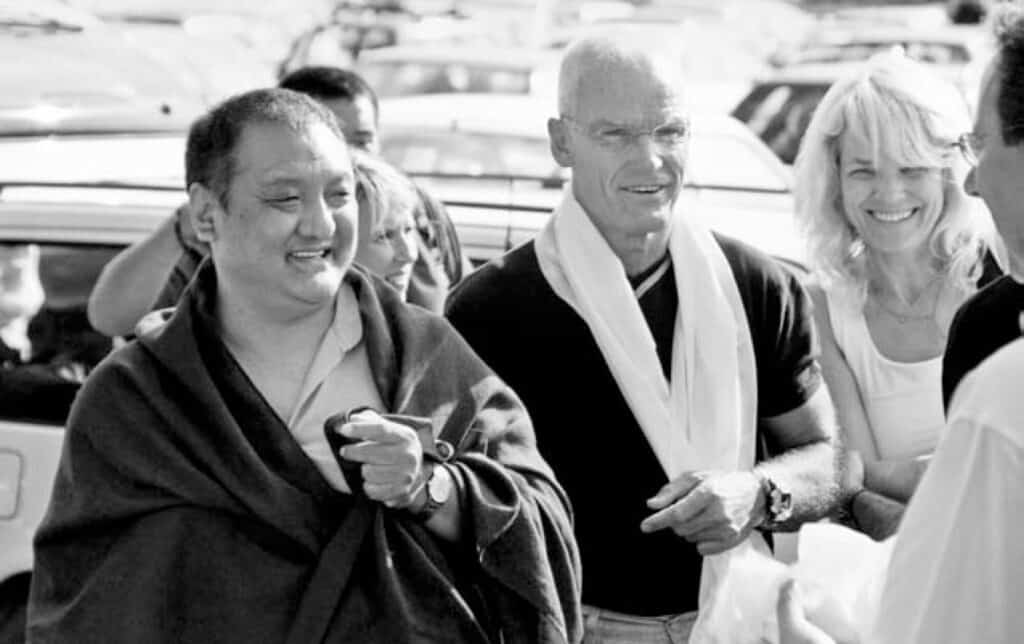
But back to your question, the quality of the teacher you choose. In the world today, I would be exceedingly wary of teachers who are irresponsible or cowardly by not keeping a critical view of religions. Spiritual people today have a duty to inform themselves of what happens around the world and make others aware if religions do not conform to our humane Western constitutions, ideals and freedoms. I know this will grate on many North American ears but whoever today muddies the waters with the platitude that religions “are all the same” puts democratic societies in grave danger and the effects of this only grow. While our informed citizens hold their heads in their hands, most European politicians today allow the historical freedoms of their societies to be whittled away by continuous pressure from a medieval, fanatical religion whose stated focus is to take over the world.
So why can Buddhists point this out so well? Because we don’t fall into the either/or, good/bad absolutes. Our teaching is that evil comes from ignorance—which can be removed—and that all beings have buddha nature. Therefore we should of course be critical, but also constructive. Certain kinds of behavior are useful on our way towards developing compassion and wisdom, ultimately realizing that space is bliss, while other actions are totally detrimental and directly opposed to anything wholesome. We can be critical like this without strong disturbing feelings because we know all beings possess an innate perfection, which can be realized with the right methods. However, people live on relative levels and certain cultural tendencies bring us closer to that perfection, while others take us to states of deep paranoia and block any progress for massive amounts of time. In trying to protect our functional societies, moralistic people will often overdo it, but it’s good we have jails, judges and places to put those who are purposefully harmful to others.
Does devotion appear as a strong feeling or does it change over time?
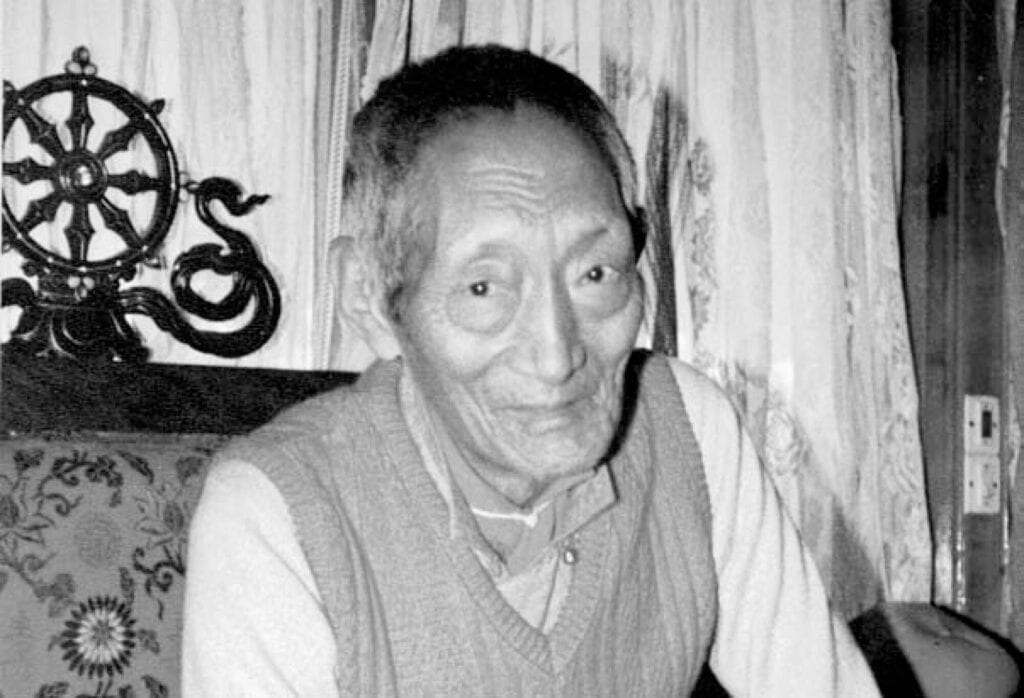
Though devotion is based on the recognition of one’s buddha nature, which does not change, devotion does change. There is longing devotion, joyful devotion and unchanging devotion. This is where one’s confidence does not increase if the lama flies in the air and doesn’t decrease if he does weird things. One just thinks, “He knows what he’s doing.” That’s where real trust has set in.
How does devotion work on a meditation level?
As a strengthening factor it’s all a question of how much money you have in the roulette game. That decides how much you can win. If your input is normal meditation, calming and holding your mind, you may compare that to a bet of $20. Winning gives you maybe $200, which is good but not very much. If you make a bet including compassion and wisdom, the wish for happiness of all beings and some awareness of the dreamlike nature of existence—which you may compare to placing $200 in the roulette—the dimension changes and when you win, maybe $2,000 will be yours. But if you give everything, totally open up to the wisdom-vibration emanating from the teacher and his lineage; if you meditate like that, taking the whole blessing and are open to the entire energy field that’s generated, they will give you the key to the casino. This is how it is: If we can open outer, inner and secret aspects of ourselves (action, motivation and view) everything will be ours.
How does devotion appear in your mind?

It appears most strongly as thankfulness and when I see I can be useful to others. Then I think to our lineage, “Wow, thanks for putting me in this situation.” Devotion isn’t a passive thing, like a bank account; it arises in the moment of acting and awareness. When I give a lecture, for instance, and I see people’s eyes and they understand, “Man, my mind is not a thing, it cannot die.” Or when this suddenly goes click inside them, “Why am I looking for all this stuff outside when the only thing that ever gets happy is my mind? Maybe I should search for happiness where it is?” When such realizations open their eyes, I say, “Wow, thank you Karmapa, thank you Lopon Tsechu Rinpoche, Kalu Rinpoche and whoever of our teachers did all this work with Hannah and myself.” Their transmission was there at that moment, and that’s what I feel.
Do you feel that the lineage is expressing itself in that moment?
Yes, but it is in no way personal. The enjoyment touches oneself, but the moment of sharing is beyond any limitation. It’s just openness and bliss.
In some Guru Yoga texts, we make wishes to see all form as the teacher’s body, all sound as the teacher’s speech, and bliss as the teacher’s mind. How does this relate to the pure view?
For a modern critical listener, the meaning is probably not transparent. It means being inseparable from one’s refuge all the time, which allows us to experience things on a high level. All form here expresses truth nature, simply because it can appear. Every sound has the blessing of the Buddha’s speech, or of the teacher’s speech, and is therefore meaningful mantra. Every thought or feeling shows the richness of the Buddha’s mind, of the teacher’s mind, and is thereby perfect. Thus all experience becomes liberating and enlightening. That’s how I would see it. That’s the way we aim to experience these things, as the blessing of the buddhas.
Knowing that, how does that help one understand emptiness? Or that mind is like space?
Beings can be inspired and open up easily from a situation where mind is full of good impressions. It is more difficult if one is disturbed by much negative input. Even though disturbing feelings are just passing by, cannot stay and will leave through their own power after a while, still one does not enjoy having them. In that situation some people spend a lot of time talking to serious-looking people in long white coats and are told to eat a lot of pills. Of course also thinking and saying positive things is just a dream and something relative, a changing illusion. But if we keep filling mind with good impressions, then we get to a point where we see so much beauty outside and inside that mind dares to go beyond its concepts, beyond its different ideas, and experiences that perfect consciousness which is aware. And when that is recognized, when that awareness comes out, there is nothing more to want. Of course this doesn’t totally remove the ego. It will pop up again whenever possible and say, “My clear light was longer than his last week,” or “Now I will quickly get enlightened.” In such moments some people think they’ve lost it, but ultimately this is not possible. They never lost it. The sun is always shining; there were just some clouds moving by. Awareness is timeless with some impermanent illusions passing through. As one stops caring about what comes and goes, one realizes mind’s free space and never leaves that perfect state.
Is there ever a time that having a critical view and devotion conflict?
No, but you have to be aware of cultural differences and then choose what is important. Even with the great 16th Karmapa, whose blessing was often like an electric wire touching Hannah and me, whom we saw as all the buddhas in one and who in front of my eyes changed into the male and female buddhas he initiated us into, still my mother’s upbringing did not leave me. When people eat with their hands, still today I look away.

Also, when somebody took him out to buy him some nice shoes, I did other work or read my International Herald Tribune. Though it was to honor the donors, I considered it a total waste of his precious time. Then there were other cases where I was electrified, like when Karmapa went to bird shops. I actually don’t like birds very much, I don’t like their smell and being very tactile, I always touch things. If I don’t do that, things do not really become alive to me. Birds, though apparently sometimes very intelligent and compassionate, you can’t really get close to them. However, when Karmapa went into those shops, which he found intuitively in towns he had never visited before, things happened. He would stand for a moment, and then tell us that this bird was saying something very intelligent, and that this other one is useless. Then he would just put his hand into the cage and the bird he praised would come and sit on it. He would take it out, blow on it and do other things with it, and after that many owners just gave him the bird or put the price really low. Karmapa did that many times and when the birds died, they stayed stiff and unmoving, with their beaks up. Karmapa then said: “It is meditating now. This evening it will be free—and you can bury it.”
How many bird shops did you go to with the 16th Karmapa?
In 1974 and ’77, probably ten across Europe. Hannah even more, sometimes with exotic collectors who would not sell. One time when we drove Karmapa to a Scottish centre, three birds were knocking their beaks against the window when he stepped into his room. We let him be alone; we felt it was a special thing. Shortly after, Karmapa came out. He had made a rough drawing of a barn and said that down there, three birds are caught under the roof. We hadn’t driven by this barn. He had come via Prestwick airport, which was on the other side. However when people went there, they found the barn. Entering it, they opened a skylight and three big birds quickly flew out from there. Whoever met the 16th Karmapa is certain he was a Buddha, there could be no doubt. And now the non-political, religious 17th Karmapa Trinley Thaye Dorje, who recognized himself, says that when he is that same age as the 16th Karmapa was when we knew him, 46 to 58, he expects to have similar abilities. I was overjoyed to hear that; there can be no greater gift to the world. Beyond any doubt, such powers prove that the world is a collective dream, seen through the colored glasses of one’s present state of mind, and so many will benefit from seeing that.

One last question. As a teacher how would you like your students to express their devotion to you?
Hard work, courage, excitement, fearlessness, joy, a surplus of humor, basic trust in oneself and others. That my students actually lift the mental level wherever they appear. I’ve seen so often that this naturally happens. In Copenhagen, I know some successful male models. They look like Nordic gods, sharp-cut faces and perfect in every proportion. When I still had the time to visit their parties, they were usually sitting there leaning back, just mega cool and keeping the expensive white powder from falling out of their noses. Then a couple of our Buddhist girls would enter, shake everything up and really make a party. Everything was there before they arrived, the music, fine bodies and everything else, but there was no spark to make this happen. This is what we always do and for this reason some monastic types think we are not good Buddhists. They use our inside joke of calling ourselves the Party lineage, because it sounds like Kagyu lineage. But as you know, any religion that has lost its door to transcendence becomes a relic. The basis for working together and getting to know each other is sharing a good party—but not a rave. It is really a most uniting and wonderful thing. In the moment, one should offer up the health, beauty, strength and love of all these fine people, their motions, the lights and any experienced richness like that. That’s a major offering to the buddhas. Our ultimate teaching is that highest joy is highest truth. If somebody looks like three weeks of rainy weather, moralizes others or claims to have some special kind of accomplishments, one should say, “This is too high for me.” (laughs) The moments of “aha” we have, our now-ness, freshness, our right-on quality is where we touch the truth. Fast motorcycles, a hundred parachute jumps, all kinds of excitement bring that about. There’s no doubt. We have inner and secret capacities that are unbelievable. So the more potential a teacher is capable of bringing out, the more devotion and thankfulness I think one should have to him or her.
Is there anything else about devotion that you would like to say?
No. Find and develop it.


