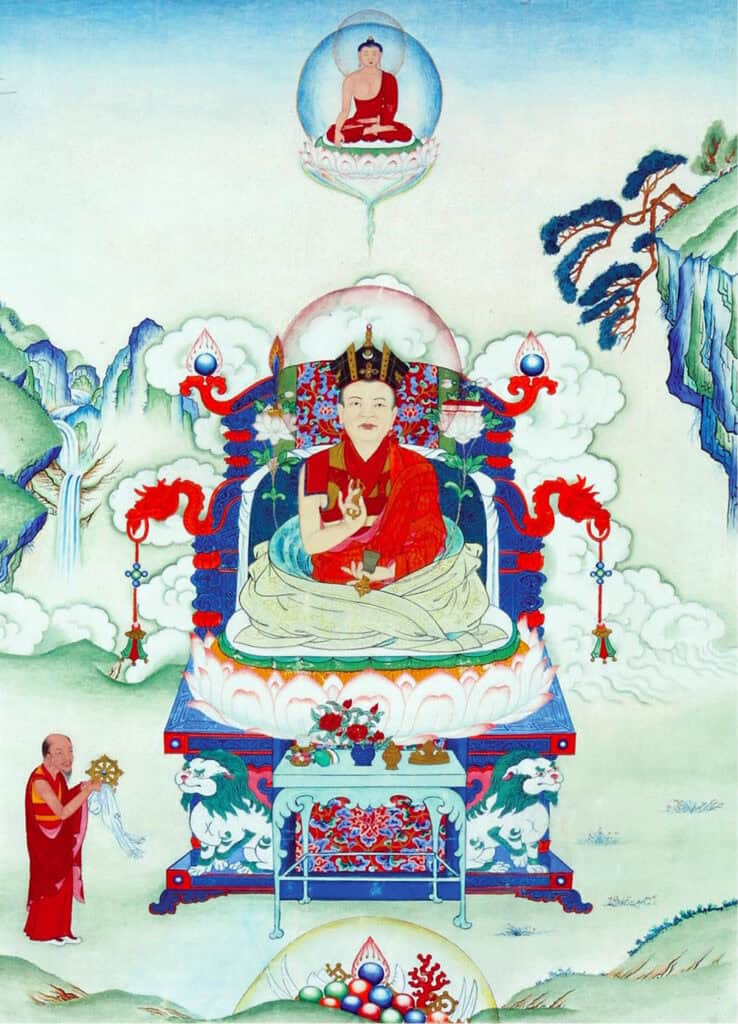
There are Guru Yoga meditations on several Karmapas, among others on the 2nd Karmapa. When the terton Yonge Mingyur Dorje was doing a retreat on the buddha aspect Black Coat (Tib. Bernagchen, Skt. Mahakala) and Almighty Ocean (Tib. Gyalwa Gyamtso, Skt. Jinasagara) the mandala of Karma Pakshi appeared to him surrounded by Guru Rinpoche, Rechungpa, Hayagriva, Vajrayogini, Mahakala, Palden Lhamo and Dorje Legpa. In this vision, he received the transmission for that Guru Yoga, later passing it on to others so that we can use it today.
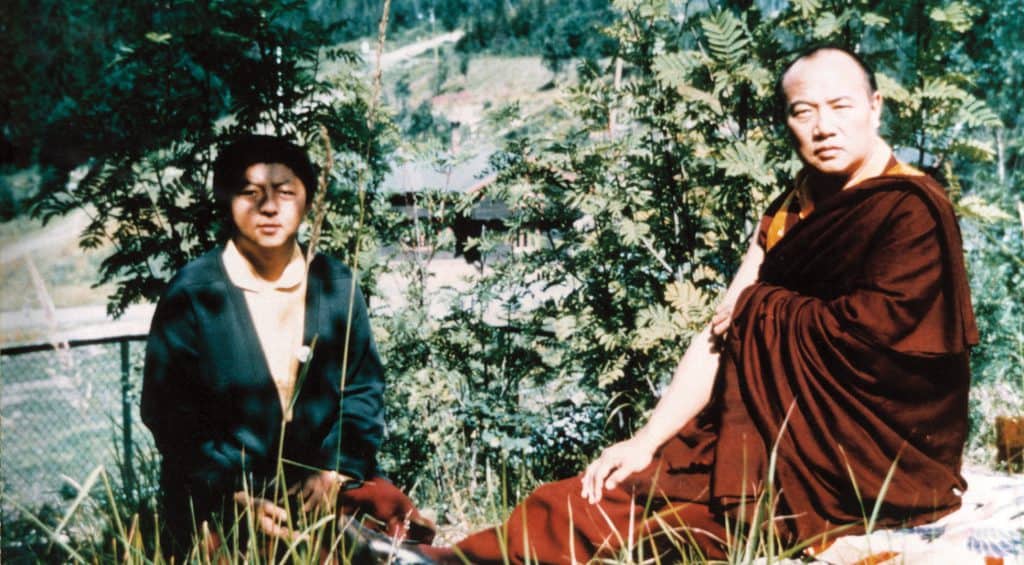
The 16th Karmapa Rangjung Rigpe Dorje also composed a very easy-to-practice meditation on himself. For those who use this practice, Gyalwa Karmapa is always present. With our normal imagination, it is difficult to understand how it is possible that Karmapa is always with us because he is not physically there. However, when we learn more about the abilities of bodhisattvas, it becomes easier to understand how he can always be present for those who open themselves.
Once one has better understood this special quality of the bodhisattvas, it is then easier to trust this statement about Gyalwa Karmapa. It is no longer just a legend because one has created a real connection.

We have many methods in the Karma Kagyü lineage such as these Guru Yogas on the various Karmapas. To truly be able to develop our mind through the Great Seal (Tib. Chagchen, Skt. Mahamudra) we need the Foundational Practices (Tib. Ngöndro). It is stressed in Ngöndro that one must first purify oneself, to remove all the negative karma from previous lives. Previous harmful actions are like seeds in our mind and lead to obstacles in the form of mental veils.
What does this mean? We are intelligent and able to understand many general things. However, when it comes to how to achieve enlightenment, it is very difficult for us because we are obscured by previous negative karmic actions. We can purify these veils with the help of the meditation on Diamond Mind (Tib. Dorje Sempa, Skt. Vajrasattva), the second part of Ngöndro.
After this purification, it is important to create optimal circumstances to become able to recognize our nature, and for this reason, we have to accumulate positive karma. That is also important for the purification itself because we need to accumulate meaningful actions instead of negative actions. For accumulating merit we use the third of the Foundational Practices, the practice of Mandala Offerings.
In the fourth of the Foundational Practices, we meditate on the presence of Gyalwa Karmapa in order to allow the right conditions to mature in us. What is meant by this? We have the ability and the intelligence to understand a lot. However, when it comes to the essential instructions for dharma practice, it is difficult for us because our mind is “hard” in a manner of speaking. Through the blessing we receive in the Guru Yoga practice, our mind becomes more receptive and we can suddenly understand each sentence as soon as we hear it.
It is often difficult for us to really apply the teachings we have heard. That is not bad in itself; it is simply in our nature as sentient beings. We need Guru Yoga meditation to develop our wisdom and to attain the abilities of a Buddha, and with that, we can overcome all the obstacles to our development.
By obstacles, I don’t mean outer circumstances, but rather the fact that we hear and practice the dharma but still hold on to our own ideas and thus keep ourselves from understanding the essential meaning of the dharma. On the one hand, our own ideas have to do with habitual tendencies from previous lives, and on the other hand, with fundamental tendencies, which we have due to our human birth.
In the course of our lives, we accumulate knowledge and develop ourselves, and subconsciously, we become very convinced by this knowledge, by the common understanding of being a human. We learn the dharma based on this foundation; and here it is really only about transforming this understanding into that of a buddha. That is the reason we meditate, receive explanations and focus on the various steps of the Great Seal.
In order to really become able to do this, we have to prepare ourselves accordingly. For instance, water cannot penetrate hard rock, and in a similar way, we first have to do something with our mind so that it can absorb the dharma teachings. After finishing the preparations, when we hear and apply the teachings, then we will spontaneously and continually experience that our understanding increasingly corresponds with the teachings. In this way, we will obtain Yeshe, primordial wisdom, the quality of a buddha. That is the ultimate result of the Guru Yoga practice.
However, Guru Yoga can already be useful in our daily lives: Through the combination of our devotion and our connection to Gyalwa Karmapa, our lives will go very well. Everything becomes more pleasant, quieter and smoother, we develop a much broader mind and our suffering lessens. Negative thoughts will not disappear all at once, but they will lessen and will disturb us less in our fundamental nature. Through this we become able to apply each dharma teaching in the correct way.
It actually functions quite easily and doesn’t have anything to do with fantasy or miracles. What makes the practice so effective is that we become very even-tempered. Normally, we are always out of balance and are fighting with our feelings; we see this everywhere in the world. In some countries there is more suffering, in other countries there is less—but nowhere are the people truly happy; something is always misunderstood, something is always complicated, because people are always holding on to something. We always experience difficulties like this and although everybody is trying to find out what the cause is, nobody really succeeds. People use various methods and some help a bit, but then they always fail eventually.
With Guru Yoga the mind naturally becomes more open, even without a lot of explanations and concentration. Increasingly, we understand outer circumstance better and how the mind functions. While one can still see many disturbing feelings in one’s own mind, they no longer develop in such a negative way. We understand better how sentient beings experience the world and can develop greater compassion for them without becoming sentimental.
Through this the mind has much more pleasant experiences. A person with a lot of compassion for others gets along with everybody and that is what we are currently lacking. If we honestly look into ourselves then we will recognize and understand this. With real compassion one recognizes the problems in the world, but is no longer as emotionally involved in them. And if this does happen on occasion, it dissolves more quickly through one’s understanding.
Such spiritual qualities cannot be forced and cannot really be trained either, but they can manifest naturally if you meditate a lot. Meditation gives us a peaceful and clear mind and, in the course of time, greater understanding. But it can often take a long time for results to arise. For this reason, in the Karma Kagyü school, we combine meditation with Guru Yoga. With the blessing of the lama, results can arise much faster through meditation. Often you do not really notice this when you actually observe yourself. However, if you look back over a longer period of time, you can see how much you have changed. That is not magic, and it doesn’t happen overnight, but when you do the practice, you will experience it like this.
There is a frequently used instruction in Guru Yoga: “Practice resting in a state inseparable from Gyalwa Karmapa.” When we do the practice to receive Karmapa’s blessing, then we practice feeling inseparable from him. This is a very effective method to develop compassion, a balanced emotional state and positive thoughts, and thus to stop negative actions. Through this, our understanding can develop.
These qualities develop through the practice of Guru Yoga without having to exert much effort in meditation. That is the special power of Guru Yoga. In general, it is advised in Buddhism to meditate a lot. If you meditate eight to nine hours a day, the mind will quickly overcome its disturbances. However, you can get the same results with just one hour of Guru Yoga a day, or even less.
How is that possible? Through the blessing of the Karmapa. Through him, our minds can mature, and our understanding will develop. Normally, one exerts oneself a lot in meditation and attempts to not let oneself be distracted, etc. … This can really be hard work, and it can bring good results, too. But with the blessing of the Karmapa, the practice of Guru Yoga requires a lot less effort and results come much more easily.
In the Kagyü lineage, before we can really begin working with the Mahamudra instructions, we first do the Foundational Practices. Without these, we might understand the Mahamudra teachings theoretically but not how to continually apply them. When we really learn to use them, then their meaning will be evident to us all the time, not just as a one-time experience. With this as a solid foundation, we continue to develop all the way to enlightenment.
In Ngöndro there is great importance placed on the fourth practice, Guru Yoga. However, for many people it takes a long time to get to this last part of the Foundational Practices. The 16th Gyalwa Karmapa composed a very simple meditation which has the same effect and which can be used before and during Ngöndro. He told Lama Ole and Hannah Nydahl that this is a very important tool that people around the world can use, and that its blessing would continually grow. Through the Karmapa’s blessing we can better understand the teachings and become stable in their application. In this meditation it is not just about giving people access to the dharma; it goes much further. People can become realized if they apply the Mahamudra instructions.
Guru Yoga is particularly emphasized in the Karma Kagyü lineage. During the lifetime of the 16th Karmapa, I saw people who really became inseparable from Gyalwa Karmapa and had very special qualities. Many of them were simple people, not great yogis nor people who led a very special lifestyle. They were people who simply used this practice every day and thereby achieved immeasurable results. They developed themselves under very different conditions and the understanding that they reached was individually very different. Each person had their own experiences, but all of them understood and internalized the meaning of the practice.
Sometimes I even saw Karmapa’s power in those who were not his followers. For instance, in India, there were famous Hindu gurus who, despite having a different religion, became convinced that Gyalwa Karmapa was a Buddha. This was quite unusual because the gurus were often somewhat proud and had thousands of devotees. However, when they saw the 16th Gyalwa Karmapa they were often completely convinced that he was a living Buddha. With normal people, that might not have been so unusual, but we are talking about gurus here who, through their meditation, had achieved miraculous powers to some degree. Some of them were really authentic and such people are often difficult to convince about the validity of a spiritual path other than their own. They had met other great Tibetan lamas such as the Dalai Lama, for example, and considered them to be very important. But generally, they always considered themselves to be equal to these lamas. When they met the 16th Karmapa, however, that was something else. They became completely convinced that he was a living Buddha. They apparently really experienced it like this, and they had no reason to exaggerate their statements nor to be overly polite to Gyalwa Karmapa.

The Indian military is stationed in both Sikkim and Bhutan. The soldiers there often invited great Hindu gurus, called swamis, to give them blessings. Once, a swami from southern India came to Rumtek and wanted the use the opportunity to meet Gyalwa Karmapa. We prepared everything for his reception, but the swami spoke neither English nor Hindi, just a southern Indian language, possibly Tamil. At the reception, the 16th Gyalwa Karmapa sat on a small sofa and asked the guru to come sit next to him. The guru’s students sat on the floor. Translation was not easy, first from his language into Hindi and then into Tibetan. We do not know exactly what the guru said about Gyalwa Karmapa, but the translator expressed it with the word Avalokiteshvara, Buddha Loving Eyes.
The guru asked me to come to him and did something with some white powder, which I thought was some kind of black magic at first. Then he took Gyalwa Karmapa’s mala and asked me to hold out my hands. He rubbed the mala over my open hands and suddenly yellow rice fell from Karmapa’s mala into my hands. I kept the rice and thought that it would disappear at some point if it were really black magic. The rice lay in an envelope on the shelf and when I checked a couple weeks later it was still there—normal rice mixed with a little saffron rice, which smelled of incense. It really came from Karmapa’s mala. Gyalwa Karmapa was completely unmoved during this episode and said nothing about it. It was a very unusual situation: neither had a proper translator, they sat together, drank some tea and went their separate ways. The guru said something about Avalokiteshvara, but nobody could really translate for Gyalwa Karmapa.
In 1972 Gyalwa Karmapa took us with him on a pilgrimage, along with Lopön Tsechu Rinpoche and Shamar Rinpoche. We went on really long train trips through India and also stopped in Bombay (Mumbai) because we were visiting the caves at Ellora. When we arrived Gyalwa Karmapa accepted an invitation from a Hindu ashram. He was very warmly received there and we stayed for three days.
On the second day, Gyalwa Karmapa sat together with our host, Baba Muktananda, an important Hindu guru. They spoke about this and that and Baba Muktananda suddenly asked if Gyalwa Karmapa would demonstrate a miracle for him. We were pretty surprised and curious how Gyalwa Karmapa would react. Historically it was quite common for great yogis and siddhas to show each other miracles. The 5th Karmapa demonstrated miracles in China similar to those shown by Buddha Shakyamuni, for instance. But that was all several centuries ago and here we had a situation in which something similar could actually happen. What would Gyalwa Karmapa do? He answered, “Tomorrow during the Black Crown ceremony you will see the miracle. It doesn’t have to be today.” Of course, we were very excited to see what would happen.
During the event the next day, there were more than 1,000 people present, including many Europeans. Gyalwa Karmapa’s throne stood in the front and Baba Muktananda’s small seat was in the audience. During the Black Crown ceremony none of us saw anything special. It seemed the same as always. But afterwards Baba Muktananda was completely convinced in Gyalwa Karmapa and said repeatedly, “I never would have thought there was really a buddha in this world. Gyalwa Karmapa is like the Buddha.” That had a lot of weight in India because he was an important man, and there were never any scandals about him. Baba Muktananda met Karmapa later in the USA and constantly spoke to his disciples about him. He respected Gyalwa Karmapa from that moment on until he died.
In 1974 Gyalwa Karmapa traveled to the USA for the first time at the invitation of Trungpa Rinpoche. It wasn’t easy to finance the invitation. When Trungpa was looking for nice accommodations for Gyalwa Karmapa, he asked a rich Chinese man named Mr. Chen if he would let Karmapa stay in his big house on Long Island. Mr. Chen was a Mahayana Buddhist; normally, Chinese Mahayana Buddhists do not take Tibetan monks very seriously and do not particularly trust them. For instance, they know that Tibetan lamas eat meat because they are not as strict as Chinese Buddhists are, and for this reason, they do not consider Tibetans to be serious Buddhists. But because it was Gyalwa Karmapa, Mr. Chen agreed. He allowed Trungpa’s team to use his house and they prepared everything for the visit.
Mr. Chen had not intended to meet Karmapa, but that changed the day before his arrival. The night before he had a dream in which the sun shone very strongly into his “Bodhi House” where a lot of Buddhist activities took place. He found that very unusual and decided to see what was going on in his house. As he came into the library the next day he saw seven large footprints on the floor. As a doctor of Buddhist philosophy, he knew what that meant and was truly surprised. He knew that the dream and the footprints meant that a buddha had come to North America. Mr. Chen decided to support him because this was a really big event. What really convinced Mr. Chen was the fact that he had seen the seven footprints before Karmapa’s arrival. It is difficult to really interpret this, but Buddha’s activity really arrived with Karmapa’s visits in Europe and the USA. Gyalwa Karmapa’s first steps in the Western world were really like the appearance of Buddha himself.
How we perceive Gyalwa Karmapa’s physical form is one thing, but he can actually manifest himself as a buddha. It is not like I’m just saying “oh, Karmapa is so great.” There are actually similarities to the life story of the historical Buddha. Since Gyalwa Karmapa first visited North America and Europe the dharma has spread over the entire world. One cannot comprehend this in its full importance; it is immeasurable.
Mr. Chen had understood this, and afterwards he did everything that Karmapa asked him to do. For instance, he built the Woodstock Center but later expressed his disappointment because the monks there did not seem serious enough. For him it was too small and narrow there and there was not enough activity. For this reason, he built another temple and invited Chinese monks.
When we practice the Guru Yoga of Gyalwa Karmapa, we are each sitting alone, but Karmapa is present for everybody as a buddha. Of course, we always want proof, and we want to see something special. In contrast to Hindu gurus, the Karmapas have never immediately shown miracles. These gurus with a high degree of realization often show special miracles, but as I have observed these often disappear soon afterwards.
I spent a lot of time with the 16th Gyalwa Karmapa and determined that if you expected him to do something, then you would not see anything. But very special things are happening in our lives all the time through his blessing. It is important to understand this, because in the course of our Guru Yoga practice we could think that others are experiencing much more than we are. But the truth is that things are changing for us and we are developing the whole time. For this reason it is very important to do the Guru Yoga practice with confidence in ourselves. Then, through the blessing, our understanding of the meaning of the teachings continually grows in our mind. It never decreases and grows without interruption, even beyond this lifetime.
To strengthen this connection in our future lives, the 7th and 8th Karmapas composed invocations for their disciples. When their students recite these they strengthen their determination to continue the practice and become able to benefit other beings. The most effective way to help others is to become a part of the activity of a great bodhisattva like the Karmapa. In this way we can help to lessen the negative actions of beings and their consequences, thus giving them the possibility to work with the teachings and to develop towards enlightenment life after life.
This view is strongly stressed in the texts from the time of the 7th and 8th Karmapas. Their students did the Ngöndro and then received the instructions for Mahamudra practice. At the same time, the Karmapas had them recite these invocations in order to solidify this direction within them for their future lives. Here it is not about instant results, but more about the long-term view: “I will continue to give my life a good direction, to think this way and to behave towards others in the right way, so that Karmapa’s blessing is always with me. I will develop myself as a bodhisattva step by step, life by life, in order to reach enlightenment.”
If you can develop yourself in this way, then you have a true goal in life, and that has twofold value: for one, you lead a decent and good life, and secondly, you can continue on this path, developing yourself without great difficulties towards the goal of enlightenment. It is very difficult to do this on your own. That’s why we make a connection with the activity of the Karmapas, which protects and supports us because we are connected with the blessing.
Even if we are not presently in a position to meditate a lot, we can focus our minds in this way. This is also a part of Guru Yoga. Between meditation sessions in our formal practice, we are very busy during the day, we lead normal lives, and everybody has to do their job. However, when we hold our minds in this way and keep good connections with people, then we are upholding the Guru Yoga practice. It is not about the recitation of texts, it is about how we hold our minds.
We meditate on being inseparable from Gyalwa Karmapa. This connection with Karmapa outside of meditation also has great significance. Through this, we get a feeling for how we can direct our thoughts in the best way and how we can deal with people in the most useful manner. This is a great help in life because sometimes it can be very difficult to change things. By focusing on the teacher, one never becomes discouraged. One understands that peoples’ lives are not easy. If we know how to give our lives a good focus, then we gain self-confidence, we apply the methods and recognize the meaning of life.
When you do Guru Yoga practice, take the time now and then to consider the goal, the connections, and your own attitude. If you do this on occasion, it will give you a lot of protection and help your practice. We talk a lot in Buddhism about emptiness, but this should not be misunderstood to mean that everything is simply empty because the blessing is always present if we are open to it. To practice and think like this is a very simple way to strengthen the connection to Karmapa and to work with Guru Yoga.