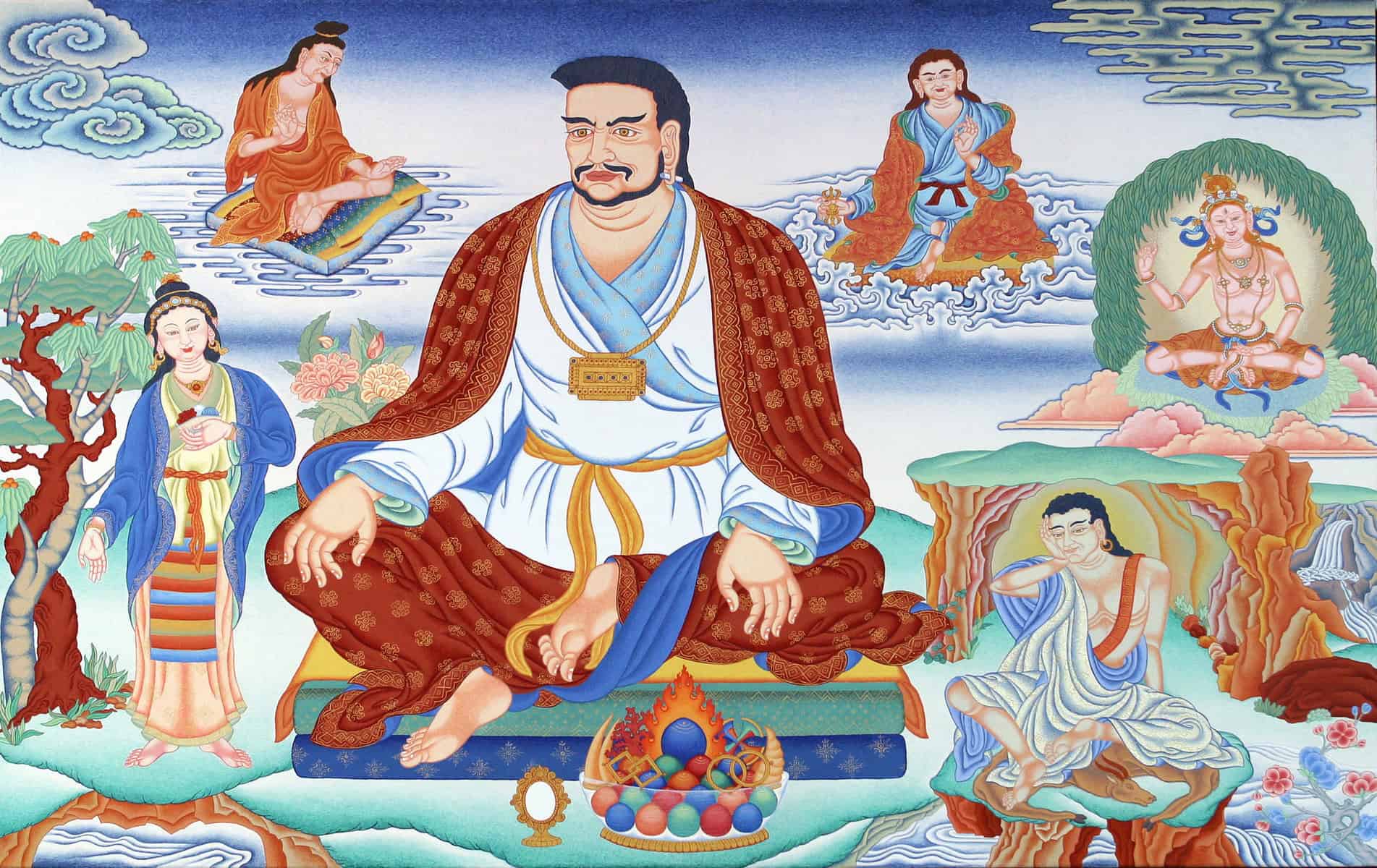
“Initiation” means to be shown something, to be taken into something, to be revealed something that one hasn’t seen before. Of course, in Buddhism, the initiations are not into the glory of some gods, or the mysteries of the Kabbalah, or anything else like that. A Buddhist initiation is always into the power and the clear light of our own mind. There’s nothing else the Buddha wants. So this stream of awareness, this stream of teaching, is given on different levels. On the outer level, it’s given in the way that people are taught what to avoid and what is useful. On the inner level, it’s given in the way that people’s compassion and wisdom, their inner qualities, are activated, and they can start working with these qualities. On the secret level, though, the meaning is very deep because here we are actually shown mind’s true essence: its radiance, its clarity, its unlimited nature, all the things that mind really contains. All this is being shown to us in different ways. In our yogi lineage, it’s frequently shown just by being with the teacher.
The Buddha was not a god, creator, judge, or punisher. He was none of that. He was somebody who recognized mind as being timeless, clear light. Recognizing that, he actually had the experience of highest fearlessness, joy, and compassion. Out of that fearlessness and compassion, the Buddha then started teaching. That was the basis for going out and starting that Buddhist system of teaching and initiation, which we are all benefiting from today and which is now making our lives meaningful. Buddhism has been making people’s lives and deaths meaningful for the last 2,500 years. It’s a very big thing. If you can make one person happy, that’s already a lot. Think of all the beings the Buddha made happy; it’s incredible.
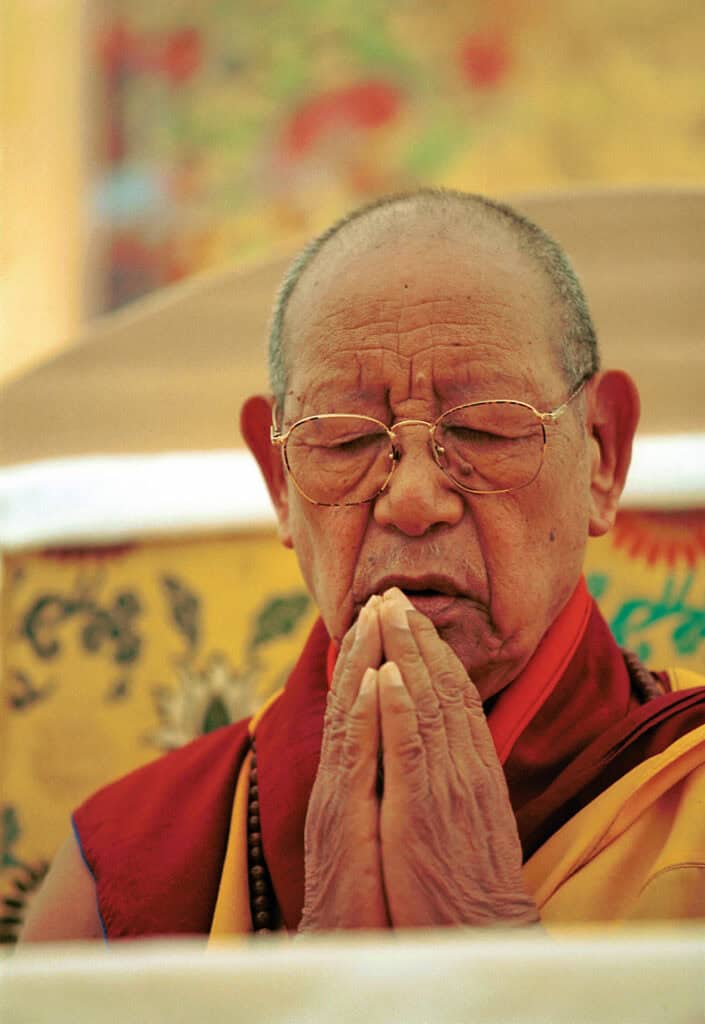
One of these ways of really meeting with mind is through contact with a teacher. If you meet someone who is spontaneous and effortless, who does what’s naturally in front of his or her nose, who lives without fear or attachment and tries to be useful to others, who takes things from a distance and doesn’t take them personally, and who uses all the things that he experiences as a mirror to his own mind so that the world becomes a teacher to him, then this is an excellent teacher. If one’s teacher has reached a level where his mind is spontaneous and effortless, where he rests in himself, then he will do things that everybody else considers very difficult and that challenge people’s ideas, concepts, and expectations. He will do these things spontaneously and effortlessly. Everything will flow. This being in the flow of things as they unfold, as they grow and happen, is a constant initiation. This is living Mahamudra. This is a very important teacher because he shows us how to do the same thing: how to rest in the moment of awareness, how to go beyond hope and fear, how to not make things solid and stiff. So we ourselves reach a level that is spontaneous and effortless, where we actually do what’s in front of our nose here and now.
Of course, nobody ever got enlightened yesterday. Nobody ever gets enlightened tomorrow. Everybody gets enlightened here and now. That’s simply how it is. Everything is this very moment. Nothing is before or after. Being with the teacher can give us confidence that we will not fall into a black hole if we stop expecting, hoping, and living in the past and the future. The teacher can make us understand that thoughts are very good servants but very bad masters, that thoughts should be something that one can click on and off as one likes while staying free in whatever happens at the same time. If one can learn that and be aware of that, then all the power, all the unfolding, all the ability inside of us will happen. In our lineage, this is what happens very directly.
I’m not telling you to go everywhere and take every initiation you come across. I actually advise you to stay inside the lineage with initiations because the methods and the blessing fields of other lineages are different. Not that one thing is good, and the other is bad. They’re all good. It’s just that if one gets into too many places, one’s inner energies can be distracted and disturbed, which nobody wants. So for that reason, I advise you to take initiations as a blessing when they are given by a teacher of the lineage, somebody who is close. It’s not a good idea to run after every initiation or to do the mixed-spirituality thing. But if you take initiations that are really going to be a part of your practice, then you should also try to remember them.
When Buddhism first started in the West, most initiations involved promises to do things that people often couldn’t do afterwards because they have such busy lives. So they started saying, “Hey, I’ll only take initiations without promises, no damtsigs, because the other stuff is too much.” Today, most initiations are given as blessings.
Also, people discovered that if they didn’t really know what was happening at an initiation or if they didn’t really take part in it, then the initiation wasn’t so significant for them. So it’s good to know what we are doing, whether we take an initiation as a blessing or if we want to work with that Buddha aspect afterwards because we feel it’s important to us. Whether we want a Medicine Buddha initiation because we heal people, or the Diamond Mind initiation because we want to do a certain practice, or Long Life Buddha initiation because we want to live longer or want to have a good connection to the pure lands—whichever of these different instructions are given, it’s good to know how an initiation works.
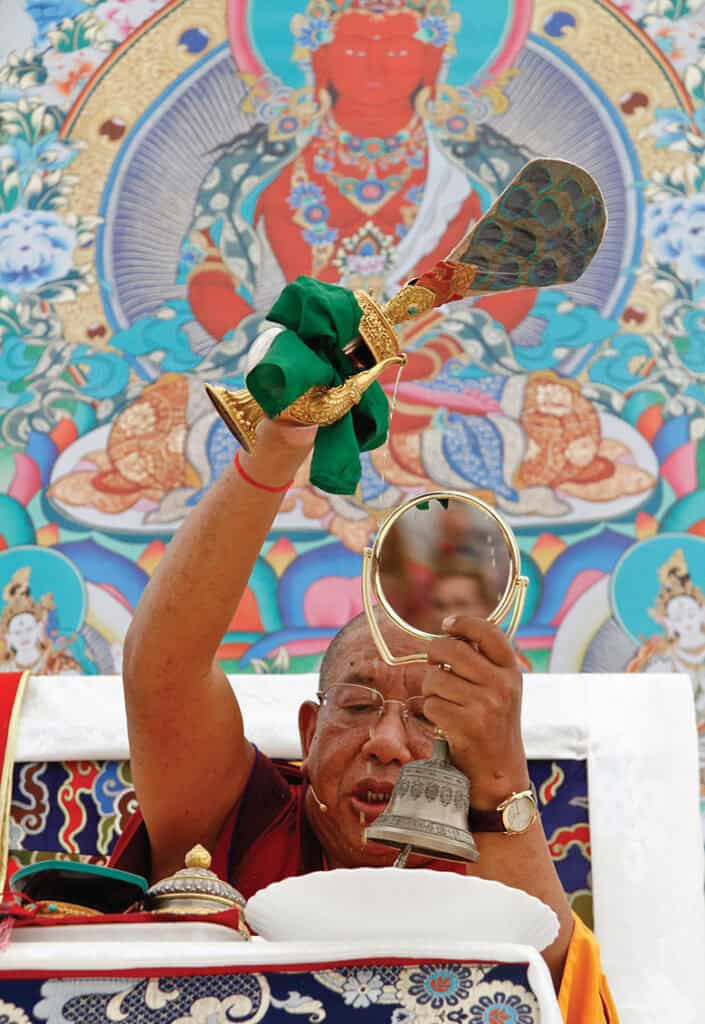
When you first come into the initiation, people will give you something to drink. Actually, you should spit it out. In some cases, if there’s no place to spit, then you swallow it, but usually, you just rinse out your mouth, which is like a symbolic purification. There is a text. At the beginning of the text, there is a purification (this is when you drink something), and you hear the sound of the Hundred-Syllable Mantra spoken. You may also join in that yourself, and then you sit down. Then you will hear the lama saying different things. The lama sits there and does a kind of puja. The whole initiation is a kind of puja, an invocation of a buddha aspect from space, a condensing of a buddha aspect out of space, which is then at different places. When the puja comes to an end, the blessing of body, speech, and mind is transmitted. There will be a torma, a little cake, or a little pillar of some kind of dough in front of him. The lama will then be calling and creating an energy field around the whole place so that no disturbing energies come in. He will offer the torma, and he will invoke all the spirits already inside, saying, “Listen, I’m giving you this to eat now. I’m giving it to you, and you have to take it and go out.” Then he also says, “If you don’t leave, I will smash your head into 1,000 bits.” He uses carrot and whip at the same time. Then another lama, somebody working for him, carries the torma out and throws it outside. So, in this way, the energy field is established.
One may meditate on a whole tent of light with crossed dorjes. Everything is crossed dorjes. Through the centers of the crossed dorjes are arrows with five-colored wisdom light radiating out. There also may be skulls. There may be chopping knives. You may imagine different things, which may either be in the text or the way you prefer to do it yourself. This is the first thing that happens at the beginning of the initiation.
There may be some sounds from drums or bells. Usually, most of the sounds that are being made with drums are to remove unclarity, to make the mind clear, and to invoke certain buddha aspects. There may also be a big drum, like for Chöd practice or for other different kinds of practices. If it’s a bell, then it’s for a milder kind of awareness.
Then the lama will sing something or chant something for a while, and that’s the history of the initiation: how it has come down, from which teacher to which teacher, how it was passed down until today, the different benefits people had from it, and so on. Then the bumpe wang is given. Bumpe means vase. A vase is a little, pregnant cup with a rim and a very thin nose. It’s a very heart-shaped vase, and it sits on a little, triangular, lotus-shaped base. Here, then, the lama meditates on the buddha aspect that he wants, the buddha aspect that he’s going to give the initiation into. He meditates on that energy inside the vase.
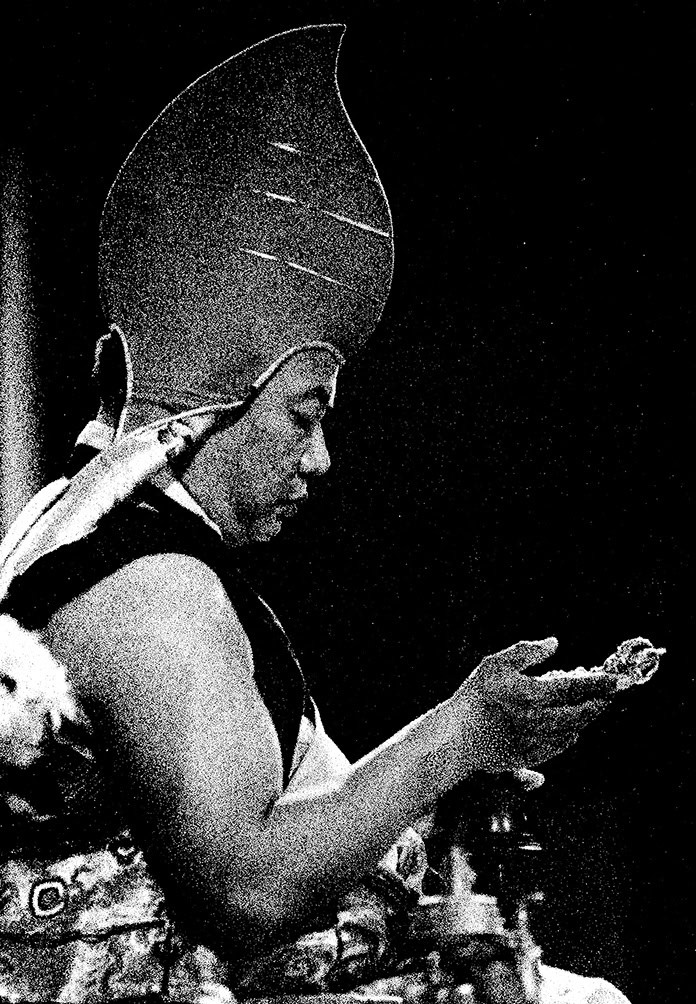
If it’s a united or a male-female aspect, then the vase is full of their union nectar. If it’s a single form, then the vase is just full of blessing nectar. After that, one will be touched on the head or, in some cases, the head and hands. Then one will bless the other parts of one’s body with the bumpe wang initiation. This initiation gives us the power to see our own bodies as transparent light bodies of the buddhas. That’s actually the goal of it. Through this blessing, we get the power to see our own body as a form of energy and light, the form that we are meditating on. This, of course, is very strong because it lifts us out of our whole conditioned world. It also transforms the outer world, making other beings into pure buddha aspects. This actually has a very deep meaning in the practice and has a very deep effect on one’s mind.
After this, body initiation is a speech initiation or the secret initiation, which is called the sang wang in Tibetan. Here one repeats a mantra after the lama. The lama will say the different syllables of the mantra, usually three times. Often a bumpa, or just the lower part of a vase, with a mala in the same color as the buddha aspect, is carried around at the same time. Then while the lama says the mantra, you say it with him: OM TARE TUTTARE TURE SOHA or OM MANI PEME HUNG or OM BENZO SATO HUNG. Whichever of the mantras you’re using, you get that feeling of it, and you share that. This gives the sang wang, the secret initiation, and this empowers us to meditate on the energy channels of the body, including the two side channels; the middle channel through the body; and the five energy wheels, denoting body, speech, mind, qualities, and activities or action power.
The body initiation enables us to do the yidam meditations, in which we become the energy form of a buddha. The speech initiation enables us to work on the inner channels, on inner heat, on all the different methods having to do with that. Of course, this also includes Phowa. Then in the third initiation, often the symbols of the different buddhas are shown, whatever items they hold. You may imagine different things, like a stream of light from the heart of the lama going into your heart. You may imagine the different symbols of the buddha whom the lama is representing, streaming into you and becoming one with you. This meeting, absorbing the attributes of, and meeting the essence of the teacher is the third initiation, which is called sherab yeshe, the wisdom awareness initiation. Here, you get the power for yogic union, for doing the meditation in the united form with a partner, or if one is monk or a nun or doesn’t happen to have a partner at that time, then with a visualized partner. If one has a partner who shares the initiation, and one has reached the level where one can work with it (which is very, very rare), then it gives us the power to take the energy and experience the four joys: joy, great joy, special joy, and spontaneous joy. We mix the male and the female essences, take the energy up through the center of the body, and spread it out everywhere, like a Christmas tree that you’re plugging in, where the lights gradually fill everything. Staying in bliss is important here. It doesn’t mean hitting the roof with joy and then coming down again. It means staying in that state and keeping the state of bliss and joy unseparated. It should not be so much bliss that it becomes like a quarter hour of freestyle wrestling, but also not so much space that nothing happens, that no feeling starts. Instead, there needs to be a balance between joy and space. Then we hold that level as much as we can and carry that into life so we are always inspired, always fresh, always on top, always shiny. This is the meaning of that initiation: to always hold that power so that one is the bliss and space.
The fourth initiation is what’s called the word initiation, and it often happens in the way that the lama says something like, “This is the sound of two hands; what’s the sound of one hand?” There’s a moment in which people pause and say, “Hey, what’s he saying?” or where the lama does something unusual, shows you something and takes it away again before you can really see.
In the case of Karmapa, when he gave Hannah and me our first Mahamudra transmission, he held a Danish 100 krone note, and at the moment when he let it go, we had to catch it. It’s quite difficult to catch if somebody is to let it go. We had to look into his eyes to really know that moment and to be aware of our minds in that moment of knowing and catching the thing. Not too early, not too late. There was just a moment, “Ah! What was that?” This kind of thing. It’s just a naked meeting of mind, and there is no chance for ideas or concepts or trips or anything. It’s just right there in that moment. This is what’s done in the tsig wang, the word initiation. My whole belly is burning when I talk about it. [gasps air] That was amazing. It’s still working. Things like that keep working. So keeping that experience all the time, just holding it and moving on with it like that all the time is really, really amazing.
Another time was in France. There was an enormous storm. Of course, if there’s a big storm, then I have to get up into the highest tree, which was swaying in the wind. It was so great, with the sound and the wind and going all over the place. Other trees were breaking and cracking. It was really exciting, lots of fun. When I came inside from that storm, I was completely open because there was no concept. I was just spaced out with all that excitement and joy. So Karmapa also got me there. Then there was a third time at Rumtek that was more formal. He called us at seven in the morning, and we had to come up to his house. Then he sat there, and he started, “How’s the mind? What’s your mind doing right now? And where is it now? Where was it before? How about your thoughts? And are they your mind? Are they not your mind? Where do they go? Before they were there…and then they are not.” Those were the three times he really formally zapped us with the Mahamudra. It was really special. It was a great, great blessing.
This state in which your mind and the lama’s mind is the same, and you’re just naked awareness, and there’s basic trust—that’s the fourth initiation. It’s about keeping that state fresh. There’s just awareness, and it’s everywhere. Then, of course, the thoughts and everything comes in again. But that very moment, “Ah!”, just of being conscious—that is what it’s all about. The more of your totality that can be conscious in that moment, the more transmission there is, the more the blessing is, the wider and broader it is. This is what happens in the fourth initiation, the tsig wang. In some cases, the lama will give these initiations to the people around him, a little group of people he works with.
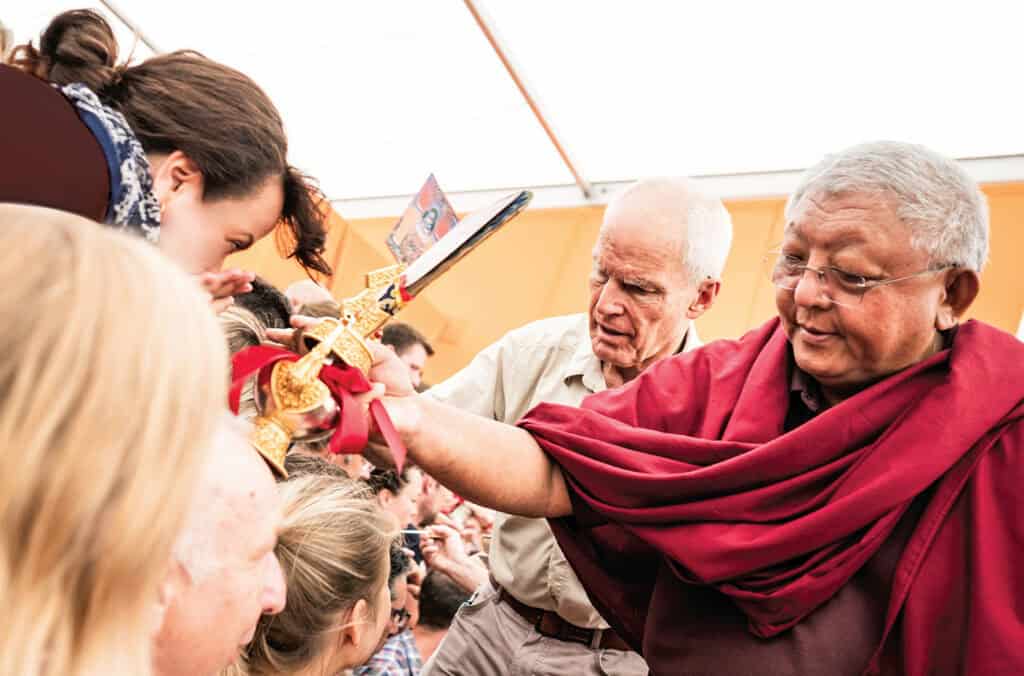
After a big, formal initiation, the lama will run up and down the rows, touching people with the different objects. That’s one way. That is usually how they do it in the East. Another way that’s also used is where the whole group of people come up and walk past the teachers or the lama. It’s a little bit slower than the other way. That’s the way that the last Karmapa liked because he liked to be with people. He liked to be close to people, touch them, and pull their beards. The last Karmapa was very touchy, very sensual, and immensely joyful in the way he behaved. He would walk up and down, laughing at everybody and blessing them. He was great, the way he did that. Depending on how many objects he has to bless with and whomever he wants to put in there and make people notice or get a bond with, how the whole energy field looks, he lets people also bless with the objects. He might have a table with the blessing objects, and people can touch them themselves instead.
Then we share all the good energies and all the wonderful things that happened with others. After that, people can leave. As I said, people often used to make promises in Tibetan that they will do this meditation from now on. They usually didn’t know what they were saying. The lama doesn’t translate it either because it’d be too much trouble for people if he said that. Of course, if you don’t know, then it doesn’t bind you. It’s not a promise if you don’t know you made it.
Then we walk out, and the lama then does the last part of the meditation in order to dissolve and free all the energies and thank the buddhas and so on. This is how an initiation runs. It’s quite good to know this when you’re coming in, and a lot of things are happening in Tibetan with bells and dorjes and so on.
This was just a little bit about initiations.