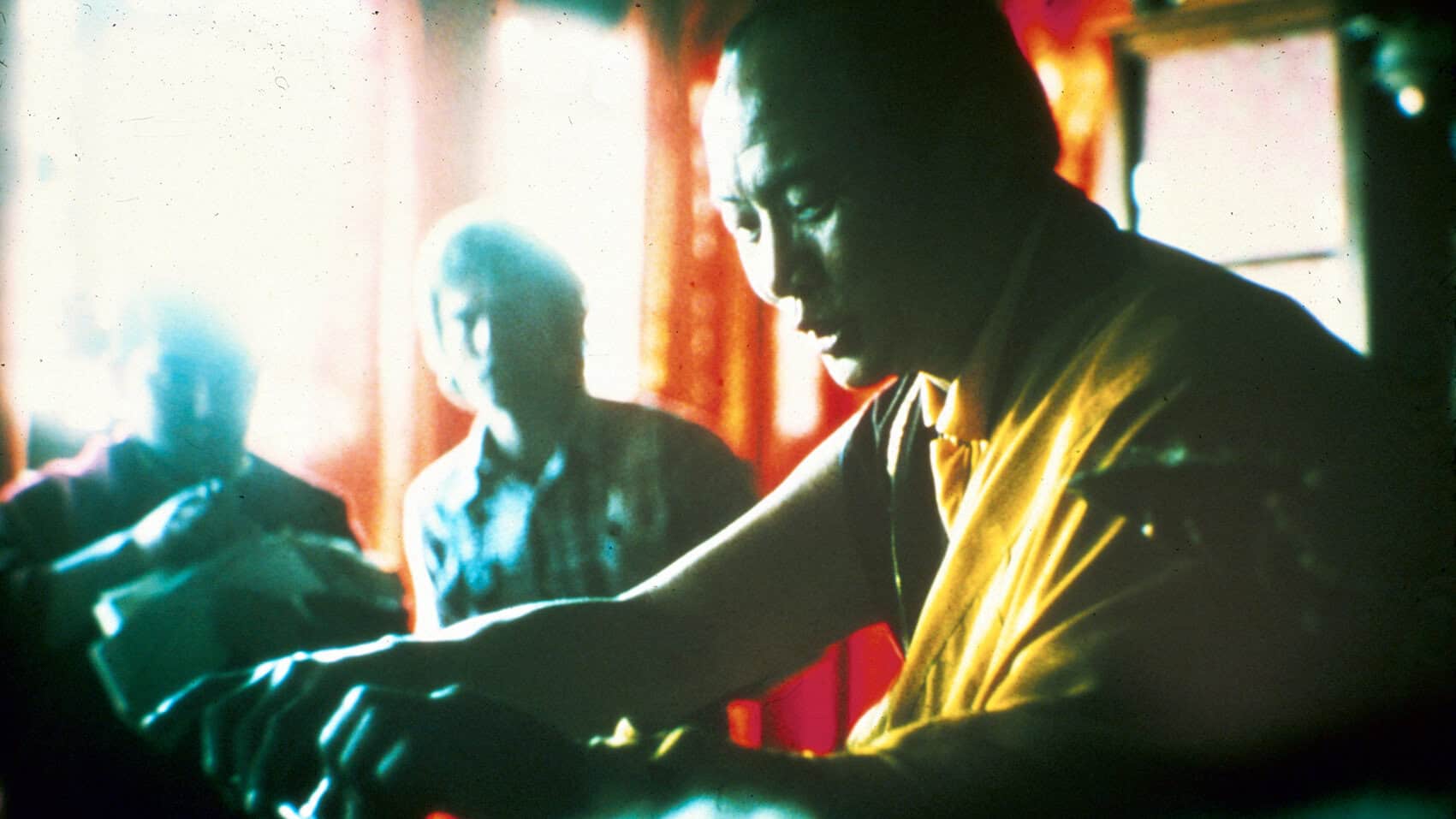
According to Buddhist medical biology, the breath is very important. Concentration on the breath is very effective for the mind to have peace. The movement of mind and the physical breath go together. When you concentrate on your breath, it will develop tranquility in the body. When the physical body has tranquility, then you can observe your mind. Of course, this tranquility is not contaminated tranquility like taking LSD. It has comfort, balance, and is very energetic.
The mind is like a wild horse. You have to tame it first, make it obedient. … It’s not easy to control. When you ride that wild horse, it’s jumping and very disobedient in the beginning. But, after you train it the right way, then suddenly the horse becomes very relaxed. Then, the horse will follow whatever you order. So mind is like the wild horse, and when you train your mind, in the beginning, it will jump like a wild horse. You have to be strong enough to face that. With patience you can easily control mind.
The method is, then, to concentrate on your breath and exhale, inhale, exhale, inhale. You can visualize in order to keep away drowsiness and falling asleep. You can prevent that by visualizing a bright color like white. Your breath appears like a beam of light. … You count twenty-one times. Then give a short break. Generally, you train your mind with a shinay practice. Among the shinay practices to pacify the mind, counting the breath—visualizing the breath as a beam of light—is the most effective to reduce the thoughts. … Every twenty-one times you can have a short break. Then, start again. Quickly your mind will get used to it. When it becomes easier, you can extend the counting to fifty, then one hundred, then one thousand. When you can do one thousand times comfortably, you will have maximum progress. You will have enormous peace in the mind. You will like it!
Awareness is very important. One has to be very cautious when concentrating on your breath, whether your awareness is there or not. If you’re fully aware of it, you realize that your mind is focused there, and when any disturbing thoughts happen, you recognize them. The moment you can recognize that, you can bring it back and focus back on the breath. That is awareness. Dullness is when you realize that your mind is thinking something else for a long time. That is the distraction of dullness; it can develop into a bad habit. One has to be very serious about it. Distraction is easy to control, but dullness distraction is invisible and difficult to control. In the beginning, you should be able to recognize and control it. Sometimes this dullness can develop from wrongly directing your gaze. Your eyes should generally slope in the direction of the level of your nose. It doesn’t mean that you should try to look at your nose.
For beginners, they say it is best not to eat rich foods in the afternoon—like French cheese or a giant steak like they eat in the U.S. Light food is very helpful for meditation. …Instead of eating heavy food in the evening, eat it in the morning and light food in the evening. This will help very much with meditation.
I will show you how I watch my mind. Maybe you can judge whether I’m in it or not by the expression on my face. [pause] Now I can’t do it because I’m laughing. … Present mind is the one you look at. Past mind is already gone. You don’t have to look for where it has gone. Watch the present mind. [Rinpoche demonstrates.] Can you see that I am watching my present mind? I could ignore all of you easily. [laughter]
Analytically explained, the unborn nature of mind means it has no beginning and no end. The present mind has no shape, no color, and no size, but it is in your experience. It is not like a coma. It’s mind; you’re fully aware of it. … We explain it, but you have to directly experience it. There’s no need to think that there is no size or shape. When you can recognize the present moment of mind—when you can look at it—you will experience that it is mind. Freshly, you will be aware of it…Every thought appears and then you examine it. You don’t have to try to stop the thoughts. Use them to examine it [mind]. This is basic Mahamudra.
Always be aware of others’ minds. When someone is disappointed or very happy, be aware of how you feel. Ask yourself what kind of happiness you need or what kind of suffering or disappointments you don’t need. If someone else has it, you will realize that it’s terrible for you so you don’t want others to have it. If you think about others’ feelings, there’s no way you will not have compassion, unless you’re really evil or possessed. You will have genuine compassion when you’re concerned about others’ minds. … Try to think that all living beings need happiness and don’t need suffering. As long as people have no knowledge of mind, they cannot feel others’ suffering. Many people in the world think humans, of course, have feelings. They could think that dogs and horses have feelings. When you think about something to eat, like lobsters and crabs, you think they don’t have feelings. … Precious knowledge means that you know that all animals are living beings. Living beings have the same mind and feelings that you have. When you are concerned about others’ feelings, you will have compassionate nature. Try to develop good thoughts. World peace depends on our mind. Also, world peace depends on knowing about the mind of living beings. … Once you have the intention for others to have happiness and concern for others’ suffering, you have compassion.
Friends are from attachment. Enemies are from attachment. Jealousy of one another is from attachment. Competition is from attachment. Everything is from attachment. As I have said before, Toyota, Suzuki, Range Rover, and Mercedes—all of these companies—have a lot of competition among them. It doesn’t make any difference to Milarepa.
Photo credit: Christoph Teufe