
How to Work with Anger
 By
By This talk was first given in San Francisco in the summer of 1995 and is followed by a question and answer session. It appeared in Buddhism Today, No. 1 (1996).
How to Work with Anger Read More »

This talk was first given in San Francisco in the summer of 1995 and is followed by a question and answer session. It appeared in Buddhism Today, No. 1 (1996).
How to Work with Anger Read More »

Interview conducted for Buddhism Today by Jonathan Bradley, November 2009.
Understanding Devotion in Diamond Way Buddhism Read More »

What is the basic function of Diamond Way Buddhist Centers? Buddhism has only one goal: to support the development of mature and independent people. It has no other function than that. Religions of belief build churches or temples for their
Life in Buddhist Centers Read More »

The 10th Karmapa Choying Dorje (1604-1674) was a consummate bodhisattva and artist who lived in Tibet at a time of breathtaking changes, including the invasion of the Mongols, the ascendancy of the Gelupga school, and the appearance of the powerful 5th Dalai Lama. In spite of this electrifying period of Tibetan history, his life is not well known even today.
Shamar Rinpoche’s book A Golden Swan in Tur-bulent Waters: The Life and Times of the 10th Karmapa Choying Dorje tells the story of the 10th Karmapa. Shamar Rinpoche’s telling is profound in at least two aspects. First, he highlights the 10th Karmapa’s power as a bodhisattva who is not political precisely during a time of much political upheaval among Tibetan Buddhists. Second, as the 14th reincarnation of the Shamarpa, he is directly in the transmission lineage of the 6th Shamarpa, who was the teacher and guru of the 10th Karmapa.
This interview was conducted by Jonathan Bradley. Following the interview is an excerpt from the book.
A Golden Swan in Turbulent Waters (The Life and Times of the 10th Karmapa Choying Dorje) Read More »
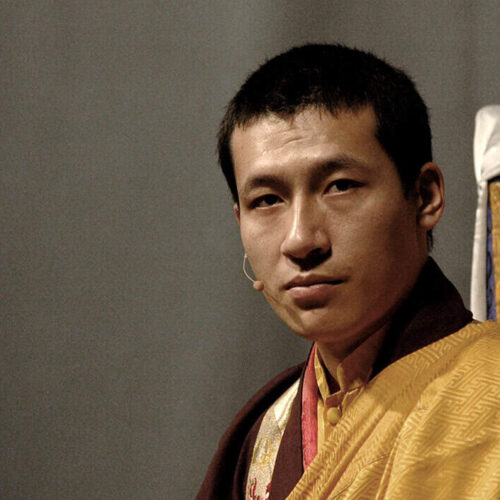
This interview was conducted by Lalita Panicker of the Hindustan Times (India) on December 11, 2012.
The Self-Immolation of Tibetans Should Stop Read More »

By looking at foundation, way, and goal, Buddhism enables everyone to fully develop their own qualities and powers. The foundation is the buddha nature that resides in every being, with its fearlessness, joy, and compassion. The way is the correct understanding of the situation and the application of the means to better the life situation. The goal is enlightenment, freedom from the transient veils and the realization of buddha-wisdoms. If a practitioner wants to reach the highest goal, beyond all concepts and limitations, one has to understand these three levels in the correct way. In order to avoid mistakes and detours on the way—and to recognize and know the way things are without deception—the Buddhist teaching of “correct knowing” (Tib. tsema) was developed. In 1995 at the Karmapa International Buddhist Institute (KIBI) Togpa Yulgal Rinpoche gave several teachings on this theme. What follows comes from explanations that he gave at that time.
Correct Perception (Questions and Answers) Read More »

Editor’s Note: Interview conducted for Buddhism Today by Jonathan Bradley, November 2009. You’ve said often that during historical times religion has created more death than politics. Many would agree with that statement. In Diamond Way Buddhism, a great deal of emphasis
Understanding Devotion in Diamond Way Buddhism (Q&A with Lama Ole Nydahl) Read More »
Q: Is there some aspect of Tibetan Buddhism that you feel is more suitable or more important for Westerners? Shamar Rinpoche: Nowadays, Tibetan, Mahayana, and Theravada Buddhists are spread everywhere and are organized very well. The Gelugpas have translated many
Buddhism East and West (Interview with the 14th Kunzig Shamar Rinpoche) Read More »
The editors of Buddhism Today prepared a list of questions about Buddhist practice for contemporary Westerners. Ben Weinlick put these questions to Lama Ole Nydahl, while driving through the Nevada desert on their way to Colorado Springs in early June 2008.
The Power of Diamond Way Buddhism Read More »
When you have compassion you will have good motivation. Then with a little bit of wisdom, you will have pure motivation. Not only good, but pure.
This interview was given in San Francisco in the Fall of 2007. Buddhism Today is grateful to Alyson Talley for her work with Rinpoche in preparing the text.
Empowerment and Compassion Read More »